
Practical guidance for planners deploying smart city surveillance: pilot narrowly, with privacy by design, and budget 12–18 months for retraining.
Plan 12–18 Month Retraining: Smart City Surveillance for Planners
Smart city surveillance delivers real-time situational awareness that measurably improves incident response and traffic management, but the technology only earns public trust when deployments are purpose-limited, privacy-by-design, and independently audited. The core trade-off is not safety versus privacy. It's whether governance keeps pace with capability. Planners should pilot narrowly, measure rigorously, and publish the results before scaling.
TL;DR:
- Effective smart city surveillance focuses on narrow, well-defined use cases like traffic incident detection or fire alerts, not broad safety claims.
- Most deployments benefit from a hybrid edge and cloud architecture, with edge processing reducing bandwidth and improving response times.
- Operational challenges include managing false positives, model retraining for local conditions, and system maintenance to sustain performance over time.
- Governance is crucial; privacy-by-design, transparent policies, and independent audits build public trust and prevent surveillance creep.
- Successful pilots require strict, pre-registered performance metrics, limited scope, stakeholder engagement, and independent evaluations before scaling.
Table of Contents
- What Is Smart City Surveillance, Exactly?
- What Are the Main Uses for Surveillance in a Smart City?
- Edge or Cloud: Which Architecture Fits Your City?
- Where Do These Systems Actually Fall Short?
- How Should Cities Govern Surveillance Data?
- Who Bears the Risk When Surveillance Gets It Wrong?
- What Do Real Deployments Actually Show?
- Why Trust Beyondsensor's Take on This?
- What Steps Should Planners Take First?
- A Practitioner's Take on Responsible Deployment
- How Beyondsensor Supports Privacy-Aware Surveillance Projects
- Sources
- FAQ
What Is Smart City Surveillance, Exactly?
Smart city surveillance refers to networked sensing infrastructure, cameras, acoustic detectors, environmental monitors, and license-plate readers, paired with AI analytics that turn raw feeds into actionable alerts. It's distinct from traditional CCTV in one critical way: the intelligence happens close to or at the point of capture, not just in a control room reviewing tape after the fact.
The building blocks are fairly consistent across cities, even when the branding differs.
- CCTV and IP cameras capture the raw visual feed and remain the backbone of most urban monitoring networks.
- Edge AI nodes run inference directly on or near the camera, classifying objects, detecting motion anomalies, or flagging behavior without sending raw video anywhere.
- Automatic Number Plate Recognition (ANPR) reads and logs vehicle plates for traffic enforcement, congestion pricing, and stolen-vehicle alerts.
- Facial recognition modules match faces against watchlists, typically the most contested component from a civil-liberties standpoint.
- Acoustic sensors detect gunshots, breaking glass, or distress calls in ambient noise, useful where camera coverage has gaps.
- Environmental and structural sensors track air quality, water levels, or vibration on bridges and buildings, feeding a parallel stream of non-security data through the same infrastructure.
The data pipeline typically flows in one direction: capture at the sensor, inference at the edge, metadata extraction, storage in an event database, then surfacing on an operator dashboard. This matters because each stage is where policy choices get made. A city that processes video at the edge and only transmits metadata, timestamps, object classes, and confidence scores, has already built in a privacy safeguard that a city streaming raw footage to a central server has not.
Performance metrics tell you what a system can actually do versus what a vendor claims it does. Latency measures how fast an alert reaches an operator after an event occurs. The City Sentinel framework, a modular AI surveillance architecture combining facial recognition, ANPR, fire detection, weapon detection, and accident detection, reports a median end-to-end recognition latency of 743 milliseconds. Precision and recall describe how often alerts are correct versus how many real events get missed. Mean Average Precision (mAP) is the standard benchmark for object-detection accuracy across a range of confidence thresholds. Face-match scores indicate confidence in identity matching, and lower thresholds catch more matches at the cost of more false positives.
What Are the Main Uses for Surveillance in a Smart City?
Surveillance systems earn their budget lines through specific, measurable applications rather than generalized "safety." Planners evaluating a proposal should ask which of these use cases the system is actually built for, since a platform tuned for traffic counting won't necessarily perform well at crowd-behavior detection.
- Traffic management and incident detection. Cameras paired with computer-vision models count vehicles, detect wrong-way driving, and flag collisions within seconds. Microservice-based blueprints like NVIDIA's Smart City Blueprint combine real-time video intelligence with behavior analytics to generate alerts and let operators query incidents in natural language rather than scrubbing through hours of footage.
- Public safety and behavioral alerts. Systems flag loitering near restricted infrastructure, sudden crowd density changes, or altercations. This is also the category most prone to false positives, since "unusual behavior" is a fuzzy category that models handle inconsistently across different environments and populations.
- Crowd monitoring at events. Temporary deployments, mobile cameras, drones, pop-up sensor networks, cover festivals, protests, or large gatherings without requiring permanent infrastructure. 5G connectivity programs make this practical by supporting the low-latency, high-bandwidth streaming that mobile units need.
- Emergency response support. Acoustic gunshot detection or fire and smoke sensors cut the time between an event occurring and dispatch receiving a location. City Sentinel's unified framework integrates fire, weapon, and violence detection into one dashboard specifically to shrink this response gap.
- Infrastructure and environmental monitoring. Not every sensor on a smart-city network is watching people. Structural sensors on bridges, air-quality monitors, and smart water metering, as seen in Singapore's PUB smart water meter program, share the same data backbone as security cameras but serve entirely different operational goals.
- Government-scale coordination. Singapore's Smart Nation initiative demonstrates how real-time monitoring and automation extend beyond security into automated immigration processing, smart parking allocation, and environmental modeling, all running on similar sensing and analytics infrastructure.
The pattern across all six is the same: value comes from matching the sensor and model type to a narrow, well-defined problem, not from buying a generic "AI surveillance platform" and hoping it generalizes.
Edge or Cloud: Which Architecture Fits Your City?
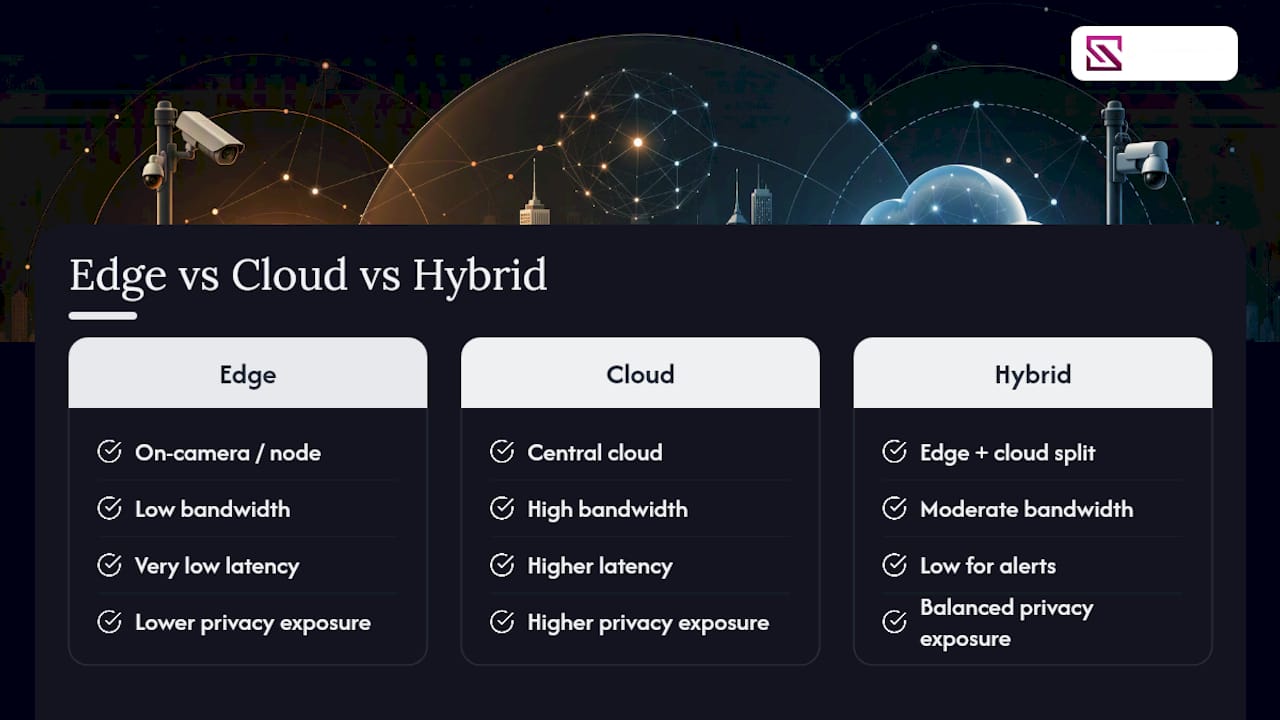
The edge-versus-cloud decision shapes everything downstream, bandwidth costs, privacy exposure, and how fast an alert reaches a human. Edge inference processes video where it's captured, on the camera or a nearby node, and transmits only metadata or short clips centrally. Cloud processing sends fuller video streams to a central system with more compute power for complex analytics.
Seoul's 2026 CCTV modernization illustrates the edge approach at scale. The city's TOPIS program pursues context-aware generative AI running inference at the camera level, which reduces the bandwidth burden of streaming raw footage citywide and improves timeliness because alerts don't wait on a round trip to a data center. The system also learns from its own false positives, tuning detection thresholds against local conditions over time rather than relying purely on a vendor's factory-trained model.
Cloud architectures still win when the analysis is too complex or too infrequent to justify dedicated hardware at every node, forensic search across months of footage, for instance, or citywide pattern analysis that needs to correlate feeds from hundreds of cameras simultaneously. Most mature deployments end up hybrid: edge nodes handle time-sensitive detection and immediate metadata generation, while a cloud layer handles storage, cross-camera correlation, and long-term analytics.
Unified dashboards are where this architecture becomes usable for a human operator. Rather than juggling a separate screen for ANPR, one for fire detection, and another for crowd analytics, a unified platform consolidates alerts into one interface with persistent event logging. City Sentinel's research found that unified dashboards materially reduce operator effort compared to running multiple single-purpose systems side by side, though the paper is clear that hitting high precision still requires local dataset tuning rather than out-of-the-box deployment.
Two integration patterns show up repeatedly in technical blueprints. RTSP (Real-Time Streaming Protocol) camera ingestion is the standard method for pulling live video into an analytics pipeline regardless of camera brand, which matters enormously for cities with mixed-vendor camera fleets accumulated over a decade of piecemeal purchasing. API-based event schemas let the video analytics layer talk to unrelated city systems, traffic signal controllers, emergency dispatch, building management, without custom point-to-point integration for every pair of systems. NVIDIA's Smart City Blueprint documents this as a microservices pattern: separate modules for video intelligence, behavior analytics, and storage that communicate over defined interfaces rather than one monolithic application.
Pro Tip: Ask any vendor proposing a citywide platform to demonstrate RTSP ingestion against your actual existing camera fleet during the pilot, not against their own reference hardware. Compatibility gaps show up fast once real, aging infrastructure enters the picture.
Where Do These Systems Actually Fall Short?
Every capability claim in a vendor deck comes with an operational cost that shows up months after deployment, not during the demo. Planners who skip this section end up with expensive hardware and an exhausted operations team.
Operator workload is the first casualty. A citywide network generating hundreds of alerts per shift will bury a human reviewer unless the system prioritizes intelligently. Alert fatigue is a documented failure mode in security operations generally: when the majority of flagged events turn out to be false alarms, operators start unconsciously discounting all alerts, including the real ones. Effective deployments require tiered severity scoring so an accidental double-parked car and a weapon detection don't land in the same queue with equal visual weight.
False positives and false negatives carry different costs, and both need a defined verification workflow before the system goes live.
- A false positive triggers unnecessary dispatch, wastes staff time, and, if it disproportionately flags certain neighborhoods or demographics, erodes public trust fast.
- A false negative means a real incident goes unflagged, which is the scenario that ends up in an incident report asking why the multimillion-dollar system missed it.
- Verification workflows, human review before automated dispatch, second-sensor confirmation, time-window checks, catch a meaningful share of both error types before they become operational or reputational problems.
Model accuracy also isn't static. Detection models trained on one city's lighting, camera angles, and population density degrade when deployed somewhere else without retraining. Practical deployment experience suggests pilots should budget for a 12 to 18 month local-data collection and retraining window before behavioral detection models reach operationally acceptable precision. That's a planning-cycle detail that rarely appears in procurement timelines, and it should.
Maintenance is the unglamorous line item that determines whether a system still works in year three. Edge nodes need firmware updates. Network links need resilience against outages, especially for acoustic and structural sensors in remote locations. Camera housings degrade in weather. None of this is exotic, but all of it needs a budget line, not an assumption that the system runs itself once installed.
How Should Cities Govern Surveillance Data?
Governance is where a surveillance deployment either earns durable public support or becomes a recurring political liability. The technical capability to monitor a city doesn't grant the legal or ethical authority to do so without limits, and the strongest programs treat governance as infrastructure, not paperwork.
Privacy-by-design starts at the architecture stage, not after deployment. That means data minimization (collecting only what a specific use case requires), anonymization or pseudonymization wherever identity isn't the point of the analysis, and strict purpose limitation so data gathered for traffic counting doesn't quietly get repurposed for unrelated law enforcement queries. Guidance on privacy by design for surveillance teams frames this as seven concrete principles rather than an abstract commitment, which is the right level of specificity for a procurement document.
A workable governance checklist includes:
- Role-based access control so only authorized personnel can view raw footage, with every access event logged and attributable to a specific user.
- Auditable logs that record who accessed what data, when, and why, reviewable by an oversight body independent of the operations team.
- Defined retention periods with automatic deletion or redaction after the period expires, rather than indefinite storage by default.
- Data-subject rights processes allowing individuals to request information about, or correction of, data held about them where legally applicable.
- Independent oversight through an audit body or ombudsman separate from the agency operating the system.
- Transparency reporting published on a regular cadence, disclosing what's being monitored, why, and what oversight found.
Public engagement channels matter as much as internal controls. Government platforms like Go portal show how a formal channel for public input, whether reporting a security flaw or raising a policy concern, builds a feedback loop that a black-box deployment never gets. A practitioner guide to data privacy in security strategy covers how to build these controls into a procurement contract rather than bolting them on afterward, which is the sequence that actually works.
Legal frameworks beyond privacy also need attention before signing a contract: data-sharing agreements with law enforcement should specify exactly which data categories can be shared, under what legal threshold, and with what audit trail. Vague language here is where good-faith deployments turn into scope creep.
Who Bears the Risk When Surveillance Gets It Wrong?
Bias in surveillance systems isn't a hypothetical edge case. It's a structural risk that shows up wherever training data underrepresents certain populations or wherever camera placement itself is uneven across neighborhoods. Facial recognition systems have documented accuracy disparities across skin tones and age groups, largely a function of unbalanced training datasets. When a detection model performs worse for a specific demographic, that group experiences both more false accusations and less protection from real threats, a double harm.
Disproportionate surveillance compounds the bias problem. If camera density and analytics intensity concentrate in lower-income or historically over-policed neighborhoods, the system generates more flagged incidents there, not because more incidents occur, but because more sensors are watching. That data then gets cited as justification for even more monitoring, a feedback loop that has little to do with actual risk and everything to do with where the cameras got installed first.
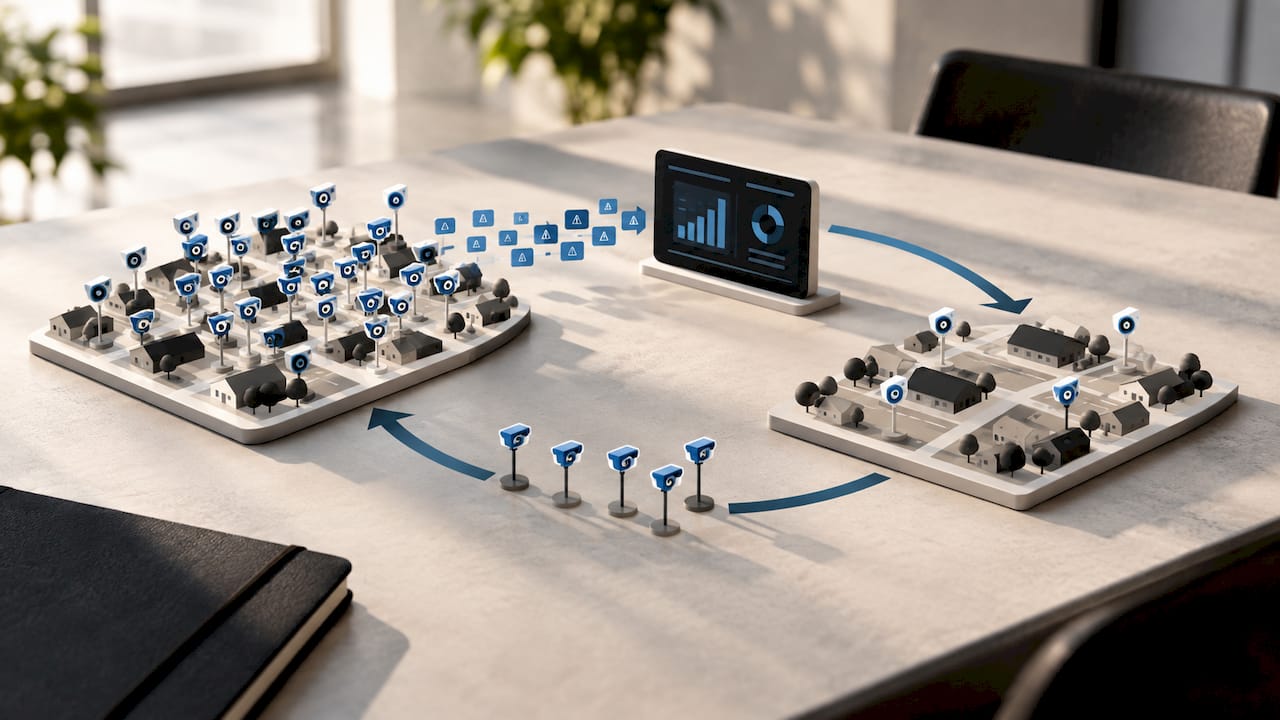
Surveillance creep describes the slow expansion of a system's purpose beyond its original justification. A network approved for traffic management quietly gains facial recognition. A pilot for gunshot detection expands into general behavioral monitoring. Each individual expansion seems reasonable in isolation, which is exactly why it needs a formal gate rather than informal approval.
Mitigating these risks requires measurement, not just intention. Independent audits of demographic accuracy disparities, published metrics on where alerts originate geographically, and structured community feedback channels all create the visibility needed to catch drift before it becomes entrenched. Human-in-the-loop verification, requiring a person to confirm any automated match before action is taken, remains one of the most reliable safeguards against both bias and error, even as it adds a step that some vendors will frame as a bottleneck. It isn't. It's the safeguard.
What Do Real Deployments Actually Show?
Case evidence matters more than vendor promises, because it's the only place where claimed capability meets measured reality.
- City Sentinel's unified framework combined facial recognition, ANPR, fire detection, weapon detection, violence detection, and accident detection into a single platform and reported a median end-to-end recognition latency of 743 milliseconds with per-module accuracy figures and full event persistence for audit purposes. The trade-off the researchers flagged directly: reaching high precision required local dataset tuning, not just deploying the base model.
- Seoul's context-aware CCTV pilot moved detection to the edge and let the system learn from its own false positives, improving accuracy over time while cutting the bandwidth cost of streaming raw footage across the network.
- Singapore's Smart Nation program shows integration reaching well past security cameras into automated immigration and smart parking, demonstrating that the same sensing and analytics infrastructure serves multiple city functions at once rather than existing as a single-purpose security layer.
The lesson for pilot design is consistent across all three: measure latency and accuracy in your own environment before scaling, budget time for local retraining, and design the unified dashboard around reducing operator workload from day one rather than treating consolidation as a later phase.
Why Trust Beyondsensor's Take on This?
This guide draws on published government initiative pages, peer-reviewed and preprint technical research including the City Sentinel framework, and municipal case data from Seoul's CCTV modernization program, cross-referenced rather than taken from a single vendor's marketing.
Experience in sensor-based security and operational technology across industrial, infrastructure, and physical-security deployments grounds this analysis in what actually breaks during implementation, not just what works in a controlled demo.
A practical procurement checklist distills the article's recommendations:
- Confirm the vendor's latency and accuracy figures against your own camera fleet, not their reference hardware.
- Require a written data-retention and access-control policy before signing, not after.
- Budget for a 12 to 18 month local retraining window on any behavioral detection module.
- Insist on an independent audit clause and a public transparency-reporting cadence.
What Steps Should Planners Take First?
A surveillance deployment that skips structured scoping tends to drift into scope creep within its first budget cycle. The sequence below keeps a pilot honest and measurable from day one.
- Scope the pilot narrowly. Define one or two specific objectives, traffic incident detection, gunshot alerting, with a fixed evaluation timeline, typically 6 to 12 months, and pre-registered success metrics rather than open-ended goals.
- Write interoperability and privacy controls into the procurement contract. Require RTSP compatibility with existing camera infrastructure, documented data-minimization practices, and a defined retention schedule as contractual terms, not vendor promises.
- Set operational KPIs before deployment, not after. Latency thresholds, an acceptable false-alert rate, uptime requirements, and a mandatory audit-log standard should all be numbers the vendor commits to in writing.
- Build stakeholder engagement into the timeline. Publish what's being monitored and why before the cameras go live, establish a public complaint channel, and commit to an independent audit at a fixed interval, six or twelve months, rather than an open-ended "ongoing review."
- Evaluate before scaling. Compare actual performance against the pre-registered metrics, not against the vendor's marketing figures, before approving a citywide rollout.
Pro Tip: Publish your pilot's evaluation criteria before the system goes live, not after results come in. It's the single cheapest way to prevent post-hoc goalpost-moving, and it signals to residents that the evaluation is real.
A Practitioner's Take on Responsible Deployment
Smart city surveillance works when it's boring: narrow scope, measured results, published audits. The technology is mature enough to deliver real safety gains. What's immature in most cities is the governance layer meant to contain it. Contrarian as it sounds, the biggest risk isn't the cameras. It's approving a citywide system before a pilot has proven what it actually does. Start smaller than feels satisfying, audit independently, and publish what you find. That's the version of this technology worth defending in public.
— Eumir
How Beyondsensor Supports Privacy-Aware Surveillance Projects
If your city or organization is past the debate stage and into procurement, the harder problem is integration, getting cameras, edge nodes, analytics, and governance controls to work as one auditable system instead of five disconnected vendor pitches. Beyondsensor's Solution Integration service was built specifically for that gap, combining multi-vendor hardware compatibility with privacy-by-design controls baked into the deployment plan rather than added afterward.

For platform-level needs, BeyondWatch provides the unified dashboard and event-persistence architecture this article recommends, one operator view instead of five single-purpose screens, with the audit logging that independent oversight requires. Regional system integrators and government agencies working through channel partnerships can explore SI Channel Enablement for localized deployment support. If you're still scoping what a responsible pilot should even include, reach out through Beyondsensor's contact page to talk through your requirements before you write the procurement brief.
Sources
- Smart City solutions
- City Sentinel: A Unified AI-Based SmartSurveillance Framework for Real-Time Multi-ThreatDetection Using Deep Learning
- Smart City Blueprint — VSS 3.2.1
- 5G innovation (IMDA)
FAQ
Is Singapore Considered a Smart City?
Yes. Singapore's Smart Nation program is one of the most cited government-led smart city initiatives worldwide, integrating real-time monitoring, automated systems, and analytics across transport, immigration, water management, and public safety under a single national strategy.
What Is the Most Heavily Surveilled City in the World?
Camera-density rankings shift depending on the survey and year, and no single authoritative figure applies globally, so this guide won't cite a specific number. What's consistent across major global cities with dense camera networks is the same governance question this article raises: whether oversight and audit mechanisms scale alongside the hardware.
What Is the Main Early Challenge in Smart City Surveillance?
The most common early failure is deploying detection models trained elsewhere without a local retraining period, which produces poor accuracy against local conditions. Research on unified surveillance frameworks recommends budgeting 12 to 18 months for local data collection and retraining before behavioral models reach acceptable precision, a step many pilots skip under budget or timeline pressure.
Which Country Has the Most Smart Cities?
There's no single definitive count, since "smart city" definitions vary widely by what infrastructure qualifies. Countries with the most visible government-led programs, including Singapore, South Korea, and several EU member states, tend to share common traits: centralized digital infrastructure strategy, published technical blueprints, and integration across transport, safety, and environmental sensing rather than isolated pilot projects.
How Do Cities Keep Surveillance Data Secure From Cyberattacks?
Layered defenses matter most: encrypted data transmission between edge nodes and central systems, role-based access control with logged authentication, and regular firmware updates on camera and sensor hardware to close known vulnerabilities. Guidance on data privacy in sensing deployments covers these controls at the practitioner level for teams building or auditing a deployment.
Recommended
Read More Articles

Stop Silent Failures: Sensor Health Monitoring for Ops & Procurement
Procurement and ops: require heartbeat intervals, drift limits, PDR targets, and network security to stop silent sensor failures.
Secure AI Model Drift in 90 Days: Six Actions for Security Teams
Stop AI model drift breaking security controls. Six actions to finish in 90 days, with monitoring metrics, procurement SLAs, and incident response steps.
5 ONVIF profile checks every integrator must run before buying cameras
Default to Profile T for new cameras. Add Profile G for local recording and Profile M for analytics. Verify each model on the ONVIF Conformant Products...
Practitioners: 6 Steps to Choose Environmental Sensors, Avoid Mistakes
Six decision steps for monitoring teams to pick, site, and deploy environmental sensors, with pilot, calibration, and sourcing advice.
Let's Build YourSecurity Ecosystem.
Whether you're a System Integrator, Solution Provider, or an End-User looking for trusted advisory, our team is ready to help you navigate the BeyondSensor landscape.
Direct Advisory
Connect with our regional experts for tailored solutioning.