
Stop AI model drift breaking security controls. Six actions to finish in 90 days, with monitoring metrics, procurement SLAs, and incident response steps.
Secure AI Model Drift in 90 Days: Six Actions for Security Teams
Model drift is a security control failure the moment a deployed AI system stops enforcing its intended policy, whether that means missing intrusions it used to catch or flagging normal activity as threats. The immediate priority is not retraining. It is instrumenting per-sensor telemetry, freezing evidence when something looks wrong, and routing the decision through human review rather than automation. Everything else, from statistical tests to governance under NIST AI RMF, ENISA, and the IMDA Model AI Governance Framework, builds on that first move.
TL;DR:
- Monitoring should focus on multiple signals, including distribution shifts, prediction confidence changes, and feature attribution to detect all drift types effectively.
- Use segment-specific baselines and preserve evidence automatically when a drift alert occurs to prevent normal seasonal variations from misleading responses.
- Incorporate strict telemetry tagging, artifact vetting, and human review for any model updates or hardware changes to mitigate natural, operational, and adversarial drift causes.
- Treat every drift detection as a control failure, requiring evidence freezing, provenance verification, and careful remediation, not immediate retraining.
- Integrate drift alerts into incident response workflows with clear triage, severity levels, and cross-team coordination to prevent downstream security or operational failures.
Table of Contents
- What AI Model Drift Security Actually Covers
- How Drift Happens: Natural, Operational, and Adversarial Causes
- Detecting Drift: Metrics, Statistical Tests, and Signals to Instrument
- Building a Monitoring Strategy for Security Deployments
- The Incident Response Playbook When Drift Looks Suspicious
- Governance, Procurement, and the Standards That Should Anchor Your Program
- Practical Checklist for the Next 90 Days
- BeyondSensor Field Perspective
- Threat Modeling Specific to AI Model Drift in Security Contexts
- Adversarial Attack Vectors Exploiting Model Drift
- Integrating Drift Detection With Cybersecurity Incident Response
- How Drift Degrades Downstream Security Analytics
- Case Studies and Examples of Drift-Driven Security Breaches
- Tools and Frameworks for Drift Security Monitoring
- Get Compliance-Ready Drift Monitoring Built Into Your Deployment
- Reframing Drift as a Control Problem, Not a Data Science Problem
- Sources
- FAQ
What AI Model Drift Security Actually Covers
AI model drift security is the discipline of detecting, containing, and governing changes in a deployed model's behavior before those changes weaken a security control. That distinction matters because "drift" in a recommendation engine is a nuisance. Drift in an access-control model, a perimeter camera analytics stack, or an anomaly-detection pipeline is an operational security event with legal and safety consequences.
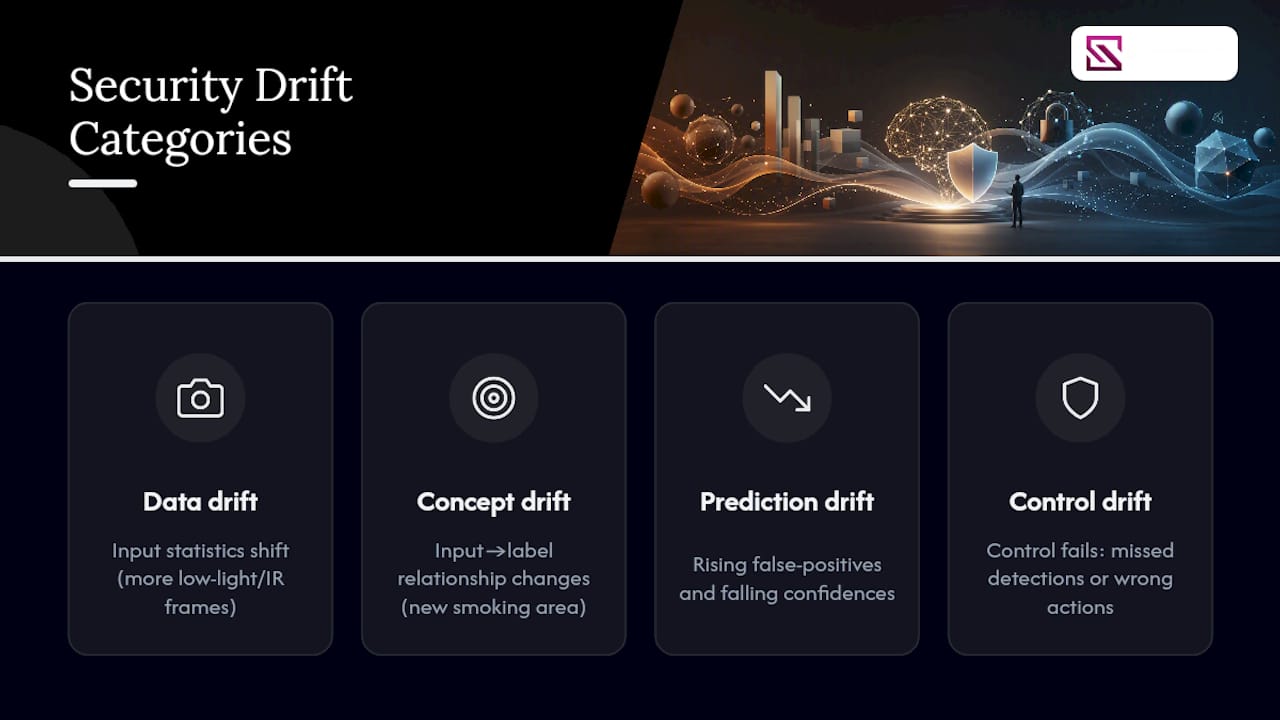
Four distinct failure types fall under this umbrella, and conflating them is why so many teams monitor the wrong thing.
Data drift happens when the statistical properties of incoming inputs shift away from what the model trained on. A camera analytics system trained on daytime footage starts seeing more infrared and low-light frames once winter cuts daylight hours, and the underlying pixel distributions move even though nothing "broke."
Concept drift occurs when the relationship between inputs and the correct label changes. A loitering-detection model trained before a building added an outdoor smoking area will misclassify a now-normal behavior pattern as suspicious, because the ground truth itself moved.
Prediction or performance drift shows up in the model's outputs directly: rising false-positive rates, falling confidence scores, or a growing rate of low-confidence predictions the system used to handle cleanly.
Control drift is the security-specific consequence layered on top of the other three: a model that quietly stops functioning as the control it was certified to be. That can mean missed detections that let an intrusion through, false positives that trigger alert fatigue until staff start ignoring the system, or automated actions (locking a door, denying access, escalating to law enforcement) firing on degraded logic. Each type demands different monitoring and a different response speed, and that difference is the backbone of the rest of this article.
How Drift Happens: Natural, Operational, and Adversarial Causes
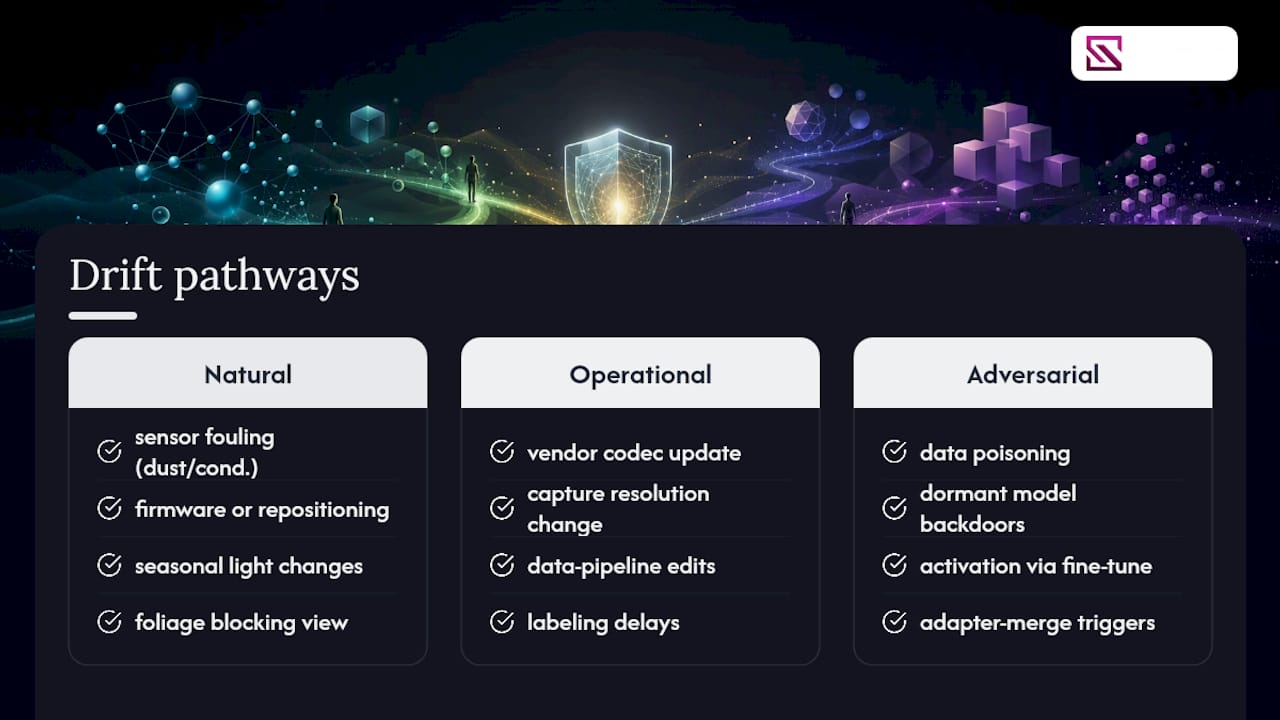
Drift rarely announces itself. It accumulates through three distinct pathways, and security teams that only watch for one of them get blind sided by the other two.
Natural and sensor-level causes are the most common. ENISA's cybersecurity research documents sensor encrustment, dust, condensation, and lens fouling that gradually change what a camera or environmental sensor reports, along with firmware updates and physical repositioning that silently alter the input distribution a model was calibrated against. Seasonal light changes, foliage growth blocking a fixed camera angle, and even a repainted wall behind a sensor all fall into this category.
Operational causes originate inside the pipeline itself, not the physical world. Data-pipeline changes, such as a vendor updating a video codec or a new capture resolution, can shift feature values without anyone touching the model. Labeling delays create training-serving skew when the ground truth used for retraining lags months behind current conditions. A model validated against last year's incident labels may already be misaligned with this year's threat patterns.
Adversarial causes are the ones that turn drift into an attack surface. Data poisoning introduces manipulated training examples designed to shift decision boundaries over time. Model backdoors can sit dormant through import and initial validation, then activate only after post-import customization such as fine-tuning or adapter merges, a pattern recent drift-detection research has flagged as a reason import-time scanning alone is not enough. Supply-chain compromise of a pretrained model or a third-party feature extractor can introduce the same risk before a system ever reaches your network.
Detecting Drift: Metrics, Statistical Tests, and Signals to Instrument
Detection lives or dies on the metrics you choose, and Azure Machine Learning's monitoring guidance makes a useful point here: no single signal catches everything, so combining several is not optional overhead, it is the baseline requirement.
Start with distribution-comparison tests that flag when incoming data no longer resembles training data:
- Population Stability Index (PSI) measures how much a feature's distribution has shifted between two time windows, widely used because it produces a single interpretable number teams can threshold and alert on.
- Kolmogorov–Smirnov (KS) test compares two distributions directly and works well for continuous features like sensor readings or confidence scores.
- Wasserstein distance captures how much "work" it would take to transform one distribution into another, which makes it more sensitive to gradual shifts that PSI can miss.
- Jensen-Shannon divergence handles categorical or multimodal features, useful for things like detected-object-class distributions in video analytics.
Statistical distance alone will not catch every failure mode security teams care about. Prediction-drift monitoring tracks the model's own outputs over time, watching for creeping shifts in class balance or confidence. Feature-attribution drift, tracking which inputs the model actually relies on for its decisions, can reveal that a model has quietly started leaning on a spurious feature, such as timestamp metadata instead of actual visual content. Confidence distribution shifts and rising refusal or "no decision" rates are often the earliest visible symptom, showing up well before accuracy metrics move.
None of this works as isolated point checks. Azure's guidance stresses combining univariate per-feature tests with multivariate and segment-level checks, because a model can pass every individual feature test while its joint behavior has shifted in a way that matters operationally. Pair statistical monitoring with periodic behavioral acceptance tests, structured scenarios that verify the model still makes the right call on known cases, and build a delayed-ground-truth pipeline so retrospective labels can validate predictions once real outcomes are known. Watch for false alarms, too. A threshold tuned for one camera at one site will misfire constantly on another with different lighting and traffic patterns, which is exactly why segment-level baselines matter more than a single global threshold.
Building a Monitoring Strategy for Security Deployments
A monitoring architecture built for security systems looks different from one built for a marketing recommendation engine, mainly because the cost of a missed alert is measured in physical safety, not click-through rate.
Start with telemetry design. Every inference needs a stable event ID, a model and artifact version tag, and a timestamp, so that when a delayed ground-truth label eventually arrives, whether from an incident report or manual review, it can be joined back to the exact prediction that generated it. Microsoft's practitioner guidance on model monitoring treats this event-ID discipline as foundational precisely because security labels almost always arrive late.
Baselines need segmentation, not a single global average:
- Build separate baselines per sensor, per camera, and per site rather than one aggregate baseline across the whole deployment.
- Maintain distinct seasonal baselines alongside recent-production baselines, since a winter lighting pattern is not an anomaly, it is a known seasonal state.
- Flag statistically unusual events (a sudden crowd, a one-off weather event) separately from genuine drift so they don't quietly retrain the baseline into accepting the anomaly as normal.
Alerting needs a clear triage path: an alert should trigger evidence preservation and a provenance check before anything else happens, followed by a behavioral acceptance test to confirm whether the model's actual decision-making has changed. ENISA's guidance is explicit that accuracy-only monitoring misses security-relevant concept changes that hide inside otherwise healthy-looking aggregate scores, which is why localized indicators and back-testing matter more than a single dashboard number.
Automation should handle low-stakes, high-confidence decisions. Anything touching physical access control, law enforcement escalation, or irreversible actions needs a human in the loop before the system acts on drifted output, a principle the IMDA framework treats as a baseline operational control rather than an optional safeguard.
Pro Tip: Tag every inference with a stable event ID at capture time, not after the fact. Retroactively trying to match an incident report to a model prediction weeks later is where most security teams lose the ability to validate what actually went wrong.
The Incident Response Playbook When Drift Looks Suspicious
An alert is a signal to investigate, not a trigger to retrain. Treating it as the latter is how teams end up retraining a model on data an attacker has already influenced.
- Contain and capture evidence. Freeze the model version in place, snapshot the input stream around the alert window, and preserve logs before anything is overwritten or rotated out.
- Localize the drift. Determine whether it's affecting one sensor, one site, or the whole fleet, since a single-camera anomaly points to a hardware or placement issue while a fleet-wide shift points to a pipeline or supply-chain problem.
- Check upstream integrity. Verify data-pipeline changes, firmware updates, and artifact provenance before assuming the model itself is at fault.
- Run behavioral acceptance tests. Compare current outputs against a known-good model on the same input set to confirm whether decision-making has genuinely changed.
- Choose remediation carefully. Rollback to a prior validated model version is usually the safest first move; shadow evaluation lets a candidate replacement run silently alongside production before promotion; controlled retraining should only happen once you've confirmed the training data itself isn't contaminated.
- Update governance after the fact. Revise monitoring thresholds, tighten SLA language with vendors, and document the incident against your audit trail.
Azure's operational recommendations back this sequencing directly: verify provenance and compare against a known-good baseline before retraining, because retraining on attacker-influenced data just re-encodes the problem into the next model version.
Governance, Procurement, and the Standards That Should Anchor Your Program
Three frameworks now form the practical backbone of drift-security governance, and each answers a different question.
NIST's AI RMF answers the question "what should we measure and when." Its MAP, MEASURE, and MANAGE functions insist that context comes first: the same statistical shift can be irrelevant in a low-stakes deployment and critical in one guarding physical access, so metrics and thresholds only make sense after you've mapped intended use, affected assets, and risk tolerance.
ENISA's cybersecurity guidance answers "how do we catch security-specific drift that aggregate accuracy hides." Its window-based relearning and back-testing recommendations exist specifically because accuracy-only dashboards miss the concept changes that matter for security outcomes.
The IMDA Model AI Governance Framework answers "what should the contract require." It lists concrete procurement expectations: model and version identifiers, change notifications when a vendor updates or retrains a model, telemetry access for your own monitoring, documented rollback support, and staff training so people reviewing model output actually understand its confidence limits and failure modes.
Turn those into contract language rather than aspirational policy. Every vendor agreement covering an AI-driven security control should specify model IDs and versioning, a change-notification clause, telemetry access, and a rollback SLA with a defined response time. Internally, pair that with documented behavioral test suites run on a schedule and an accountability chain that names who signs off when a drift alert requires a human decision.
Practical Checklist for the Next 90 Days
Six actions separate teams that catch drift early from teams that discover it during an incident review.
- Instrument per-sensor telemetry (quick win): tag every inference with sensor ID, site, timestamp, and model version.
- Set segment-level baselines (quick win): stop comparing performance against one global average.
- Implement an evidence-freeze protocol (quick win): define what gets preserved automatically the moment a drift alert fires.
- Require behavioral acceptance tests (project work): build a standing test suite that runs after every model update or customization.
- Add artifact versioning and vetting (project work): quarantine and test imported models before promotion, especially after fine-tuning.
- Update supplier SLAs (project work): insist on change notifications, telemetry access, and rollback support in every renewed contract.
Pro Tip: Join every inference to a stable event ID before you do anything else on this list. Every other improvement, from behavioral testing to retrospective labeling, depends on being able to trace a prediction back to what actually happened afterward.
BeyondSensor Field Perspective
Sensor-Specific Deployment Lessons
Camera and sensor placement changes model behavior in ways a dashboard rarely shows directly. A firmware update that shifts exposure handling, a lens recalibration after cleaning, or integrating a third-party sensor into a multi-vendor stack can all move the input distribution a model was tuned against, long before accuracy metrics show a dip.
Deployments that hold up under audit share one habit: they treat calibration and firmware changes as drift events in their own right, not just maintenance line items. A camera swap or a lens clean gets logged with the same rigor as a model version change, because both can move the input distribution a security control depends on.
Procurement checklists used in real integrations should require telemetry exposure, documented rollback paths, and a test suite that runs after every hardware or firmware change, not just software updates. BeyondSecure is built around exposing that telemetry rather than hiding it behind a vendor black box.
Threat Modeling Specific to AI Model Drift in Security Contexts
Threat modeling for drift starts from a different question than conventional cybersecurity threat modeling. Instead of asking "how could an attacker breach this system," it asks "how could an attacker exploit the fact that this system's decision boundary changes over time."
That framing surfaces attack paths a static threat model misses entirely. An adversary who understands your retraining cadence can time poisoned inputs to land right before a scheduled retrain, knowing the model will absorb manipulated patterns as legitimate signal. An attacker with knowledge of your baseline windows can introduce gradual, sub-threshold changes designed to stay under your PSI or KS alert thresholds while still shifting the decision boundary meaningfully over months.
Effective threat models for drift map three asset categories: the training data pipeline, the live inference stream, and the retraining trigger logic itself. Each has a different attacker profile. A compromised data labeling vendor threatens the first. A physical actor manipulating sensor input, such as strategically placed reflective material confusing a camera's exposure logic, threatens the second. An insider or compromised CI/CD pipeline controlling when and how retraining fires threatens the third.
NIST's AI RMF frames this as a mapping exercise before measurement: you cannot choose meaningful drift thresholds until you've identified which assets a drifted decision boundary would actually put at risk, and who benefits from moving that boundary undetected.
Adversarial Attack Vectors Exploiting Model Drift
Drift is not just a byproduct of attacks. It is increasingly the mechanism attackers use to achieve their goal.
Slow poisoning introduces manipulated examples gradually enough that no single retraining cycle looks anomalous, while the cumulative effect over several cycles meaningfully shifts what the model treats as normal. This works specifically because most drift monitoring compares recent windows to each other rather than to a stable, long-term ground truth.
Dormant backdoor activation exploits the customization step rather than the original training run. A pretrained model can pass every pre-deployment security check clean, then have a backdoor activate only after fine-tuning or adapter merging introduces the specific trigger condition. Recent drift-detection research has documented this pattern directly, and it's the core reason import-time scanning alone leaves a real gap.
Threshold probing involves an adversary deliberately testing how much input variation a system tolerates before triggering an alert, then operating just inside that tolerance. This is functionally an adversarial reconnaissance technique aimed squarely at your monitoring configuration rather than the model's core logic.
Supply-chain substitution swaps a legitimate model artifact or feature extractor for a compromised one during an update cycle. OWASP's AISVS supply-chain guidance recommends artifact quarantine and mandatory behavioral acceptance testing before promotion specifically to catch this, since a scan of the artifact's static properties will not reveal a dormant behavioral change.
Integrating Drift Detection With Cybersecurity Incident Response
Drift detection and incident response run on different clocks by default, and that mismatch is a real operational gap. Drift monitoring often runs on daily or weekly batch cycles, while incident response expects near-real-time signal. Closing that gap means routing drift alerts into the same triage queue as conventional security alerts, not a separate dashboard only the ML team checks.
Practically, that means giving a drift alert the same severity classification structure as a network intrusion alert: a defined escalation path, an assigned owner, and a response-time SLA. ETSI's Securing Artificial Intelligence standard recommends logging user and system actions specifically so that when a drift alert does escalate into a full incident, investigators have the audit trail to reconstruct what happened without relying on the drifted model's own outputs as ground truth.
The behavioral acceptance test suite should double as an incident-response tool, not just a pre-deployment gate. When responders need to determine quickly whether a model's current behavior reflects a genuine security compromise or an environmental change, running the standing acceptance test suite against the live model gives a faster answer than waiting for a full statistical drift report to accumulate enough data points.
Cross-train the two teams. Security incident responders rarely know how to read a PSI chart, and ML engineers rarely know standard incident triage procedure. A joint runbook that translates "PSI exceeded 0.25 on Camera Zone 4" into "possible control degradation, escalate per Tier 2 incident procedure" closes that gap without requiring either team to become expert in the other's discipline.
How Drift Degrades Downstream Security Analytics
A drifted model rarely fails in isolation. Its output feeds dashboards, risk scores, and automated workflows that other systems and analysts trust as ground truth, and that trust is exactly what makes the damage compound.
Consider a video analytics platform that unifies feeds from multiple sites into a single risk dashboard. If one site's model has drifted and started under-detecting genuine anomalies, the aggregate risk score for that site quietly drops, not because risk actually decreased, but because the detection layer got quieter. Analysts reviewing the dashboard have no way to distinguish "this site got safer" from "this site's model stopped seeing clearly" unless the underlying telemetry surfaces that distinction.
The same compounding effect hits automated decision chains. A visitor management system that feeds a drifted face-matching model's confidence scores into an automated access decision inherits every bit of that drift, and the failure surfaces not as a model error but as an access-control incident. By the time someone traces the root cause back to the model, the downstream decision has already happened.
This is the strongest argument for segment-level, per-model monitoring rather than trusting an aggregate security posture score. A unified dashboard that blends five sites' worth of detection data into one number can mask a genuine, dangerous degradation at a single site for weeks. Platforms like BeyondWatch are built around keeping that per-site, per-sensor granularity visible rather than collapsing it into a single reassuring number.
Case Studies and Examples of Drift-Driven Security Breaches
Documented, named breach cases attributing a specific failure entirely to unmonitored model drift are still rare in public reporting, largely because organizations that suffer this kind of failure rarely disclose the mechanism in detail. But the pattern shows up clearly in the research literature and standards bodies that study these systems.
ENISA's cybersecurity report documents sensor-encrustment scenarios in physical security deployments where gradually degraded input quality caused detection models to miss events that earlier, cleaner input would have caught, without any single dramatic failure point that would have triggered a manual review. The degradation is the story: a slow slide rather than a breach with a single root cause.
The dormant-backdoor pattern documented in recent drift-detection research illustrates a different but related risk: a model that passes every pre-deployment security test clean, only for a backdoor to activate after a routine fine-tuning update months later. In a security context, that's a model that guarded a perimeter correctly for months before a scheduled customization step quietly introduced a blind spot no one was watching for, since nobody re-runs pre-deployment tests after what looks like a minor update.
The consistent lesson across both patterns is that the failures that matter most rarely look dramatic in the moment. They look like a slightly quieter dashboard, a marginally lower alert rate, a model that seems to be working fine right up until an unrelated incident forces a review that finally surfaces how long it had actually been degraded.
Tools and Frameworks for Drift Security Monitoring
No single tool covers the full stack from statistical detection through incident response, which is exactly why a drift-security program needs to combine categories rather than pick one platform and call it done.
Built-in ML platform monitoring covers the statistical layer. Platforms like Azure Machine Learning provide native data drift, prediction drift, and feature-attribution drift signals, along with the infrastructure to compare production distributions against configurable reference baselines.
Standards-based test frameworks cover behavioral validation. ETSI's Securing Artificial Intelligence standard and OWASP's AISVS provide structured guidance for building acceptance test suites and supply-chain vetting procedures rather than off-the-shelf software, which teams then implement against their own model artifacts.
Governance and audit frameworks cover the paper trail. The NIST AI RMF and IMDA's governance framework don't monitor anything directly, but they define what your monitoring program needs to produce to satisfy an auditor or procurement reviewer.
Sensor-specific platforms close the gap the generic ML tools leave open: correlating drift signals with the physical and firmware context that caused them. A statistical monitoring tool has no way of knowing that a PSI spike on Camera 4 correlates with a firmware push that same week unless the platform managing that hardware surfaces both signals together. That correlation is where a unified operations layer like BeyondPatrol adds value a pure statistics package can't: linking the model-level signal to the physical-layer event that actually caused it.
Get Compliance-Ready Drift Monitoring Built Into Your Deployment
Most drift-security failures trace back to the same gap: statistical monitoring that lives in a data science tool, disconnected from the physical sensors, firmware versions, and access-control decisions it's supposed to be protecting. Closing that gap requires a platform that treats model versioning, telemetry, and rollback support as core infrastructure, not an afterthought bolted on after deployment.
Beyondsensor builds that connective layer for physical security deployments across sensor hardware, video analytics, and access-control systems. BeyondSecure exposes the model and firmware telemetry your monitoring program actually needs, while Solution Integration support helps system integrators and enterprise security teams wire drift detection into existing incident-response workflows rather than running it as a parallel, disconnected process. Identifying which camera, firmware version, and model artifact produced a given alert is an operational gap worth addressing in security monitoring.
Reframing Drift as a Control Problem, Not a Data Science Problem
Model drift belongs in the same conversation as patch management and access review, not tucked away as a machine learning maintenance task nobody outside the data team sees. Treat every drift alert as a potential control failure until proven otherwise: freeze evidence first, verify before you retrain, and demand telemetry and rollback support in every vendor contract you sign. Start with the checklist above, and use the frameworks and FAQ below to fill in what your own program still lacks.
— Eumir
Sources
- IMDA — Model AI Governance Framework
- NIST AI Risk Management Framework (AI RMF)
- ENISA — Artificial Intelligence Cybersecurity Challenges
FAQ
What Is Drift in an AI Model?
Drift is any change in a deployed model's behavior caused by shifts in input data, the underlying relationship between inputs and outcomes, or the model's own outputs over time. In a security context, drift becomes a control failure when it causes missed detections, false positives, or unsafe automated actions rather than a mere data science nuisance.
How Do You Prevent AI Model Drift?
You can't fully prevent drift since real-world conditions always change, but you can catch it early by instrumenting per-sensor telemetry, setting segment-level baselines instead of one global average, and running behavioral acceptance tests after every model or firmware update. Standards from ENISA recommend window-based relearning and back-testing specifically to keep drift from silently compounding.
What Is the 30% Rule in AI?
If you've heard the term used elsewhere, it likely refers to an informal internal threshold some teams set for acceptable performance degradation, not a recognized industry standard from NIST, ENISA, or IMDA.
What Does "AI Drifting" Mean?
"AI drifting" describes a model's behavior gradually diverging from what it was trained and validated to do, usually because the data it sees in production no longer matches its training data. In security systems, this shows up as a model that used to detect real threats reliably starting to miss them, or flagging normal activity as suspicious, without anyone changing the model itself.
How Is Model Drift Different From a Cybersecurity Attack?
Drift can happen naturally through sensor aging or seasonal change, but it can also be deliberately caused by an adversary through slow data poisoning or a dormant backdoor triggered after fine-tuning, as documented in recent drift-detection research. That overlap is exactly why drift monitoring needs to feed into the same incident-response process as conventional cybersecurity alerts rather than sitting in a separate data science dashboard.
Recommended
Read More Articles
Stop Silent Failures: Sensor Health Monitoring for Ops & Procurement
Procurement and ops: require heartbeat intervals, drift limits, PDR targets, and network security to stop silent sensor failures.
5 ONVIF profile checks every integrator must run before buying cameras
Default to Profile T for new cameras. Add Profile G for local recording and Profile M for analytics. Verify each model on the ONVIF Conformant Products...
Plan 12–18 Month Retraining: Smart City Surveillance for Planners
Practical guidance for planners deploying smart city surveillance: pilot narrowly, with privacy by design, and budget 12–18 months for retraining.
Practitioners: 6 Steps to Choose Environmental Sensors, Avoid Mistakes
Six decision steps for monitoring teams to pick, site, and deploy environmental sensors, with pilot, calibration, and sourcing advice.
Let's Build YourSecurity Ecosystem.
Whether you're a System Integrator, Solution Provider, or an End-User looking for trusted advisory, our team is ready to help you navigate the BeyondSensor landscape.
Direct Advisory
Connect with our regional experts for tailored solutioning.