
Stop Silent Failures: Sensor Health Monitoring for Ops & Procurement
Procurement and ops: require heartbeat intervals, drift limits, PDR targets, and network security to stop silent sensor failures.

Stop Silent Failures: Sensor Health Monitoring for Ops & Procurement

Sensor health monitoring is the discipline of tracking whether your sensors and sensor network are both operational and trustworthy: calibration, connectivity, and data quality, not just power status. The priority is combining lightweight state telemetry, heartbeats and diagnostics, with continuous data-quality checks, because the most damaging failures are the silent ones that never trigger a device-down alert.
TL;DR:
- Effective sensor health monitoring requires tracking measurement drift, processing faults, communication decay, and energy decline using specific observables for early detection.
- Detecting silent failures involves a combination of neighbor monitoring, local self-diagnostics, and data analysis to catch issues that traditional outage checks overlook.
- Security practices like AES128 encryption, message integrity, network segmentation, and physical access controls are essential to keep sensor telemetry trustworthy and prevent tampering.
- Monitoring thresholds such as missed check-ins, low packet delivery, calibration residuals, and battery voltage declines must be tailored to each deployment's risk and tolerance levels.
- Integrating diagnostics, network design, and procurement into a unified approach minimizes blind spots caused by gradual degradation and speeds up fault detection.
Table of Contents
- What Does Sensor Health Monitoring Actually Cover?
- What Causes Sensors to Fail, and What Should You Watch?
- How Do You Detect a Failing Sensor Before It Goes Dark?
- What Network and Security Practices Keep Health Data Trustworthy?
- What Metrics and Maintenance Cadence Should You Actually Use?
- The BeyondSensor Field Perspective on Procurement and Integration
- How BeyondSensor Supports Sensor Health Monitoring Programs
- Sources
- FAQ
What Does Sensor Health Monitoring Actually Cover?
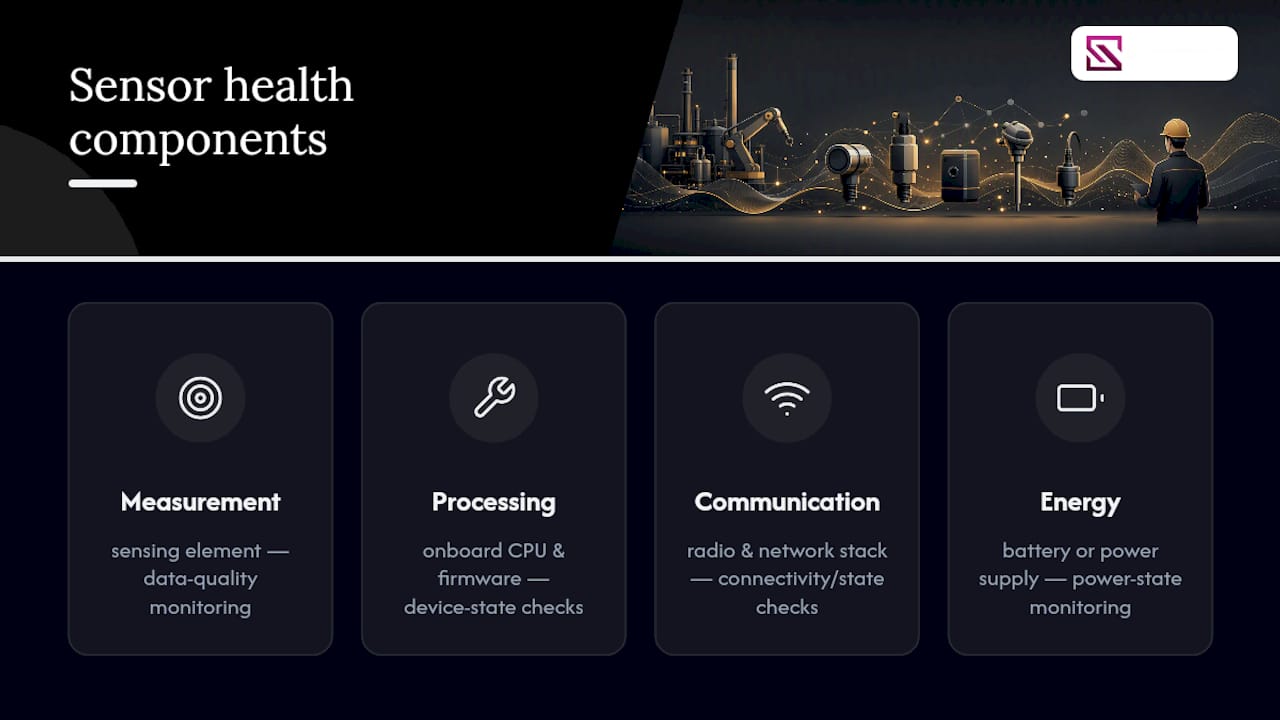
Every sensor node has four subsystems that can fail independently, and a health monitoring program has to watch all four: measurement (the sensing element itself), local processing (the onboard CPU and firmware), communication (the radio and network stack), and energy (battery or power supply). System-level analyses of structural health monitoring deployments treat these as the baseline functions worth instrumenting, and the same logic applies directly to security camera arrays, access control readers, and industrial process sensors.
Most teams only watch for outright outages. That misses the failures that cost the most. Reports on physical security operations describe these silent failures as more dangerous than total outages precisely because they create false confidence. That is why device-state monitoring and data-quality monitoring have to run together. State checks tell you a sensor is alive. Quality checks tell you whether to believe what it's reporting.
What Causes Sensors to Fail, and What Should You Watch?
Sensor failures rarely start as failures. They start as drift. Thermal cycling loosens mounts and shifts optical alignment over months. Adhesive degradation on strain gauges and accelerometers introduces gradual measurement bias. Power supplies decay in ways that show up first as brownout resets, not dead batteries. RF interference from co-located equipment corrupts packets before it ever kills a link outright. Software faults, memory leaks, buffer overflows, stuck processes, tend to surface only after days or weeks of uptime.
Practitioner guidance on failure taxonomy makes a useful distinction between cause, mechanism, and mode: thermal cycling (cause) leads to adhesive degradation (mechanism) leads to gain drift (mode). Your monitoring strategy needs observables for each stage, not just the final failure.
Map the mechanisms to concrete signals your dashboard should track:
- Measurement drift: calibration residuals against a known reference, gain and offset trends over time
- Processing faults: CPU utilization spikes, memory allocation failures, unexpected reboot counts
- Communication decay: heartbeat interval gaps, RSSI trending downward, packet delivery ratio (PDR)
- Energy decline: battery voltage curve deviation, charge cycle counts, current draw anomalies
- Storage and bandwidth creep: disk utilization percentage, write latency, sustained throughput versus baseline
Pro Tip: Log calibration residuals even when they're within tolerance. A sensor that's drifting linearly toward its limit gives you weeks of warning; one you only check against a pass/fail threshold gives you zero.
How Do You Detect a Failing Sensor Before It Goes Dark?
Detection architecture comes down to three complementary layers, and most mature deployments run all three at once.
- Distributed neighbor monitoring. Nodes exchange lightweight heartbeats and compare readings against nearby peers using variance-bound detectors. Systems like Memento demonstrated that status-compression protocols can cut monitoring bandwidth substantially while keeping false positive rates low and detection timely, an approach that translates well to camera clusters and industrial sensor grids.
- Local self-diagnostics. Node-level fault indicators and lightweight self-tests, sometimes called active-node reliability checks, let a device flag its own degradation without waiting for a central system to notice. Research into self-diagnostic sensor platforms found these checks improve fault detectability with negligible energy or hardware overhead, which matters when nodes run on constrained battery budgets.
- Data-oriented analysis. Redundancy, spatial sensor fusion, and anomaly detection catch problems that state checks miss entirely, a sensor reporting plausible but wrong values. The dependability survey on WSN data quality identifies spatial and temporal redundancy as the core techniques for both detecting and masking these faults.
Use each where it fits:
- Redundancy when sensor cost is low relative to the risk of a blind spot
- Fusion when multiple sensor types cover overlapping physical space (a camera and a motion detector on the same corridor)
- Anomaly detection when the failure mode is unpredictable and you can't predefine a threshold
The tuning question is always the same: how large should your neighbor group be, how long should a timeout run before you declare a fault, and what false-positive rate can operations tolerate. Tighter timeouts catch failures faster but flag more transient noise as faults. There's no universal setting. It depends on how costly a missed detection is versus how costly a false alarm is for that specific deployment.
What Network and Security Practices Keep Health Data Trustworthy?
None of this detection logic matters if the network carrying the telemetry is unreliable or the data itself can be spoofed. Industrial wireless deployments that report above 99.999% reliability generally rely on time-slotted channel hopping, TSCH, often implemented through SmartMesh, precisely because it manages topology intelligently in harsh RF environments rather than depending on a single fixed link.
Security has to be built into the same layer, not bolted on afterward:
- AES128 encryption on all sensor traffic, including health telemetry itself
- Message integrity codes (MICs) to detect tampering, not just eavesdropping
- Documented key lifecycle management, including rotation and secure provisioning
- Network segmentation isolating sensor traffic from general IT and unsecured industrial protocols
- Trust Center protection for ZigBee/802.15.4 deployments, since a compromised Trust Center compromises the whole mesh
That last point comes straight from federal ZigBee security guidance, which calls for defense-in-depth and traffic restriction between wireless and wired plant networks. Encryption alone won't save you if wiring closets sit unlocked. Physical access controls on gateways and cabling have to accompany any cryptographic scheme, since protocol-level protections assume an adversary can't just walk up and touch the hardware.
Pro Tip: If your gateway design has a single point of ingestion for all sensor health data, you've built one very attractive target. Segment it so a gateway compromise can't blind your entire monitoring stack at once.
What Metrics and Maintenance Cadence Should You Actually Use?
Turning all of this into something a facility team can operate requires specific thresholds, not general principles. A practical starting set:
- Heartbeat gaps: alert if a node misses three consecutive expected check-ins
- Packet delivery ratio (PDR): flag any sustained drop below 95% of baseline
- Calibration drift: flag residuals exceeding the manufacturer's stated tolerance band
- Storage utilization: alert at 80% capacity, escalate at 90%
- Battery voltage: track against the discharge curve, not a flat threshold
- RSSI/link quality: flag a sustained downward trend over rolling seven-day windows
Escalation timelines should match consequence. A communication failure on a safety-critical sensor deserves a response measured in seconds. Calibration drift on an environmental sensor can wait hours for a human to review. Treating both the same either buries your operations team in noise or lets a real emergency sit in a queue.
A workable cadence: automated checks daily, dashboard review weekly, physical field inspection quarterly. Cost drivers are mostly the inspection frequency and whether diagnostics can run remotely; remote diagnostics cut truck rolls dramatically, but they require the state and data-quality instrumentation described above already being in place.
The BeyondSensor Field Perspective on Procurement and Integration
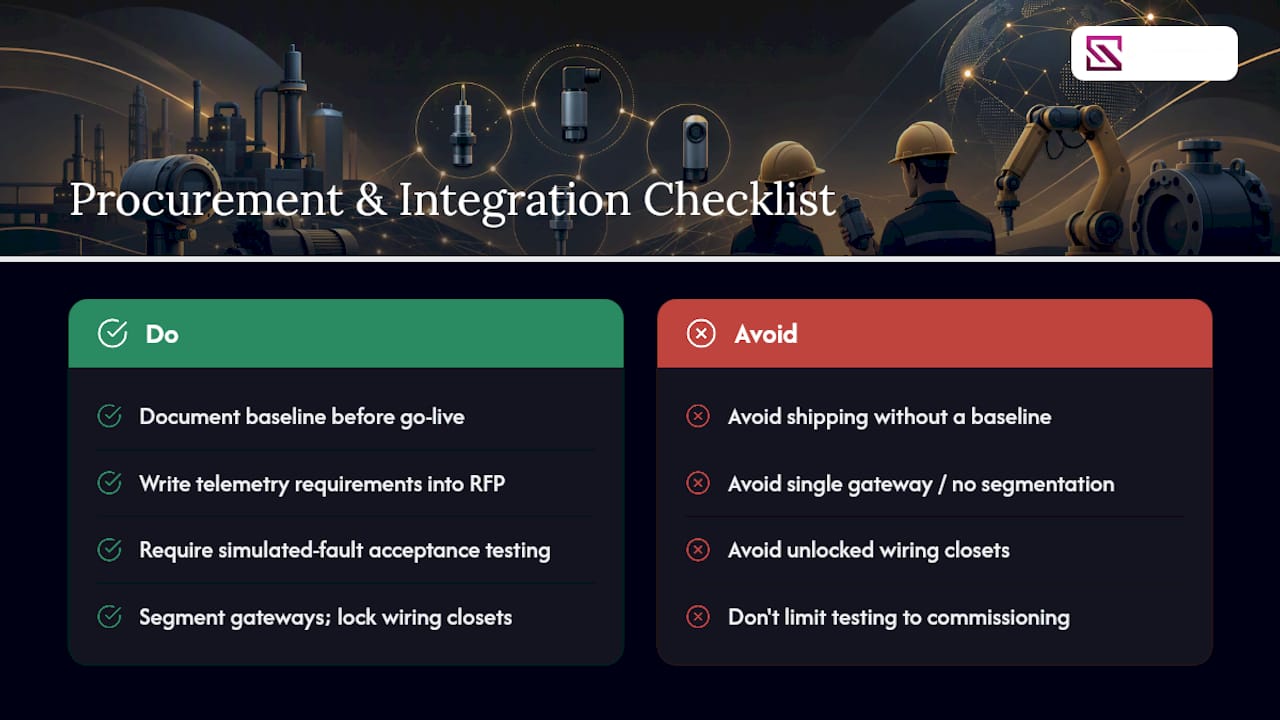
Every deployment we see fail the same way: no documented baseline before go-live, so "normal" is a guess. Write health telemetry requirements directly into your RFP, specific heartbeat intervals, calibration residual thresholds, false-positive rate ceilings, and require vendors to demonstrate detection behavior under simulated faults during acceptance testing, not just at commissioning.
The second recurring mistake is architectural: a single gateway with no segmentation, and wiring closets nobody locks. Pilot programs should test both failure injection and physical tamper response before full rollout.
— Eumir
How BeyondSensor Supports Sensor Health Monitoring Programs
A practical approach is to unify health monitoring from disconnected point tools. Where most teams juggle a diagnostics vendor, a network integrator, and a separate security consultant, Solution Integration puts state telemetry, data-quality checks, and secure network design under one engineering engagement.

For procurement and system integration teams, that means fewer handoffs and faster detection time from day one, since diagnostics and network architecture get designed together instead of bolted together after deployment. Ecosystem Matchmaking connects you to validated regional partners when hardware sourcing or local compliance needs specific expertise, and SI Channel Enablement supports integrators building this capability into their own service offerings. If you're scoping a pilot or drafting an RFP for a health monitoring rollout, start a conversation through Solution Integration and bring your baseline requirements to the first call.
Sources
For deeper technical grounding, review the WSN data quality survey on redundancy and fusion, the Analog Devices industrial IoT reliability piece, and federal ZigBee security guidance. For deployment context, see Beyondsensor's guide on securing sensor networks.
- A survey on data quality for dependable monitoring in wireless sensor networks
- Securing ZigBee wireless networks (industrial guidance)
- Memento: energy-efficient distributed monitoring for sensornets
- State of the art of drift and failures in Wireless Sensor Systems for Structural Health Monitoring (EWSHM 2026)
FAQ
What Is the Difference Between State and Data-Quality Monitoring?
State monitoring checks whether a sensor is alive and connected, using heartbeats and diagnostics. Data-quality monitoring checks whether its readings are accurate, using redundancy, fusion, and anomaly detection. You need both, because a sensor can be fully online while reporting corrupted or drifted values.
How Often Should Sensor Health Checks Run?
Automated state and data-quality checks should run continuously or on short intervals measured in minutes. Dashboard-level human review typically happens weekly, with physical field inspections on a quarterly cadence for most industrial and security deployments.
What Encryption Standard Should Sensor Networks Use?
AES128 combined with message integrity codes is the baseline most industrial wireless deployments rely on for encrypted, tamper-resistant telemetry. Key management and rotation matter as much as the algorithm itself, since a compromised key defeats encryption regardless of strength.
Does BeyondSensor Provide Sensor Health Monitoring Services?
Beyondsensor supports health monitoring through Solution Integration, combining secure network design with diagnostics deployment for industrial and security sensor networks. Pricing for these engagements is available on request through the services page.
What Is the Biggest Blind Spot in Most Sensor Deployments?
Silent degradation, bandwidth creep, storage saturation, and gradual calibration drift, causes more coverage loss than outright device failures, according to physical security operations reporting. Most monitoring setups only alert on hard failures and miss this category entirely.
Recommended
Read More Articles

Secure AI Model Drift in 90 Days: Six Actions for Security Teams
Stop AI model drift breaking security controls. Six actions to finish in 90 days, with monitoring metrics, procurement SLAs, and incident response steps.
5 ONVIF profile checks every integrator must run before buying cameras
Default to Profile T for new cameras. Add Profile G for local recording and Profile M for analytics. Verify each model on the ONVIF Conformant Products...

Plan 12–18 Month Retraining: Smart City Surveillance for Planners
Practical guidance for planners deploying smart city surveillance: pilot narrowly, with privacy by design, and budget 12–18 months for retraining.
Practitioners: 6 Steps to Choose Environmental Sensors, Avoid Mistakes
Six decision steps for monitoring teams to pick, site, and deploy environmental sensors, with pilot, calibration, and sourcing advice.
Let's Build YourSecurity Ecosystem.
Whether you're a System Integrator, Solution Provider, or an End-User looking for trusted advisory, our team is ready to help you navigate the BeyondSensor landscape.
Direct Advisory
Connect with our regional experts for tailored solutioning.