
How seismic intrusion sensors detect footsteps and tunnelling, how they compare with microwave and infrared, and how to pilot them on a Singapore site.
Seismic Intrusion Sensors: How They Work and Where They Fit

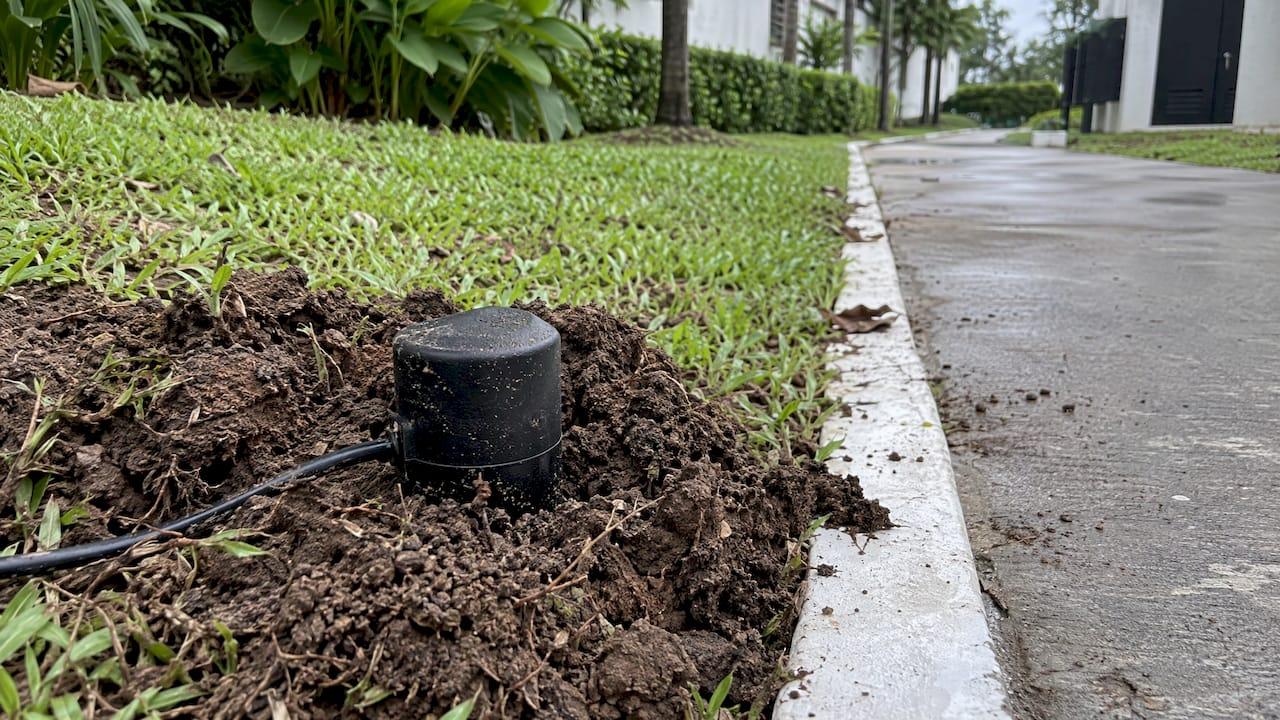
Seismic intrusion sensors detect the vibration that a person, vehicle or digging tool sends through the ground, so they can protect a perimeter without any visible hardware above the surface. They work best as one layer in a mixed design, paired with a sensor that covers their weak points and validated on the actual site before a final selection. For integrators and security teams in Singapore, Malaysia and the Philippines, the real task is deciding where ground-based detection earns its place and how to keep nuisance alarms down in wet, noisy tropical sites. This article covers the mechanics, the comparison with microwave and infrared, and a pilot approach, with the evidence behind each point.
TL;DR
- Seismic sensors, usually geophones buried along a perimeter, pick up footsteps, vehicles and digging. The US Defense Systems Information Analysis Center describes them as the most common type of unattended ground sensor.
- No single sensor catches every intruder profile (walking, running, crawling) without excessive nuisance alarms, so design with two or more complementary technologies.
- Microwave and active infrared are above-ground, line-of-sight or volumetric choices. Microwave tolerates weather better, while infrared beams suffer in fog, heavy rain and dust.
- Soil, drainage, underground utilities, public footpaths and traffic decide how a seismic layer performs, so a site survey and a trial installation come before final selection.
- Integrate every sensor into one dashboard with tamper protection, so operators handle exceptions rather than watch raw signals.
Table of Contents
- What seismic intrusion sensors are
- How seismic intrusion detection works along a perimeter
- Nuisance alarms: the real cost of any perimeter sensor
- Microwave vs infrared perimeter sensors
- Where seismic detection fits in a layered design
- Installation rules that protect the system itself
- Survey and pilot before you select
- Perspective
- How BeyondSensor supports your perimeter project
- FAQ
- Sources
What seismic intrusion sensors are
A seismic sensor measures ground movement. In earthquake monitoring it records large tremors. In intrusion detection the same principle is applied at a far smaller scale: a geophone, a sensor that converts ground vibration into an electrical signal, sits in the soil and responds to the small shocks that footsteps, vehicle tyres or digging create.
The DSIAC unattended ground sensor survey lists seismic, acoustic, magnetic, electro-optical and infrared sensors as the main families. It notes that seismic sensors can effectively detect personnel, wheeled and tracked vehicles, and helicopters, and that the US Border Patrol uses unattended ground sensors on its northern and southern borders. The takeaway for a facility owner is that seismic detection is a mature, field-proven technique, not an experimental one.
The practical appeal is concealment. A buried sensor cannot be seen, cut at the fence or visibly bypassed, and it does not depend on the fence being intact. That makes it a fit for sites where aesthetics, heritage or fence-free boundaries rule out visible posts and beams.
How seismic intrusion detection works along a perimeter
A classic design is documented in a 1983 NASA Ames patent for a scanning seismic intrusion detection system. It uses an array of geophones laid along the perimeter, each connected by two wires to a central station. The station can run in two modes:
- Summed-signal threshold mode. The signals of all sensors are added together, and an alarm sounds when the total crosses a threshold. This is simple and quick to respond, but it says little about where the event happened.
- Multiplexed mode. The station interrogates each sensor in sequence, so the alarm can be tied to a position along the line.
The patent describes monitoring for surface movement and for tunnelling, which is the case a fence-mounted or above-ground sensor cannot see at all. Modern systems add digital processing, classification and network connectivity, but the layout logic is the same: a line of sensing points, a processor that discriminates real events from background vibration, and a report to the operator.
What decides detection range and reliability
Ground coupling is everything. The signal a footstep produces travels differently through dense clay, loose fill, a saturated bank or a concrete apron. An OSTI report on perimeter intrusion detection and assessment says the site survey must identify topography, soil composition, climate, animal population, road locations, drainage, electromagnetic emitters and underground utilities. Each of those either carries vibration, absorbs it or adds a source of false signals.
For a Singapore or regional site, three of these deserve early attention:
- Drainage and ground saturation. Frequent heavy rain changes how the soil transmits vibration and adds its own noise. The UK's National Protective Security Authority (NPSA) lists strong winds, fog and ground saturation among the factors that can affect perimeter system performance in its guide to perimeter intrusion detection systems.
- Traffic and public footpaths. Roads, rail lines, construction and public footways near the boundary generate vibration that has nothing to do with intrusion. The same guide flags public footways as a cause of alarms.
- Underground services. Ducts, cables and pipes can prevent ground-based installation or create vibration paths. Trace them before anyone digs.
Nuisance alarms: the real cost of any perimeter sensor
A sensor that alarms constantly is switched off in practice. The OSTI report concludes that no single sensor can detect all intruder profiles, walking, running or crawling, without excessive nuisance alarms. A combination of two or more complementary sensors keeps the nuisance alarm rate acceptable without lowering the probability of detection.
A Singapore-based research team offers a useful data point on weather. In a peer-reviewed study of fence intrusion detection using fiber optic sensing, short fiber segments acting as reference sensors cut the nuisance alarm rate by 90.7%, from 2.931 to 0.292 per hour, in field trials. Heavy rain and strong wind were the main nuisance sources. The same authors note that this approach handles environmental conditions but not wildlife, so it should feed an alarm algorithm that adds advanced signal processing, including AI-based methods, as a first decision level.
That conclusion applies to seismic sensing too. Raw vibration is cheap to collect and hard to interpret. The value sits in the classification layer: telling a person walking from rainfall, a monitor lizard or a passing lorry. When you evaluate any seismic offer, ask how events are classified and how that classification is tuned for the site.

Microwave vs infrared perimeter sensors
Seismic sensors are buried, while microwave and infrared sensors are installed above ground and watch a zone or a line. Integrators comparing them for the same boundary usually weigh the following.
| Factor | Active infrared beam | Microwave | Seismic (buried) |
|---|---|---|---|
| Detection method | Modulated infrared beam between transmitter and receiver, alarm on interruption | Radio-frequency field, alarm on motion in the volume | Ground vibration picked up by buried sensors |
| Typical range | Up to 200 m per SEN.news | 100 to 300 m or more, same source | Set by sensor spacing and soil coupling |
| Weather tolerance | Moderate: fog, heavy rain and dust attenuate the signal | Excellent | Affected by saturated ground and rain noise |
| Alignment sensitivity | High | Low | Not applicable, but ground coupling matters |
| Main nuisance risk | Fog, obstruction | Volumetric spill, metal objects, moving water | Traffic, construction, rain, animals |
| Visibility | Visible posts | Visible posts | Concealed |
The NPSA guide adds the installation detail that decides real-world outcomes:
- Active infrared needs flat ground, because undulations create dead zones, and typically uses a hard-wired synchronisation cable between transmitter and receiver pairs, ideally in underground ducting.
- Passive infrared has poor immunity to changing temperatures and is less suited to outdoor use.
- Bistatic microwave has dead zones near both the transmitter and the receiver, normally covered by overlapping adjacent zones, and needs a well-maintained detection area. Doppler microwave has dead zones near the transceiver. Both types are susceptible to metallic objects and moving bodies of water.
SEN.news summarises the fit simply: infrared for clear perimeters, fence lines, rooftops and corridors, and microwave for open areas and adverse-weather sites. A tropical site with sudden downpours, drainage channels and vegetation will often lean toward microwave for open ground, while seismic or fence-mounted sensing covers the boundary where concealment or tunnelling matters.
Where seismic detection fits in a layered design
The NPSA guide warns that systems with dead zones near their sensors are vulnerable to crawling and rolling attacks. Dead zones must be covered by overlapping adjacent zones or by an additional technology. This is the strongest argument for layering, and it is how seismic sensing is best used:
- Concealed outer line. Buried sensors behind or beside a fence give early warning without advertising where detection occurs.
- Tunnelling and subsurface threats. Few above-ground sensors address these, which is the case the 1983 NASA design was built for.
- Gap coverage. Where a microwave or infrared zone leaves a dead area near the transmitter or receiver, a ground sensor can close it.
- Fence-line pairing. Seismic detection behind a fence combined with fence-mounted sensing gives two independent triggers. Our guides to fence vibration sensors and fiber optic perimeter security cover the companion technologies in detail.
When two sensors disagree, the alarm logic matters. A site might require both a seismic trigger and a camera analytic to confirm before dispatch, which cuts guard call-outs for events that do not need them.
Installation rules that protect the system itself
A perimeter system is also a target. The NPSA installation guidance is specific and worth building into every specification:
- Place transmitters and receivers on the secure side of the perimeter.
- Run cabling at stand-off on the secure side.
- Locate processor boxes as far from the perimeter as possible, preferably indoors.
- Fit tamper switches on all removable lids and use IP-rated outdoor enclosures.
For buried sensors, add records of burial depth, sensor positions and cable routes to the as-built documents, so later civil works do not cut or disturb the line without anyone noticing.
Survey and pilot before you select
The OSTI experts conclude that sensor selection must rest on how the operating environment influences performance. Because knowledge linking sensor performance to environment is limited, on-site evaluation is required before final selection: a site survey, identification of candidate sensors and an experimental installation.
That sequence is the heart of a defensible procurement. A practical version looks like this:
- Survey. Record soil, drainage, utilities, nearby traffic, vegetation and wildlife, electromagnetic emitters and public access. Our security site survey checklist and line of sight survey guide set out the checks.
- Shortlist. Pick two complementary technologies for each boundary segment, not one.
- Trial installation. Install a short section in the worst-case ground and run it through wet and dry conditions, including crawling and slow-walk tests. Disciplined integration testing in matching environments keeps the trial results representative of the live site.
- Measure. Track detection against intruder profiles and nuisance alarms per hour, then compare. Our piece on pilot KPIs for perimeter intrusion detection lists the three measures to put in the acceptance criteria.
- Place and lock the design. Our standards-led sensor placement guide and 2026 sensor deployment guide help turn pilot results into a placement plan.
Integration checklist
Before sign-off, confirm each sensor feeds one operating picture. SEN.news notes that infrared beams integrate through relay outputs with alarm panels, access control and IP-based I/O modules feeding VMS or PSIM platforms (video management and physical security information management systems). Apply the same test to seismic and microwave units: relay or IP output, time-stamped events, tamper alarms, and a clear mapping from each sensor zone to a camera preset.
Perspective
Seismic sensing is attractive because it is quiet and hidden, but a hidden sensor still has to prove itself on your ground. We have seen that the decision is rarely about one technology. It is about how several sensors, cameras and rules behave together once the first heavy rain arrives.
That is why we build around a unified platform with multi-vendor integration and localized technical validation. Southeast Asian sites differ in soil, climate and compliance expectations, and a design validated in one country should not be assumed to hold in another. Our approach is to treat sensor outputs as inputs to exception-based monitoring: AI never blinks, so operators review the events that matter instead of watching every signal.
For integrators, the commercial win is a pilot that ends with numbers: detection against intruder profiles, nuisance alarms per hour, and a clear integration path. We designed our solution integration and ecosystem matchmaking services to get you to that point faster.
Eumir
How BeyondSensor supports your perimeter project
If you are specifying a layered perimeter for a Singapore, Malaysia or Philippines site, our Solution Integration service brings sensors, software and deployment planning together under one design. Where the right sensor sits with another technology provider, Ecosystem Matchmaking connects integrators and solution providers for deployment and integration. BeyondWatch and BeyondSecure give operators a single place to see and act on events.

To discuss a project, start from our system integrators page.
FAQ
What can seismic intrusion detection identify?
Seismic sensors respond to ground vibration, so they can detect people on foot, wheeled and tracked vehicles and helicopters, according to the DSIAC survey. A buried array can also monitor tunnelling, as described in the NASA patent. Classification software determines which of these a given event most likely is.
Is seismic or microwave better for a perimeter?
Neither wins on its own. Microwave covers 100 to 300 m or more with excellent weather tolerance, while seismic sensing is concealed and covers subsurface activity. OSTI's conclusion is that two or more complementary sensors keep nuisance alarms acceptable without losing detection, so most sites combine them.
Why do infrared beams struggle in some conditions?
Active infrared works by line of sight, so fog, heavy rain, dust and airborne particles attenuate the signal over longer distances. The NPSA guide adds that undulating ground creates dead zones. Infrared suits clear, flat boundaries, fence lines, rooftops and corridors.
What should we check before installing buried sensors?
Survey soil composition, drainage, underground utilities, nearby roads and footpaths, and animal activity. Then run a trial installation across wet and dry conditions before final selection, as the OSTI experts recommend.
Sources
- Unattended Ground Sensor Survey, DSIAC
- Scanning seismic intrusion detection method and apparatus, NASA
- Perimeter Intrusion Detection and Assessment System, OSTI
- Self-Contained Reference Sensors to Reduce Nuisance Alarm Rate, MDPI
- Active Infrared Beams In Perimeter Security, SEN.news
- Guide to Perimeter Intrusion Detection Systems, NPSA
Recommended
Read More Articles

Visitor Data Privacy in Singapore: A PDPA Guide for Site Teams
How Singapore sites should collect, notify, secure and delete visitor data under the PDPA, and how a digital visitor system makes each duty routine.

CCTV Tender Specifications in Singapore: What to Write and Check
How to write or answer a CCTV tender specification in Singapore: camera, retention, network, analytics and acceptance requirements, with SPF, MOM, IMDA and PUB figures.

Alarm Deduplication for Security Teams: A Practical Guide
How alarm deduplication, correlation rules, severity mapping and escalation matrices work together to cut duplicate alarms without hiding the ones that matter.
Vehicle Classification Analytics: A Guide for Singapore Sites
How vehicle classification analytics and vehicle type detection work, which classes to use in Singapore, and how to plan camera placement, integration and data.
Let's Build YourSecurity Ecosystem.
Whether you're a System Integrator, Solution Provider, or an End-User looking for trusted advisory, our team is ready to help you navigate the BeyondSensor landscape.
Direct Advisory
Connect with our regional experts for tailored solutioning.