
A practitioner playbook for Privacy by Design in surveillance: the seven core PbD principles, an operational checklist, technical controls, and deployment...
Seven Privacy by Design Principles for Surveillance Teams
Privacy by design surveillance means building necessity, proportionality, and minimization into a camera or sensor system before a single pixel gets captured, not bolting on compliance after deployment. That requires seven specific design principles, a documented DPIA, short retention windows, default masking, and encrypted access controls specified before procurement. Treat the checklist sections below as the operational path from that principle to a system that actually passes an audit.
TL;DR:
- Surveillance systems must incorporate privacy features such as masking, encryption, and short retention periods from the outset, not added after deployment.
- Privacy embedded into design involves automatic masking, configurable retention limits, and architectural safeguards, making retrofitting difficult and costly.
- Conducting necessity and proportionality tests before procurement ensures surveillance is justified and minimizes data collection, especially with biometric systems or public space coverage.
- Practical implementation relies on detailed DPIAs, including data flow maps, purpose statements, risk registers, and retention matrices, kept updated throughout system growth.
- Technical controls like edge analytics, real-time masking, and layered access management are essential to enforce privacy and meet audit standards effectively.
Table of Contents
- What Does Privacy by Design Mean for Surveillance Systems?
- How Do You Assess Ethics and Proportionality in Surveillance?
- How Do You Build a Privacy by Design Implementation Checklist?
- What Technical Controls Actually Enforce Privacy in Surveillance?
- What Belongs in a Surveillance DPIA?
- How BeyondSensor Turns PbD Principles Into Deployment Artifacts
- Why Embedding Privacy by Design Is Also Better Governance
- How BeyondSensor Supports Privacy by Design Deployments
- Sources
- FAQ
What Does Privacy by Design Mean for Surveillance Systems?
Privacy by Design, or PbD, is not a compliance checkbox. It is a design methodology developed by Dr. Ann Cavoukian, Ontario's former Information and Privacy Commissioner, that treats privacy protection as an engineering requirement rather than a legal afterthought. The framework rests on seven foundational principles, and every one of them has a distinct, testable meaning when applied to cameras, microphones, and biometric sensors instead of generic software.
Surveillance technology ethics gets complicated fast because the systems in question watch people who never opted in. A retail analytics platform or a building access controller doesn't ask permission the way a mobile app does. That makes translating abstract principles into surveillance-specific practice the actual job, not an academic exercise.
- Proactive not reactive. Privacy risks in a camera network get identified during system design, not after a data subject complains. This means running a privacy risk review before selecting hardware, not after installation.
- Privacy as the default setting. A newly installed camera should ship with the narrowest possible data collection configuration active, meaning audio capture off, facial recognition off, and cloud upload off unless a documented purpose requires each one.
- Privacy embedded into design. Masking zones, retention timers, and access tiers are architectural features of the system, coded into the platform itself, not settings a facility manager has to remember to configure correctly.
- Full functionality, positive-sum, not zero-sum. A well-designed surveillance system does not force a trade-off between security outcomes and privacy protection; edge analytics that count occupancy without storing identifiable faces prove both goals are achievable together.
- End-to-end security. Data protection spans the full lifecycle: encrypted transmission from camera to server, encrypted storage at rest, and secure deletion at the end of the retention period, with no unprotected gap anywhere in that chain.
- Visibility and transparency. Anyone entering a monitored space can find out what is being recorded, why, and by whom, backed by real documentation rather than a generic sign at the entrance.
- Respect for user privacy. The system architecture keeps the individual's interests central, meaning defaults favor the person being observed even when a more invasive configuration would be operationally simpler.
Each principle sounds intuitive in isolation. What trips up most security teams is principle three, privacy embedded into design, because retrofitting an existing camera fleet with masking or automated deletion is far harder than specifying those features at procurement. A common operational pitfall is treating PbD as an add-on layer instead of a default configuration, which is why visitor management systems and camera platforms alike need automatic data expiration built in from day one, not scripted in afterward by an overworked IT administrator. A guide to data privacy in sensing walks through how these seven principles map onto real sensor deployments across industrial and facility contexts.
How Do You Assess Ethics and Proportionality in Surveillance?
Surveillance is not automatically unethical, but it is also never neutral. Its moral status depends entirely on justified cause, proportionality, and the technical means chosen to achieve the stated goal, according to scholarly work on surveillance ethics. A camera pointed at a warehouse loading dock to prevent theft sits in a very different ethical category than the same camera running facial recognition against a watchlist of employees.
The risks compound in specific, technical ways:
- Mass collection turns a targeted security tool into a bulk data warehouse, capturing far more about far more people than the stated purpose requires.
- Mission creep happens when a system installed for one purpose, say parking lot safety, quietly gets repurposed for HR performance monitoring or marketing analytics without a new legal basis.
- Re-identification risk means supposedly anonymized footage can often be traced back to specific individuals through metadata, gait analysis, or cross-referencing with other datasets.
- Biased analytics in facial recognition and behavior detection models have documented accuracy gaps across demographic groups, meaning error rates fall unevenly on already marginalized populations.
- Chilling effects occur when people modify their behavior, avoid public spaces, or self-censor simply because they know they are being watched, even absent any actual misuse of the data.
Data point: analytics intrusiveness sits on a gradient, not a binary. EDPB guidance draws a clear line between simple counting algorithms, which are comparatively low risk, and biometric or behavior-recognition models, which carry substantially higher privacy weight and demand stricter justification.
Running a proportionality test means asking three questions in sequence, and stopping if any answer fails. Is the surveillance necessary to achieve a specific, documented goal that cannot be met through a less invasive means? Is the scope of data collected, in area, duration, and detail, proportionate to that goal? Does the deployment avoid discriminatory impact on any group of people who will be observed? Responsible-use surveillance principles call for exactly this kind of scope and retention limitation, alongside secure post-acquisition handling and specific safeguards around biometric tools.
When a deployment touches biometric identification, covers public space at scale, or involves vulnerable populations such as minors or patients, escalate past the standard technical review. That means pulling in legal counsel, a data protection officer, and, where the deployment is contentious or novel, external stakeholder consultation before a single camera goes live.
How Do You Build a Privacy by Design Implementation Checklist?
Turning principle into practice requires a sequence, not a single meeting. Skipping the order, running procurement before the necessity test, for instance, is how organizations end up with hardware that cannot support the privacy controls the DPIA later demands.
1. Document the purpose before you shop for hardware. Write down, in specific terms, why surveillance is needed, what problem it solves, and what evidence supports that need. A vague purpose like "improve security" cannot survive a proportionality challenge; "reduce loading dock theft, which caused significant losses recently" can.
2. Run the necessity test. Confirm no less invasive method, better lighting, access control, staff presence, achieves the same goal. If surveillance passes this test, move forward; if it doesn't, stop.
3. Write privacy requirements into the RFP itself. Procurement specifications should mandate masking capability, configurable retention limits, encrypted storage, and vendor attestations covering each control, according to EDPB guidance on video device deployment. A vendor who cannot document these features in writing should not make the shortlist.
4. Scope and complete the DPIA. A data protection impact assessment is mandatory under most frameworks for large-scale public surveillance and any biometric processing. It needs a data flow map, a lawful basis statement, a documented risk register, and a mitigation plan tied to each identified risk.
5. Assign controller and processor roles explicitly. Someone owns the decision to deploy and the legal responsibility that comes with it. If a system integrator or cloud vendor processes the footage, that relationship needs a data processing agreement, not a handshake.
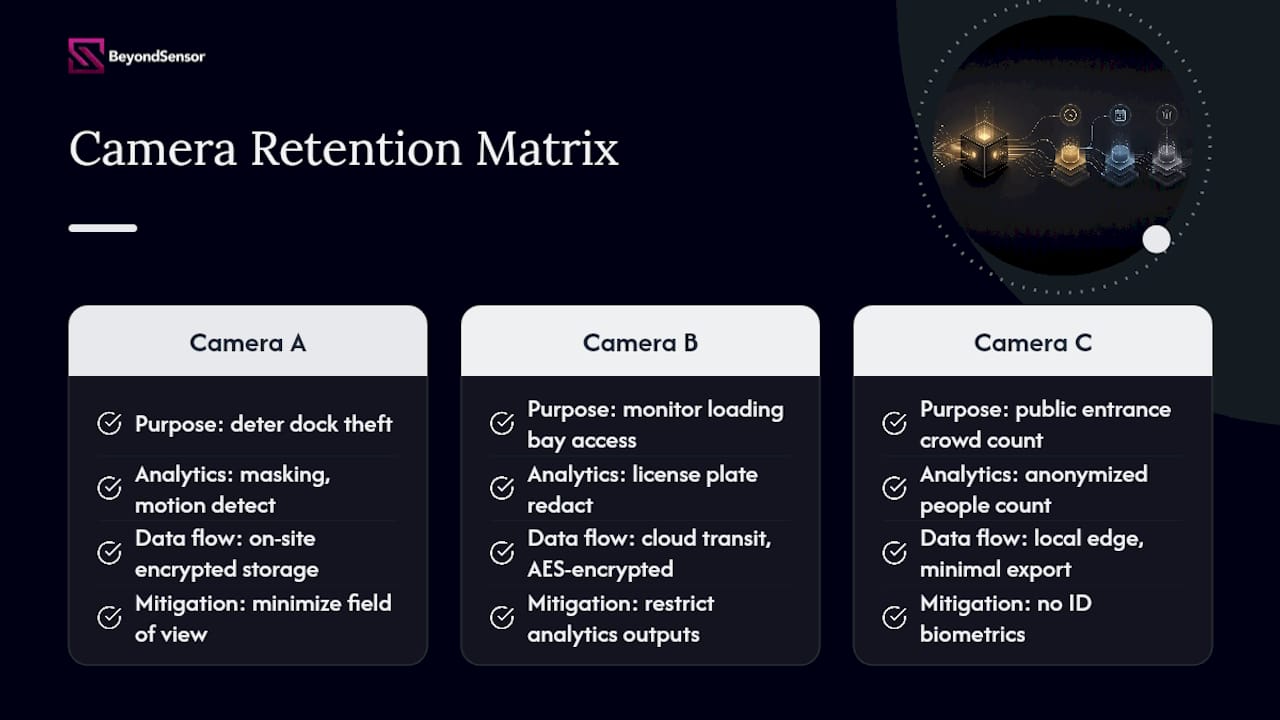
6. Build the retention matrix before installation, not after. Map every camera location against its stated purpose, the analytics running on its feed, and the exact retention period that purpose justifies. A practical retention matrix of this kind dramatically simplifies both the DPIA and any later supervisory request, and it doubles as the single source of truth when someone asks why footage from camera 14 is still on the server. A breakdown of CCTV data retention rules offers a practical template security teams can adapt directly.
7. Set access controls on a strict need-to-know basis. Tier access by role, log every view and export, and review the access list quarterly. A facility manager rarely needs the same footage access as a security operations lead investigating an incident.
8. Train every person who touches the system. Operators, installers, and administrators all need to understand what the masking settings do, why the retention timer exists, and what constitutes misuse. Untrained staff are the single most common source of PbD failures in otherwise well-designed systems.
9. Build audit logging into daily operations, not just incident response. Every access, export, configuration change, and deletion needs a timestamped, immutable log entry. This is what turns "we have a privacy policy" into "we can prove compliance."
10. Schedule periodic reassessment. A system built to spec in 2026 will drift, cameras get added, analytics get upgraded, retention gets quietly extended because deleting old footage feels risky. Put a review on the calendar, not a hope.
Pro Tip: Build the retention matrix and the DPIA data flow map as the same document, updated together. Teams that keep them separate almost always let one drift out of sync with the other, and that gap is exactly what a supervisory audit finds first.
A guide to security compliance in sensing systems walks through this sequence with more detail on the organizational controls layer, and the role of data privacy in security strategy covers how procurement teams should structure vendor requirements around it.
What Technical Controls Actually Enforce Privacy in Surveillance?
Governance documents mean nothing if the hardware and software underneath cannot enforce what they promise. Four technical patterns do most of the real work here, and each one comes with genuine trade-offs worth understanding before you specify them.
Edge analytics and selective capture push processing to the camera or sensor itself, so raw video never leaves the device. Instead of streaming full footage to a central server, an edge system can output only the metadata it needs, an occupancy count, a motion event, a license plate match, and discard the raw frame. An overview of surveillance analytics explains how this distinction between raw-stream and metadata-only architectures shapes both privacy exposure and bandwidth cost.
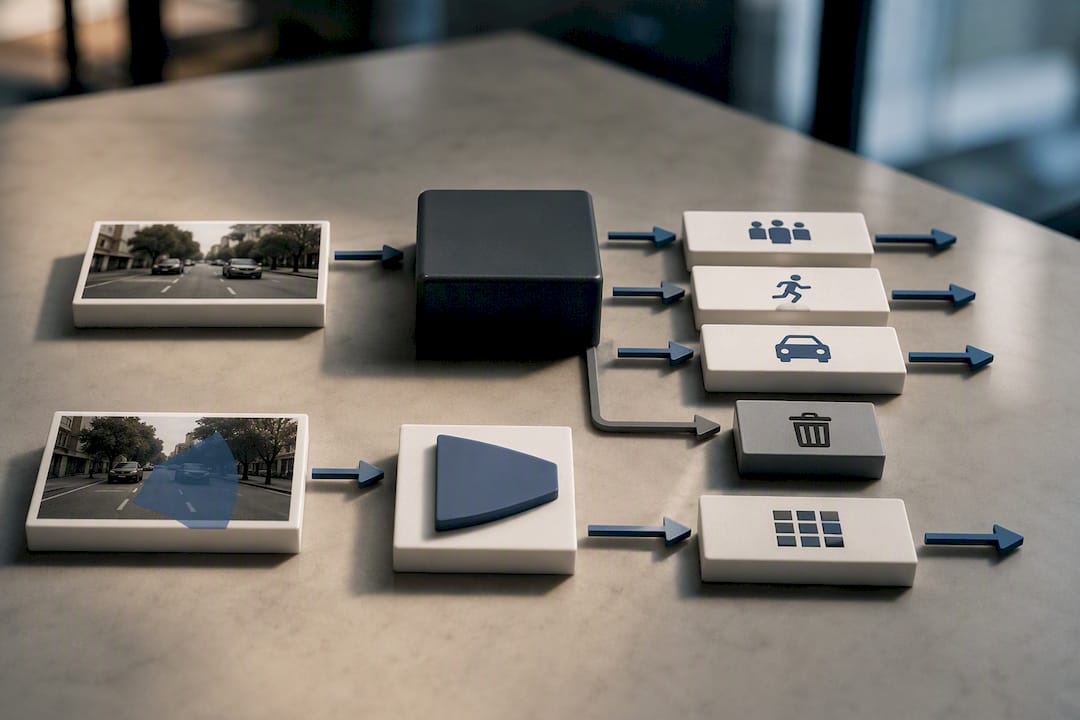
Privacy masking blurs or blocks specific regions of a frame, whether that's a neighboring property visible from a security camera or the faces of bystanders not relevant to a monitored zone. CCTV privacy masking setup typically happens at the camera firmware level, meaning the masked region never gets recorded in the first place rather than being blurred after the fact in post-processing, which matters because a system that only masks on playback still stores the unmasked original. Real-time on-device masking models can output privacy-safe metadata directly, avoiding the need to store or transmit an identifiable image at all.
Anonymization and pseudonymization reduce identifiability but don't eliminate it. Anonymized footage can often be re-identified through cross-referencing with other datasets, timing correlation, or simply recognizable clothing and gait. Pseudonymization, replacing a face with a tracking ID, is reversible by design and needs the same access controls as raw personal data because, legally, it typically still counts as personal data.
Encryption, key management, and secure deletion close the lifecycle gap. Footage should be encrypted in transit and at rest, key access should be logged and role-restricted, and deletion at the end of the retention period needs to be cryptographically verifiable, not just a database entry marked "deleted" while the underlying file sits untouched on disk.
- Favor privacy-friendly technologies like masking and scrambling over raw capture whenever the use case allows it.
- Disable features you don't need, unlimited zoom, audio capture, wide-angle overreach, rather than leaving them active by default.
- Edit out unrelated individuals before sharing footage externally, whether with law enforcement, insurers, or another department.
- Log every access to encryption keys with the same rigor applied to footage access itself.
Pro Tip: When evaluating a vendor's masking claim, ask specifically whether masking happens before storage or only at the display layer. The difference determines whether your retention policy actually protects anyone or just looks like it does on a dashboard.
What Belongs in a Surveillance DPIA?
A data protection impact assessment is the project's accountability record, the document that proves, months or years later, that privacy was actually considered rather than assumed. Comparative legal scholarship treats this documentation obligation as central to how supervisory authorities and courts evaluate whether an organization met its accountability duties, not optional paperwork filed and forgotten.
A surveillance DPIA needs several elements that generic software DPIAs often skip:
- Purpose and lawful basis, stated specifically enough that a regulator could evaluate whether the surveillance is proportionate to it, not a generic "security purposes" line.
- Data flow maps showing exactly where footage travels, from camera to local storage to cloud backup to any third party, including system integrators and analytics vendors.
- A camera and sensor location map, documenting the physical placement, field of view, and whether each device captures public space, semi-private space, or areas with heightened sensitivity like restrooms or medical treatment rooms.
- An analytics feature inventory, listing every AI or rule-based feature running on each feed, facial recognition, license plate reading, behavior detection, and the specific justification for each one.
- A retention schedule broken out by camera and feature, since a general security camera and a facial-recognition-enabled entry system almost never justify the same retention period.
- A risk register with mitigation tracking, listing identified risks (re-identification, unauthorized access, mission creep) against the specific control addressing each one, and noting any residual risk that remains after mitigation.
This documentation does double duty. It satisfies the EDPB's requirement that DPIAs cover large-scale public surveillance and biometric processing, and it becomes the single artifact a supervisory authority or internal auditor asks for first when questions arise. A risk assessment guide for security practitioners offers a methodology that maps cleanly onto this risk register structure, and the security risk assessment checklist for facility owners is worth pairing with it during the documentation phase.
Keep the camera map and retention schedule as living documents, not one-time deliverables filed after the initial deployment review. A system that grows by three cameras and a new analytics feature over eighteen months without updating its DPIA has quietly drifted out of compliance, even if nothing about the original assessment was wrong.
How BeyondSensor Turns PbD Principles Into Deployment Artifacts
Translating the seven principles into a working system means having the right templates ready before procurement starts, not improvising them mid-project. Work with system integrators and facility teams on exactly this handoff: a DPIA checklist scoped to the specific sensor deployment, procurement language that mandates masking and retention controls in the RFP itself, and a retention matrix template that maps camera, purpose, analytics, and deletion date into one document.
Three patterns show up across most well-designed deployments:
- Ephemerality by default. Footage that has no documented purpose past a short window gets deleted automatically, not manually, closing the gap where "we'll clean it up later" becomes "we never did."
- On-device masking. Processing sensitive regions at the sensor level, rather than in a central server after the fact, means the unmasked version never exists in storage to begin with.
- Layered access control. Role-based tiers separate who can view live feeds, who can export footage, and who can access raw unmasked data, with each tier logged independently.
Data privacy in sensing and the infrastructure surveillance integration guide for facilities both go deeper into how these patterns get specified at the integration stage, before hardware selection locks a facility into a design that's expensive to retrofit later.
Why Embedding Privacy by Design Is Also Better Governance
The strongest argument for PbD in surveillance has nothing to do with avoiding fines. Systems designed around necessity, minimization, and transparency simply fail less often, and fail smaller, when something goes wrong. A breach involving three days of masked, encrypted footage under a tight retention window is a very different incident than one involving eighteen months of unmasked, unencrypted video sitting on an unmonitored server.
Reputational risk follows the same logic. Trust, once lost because a monitored population discovers surveillance exceeded its stated purpose, rarely comes back through a press release. It comes back, if at all, through demonstrated architectural change.
Sustaining PbD past the initial deployment takes structural commitment: privacy requirements baked into every procurement cycle, architecture reviews scheduled alongside security reviews rather than treated as a separate compliance track, and periodic reassessment written into the budget, not left to whoever remembers next year. Organizations that treat PbD as a one-time project checkbox find themselves rebuilding the same governance work from scratch every time a regulator asks a hard question. Organizations that fold it into ongoing security strategy answer that question in an afternoon.
— Eumir
How BeyondSensor Supports Privacy by Design Deployments
Most facility teams get stuck at the exact gap this article maps: strong policy intentions, weak technical enforcement. This gap can be closed by working directly with system integrators to specify masking, retention, and access control at the hardware and platform level, before installation locks in a design that's costly to change.

That means DPIA co-development scoped to your actual camera and sensor layout, secure sensor platforms with masking and encryption built into the default configuration rather than added as a paid extra, and integration support that turns a retention matrix from a spreadsheet exercise into an enforced system setting. For teams evaluating a new deployment or auditing an existing one, the practical next step is a technical review: map your current camera and sensor inventory against the checklist above, identify where retention or masking gaps sit, and scope a pilot before committing to a full rollout. System integrator services outline how that review process works, and the tools overview covers the platform capabilities available to support it. Teams that also want to verify how their documentation and public-facing transparency notices read to AI-driven search tools can run a visibility audit alongside the technical review. Start with the camera inventory and retention gap check, and the rest of the deployment plan follows from there.
Sources
- Privacy by Design — The seven foundational principles (IETF slides)
- Freedom Online Coalition: Surveillance principles
- Surveillance ethics (Internet Encyclopedia of Philosophy)
FAQ
What Are the 7 Principles of Privacy by Design?
The seven principles, defined by Dr. Ann Cavoukian, are proactive not reactive, privacy as the default setting, privacy embedded into design, full functionality (positive-sum, not zero-sum), end-to-end security, visibility and transparency, and respect for user privacy.
What Does "Privacy by Design" Mean in Surveillance?
It means a surveillance system is built so that data minimization, masking, short retention, and encryption are the default configuration from the moment a camera or sensor is specified, not controls added after a complaint or audit.
Can You Give an Example of Privacy by Design in Surveillance?
A parking lot camera configured to run occupancy-counting analytics at the edge, output only aggregate counts instead of storing raw video, and automatically delete any retained footage within a short, documented retention period is a working example of privacy embedded into design from the start.
What Is the Difference Between Privacy and Surveillance?
Privacy is an individual's interest in controlling information about themselves, while surveillance is the systematic observation of people or spaces; PbD exists specifically to keep surveillance's necessary security function from overriding that privacy interest by default.
When Is a DPIA Required for a Surveillance System?
A DPIA is required for large-scale public surveillance and for any deployment involving biometric processing, and it should map data flows, document lawful basis, and maintain a risk register with tracked mitigations throughout the system's life.
Recommended
Read More Articles

Stop Silent Failures: Sensor Health Monitoring for Ops & Procurement
Procurement and ops: require heartbeat intervals, drift limits, PDR targets, and network security to stop silent sensor failures.

Secure AI Model Drift in 90 Days: Six Actions for Security Teams
Stop AI model drift breaking security controls. Six actions to finish in 90 days, with monitoring metrics, procurement SLAs, and incident response steps.
5 ONVIF profile checks every integrator must run before buying cameras
Default to Profile T for new cameras. Add Profile G for local recording and Profile M for analytics. Verify each model on the ONVIF Conformant Products...

Plan 12–18 Month Retraining: Smart City Surveillance for Planners
Practical guidance for planners deploying smart city surveillance: pilot narrowly, with privacy by design, and budget 12–18 months for retraining.
Let's Build YourSecurity Ecosystem.
Whether you're a System Integrator, Solution Provider, or an End-User looking for trusted advisory, our team is ready to help you navigate the BeyondSensor landscape.
Direct Advisory
Connect with our regional experts for tailored solutioning.