
Learn how planners combine reference stations, wireless sensors, and edge analytics to map noise, identify sources, protect privacy, and plan deployments.
Smart City Noise Monitoring for Planners: Edge Privacy at the Source

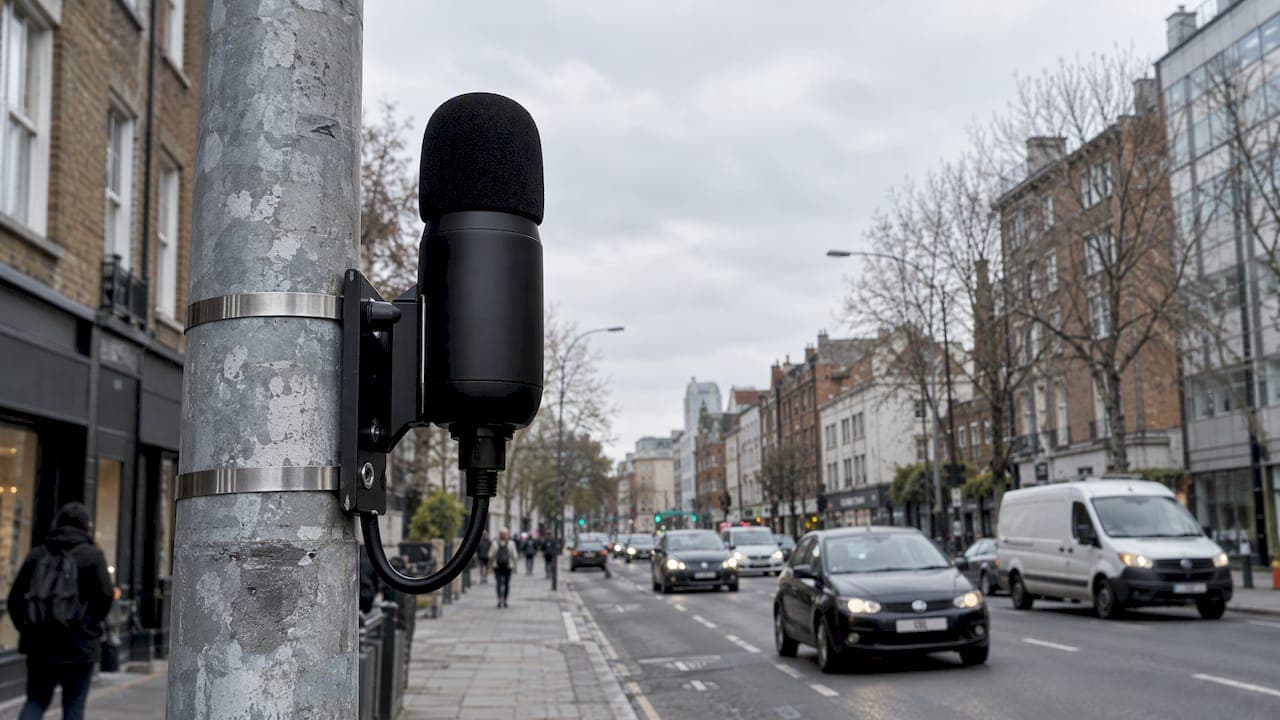
Smart city noise monitoring uses distributed acoustic sensors and edge analytics to produce real-time noise maps and source metadata that cities can act on, drawing on frameworks like WHO community noise guidance and Singapore's NEA technical guidance. The resulting data drives hotspot detection, source identification, and evidence for behavioral nudges or targeted enforcement, with our team at BeyondSensor supporting integration work for these systems.
TL;DR:
- Anchor compliance monitoring with IEC 61672 Type 1 stations, then fill coverage gaps with less precise wireless nodes and calibrate mobile sensors in the field.
- Process audio on each sensor and transmit sound levels, source labels, and location metadata only; this protects privacy and reduces bandwidth.
- A mobile sensor study reached calibration accuracy up to R² 0.960 when models included vehicle speed and training reflected real field conditions.
- Leuven’s pilot paired wireless sensors with lighting cues instead of fines and reported 30% less nighttime noise, especially before 1 a.m., without storing raw audio.
Table of Contents
- What a smart-city noise monitoring system looks like
- Sensor types and network architectures for full coverage
- How edge analytics turn raw sound into usable noise maps
- Planning a deployment: site selection through operations
- From data to decisions: nudges, enforcement, and planning
- Accuracy, privacy, and the standards worth building around
- Evidence from the field: pilots and datasets worth knowing
- What planners and integrators tend to underestimate
- How a solutions integrator speeds your rollout
- FAQ
- Sources
What a smart-city noise monitoring system looks like
A working system moves data through several stages: acoustic sensors capture sound, edge processors classify and quantify it on-site, gateways relay metadata over wireless networks, a cloud platform ingests and stores the stream, and dashboards or APIs expose it to whoever needs it. Each stage has a job, and skipping one usually means paying for it later in bandwidth costs or data you cannot trust.

The outputs that matter operationally include LAeq and LAF sound-level metrics, event counts, classified sound types (traffic, construction, voices, sirens), direction-of-arrival metadata, and geotagged time series that let you trace a spike back to a location and moment. Facility operators use these feeds to catch recurring disturbances before complaints pile up. Enforcement teams use timestamped events as evidence. Urban planners fold the same data into exposure maps that inform zoning and building design. Public-facing dashboards turn the raw numbers into something residents can actually check instead of just tolerate.
Sensor types and network architectures for full coverage
Coverage quality depends on mixing sensor types rather than betting on one. Stationary noise monitoring terminals (NMTs) provide continuous, high-fidelity measurement and frequency analysis, and where a reference-grade reading is required, they should meet IEC 61672 Type 1 accuracy. Low-cost wireless acoustic sensor network (WASN) nodes fill in the spatial gaps between those reference stations, trading some precision for density, and typically connect over LoRaWAN or 4G depending on how much power and bandwidth a site allows. Mobile nodes, mounted on vehicles, bikes, or carried as smartphones, extend coverage into areas where fixed infrastructure is impractical.
- Stationary NMTs: best for compliance-grade, continuous monitoring at known hotspots.
- WASN nodes: lower cost per unit, useful for dense grids across neighborhoods.
- Mobile nodes: highest spatial flexibility, but field and mobile calibration becomes essential since lab calibration alone tends to underestimate errors introduced by motion and changing environments.
A hybrid deployment, anchoring a few Type 1 reference stations and surrounding them with WASN and mobile coverage, avoids the common pitfall of static-only networks that miss everything happening between fixed points.
How edge analytics turn raw sound into usable noise maps
Processing at the sensor, rather than in the cloud, is what makes this approach both scalable and privacy-respecting. An end-to-end IoT system built at NTU demonstrated on-device sound classification, direction-of-arrival estimation, and sound pressure level computation, transmitting only metadata over MQTT and AMQP message queues rather than raw audio. That single design choice cuts bandwidth needs dramatically and removes the privacy liability of streaming continuous audio off-site.
- On-device classification tags the likely source (traffic, construction, voices) before anything leaves the sensor.
- Direction-of-arrival and SPL calculations happen locally, so the cloud receives structured metadata, not waveforms.
- Standardized data models like NGSI-LD let different vendors' sensors feed one dashboard without custom integration work.
Machine learning models trained for source identification still need calibration against real conditions. Research on mobile IoT noise nodes found that Random Forest Regression, with vehicle velocity included as a feature, reached calibration accuracy up to an R² of 0.960, a result that only held once field conditions, not lab conditions, were part of the training data. Noise maps gain more value when correlated with other feeds, traffic counters in particular, since a spike that lines up with vehicle counts tells a different story than one that does not.
Pro Tip: Pair every noise sensor site with a traffic counter where possible: correlated data turns a noise spike into an explainable event instead of a mystery.
Planning a deployment: site selection through operations
A repeatable rollout sequence keeps pilots from stalling before they reach scale. The Net4Cities monitoring and implementation roadmap lays out three phases that work for most municipal and campus deployments alike.
- Site and instrument selection: identify locations where a single source, often traffic, dominates, confirm power and connectivity options, and check mounting points against stakeholder priorities.
- Installation and commissioning: complete technical site visits, register each device on the platform, run initial calibration, and integrate the feed with existing dashboards or traffic systems.
- Operational phase: run System Integrity Checks (SIC) before treating readings as a true acoustic characterization of a site, monitor device health remotely, and schedule recalibration on a fixed cadence.
A realistic timeline includes a scoping workshop with local authorities early, a site survey and installation window, and a short commissioning period before full operational handoff to whoever owns day-to-day monitoring. Our guide to deploying smart sensors walks through a sensor rollout in more operational detail.
From data to decisions: nudges, enforcement, and planning
Live noise data only earns its budget line when it changes behavior or policy. The lowest-friction interventions are visual nudges rather than citations: street lighting that dims or brightens in response to noise levels, or terrace lamps that signal when a space is getting loud, give people immediate feedback without involving enforcement at all.
- Timestamped, geotagged events give enforcement teams defensible evidence for incident triage instead of relying on complaint logs alone.
- Exposure maps built from monitoring data inform where barriers, setbacks, or building orientation changes actually reduce noise, which matters because late-stage mitigation in dense urban areas has limited impact compared with addressing acoustic design early.
- Public dashboards let residents see the same data agencies see, which builds trust faster than a complaint hotline.
- Crowdsourced or voluntary noise reports can fill gaps between fixed sensor locations, especially in areas not yet covered by a formal network.
Accuracy, privacy, and the standards worth building around
Measurement accuracy starts with the instrument. A reference-grade deployment calls for integrating sound level meters meeting IEC 61672 Type 1 or an equivalent standard, and Singapore's NEA technical guideline for land traffic noise impact assessment outlines how baseline measurements and 3D modeling tools like SoundPLAN or CadnaA are used in formal assessments.
- Calibrate in the field, not just in the lab: mobile sensors in particular drift under real-world conditions that a lab bench never replicates.
- Process audio locally and transmit only metadata, never raw recordings, to keep the network privacy-respecting by design.
- Follow NEA's boundary noise limit guidance for mechanical ventilation and air-conditioning equipment when monitoring near non-industrial buildings.
- Rerun System Integrity Checks on a defined schedule rather than assuming a calibrated sensor stays calibrated indefinitely.
One documented result: mobile-node calibration using Random Forest Regression with velocity as an input feature reached an R² of up to 0.960, showing that field-based calibration approaches can closely match reference accuracy even on moving sensors.
Evidence from the field: pilots and datasets worth knowing
A FIWARE-based pilot in Leuven used wireless acoustic sensors paired with lighting-based nudges and reported a 30% reduction in nighttime noise, particularly before 1 a.m., without relying on fines. The sensors produced sound-level and classified-origin metadata without ever storing raw audio, which kept the approach privacy-respecting while still giving the city measurable results.
For teams building or training classification models, the SINGA:PURA dataset offers 6,547 strongly labeled recordings collected across 14 sensors in a WASN deployment between August and October 2020, supporting sound event tagging and localization work compatible with the SONYC-UST taxonomy. The Net4Cities roadmap referenced earlier remains the clearest published blueprint for pairing noise terminals with traffic counters and running integrity checks before treating a dataset as representative.

What planners and integrators tend to underestimate
Most noise monitoring pitches sell the sensors; few budget for what keeps them accurate. Field calibration, hybrid coverage, and ongoing maintenance are not optional add-ons, they are the difference between a dashboard people trust and one they quietly ignore. Keep interventions legible to nontechnical stakeholders, a city council member needs a map, not a spectrogram, and build privacy into the architecture from day one rather than retrofitting it after a public records request.
— Eumir
How a solutions integrator speeds your rollout
Moving from a noise monitoring pilot to a city-wide network involves calibration work, standards compliance, and coordination across agencies and vendors, the kind of work our Solution Integration team can support.

When a project needs multi-vendor sensor compatibility or regional validation before deployment, our Ecosystem Matchmaking service connects the right technology partners to your site requirements. If you are scoping a pilot or planning a scale-up, reach out through Solution Integration to start a project conversation.
FAQ
What is noise monitoring in a smart city?
Smart city noise monitoring uses networks of acoustic sensors, often combining fixed noise monitoring terminals with mobile or low-cost wireless nodes, to measure sound levels continuously and classify their likely sources. The data feeds real-time noise maps, dashboards, and alerts that support planning, enforcement, and public engagement.
How accurate are low-cost noise sensors compared to reference stations?
Reference-grade accuracy requires instruments meeting standards like IEC 61672 Type 1, while low-cost sensors trade some precision for density and coverage. With proper field calibration, mobile sensors can approach strong accuracy: one study using Random Forest Regression with velocity as an input reached a calibration R² of up to 0.960.
Does noise monitoring require recording and storing audio?
No, well-designed systems process sound on the sensor itself and transmit only metadata such as sound pressure levels and classification tags, not raw audio. The NTU end-to-end IoT system demonstrated this approach, preserving privacy while still enabling source identification.
What results have real-world noise monitoring pilots shown?
A pilot in Leuven using sensor-triggered behavioral nudges, like adjusted lighting rather than fines, reported a 30% reduction in nighttime noise, particularly before 1 a.m. The approach relied on classified metadata rather than punitive enforcement to change behavior.
How does noise monitoring integrate with broader smart city platforms?
Standardized data models and message protocols like MQTT, AMQP, and NGSI-LD let noise sensor feeds plug into existing smart city dashboards alongside traffic, lighting, and environmental data. Our environmental sensing guide covers how these integrations typically get scoped for broader deployments, and coordination strategies from resources like the Public Safety Consulting Group can help municipalities align noise data with wider public safety operations.
Sources
- Noise monitoring: Remarkably less nighttime noise in Leuven’s smart city – FIWARE
- Dr
- IoT-based Noise Monitoring using Mobile Nodes for Smart Cities
- Monitoring and Implementation Roadmap
Recommended
Read More Articles
Heat Stress Monitoring for Singapore Safety Managers: The 32°C Rule
Singapore safety managers can monitor heat stress with hourly WBGT readings, apply the 32°C rest rule, and vet wearable alerts before relying on them.
Installers, Find the Signal Peak in Photoelectric Beam Alignment
Align photoelectric beams with gunsights, lasers, and signal readouts. Read AQ, RX, and IR, then lock the optics and verify with a cover test.

Secure Technology Interoperability: Bridge IT and OT with Zero Trust
See how zero trust, ISA/IEC 62443, mutual TLS, and API controls secure technology interoperability, from data schemas to practical IT/OT deployments.

Regional Validation Testing: 5 Risk Areas for Singapore Software Teams
Plan regional validation testing with NASA and Tricentis, Singapore PDPC and IMDA checks, and BrowserStack or Tailscale to prepare pilots for audits.
Let's Build YourSecurity Ecosystem.
Whether you're a System Integrator, Solution Provider, or an End-User looking for trusted advisory, our team is ready to help you navigate the BeyondSensor landscape.
Direct Advisory
Connect with our regional experts for tailored solutioning.