
Discover key insights in our environmental sensing solution guide, helping industries meet compliance, enhance safety, and achieve sustainability goals.

Environmental Sensing Solutions: Complete 2026 Guide

Environmental sensing solutions are integrated systems combining sensors, networks, and software to collect, transmit, and analyze environmental data in real time. For professionals managing compliance obligations, operational safety, or sustainability targets, these systems are no longer optional infrastructure. A large proportion of industries have adopted monitoring solutions to reduce emissions, driven by tightening environmental regulations worldwide. The global environmental sensing and monitoring market is expected to grow significantly in the coming years.
What makes these solutions especially consequential is their scope. A well-designed system does more than log readings. It connects field sensors to cloud analytics, flags threshold breaches in real time, and feeds compliance reports automatically. Industries from manufacturing and agriculture to smart cities and critical infrastructure depend on this data layer to make decisions that would otherwise require costly manual inspection.
Key capabilities that define a mature environmental sensing solution:
- Real-time data acquisition across distributed sensor nodes
- IoT connectivity for continuous transmission to cloud or edge platforms
- Multi-parameter sensing covering air, water, soil, noise, and microclimate
- AI-assisted analytics for pattern recognition and predictive alerts
- Compliance reporting aligned with EPA, OSHA, and state-level regulatory frameworks
What types of environmental sensors should you know about?
Environmental sensors span a wide range of physical measurement principles, and choosing the wrong type for a given application wastes both budget and data quality. The primary categories break down by what they measure and the underlying detection technology.
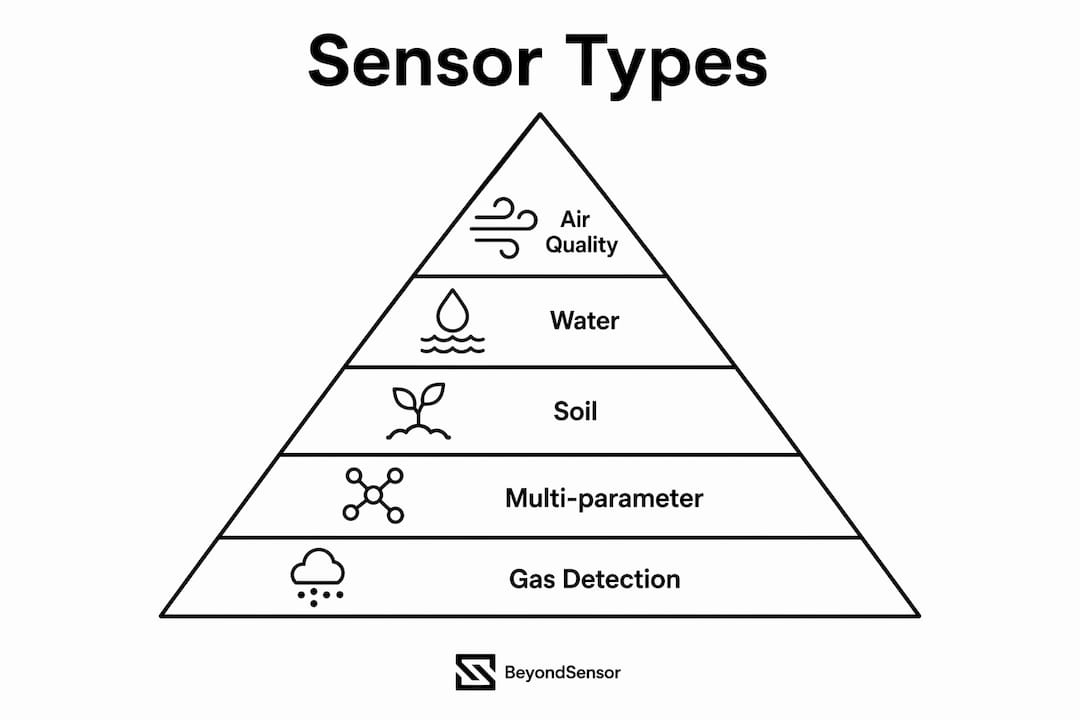
Air quality sensors detect particulate matter (PM2.5, PM10), carbon dioxide, nitrogen dioxide, sulfur dioxide, ozone, and volatile organic compounds. Most rely on electrochemical cells for gas detection or laser particle counters for particulates. Water quality sensors measure pH, dissolved oxygen, electrical conductivity, turbidity, and residual chlorine using optical or electrochemical probes. Soil sensors track moisture, temperature, electrical conductivity, and nutrient levels through capacitance probes or time-domain reflectometry. Noise sensors use calibrated microphones and digital signal processors to quantify sound pressure levels in decibels. Weather and microclimate sensors measure temperature, humidity, wind speed, wind direction, barometric pressure, and solar radiation, often packaged as multi-parameter weather stations.
| Sensor Type | Measured Parameters | Core Technology | Typical Application | Power Profile |
|---|---|---|---|---|
| Air quality | PM2.5, CO2, NO2, SO2, VOCs | Electrochemical, optical | Urban monitoring, industrial sites | Low to medium |
| Water quality | pH, DO, turbidity, conductivity | Optical, electrochemical | Wastewater, drinking water | Low |
| Soil | Moisture, temperature, EC | Capacitance, TDR | Agriculture, land remediation | Very low |
| Noise | Sound pressure level (dB) | Calibrated microphone | Urban planning, industrial zones | Low |
| Weather/microclimate | Temp, humidity, wind, pressure | Thermistor, anemometer | Field sites, smart cities | Low to medium |
| Gas detection | CO, CH4, H2S, NH3 | Electrochemical, catalytic | Industrial safety, confined spaces | Medium |
Fully automatic systems hold 58% market share of the environmental sensing market in 2026, indicating a clear industry preference for continuous over periodic monitoring. Automated, always-on sensing outperforms periodic manual sampling for any application where conditions change faster than a technician can visit.
Multi-parameter sensors deserve particular attention. A single unit measuring temperature, humidity, CO2, and particulates simultaneously reduces installation complexity and communication overhead. For decision-makers evaluating sensor selection, the governing question is always what environmental condition you need to understand, not which sensor looks most capable on a spec sheet.
Where do environmental sensing applications deliver the most value?
IoT sensor networks are deployed across air quality tracking, water contamination detection, soil condition monitoring, and disaster early warning, demonstrating how broadly these technologies apply. Each industry context shapes the sensor mix, data cadence, and compliance requirements differently.

Agriculture and precision farming rely on soil moisture, temperature, and electrical conductivity sensors to guide irrigation and fertilization decisions. Sensors buried at multiple depths across a field give farmers a real picture of root-zone conditions rather than a single surface reading. Combined with weather stations tracking evapotranspiration, these networks reduce water use while protecting yield.
Manufacturing and industrial facilities use gas detection arrays and air quality monitors to meet OSHA permissible exposure limits and EPA emission standards. A chemical plant monitoring hydrogen sulfide, ammonia, and volatile organics in real time can respond to a leak in minutes rather than hours. That response speed is the difference between a contained incident and a reportable release.
Smart cities and urban infrastructure deploy distributed air quality networks to track PM2.5 and NO2 hotspots across neighborhoods. City planners use this data to evaluate traffic management interventions, low-emission zones, and green infrastructure placement. Noise monitoring networks near airports and highways feed into zoning decisions and community health assessments.
Water utilities and environmental agencies monitor source water, treatment processes, and distribution networks continuously. Sensors measuring pH, turbidity, and residual chlorine at multiple points in a distribution system catch contamination events before they reach consumers.
Key industry advantages at a glance:
- Regulatory compliance: Continuous data logs satisfy EPA, state agency, and permit reporting requirements without manual sampling gaps
- Operational efficiency: Automated alerts replace scheduled inspections, freeing staff for higher-value tasks
- Public health protection: Real-time air and water quality data enables rapid community notification
- Sustainability tracking: Emissions and resource consumption data feeds ESG reporting and carbon accounting
- Disaster prevention: Flood sensors, fire detection arrays, and landslide monitors provide early warning that manual patrols cannot match
Which software platforms support environmental monitoring most effectively?
Hardware sensors generate data. Software turns that data into decisions. The platforms that matter most in 2026 fall into three functional categories: compliance and audit management, operational monitoring dashboards, and AI-powered analytics environments.

SafetyCulture (formerly iAuditor) handles inspection workflows, audit trails, and corrective action tracking. It works well for organizations that need to document environmental checks alongside safety and quality processes in a single platform. The mobile-first design suits field teams conducting site audits.
EHS Insight focuses on environmental, health, and safety program management. Its strength is connecting sensor data to regulatory compliance workflows, incident reporting, and permit tracking. Organizations managing multiple facilities across different regulatory jurisdictions find the centralized compliance calendar particularly useful.
ERA EH&S targets enterprise-scale environmental compliance, with modules covering air emissions, water discharge, waste management, and chemical inventory. The platform integrates with SCADA systems and process historians, making it a natural fit for manufacturers already running industrial control infrastructure.
EnviroData Solutions specializes in environmental data management for consulting firms and regulatory agencies. Its data validation, chain-of-custody tracking, and laboratory information management features address the rigorous documentation requirements of remediation projects and permit compliance.
Cleartrace focuses on energy and carbon tracking, connecting utility meter data and environmental sensor feeds to sustainability reporting frameworks including GHG Protocol and CDP. It suits organizations with aggressive net-zero commitments that need auditable emissions data.
Rotronic provides humidity and temperature monitoring solutions with a strong emphasis on pharmaceutical, food, and cleanroom applications where regulatory validation (FDA 21 CFR Part 11, EU GMP Annex 11) governs data integrity requirements.
Envirosuite delivers real-time environmental intelligence for airports, ports, mining operations, and industrial facilities. Its noise and air quality modeling capabilities translate raw sensor data into community impact assessments and regulatory reports.
Essential features to evaluate across any platform:
- Real-time data visualization with configurable dashboards
- Threshold-based alerting via SMS, email, or API webhook
- Multi-sensor data fusion and cross-parameter correlation
- Cloud integration with secure data storage and audit trails
- AI analytics for anomaly detection and predictive maintenance
- Compliance report generation aligned with EPA and state formats
- API connectivity for integration with existing ERP or SCADA systems
- Scalability to support expanding sensor networks without re-architecture
Compatibility between sensor hardware and software platform is a practical constraint that gets underestimated. A platform that cannot ingest data from your chosen sensor protocol (LoRaWAN, Modbus, MQTT) creates integration work that adds cost and delays deployment. Verify the data pipeline before committing to either hardware or software.
How do you choose and deploy an environmental sensing solution effectively?
The most common mistake in sensor network design is starting with a sensor catalog instead of a monitoring question. Professionals should define the monitoring objective first to optimize network design, communication protocol, and system complexity. That discipline prevents both over-sensing (deploying expensive multi-parameter units where a single-parameter sensor suffices) and under-sensing (missing critical zones because the design assumed uniform conditions).
Network protocol selection follows directly from the deployment environment. LPWAN protocols like LoRaWAN outperform cellular and Wi-Fi for slow-moving environmental data in remote or densely built environments, offering battery efficiency and superior signal penetration through walls and across open fields. A warehouse monitoring temperature and humidity across 50,000 square feet does not need broadband. It needs reliable, low-power telemetry that runs for years on a battery.
Multi-point monitoring is the standard for any space where conditions vary across zones. A single sensor placed at the center of a greenhouse gives you one reading. Sensors at canopy level, root zone, and near ventilation inlets give you a picture of how the environment actually behaves. Single-sensor setups routinely produce microclimate blind spots that distort readings and lead to poor decisions.
Pro Tip: Before selecting any sensor, write down the specific threshold that would trigger an operational response. That threshold determines the required measurement range, accuracy class, and sampling frequency, which in turn determines the appropriate sensor type and communication protocol.
Deployment best practices:
- Phase 1: Install a single representative monitoring point to validate sensor performance and data pipeline before scaling
- Phase 2: Expand to multi-zone coverage once the baseline system is proven
- Phase 3: Add sensor diversity (additional parameters) only where the data will drive a specific decision
- Calibration: Follow manufacturer schedules and document every calibration event with timestamp and technician ID
- Network stability: Unreliable network connectivity compromises data quality more often than sensor hardware failures; redundant gateway paths are worth the cost
- Data quality assurance: Implement automated range-check filters to flag readings outside physically plausible bounds before they enter the analytics layer
- System redundancy: Critical monitoring points should have backup sensors or manual verification protocols for periods of sensor downtime
For facilities integrating sensing into broader operational systems, Beyondsensor's sensing solution selection guide covers the decision framework in detail, including how to align sensor choices with security and compliance requirements.
What trends are shaping the future of environmental sensing?
The market's direction is clear: more automation, more intelligence, and more connectivity. IoT integration drives a significant portion of environmental sensing solutions, with many using cloud-based platforms for analytics. Those figures reflect a structural shift away from standalone data loggers toward networked systems that feed continuous intelligence to decision-makers.
AI and machine learning are moving from experimental to operational in environmental monitoring. Machine learning algorithms denoise sensor data, classify pollution events, and build predictive models that flag anomalies before they become incidents. A network that once required a technician to review weekly data exports now surfaces exceptions automatically.
Edge computing is closing the latency gap for time-sensitive applications. Processing data at the sensor node or local gateway, rather than routing everything to a central cloud, enables real-time responses for air quality alerts, flood warnings, and industrial gas detection without depending on network uptime.
Emerging technologies and market drivers to track:
- Multi-parameter sensor integration: Single units measuring five or more parameters simultaneously reduce deployment cost and data management complexity
- Standardized IoT protocols: Growing adoption of LoRaWAN, NB-IoT, and MQTT is reducing interoperability friction between hardware vendors and software platforms
- Smart city mandates: Municipal governments across the US are embedding environmental sensing requirements into infrastructure contracts and building codes
- Sustainability reporting pressure: SEC climate disclosure rules and voluntary ESG frameworks are creating demand for auditable, continuous environmental data
- Disaster monitoring expansion: Flood, wildfire, and landslide sensor networks are scaling rapidly as climate risk drives investment in early warning infrastructure
- Satellite and ground sensor fusion: Combining remote sensing data with ground-level IoT networks improves spatial coverage for large-area monitoring programs
The trajectory points toward interoperable, AI-native sensing networks where data from air, water, soil, and noise sensors feeds a unified environmental intelligence layer. Organizations that build their sensing infrastructure on open protocols and cloud-native software today will integrate these advances without replacing their existing investments.
Beyondsensor's perspective on intelligent environmental sensing
Beyondsensor approaches environmental sensing from a systems engineering standpoint, not a sensor catalog. The core principle is that a sensing network is only as useful as the decisions it enables. Hardware precision matters, but network architecture, data integrity, and software integration determine whether a deployment actually changes how an organization operates.
Key guidance from Beyondsensor's work with system integrators and facility operators:
- Start with the operational question. Define what condition would trigger a response before specifying any hardware. This prevents over-engineering and ensures every sensor in the network earns its place.
- Design for data integrity, not just data volume. A network generating unreliable readings at high frequency is worse than a smaller network with validated, trustworthy data.
- Treat network stability as a first-class requirement. Sensor hardware rarely causes data gaps. Communication failures do. Redundant gateways and offline buffering are standard practice in resilient deployments.
- Integrate security from the start. Environmental sensor networks transmit operational data that can reveal facility conditions, production schedules, and compliance status. Encrypted transmission and access controls are not optional additions.
- Plan for scale. A pilot deployment that proves the concept should use the same protocols and platform as the eventual full-scale network. Rebuilding the data pipeline at scale is expensive.
Beyondsensor's published guides on emerging sensing innovations reflect this systems-first philosophy, covering how sensor network design intersects with physical security, operational resilience, and regulatory compliance. For facility managers evaluating how environmental sensing fits into broader infrastructure programs, the smart facility integration framework provides a practical starting point.
Facilities management organizations integrating environmental sensing alongside operational safety programs, such as those working with facilities management services providers, benefit from aligning sensor network design with existing maintenance and compliance workflows from the outset.
How should you manage and analyze environmental sensor data?
Raw sensor data has no operational value until it is cleaned, contextualized, and connected to a decision workflow. Data management for environmental sensing networks involves four distinct layers: ingestion, validation, storage, and analysis.
Ingestion covers the pipeline from sensor to platform. MQTT and HTTP APIs handle most cloud-connected deployments. Edge gateways buffer data locally during connectivity interruptions, preventing gaps in the time series that would compromise compliance records.
Validation filters out physically implausible readings before they contaminate the dataset. Automated range checks, spike detection algorithms, and cross-sensor consistency checks catch sensor drift, fouling, and communication errors. This step is where machine learning methods add measurable value: denoising algorithms trained on historical data distinguish genuine environmental events from sensor artifacts with far greater accuracy than static threshold filters.
Storage architecture depends on retention requirements. Regulatory compliance often mandates multi-year data retention with audit trail integrity. Cloud object storage with immutable write policies satisfies most EPA and state agency requirements. Time-series databases like InfluxDB handle high-frequency sensor data more efficiently than relational databases.
Analysis translates stored data into operational intelligence. Dashboards surface real-time conditions. Statistical process control charts identify gradual sensor drift. Predictive models built on historical patterns flag conditions likely to breach thresholds before they do. For organizations with multiple facilities, cross-site benchmarking identifies which locations are performing outside the norm and why.
Data governance practices that matter in practice:
- Assign data ownership and access controls at the sensor and dataset level
- Document calibration records and maintenance events in the same system as the sensor data
- Establish data retention policies that meet the longest applicable regulatory requirement
- Test backup and recovery procedures before a data loss event, not after
What US regulatory standards govern environmental sensing compliance?
Environmental sensing in the United States operates within a layered regulatory framework. Federal agencies set baseline standards; state agencies often impose stricter requirements; and sector-specific regulations add additional obligations for industries like pharmaceuticals, food processing, and chemical manufacturing.
The Environmental Protection Agency (EPA) sets National Ambient Air Quality Standards (NAAQS) under the Clean Air Act, defining acceptable concentration limits for six criteria pollutants: particulate matter, ozone, carbon monoxide, nitrogen dioxide, sulfur dioxide, and lead. Facilities with Title V air permits must demonstrate continuous compliance, which increasingly means deploying continuous emissions monitoring systems (CEMS) rather than relying on periodic stack tests.
The Clean Water Act governs discharge monitoring through National Pollutant Discharge Elimination System (NPDES) permits. Permit holders must monitor effluent quality at defined frequencies, with results reported to EPA's electronic reporting system. Real-time water quality sensors at discharge points provide the data density that periodic grab sampling cannot.
OSHA sets permissible exposure limits (PELs) for workplace air contaminants under 29 CFR 1910.1000. Facilities handling hazardous chemicals must monitor worker exposure, and continuous area monitoring with gas detection sensors is the most defensible approach for demonstrating compliance.
State environmental agencies in California (CARB), Texas (TCEQ), New York (NYSDEC), and other major industrial states routinely exceed federal standards. California's Air Resources Board, for example, has adopted monitoring requirements for fence-line air quality at petroleum refineries that go well beyond federal NAAQS obligations.
Sector-specific standards include FDA 21 CFR Part 11 for pharmaceutical environmental monitoring data integrity, USDA requirements for food storage temperature monitoring, and NRC regulations for radiation monitoring at nuclear facilities. Each framework specifies not just what to measure but how data must be recorded, validated, and retained.
For organizations navigating compliance across multiple frameworks, real-time monitoring systems that generate continuous, timestamped, auditable records provide the strongest compliance posture. Periodic sampling creates gaps that regulators increasingly scrutinize.
Key Takeaways
Effective environmental sensing requires matching sensor technology, network protocol, and software platform to a clearly defined monitoring objective before any hardware is specified.
| Point | Details |
|---|---|
| Automation dominates the market | Fully automatic systems hold 58% market share in 2026, reflecting industry preference for continuous over periodic monitoring. |
| IoT connectivity is standard | Environmental sensing solutions typically feature IoT connectivity and utilize cloud platforms for analytics. |
| Start with the question, not the sensor | Defining the monitoring threshold before selecting hardware prevents over-engineering and ensures every sensor earns its place. |
| Network stability drives data quality | Unreliable connectivity causes more data gaps than sensor hardware failures; redundant gateways are a baseline requirement. |
| Regulatory compliance requires continuous data | EPA, OSHA, and state agencies increasingly expect continuous, auditable sensor records rather than periodic grab samples. |
Ready to build a more intelligent sensing network?

Beyondsensor works with system integrators and security agencies to design, deploy, and manage environmental sensing networks that deliver reliable data and defensible compliance records. Whether you are building a new monitoring infrastructure or integrating sensors into an existing facility management program, Beyondsensor's advanced sensing solutions for system integrators provide the technical foundation and deployment expertise to get it right the first time. Security agencies looking to extend situational awareness through environmental data can explore Beyondsensor's solutions for security agencies for purpose-built configurations aligned with physical security requirements.
Recommended
Read More Articles
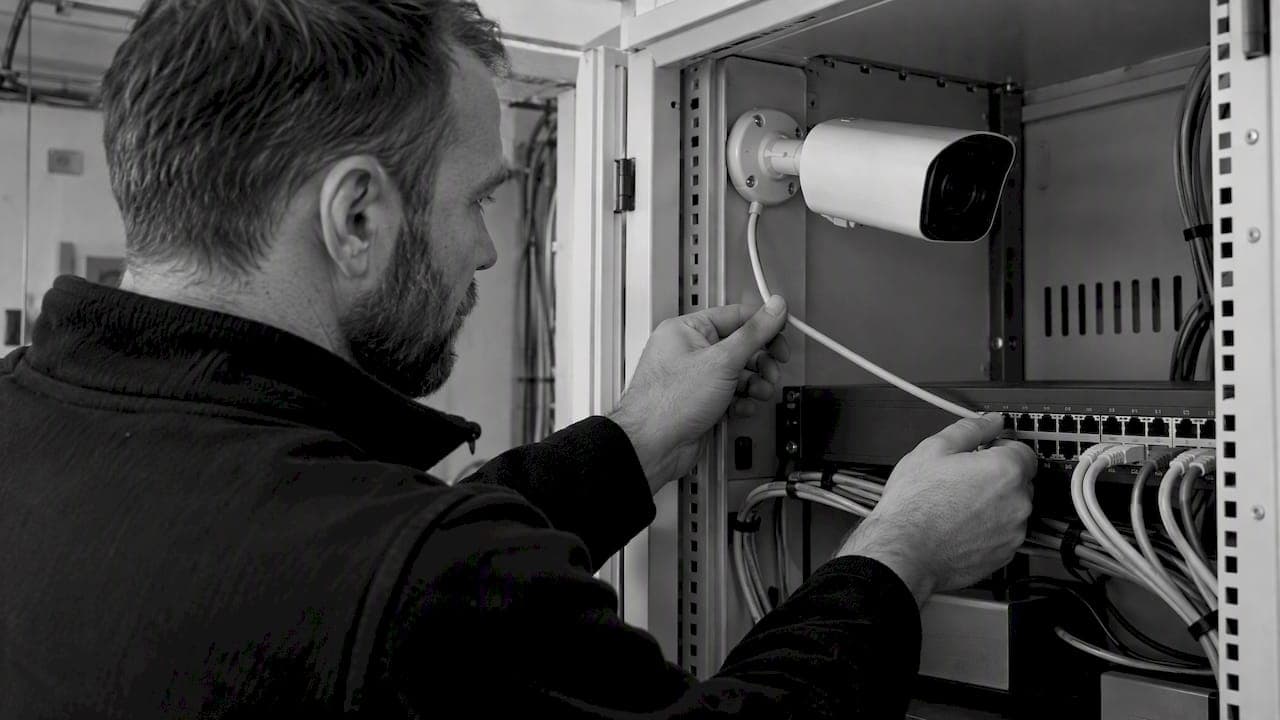
RTSP Security Risks: Integrators Must Block Exposed Ports 554 and 8554
See how integrators can reduce RTSP security risks: close exposed ports 554 and 8554, secure camera access, and verify each deployment with practical checks.

Require MAEpp and X Accuracy Before You Buy People Counting Systems
Verify people counting accuracy by demanding MAEpp, X Accuracy, and directional-bias reports. Validate on-site with at least 100 events per direction...
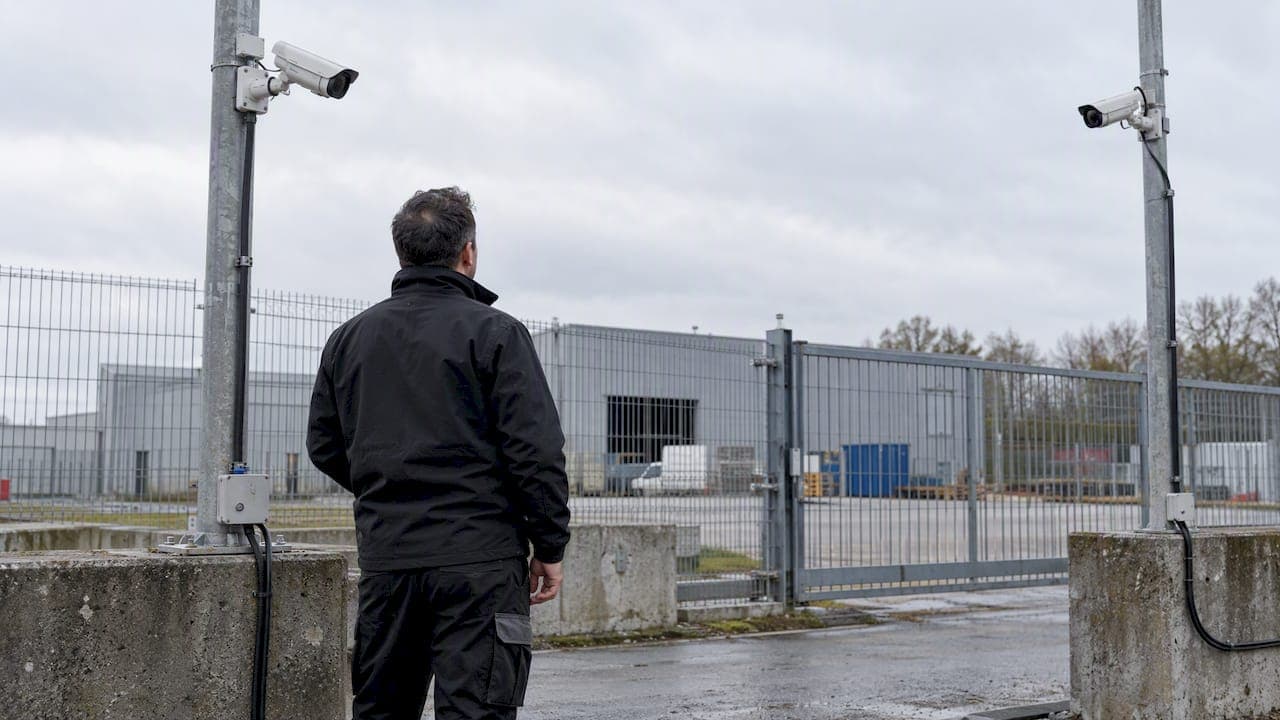
30–90 Day Pilot Validates Redundant Camera Networks for Engineers
Standards led, practical steps for engineers to deploy redundant camera networks: MRP, dual homing, and aggregation patterns, commissioning checks, and...

30 Day Pilot Proves Video Analytics Accuracy for Security Teams
Validate video analytics accuracy with scenario tests, camera tuning, transfer learning and a 30 day edge first pilot for security teams.
Let's Build YourSecurity Ecosystem.
Whether you're a System Integrator, Solution Provider, or an End-User looking for trusted advisory, our team is ready to help you navigate the BeyondSensor landscape.
Direct Advisory
Connect with our regional experts for tailored solutioning.