
Discover how to secure sensor networks with our 2026 IT guide. Learn essential strategies for deployment and protection against breaches.

How to Secure Sensor Networks: 2026 IT Guide

TL;DR:
- Sensor networks are now central to critical infrastructure, requiring robust security practices from architecture to ongoing monitoring. Implementing unique device identities via mutual TLS, segmentation with VLANs, and secure firmware updates is essential to prevent breaches and device compromise. Continuous logging, behavior analysis, and operational discipline ensure these systems remain resilient against evolving threats.
Sensor networks are no longer peripheral infrastructure. They sit at the operational core of industrial facilities, smart buildings, and critical environments where a breach can mean far more than stolen data. For IT professionals and network administrators, knowing how to secure sensor networks is a front-line responsibility that has grown harder as device counts scale and attack surfaces multiply. This guide covers the full stack: from pre-deployment architecture decisions through device authentication, encrypted communication, firmware integrity, and continuous monitoring. Every section reflects current 2026 best practices.
Table of Contents
- Key takeaways
- How to secure sensor networks: starting with architecture
- Device authentication and identity management
- Securing data communication and network architecture
- Firmware integrity, secure updates, and device hardening
- Monitoring, logging, and maintaining security posture
- My perspective on sensor network security
- Beyondsensor's secure sensor solutions for IT teams
- FAQ
Key takeaways
| Point | Details |
|---|---|
| Start with threat modeling | Classify devices and map communication flows before deploying any sensor to understand attack surfaces. |
| Use mutual TLS with unique certificates | Each sensor needs its own X.509 certificate to prevent impersonation and man-in-the-middle attacks. |
| Segment networks with VLANs | Isolate sensor traffic from corporate systems to limit lateral movement if a device is compromised. |
| Sign and verify all firmware | Never allow unsigned firmware updates. Rollback protection prevents downgrade attacks. |
| Monitor continuously | Log authentication events and behavioral anomalies. Integrate with a SIEM for centralized visibility. |
How to secure sensor networks: starting with architecture
Before writing a single firewall rule, you need a clear picture of what you are protecting. Sensor networks span a wide range of components: edge sensors, microcontrollers, gateways, communication brokers, cloud ingestion endpoints, and everything wired or wireless between them. Protocols vary widely, from MQTT and CoAP to OPC-UA and proprietary radio stacks. Each introduces distinct security characteristics and failure modes.
The IEC 62443 standard provides a defense-in-depth model specifically designed for industrial automation and control systems. It defines seven foundational requirements covering identification, authentication, use control, data confidentiality, restricted data flow, timely response, and resource availability. These seven requirements serve as a practical checklist for sensor network security planning, not just compliance paperwork.
Start with a full device inventory. Classify every sensor by function, communication protocol, physical location, and data sensitivity. This classification drives your segmentation strategy and authentication requirements. High-sensitivity environmental sensors feeding into safety systems demand stricter controls than, say, occupancy sensors in a lobby.
From that inventory, build a threat model. Consider these key questions:
- Who can physically access each sensor node?
- What happens if a sensor sends falsified data?
- Which protocols expose the network to unauthenticated connections?
- Where does sensor data transit before it reaches a trusted processing environment?
NIST SP 1800-36 provides a framework for automated, secure onboarding of IP-based IoT devices, emphasizing that device identity verification must happen before credentials are provisioned. This is a critical sequence. Organizations that skip identity verification at onboarding create gaps that are painful to close after deployment.
| Security principle | What it means for sensor networks |
|---|---|
| Device identity | Each sensor has a unique, verifiable credential before network access |
| Data confidentiality | Sensor telemetry is encrypted in transit and, where needed, at rest |
| Data integrity | Sensor readings cannot be modified in transit without detection |
| Availability | Security controls must not create bottlenecks that degrade sensor uptime |
Device authentication and identity management
Shared secrets and static passwords fail sensor networks for a structural reason. If one device is compromised, every device using the same credential is exposed. The gold standard for IoT authentication in 2026 is mutual TLS with unique X.509 certificates per device. During the TLS handshake, both the server and the sensor authenticate each other. An attacker cannot impersonate either party without possessing the private key, which never travels the wire.
Here is how to implement device authentication correctly:
- Issue unique X.509 certificates to every sensor at manufacturing or provisioning time. Avoid certificate templates that share private keys across devices.
- Use a private PKI for your sensor fleet rather than public certificate authorities. This gives you direct control over issuance, renewal, and revocation policies.
- Store private keys in secure elements or Hardware Security Modules (HSMs). Private keys inside secure elements never leave the chip. Cryptographic operations execute inside the secure enclave, preventing extraction attacks even if the device firmware is compromised.
- Automate certificate enrollment using protocols such as EST (Enrollment over Secure Transport) or SCEP. Manual certificate deployment at scale produces gaps, expired certs, and configuration drift.
- Implement certificate revocation with OCSP or CRL distribution. A sensor that is decommissioned or suspected of compromise must have its certificate revoked within hours, not weeks.
- Plan for certificate lifecycle differences in IoT. Certificate management for IoT devices differs fundamentally from server certificates. Sensors may have decade-long operational lifecycles with intermittent connectivity, making traditional renewal windows impractical. Short-lived certificates with automated renewal, or EST re-enrollment on reconnection, address this gap.
Pro Tip: If your sensor hardware supports it, enroll device certificates during the manufacturing stage through a factory provisioning process. This eliminates the manual-at-deployment provisioning step and ensures every device arrives on-site with a pre-issued, verifiable identity.
Identity management also forms the foundation of a zero-trust posture for sensor networks, enabling granular access policies and precise revocation without taking down entire network segments.
Securing data communication and network architecture
Authentication gets the device onto the network. Encryption and segmentation determine what damage a compromised device can do. These two controls, combined, define the blast radius of any incident.
For encrypting sensor telemetry in transit, TLS (for TCP-based protocols like MQTT over TLS) and DTLS (for UDP-based protocols like CoAP) are the standard mechanisms. Some constrained sensor hardware struggles with the computational overhead of full TLS 1.3. In those cases, DTLS 1.3 with lightweight cipher suites such as ChaCha20-Poly1305 offers a practical alternative that does not sacrifice forward secrecy.
VLAN segmentation and firewall rules are critical for isolating IoT devices and limiting lateral movement. The design principle is simple: sensor traffic should never have a direct path to corporate systems. Implement this with dedicated VLANs per sensor class, and enforce strict inter-VLAN firewall rules.
Key network hardening measures for sensor deployments include:
- VLAN isolation per sensor tier. Separate high-criticality sensors (safety, access control) from lower-risk environmental sensors.
- Firewall rules that default to deny. Only allow explicitly approved ports between the sensor VLAN and the processing backend.
- Access control lists on the MQTT broker. Restrict publish and subscribe permissions per device topic. A temperature sensor should never have write access to an access control topic.
- Block device-to-device communication within the sensor VLAN unless operationally required. Peer-to-peer traffic between sensors is a lateral movement vector.
- Log all traffic crossing VLAN boundaries. Anomalous inter-VLAN connections are often the first indicator of a compromised device.
Pro Tip: Run a regular review of your firewall rule sets, not just when incidents occur. Sensor networks grow organically, and permissive rules added during a deployment rush often persist long after they are needed. Quarterly rule audits catch this drift.
For industrial and environmental sensor operations, layered communication security is not optional. Regulatory and operational risk both demand it.
Firmware integrity, secure updates, and device hardening
A compromised firmware image can turn a trusted sensor into an insider threat. Firmware signing and rollback protection are the controls that prevent this. The process must be verifiable and automated, not reliant on manual checks.
Follow these steps for a defensible firmware security posture:
- Sign all firmware images with a private key held in an HSM under strict access control. The signing key must never exist on any build server in plaintext.
- Verify signatures on the device before installation. The sensor's bootloader or update agent should reject any image that fails cryptographic verification, regardless of its source.
- Implement rollback protection using a firmware version counter stored in write-once or monotonic memory. An attacker who intercepts a valid older firmware image should not be able to downgrade a device to a vulnerable state.
- Disable all debug interfaces (JTAG, UART, serial console) in production builds. These interfaces provide direct hardware access and are a common initial compromise vector.
- Rotate default credentials before any device connects to a production network. Default credentials on sensor gateways appear consistently in OWASP IoT Top 10 analysis as one of the most exploited vulnerabilities.
- Maintain a firmware version inventory. Know the exact firmware version running on every device. Unpatched devices in production create known, exploitable gaps that attackers enumerate with basic scanning.
Over-the-air (OTA) update channels are a supply chain risk of their own. Use an authenticated, encrypted update channel. Validate that update servers present valid certificates, and require device-side signature verification as a second layer. An attacker who controls the update channel controls every device that trusts it.
Monitoring, logging, and maintaining security posture
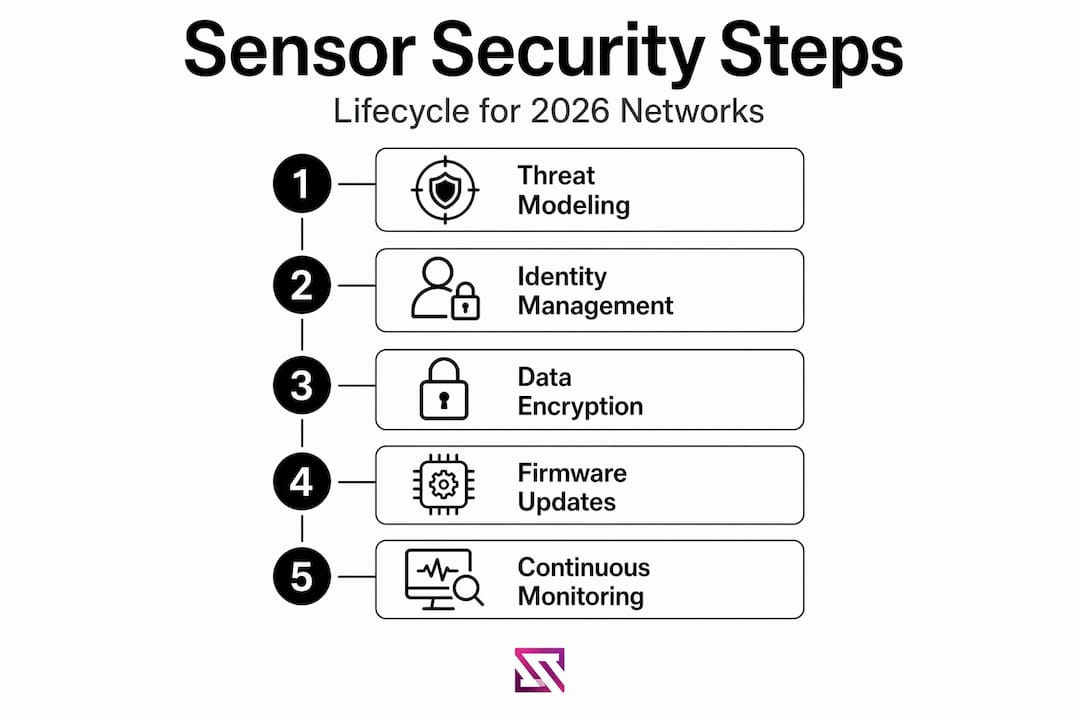
Deploying strong authentication and encryption is not the finish line. Sensor networks change: devices are added, configurations drift, and threats evolve. Continuous monitoring closes the gap between deployment-time security and runtime security.

SIEM integration and log aggregation provide the centralized visibility that distributed sensor deployments make otherwise impossible. Without aggregation, a pattern of failed authentication attempts spread across dozens of sensors looks like noise. Aggregated, it looks like a credential-stuffing attack.
Key monitoring and logging practices for sensor networks:
- Log every authentication event, both successful and failed, with timestamp, device identity, and source IP. Failed authentication spikes on a specific device often indicate a brute-force or replay attempt.
- Log all firmware update activities, including the source of the update, the version installed, and whether signature verification passed or failed.
- Implement behavioral anomaly detection. Establish a baseline for normal sensor communication patterns (frequency, payload size, destination) and alert on deviations. A temperature sensor that suddenly starts making DNS queries or opening connections to external IPs is a clear indicator of compromise.
- Review device certificate status regularly. Certificates approaching expiration without renewal flagged in your CMDB are a service availability risk. Certificates belonging to decommissioned devices that were not revoked are a security risk.
- Define incident response playbooks for sensor-specific scenarios: compromised device isolation, emergency firmware rollback, certificate revocation under incident conditions, and sensor replacement without service disruption.
A layered monitoring approach aligned with integrated physical security strategies gives security teams a coherent picture across both digital and physical domains.
Finally, apply data minimization at the edge: collect only the telemetry your operations actually need. Redact or hash sensitive attributes before they leave the sensor or gateway. Less data in motion means less exposure, and it directly reduces the value of intercepted traffic to an attacker.
My perspective on sensor network security
I have seen organizations build excellent perimeter security and then deploy dozens of sensors with shared credentials and no segmentation on the same corporate network. The perimeter becomes irrelevant. In my experience, the single biggest gap is not the absence of encryption. It is the absence of operationalized certificate lifecycle management.
Teams implement mutual TLS correctly at deployment and then discover, 14 months later, that half their sensor fleet has certificates that expired silently. The sensors kept running on cached sessions, and nobody noticed until a renewal failure took down a production feed. This is not a technical failure. It is a process failure. Automated renewal monitoring and expiry alerting need to be first-class operational requirements from day one.
Data minimization is another control that gets less attention than it deserves. Collecting full sensor telemetry payloads, including metadata that could identify individuals or reveal operational patterns, creates unnecessary exposure. Anonymizing or aggregating sensitive data before it leaves the edge is a simple architectural decision with a meaningful risk reduction outcome.
My take: treat sensor network security as an operational discipline, not a deployment checklist. The controls are only as good as the processes that maintain them.
— Eumir
Beyondsensor's secure sensor solutions for IT teams

Beyondsensor builds sensor security into the architecture, not as an afterthought. Their platform addresses the full lifecycle that this guide covers: secure device onboarding with verified identity, encrypted communication channels, and certificate lifecycle management integrated into operational workflows. For system integrators working across industrial automation, smart infrastructure, and physical security deployments, Beyondsensor provides the technical foundation to achieve compliance with IEC 62443 and regional regulatory requirements across Singapore, Malaysia, the Philippines, and beyond. Explore their BeyondSecure innovation for security-focused sensor integration that covers both hardware trust and data protection at scale.
FAQ
What is the best authentication method for sensor networks?
Mutual TLS with unique X.509 certificates per device is the current best practice. It prevents impersonation and man-in-the-middle attacks by requiring both the server and the sensor to authenticate during the TLS handshake.
How do you encrypt sensor data in transit?
Use TLS for TCP-based protocols such as MQTT, and DTLS for UDP-based protocols such as CoAP. For constrained devices, lightweight cipher suites like ChaCha20-Poly1305 provide strong encryption with reduced computational overhead.
Why is network segmentation critical for sensor security?
Segmentation with VLANs and strict firewall rules limits the blast radius of a compromised sensor. Without segmentation, a single breached device can reach corporate systems, other sensors, and control interfaces across the same flat network.
How often should firmware be updated on sensor devices?
Update firmware whenever a security patch is released by the vendor. Maintain a firmware version inventory and treat any unpatched device as a known risk until updated. All updates should pass cryptographic signature verification before installation.
What should be logged in a sensor network security program?
Log authentication events (successful and failed), firmware update activities, traffic crossing VLAN boundaries, and behavioral anomalies. Aggregate these logs in a SIEM for centralized analysis and alert on deviations from established baselines.
Recommended
- Top sensor security tips for safety & compliance 2026 | News | BeyondSensor
- Secure Sensing Explained: Defend Industrial & Environmental Ops | News | BeyondSensor
- How to Secure Facilities with Advanced Sensor Technology | News | BeyondSensor
- Security compliance in sensing systems: a step-by-step guide | News | BeyondSensor
Read More Articles
RTSP Security Risks: Integrators Must Block Exposed Ports 554 and 8554
See how integrators can reduce RTSP security risks: close exposed ports 554 and 8554, secure camera access, and verify each deployment with practical checks.

Require MAEpp and X Accuracy Before You Buy People Counting Systems
Verify people counting accuracy by demanding MAEpp, X Accuracy, and directional-bias reports. Validate on-site with at least 100 events per direction...

30–90 Day Pilot Validates Redundant Camera Networks for Engineers
Standards led, practical steps for engineers to deploy redundant camera networks: MRP, dual homing, and aggregation patterns, commissioning checks, and...

30 Day Pilot Proves Video Analytics Accuracy for Security Teams
Validate video analytics accuracy with scenario tests, camera tuning, transfer learning and a 30 day edge first pilot for security teams.
Let's Build YourSecurity Ecosystem.
Whether you're a System Integrator, Solution Provider, or an End-User looking for trusted advisory, our team is ready to help you navigate the BeyondSensor landscape.
Direct Advisory
Connect with our regional experts for tailored solutioning.