
A specifier's playbook for gunshot detection: procurement and commissioning checklists, 8 vendor questions, verification steps, and a 3–6 month pilot rule.

Buy Right: Gunshot Detection for Security Teams, 8 Questions
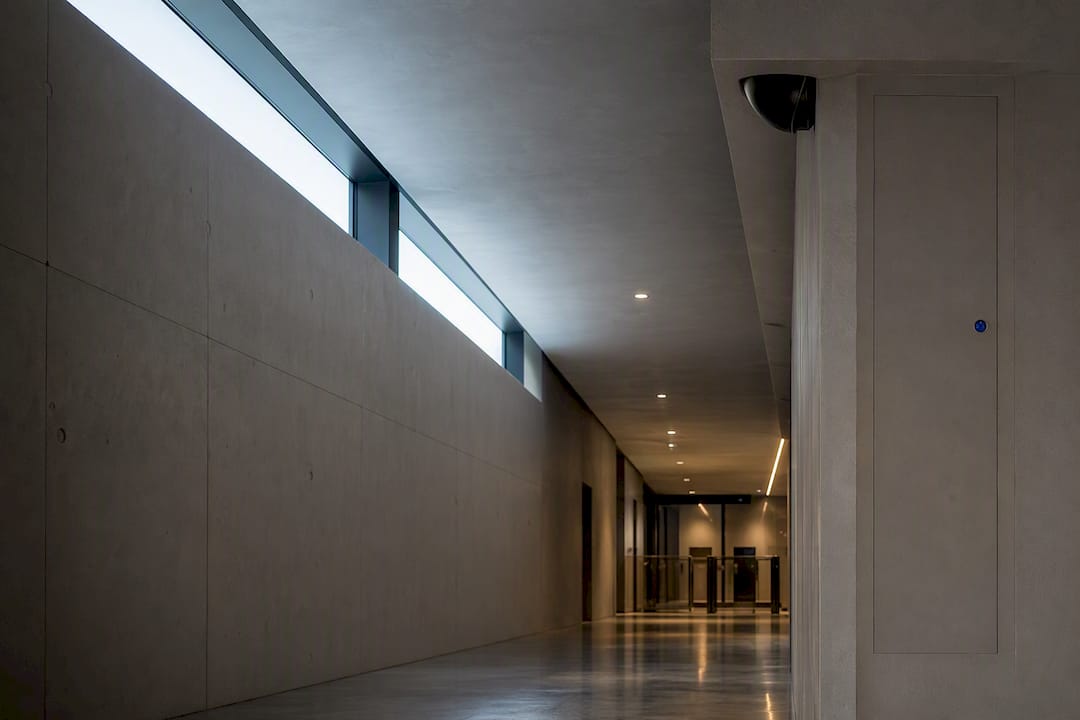
A gunshot detection system identifies the acoustic or optical signature of gunfire, then pinpoints its location so responders can move faster and with better information. The technology suits high-risk campuses, transit hubs, and dense facilities where seconds of warning matter; it does little for low-risk sites with no history of firearm incidents. This guide draws on testing from Pacific Northwest National Laboratory, federal deployment guidance, and Beyondsensor's own field experience.
TL;DR:
- Dense urban environments require high sensor density and multimodal detection (acoustic, optical, and vibration) for accurate gunfire localization.
- Typical field localization error is about 12 meters, which can worsen with weather, terrain, or complex building acoustics.
- Verification involves pre-installation surveys, simulated testing, and ongoing recalibration, with vendors advised to provide detailed validation data.
- Integration of AI, sensor fusion, and edge computing is progressing towards faster, more reliable alerts with reduced reliance on cloud processing.
- Legal and privacy considerations demand clear policies on data retention, evidence chain-of-custody, and ownership of audio recordings, especially for forensic use.
Table of Contents
- How Gunshot Detection Systems Work: Sensing Modalities And Localization Basics
- How Accurate Is Gunshot Detection, And What Limits Its Performance?
- What Does Verification And Commissioning Look Like?
- Eight Questions To Ask Before You Buy A Gunshot Detection System
- Turning Alerts Into Action: Policies, Training, And Response
- Beyondsensor's Field Perspective On Deployment
- From Battlefield Radar To Building Sensors: A Short History
- Which Standards And Certifications Actually Matter?
- Where Gunshot Detection Works Best: Urban, Rural, Indoor, Outdoor
- What Legal And Privacy Rules Apply To Gunshot Detection Data?
- Where Is Gunshot Detection Technology Headed Next?
- Pilot Or Deploy? A Practitioner's Rule Of Thumb
- How Beyondsensor Supports Gunshot Detection Deployments
- Sources
How Gunshot Detection Systems Work: Sensing Modalities And Localization Basics
Every gunshot detection system relies on one of three physical signatures. Acoustic sensors listen for the muzzle blast (the sharp report at the firearm) and the shockwave (the sonic disturbance the bullet itself creates as it travels). Optical or infrared sensors instead detect the flash at the muzzle, which reacts almost instantly but only works when the sensor has a clear line of sight to the shooter. Vibration and structural sensors pick up impact energy transmitted through walls or floors, a useful backup for indoor corridors and stairwells where sound reflects unpredictably.
Localization comes down to how many sensors hear the same event. A single acoustic unit can classify a sound as gunfire but usually cannot fix a precise location. Multiple sensors triangulate the source by comparing the tiny differences in arrival time across the array, which is why coverage density (how many units per acre or per floor) directly determines how tight the location estimate will be.
Processing happens at two levels:
- Edge processing analyzes audio on the sensor itself and sends only a classification result, which cuts latency and limits how much raw audio leaves the device.
- Cloud processing routes audio to a remote server for analysis, often with more frequent algorithm updates but added transmission delay and privacy exposure.
Practitioner guidance also cautions that acoustic-only systems struggle more in complex built environments, where sensor fusion with optical detection tends to reduce mislocalization.
How Accurate Is Gunshot Detection, And What Limits Its Performance?
Laboratory conditions and street conditions rarely match. PNNL's controlled testing found that advanced acoustic gunshot detection achieves 99.99% threat discrimination and 99.7% weapon classification accuracy in confined spaces, figures that represent a best case rather than a guaranteed outcome once a system sits in a real parking structure or open plaza.
In the field, practitioner guidance developed with the Office of Justice Programs puts typical spatial error at around 12 meters (about 41 feet) under good conditions. That margin can widen significantly once weather, terrain, or building density interfere with the sensor array.
Several conditions push error rates higher on either side of the ledger:
- Wind and precipitation distort sound propagation and can delay or dampen the acoustic signature sensors depend on.
- Urban echo and reverberation off building facades create multipath reflections that confuse triangulation, a known weakness in dense city blocks.
- Simultaneous shooters or rapid, overlapping fire can register as a single event or get miscounted entirely.
- Suppressed weapons reduce the muzzle blast's acoustic signature, sometimes below a sensor's detection threshold.
Indoor environments behave differently from outdoor ones. Reflective surfaces amplify reverberation, which is why vibration sensors and denser acoustic grids typically outperform a sparse outdoor-style layout inside a building. Before signing a contract, ask any vendor for sample detection clips, receiver operating characteristic (ROC) curve data, and field test results from a site with comparable acoustics to yours, not just a lab demo.
What Does Verification And Commissioning Look Like?
A system that passes a factory test can still fail on-site if it was never validated against the building's actual acoustics. Commissioning closes that gap.
- Run a pre-installation survey. Map sightlines, ambient noise sources, and structural obstructions before setting sensor grid spacing, since spacing decisions made from a floor plan alone routinely underestimate real-world interference.
- Conduct simulated gunfire testing. Vendors should fire blanks or use calibrated acoustic playback at multiple points across the coverage area and log detection accuracy and localization error against agreed acceptance criteria.
- Demand full documentation. Require a written commissioning report covering sensor placement, test results, and signed acceptance from both parties, a standard NPSA technical guidance treats as a baseline expectation rather than an optional extra.
- Schedule recalibration. Build in periodic recalibration and tamper detection checks, since sensor drift and physical tampering both degrade accuracy over time.
Pro Tip: Write built-in self-test features, guaranteed troubleshooting response times, and a fixed number of annual on-site calibration visits directly into the contract. Verbal promises about "ongoing support" tend to evaporate once the invoice is paid.
Eight Questions To Ask Before You Buy A Gunshot Detection System
Security Business's practitioner checklist distills procurement down to the questions that separate a workable deployment from an expensive disappointment. Ask vendors to answer each question in writing.
On architecture and performance:
- Does detection happen at the edge or in the cloud, and what is the average detection-to-alert time?
- Is the system built on single-sensor intelligent units or a mesh array, and what coverage density does that require per acre or per floor?
- What accuracy and localization data can you show from a site with similar acoustics to mine, not just a lab environment?
On integration and cost:
- Which computer-aided dispatch (CAD), video management system (VMS), access control, and mass notification platforms does the system already integrate with, and is there a documented API?
- What does full ownership actually cost over three to five years, once recalibration, incident review services, and data storage fees are added? Recurring costs like these can exceed the original hardware price over that window, a detail few sales presentations lead with.
- Who owns the raw audio the sensors capture, and what chain-of-custody procedures preserve it as usable evidence?
- What does vendor-provided verification look like: automated only, or with human analyst review before an alert reaches dispatch?
- What service-level agreement governs false-alert response and ongoing tuning?
Pairing the system with an integration strategy for security sensors before you shortlist vendors makes it far easier to compare answers apples to apples.
Turning Alerts Into Action: Policies, Training, And Response
A gunshot detection system that generates alerts nobody knows how to act on is a costly notification tool, not a security asset. Folding alerts into emergency operations plans (EOPs) starts with dispatch prioritization: most agencies that see real benefit route gunshot alerts directly into CAD as the highest-priority call type, ahead of routine calls, rather than queuing them behind whatever came in first.
Training has to reach three groups, not just one:
- Control-room staff need repeated drills on distinguishing confirmed alerts from low-confidence ones and on the escalation path for each.
- Dispatchers need scripted protocols for relaying location data and weapon classification to responding units in seconds, not minutes.
- Field officers need briefings on what the system's location estimate actually means, including its typical margin of error, so they don't treat a 12-meter estimate as a street address.
Investigations depend on linking the audio clip to the right VMS footage and CAD entry quickly, before the trail goes cold. A practical guide to sensor deployment can help teams map that data flow before an incident happens rather than during one. Written policy should also spell out data retention limits and public-facing language about what the system does and doesn't record, since vague policies tend to fuel community pushback that quietly discourages the manual reporting the system is supposed to complement, not replace, according to guidance from the ASU Center for Problem-Oriented Policing.
Beyondsensor's Field Perspective On Deployment
Sensor-based physical security deployments often span industrial sites, smart infrastructure, and government facilities, with regional teams based in Southeast Asia and offices opening in multiple countries. That regional footprint shapes how we think about gunshot detection specifically: acoustic behavior in a covered parking structure in one climate zone rarely matches a rural warehouse yard in another, so we push clients toward site-specific validation rather than trusting a spec sheet written for a different environment.
Deployment patterns we recommend consistently include:
- Layering acoustic sensors with existing video analytics dashboards so an alert arrives with corroborating footage attached, not as an isolated data point.
- Treating unified security operation dashboards as the single point where alerts, VMS, and access control status converge, rather than forcing operators to check three separate screens.
- Building tamper detection and recalibration checks into the same maintenance cycle as other sensor hardware, instead of treating gunshot detection as a separate system on its own schedule.
. During procurement, ask any provider, including us, for proprietary field-validation data, incident-review logs from comparable environments, and a documented false-alert rate before committing to a full rollout.
From Battlefield Radar To Building Sensors: A Short History
Modern gunshot detection traces back to military sniper-detection systems developed for battlefield use in the 1990s, which used acoustic arrays to locate hostile fire and warn troops. Civilian adaptation began in the early 2000s, when U.S. cities piloted fixed acoustic sensor networks on utility poles to flag gunfire in high-crime neighborhoods and route data straight to police dispatch.
Early systems suffered from high false-positive rates, since basic algorithms struggled to tell fireworks, car backfires, and construction noise apart from actual gunfire. That reputation problem shaped a decade of skepticism among police departments and elected officials, and it's part of why current vendors lean so heavily on published accuracy figures to rebuild trust.
The 2010s brought two real shifts. First, machine learning classification models replaced simpler waveform matching, cutting false positives meaningfully by learning the difference between an acoustic transient and true gunfire. Second, sensor miniaturization and cheaper hardware made denser, building-level deployments financially realistic, not just city-wide utility-pole networks.
Today's systems increasingly combine acoustic detection with optical and vibration sensing, reflecting a broader industry move toward sensor fusion instead of single-modality reliance. Federal guidance has followed that evolution: agencies including the Department of Homeland Security now list gunshot detection among authorized equipment categories for grant-funded security projects, a formal recognition that took roughly two decades of field deployment to earn.
Which Standards And Certifications Actually Matter?
No single certification body governs gunshot detection the way UL governs fire alarms, which makes vendor claims harder to independently verify. That gap is exactly why buyers need to lean on the technical guidance that does exist rather than a vendor's own marketing claims.
The NPSA's technical guidance is the closest thing to an independent specification framework available, covering verification method taxonomy, user-interface expectations, and environmental testing requirements. It doesn't certify products, but it gives buyers a checklist to hold vendors against.
In the United States, the DHS authorized equipment list functions less as a technical certification and more as a procurement gate: a system needs to appear on that list for many agencies to use federal grant funding on it. That's a financial and administrative standard, not a proof of field accuracy.
Beyond those two references, most performance claims come from vendor-commissioned or lab testing like PNNL's, which is genuinely rigorous but conducted under controlled conditions the vendor selects. There's no equivalent to a fire-suppression system's third-party burn test that every gunshot detection product must pass before sale. Given that gap, the practical standard security teams should hold vendors to is documented, repeatable field commissioning data from a site with comparable acoustics, not a certification logo.
Where Gunshot Detection Works Best: Urban, Rural, Indoor, Outdoor
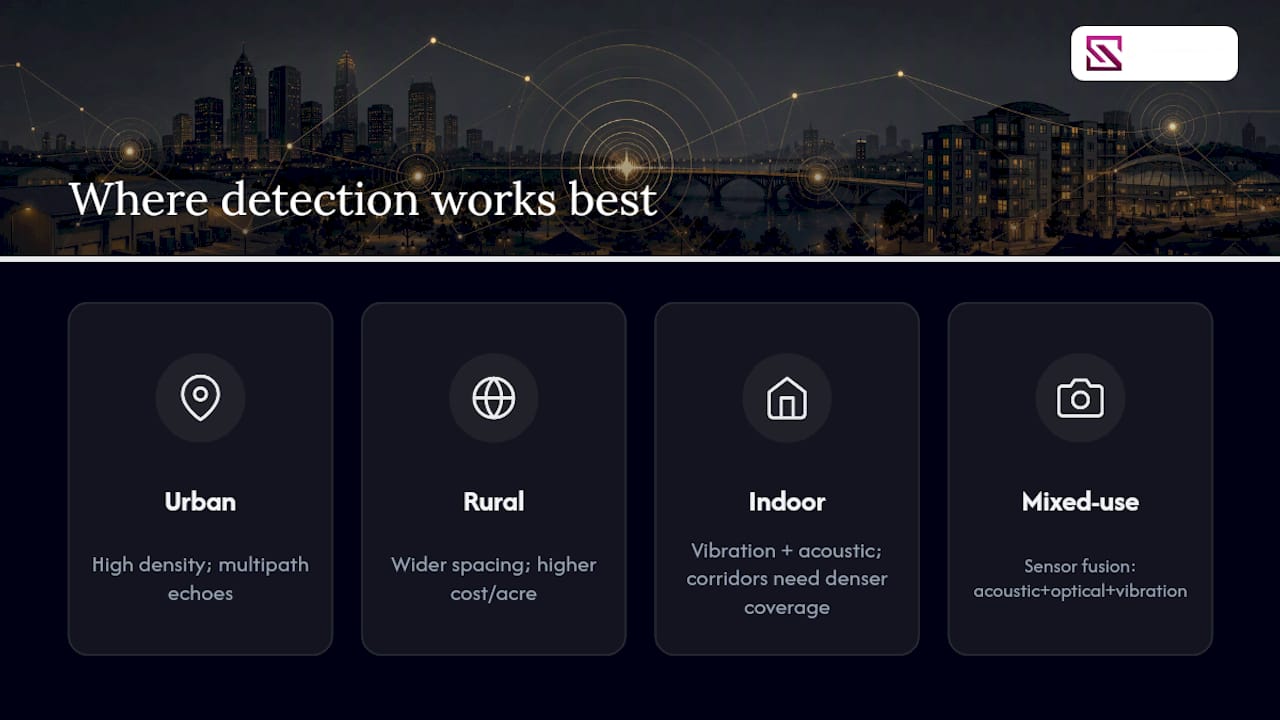
Environment changes what "good performance" even looks like. Dense urban deployments benefit from higher sensor density because building facades create echo and multipath interference that a sparse array can't resolve; ASU's practitioner guidance frames gunshot detection as one layer of a broader situational awareness strategy specifically because urban acoustic conditions are unpredictable enough that no single sensing method covers every case.
Rural and open-perimeter sites face the opposite problem: fewer obstructions mean cleaner acoustic signatures, but the same open terrain that helps localization also means sensors need to be spaced farther apart to cover the same acreage, which raises per-square-foot hardware costs even though accuracy per sensor tends to improve.
Indoor deployments (schools, hospitals, office towers, and industrial facilities) depend more heavily on vibration and structural sensing layered with acoustic detection, since hard interior surfaces reflect sound in ways open-air systems were never tuned for. Corridors and stairwells in particular need denser coverage than open floor plans, because sound behaves differently in a narrow, hard-walled space than in a warehouse bay.
Mixed-use campuses (a hospital with an attached parking garage, or a school with an outdoor athletic field) are the hardest environments to spec correctly, because a single sensor type rarely performs consistently across both zones. That's usually where sensor fusion, acoustic plus optical plus vibration, earns its added cost, since no single modality handles the transition between open outdoor space and enclosed structure well on its own.
What Legal And Privacy Rules Apply To Gunshot Detection Data?
Gunshot detection systems capture continuous ambient audio, which raises real privacy questions distinct from video surveillance. Unlike a camera pointed at a fixed area, acoustic sensors can pick up conversations near the sensor before an algorithm determines the sound isn't gunfire, which is why data retention and audio-handling policy deserve as much attention as the hardware spec.
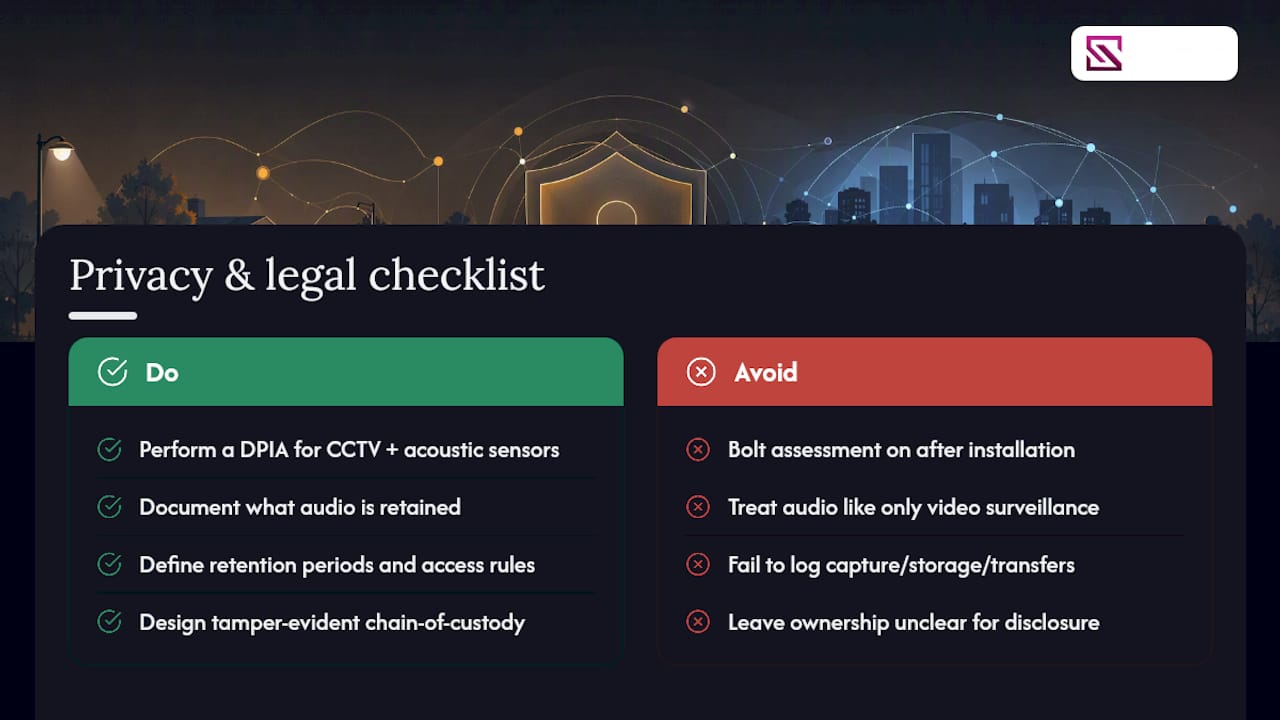
Facilities considering deployment alongside existing camera networks should treat a data protection impact assessment for CCTV and acoustic sensors as a standard part of the planning process, not an afterthought bolted on after installation. That assessment should document what audio gets retained, for how long, who can access it, and under what circumstances raw clips get shared outside the organization, questions that matter as much for a private facility as for a government deployment.
Chain-of-custody matters just as much once an alert becomes evidence. If a gunshot detection clip is going to support a criminal investigation or civil case, the system needs documented, tamper-evident logging showing exactly how that audio was captured, stored, and transferred, mirroring the standards forensic teams already apply to digital evidence. Firms specializing in forensic data analysis for investigations can help facility security teams design that evidentiary chain before it's ever tested in an actual case.
Because acoustic sensors sit in a legal gray area between surveillance and detection, buyers should also confirm who technically owns the raw audio: the facility, the vendor, or a third-party monitoring service, since that ownership determines who controls disclosure if law enforcement requests access.
Where Is Gunshot Detection Technology Headed Next?
Artificial intelligence is doing more than classifying gunfire faster. Newer models increasingly incorporate contextual signals, crowd movement captured on adjacent cameras, unusual foot traffic patterns, even door-forced-open events, to cross-validate an acoustic alert before it reaches a dispatcher, cutting the lag between detection and confident verification.
Sensor fusion is moving from a premium feature to a baseline expectation. Combining acoustic, optical, and vibration data isn't new in concept, but tighter integration between those data streams inside a single processing pipeline, rather than three separate systems reporting to one dashboard, is where vendor development is concentrated now.
Edge computing is also getting more capable, letting more classification work happen on the sensor itself rather than in the cloud. That trend cuts both latency and the volume of raw audio transmitted off-site, which directly addresses the privacy concerns tied to continuous acoustic monitoring.
Expect deeper integration with unified security operation dashboards as the next real shift, less about detection accuracy and more about how fast a verified alert becomes an actionable dispatch instruction across camera, access control, and mass notification systems simultaneously. The technology's next competitive edge won't be measured in decimal points of accuracy. It'll be measured in how many separate systems an alert has to pass through before a human actually sees it.
Pilot Or Deploy? A Practitioner's Rule Of Thumb
Pilot first when a site has no documented history of gunfire incidents or when budget requires proving value before a full rollout. Scope the pilot to a defined zone, a fixed duration of three to six months, and a clear measurement plan.
Move straight to full deployment when a facility already has an incident history, high foot traffic, or forensic requirements that justify the cost of complete coverage and long-term maintenance.
Judge either path against three KPIs drawn from the Urban Institute's evaluation work: improvement in response time, the verification rate of alerts against confirmed incidents, and the number of usable investigation leads generated per alert.
— Eumir
How Beyondsensor Supports Gunshot Detection Deployments
Beyondsensor builds the hardware and software layer that makes a gunshot detection deployment actually operational, not just installed. That means sensor hardware built for the acoustic and vibration modalities this guide covers, analytics that feed alerts into a unified security operation dashboard, and integration services that connect detection data to your existing VMS and access control systems instead of leaving it stranded in its own silo.

Where a standalone acoustic sensor vendor stops at the hardware sale, Beyondsensor's integration work is built to carry the alert all the way to a dispatcher's screen, closing the gap between detection and response that this guide has walked through section by section. If you're weighing a pilot deployment or need technical data to compare against another vendor's proposal, start by reviewing the available sensing tools or reach out through the end-user solutions page to request a technical consultation.
Sources
- Acoustic gunshot detection detects weapon being fired — PNNL
- Gunshot detection: Reducing gunfire through acoustic technology — Office of Justice Programs
- Gunshot Detection Systems — NPSA
Recommended
Read More Articles
Cut False Alarms with Edge AI Thermal Analytics for Security Teams
Procurement-minded guidance for security teams and facility managers on deploying edge-based thermal analytics: reduce false alarms, verify geospatial...
Remote Site Monitoring: 72 Hour Buffering, Procurement Checks, and ROI
Operator focused technical guide to remote site monitoring. Specify sensors and gateways, sequence pilots, avoid vendor lock-in, and prove ROI.
3–6 Month Pilot: PSIM Driven SOC Setup for Integrators
Integration-first playbook for integrators and facilities teams: inventory devices, write open-API RFPs, run a 3–6 month pilot, measure KPIs, and cut...
Open Standards, Edge Resilient Access Control: 5 Steps for Integrators
Five practical steps for security integrators to build open standards, edge resilient access control systems and avoid costly rework.
Let's Build YourSecurity Ecosystem.
Whether you're a System Integrator, Solution Provider, or an End-User looking for trusted advisory, our team is ready to help you navigate the BeyondSensor landscape.
Direct Advisory
Connect with our regional experts for tailored solutioning.