
How smart lamppost and streetlight monitoring works in Singapore: sensors, fault alerts, data governance, deployment checks and measured results from LTA and GovTech.
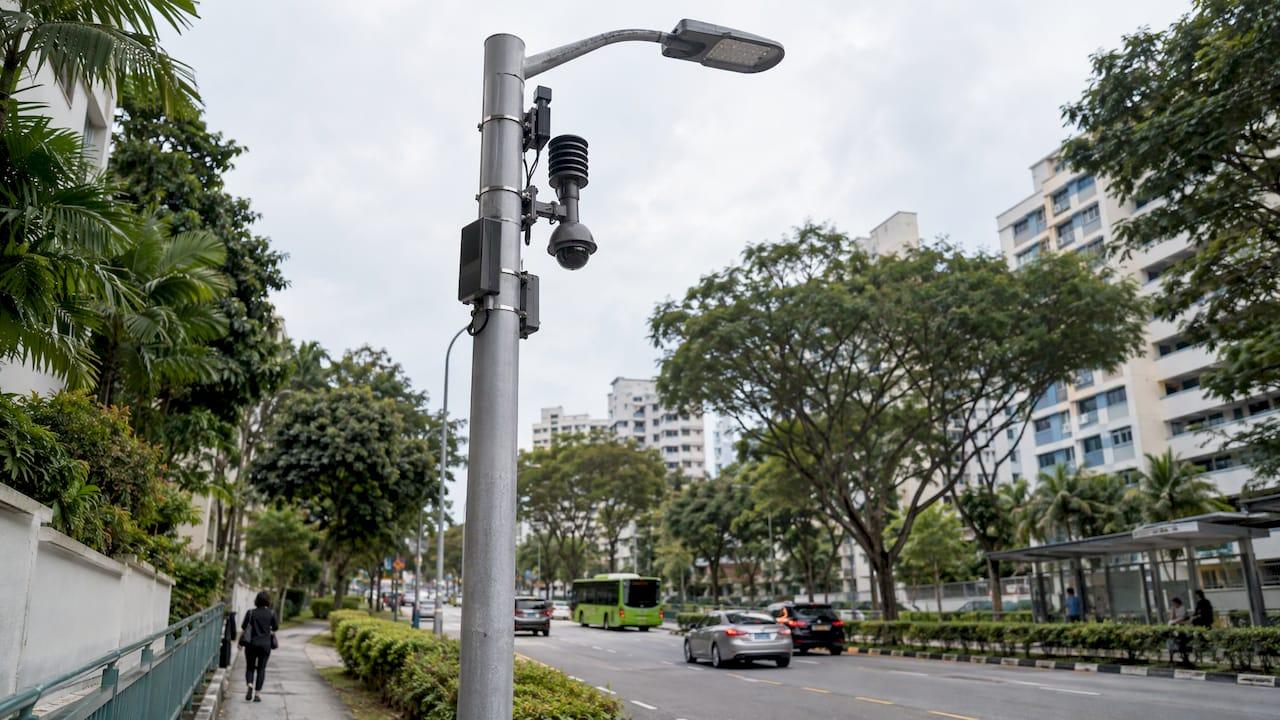
Smart Lamppost Monitoring in Singapore: How It Works

Smart lamppost monitoring turns an ordinary streetlight into a networked point of sensing and control. A controller on the pole reports lamp status to a central platform. Optional sensors add video, environmental and location data. In Singapore, this runs on two tracks: LTA's Remote Control and Monitoring System (RCMS) for the lights themselves, and GovTech's Lamppost-as-a-Platform (LaaP) for shared sensors. This guide explains how both work, what they have delivered and what facility owners and integrators should plan for before they deploy.
TL;DR
- A streetlight monitoring system pairs a pole-level controller, a network link and a management platform. It switches lights remotely and raises alerts on faults.
- LTA reports that RCMS street lamps use 8.75 million kWh less energy a year than before, and that nightly patrols to find faulty lamps are no longer needed.
- Smart lampposts can also carry video, environmental and geolocation sensors. Their data is governed by statute and technical controls such as encryption and access limits.
- Plan for power windows, bandwidth, shared mounting and certification before you choose sensors.
- Exception-based monitoring on a unified dashboard keeps operators focused on events instead of screens.
Table of Contents
- What smart lamppost monitoring actually is
- How a streetlight monitoring system works
- What sensors a smart lamppost can carry
- What Singapore's results show
- Privacy and data governance
- Deployment checks before you mount anything
- From alerts to action: the operations layer
- Our perspective
- Bringing it to your site
- FAQ
- Sources
What smart lamppost monitoring actually is
There are two layers, and readers often mix them up.
The first is lighting control and fault monitoring. The ITU describes smart street light services as a response to the high energy use and maintenance cost of conventional lights. ITU-T Y.4458 points to fine-grained, automatic remote management, energy-saving control, and automatic fault detection and alarms as the answer.
The second is sensing on the pole. In Singapore's LaaP, lampposts are fitted with static video, environmental and geolocation sensors that collect localised data for analytics and smart-city services.
The two layers can share the same pole, power and backhaul. They serve different owners, though. A lighting authority cares about uptime and energy. A security or operations team cares about events and evidence.
How a streetlight monitoring system works
ITU-T Y.4458 gives a clean reference model. It has four parts, according to the ITU recommendation:
- An SSL controller at the pole, which connects to the platform and executes control commands.
- An IoT network, which can be cellular, short-range or wired.
- An SSL platform, which monitors and manages the lights and provides services.
- A web or app client for administrators.
Singapore's RCMS follows the same logic. LTA explains that its control nodes are the "brains" of the system. They are programmed with calendars to switch lights on and off according to sunrise and sunset times, using meteorological data. Each node also collects the lamp temperature and uses a light sensor to read how bright its surroundings are.
This replaced a simpler arrangement. LTA said it was introducing the system so that lights could respond to inclement weather. They are switched remotely based on actual street-lighting needs, instead of timer-based seasonal programming.
What sensors a smart lamppost can carry
GovTech's LaaP shows the range of what a pole can host. Its sensors can provide video footage, still images and environmental readings. The uses that GovTech describes include:
| Sensor type | What it collects | How the data is used |
|---|---|---|
| Video | Footage and still images | Analytics that estimate crowds and waiting times at bus stops and pedestrian crossings |
| Environmental | Readings of local conditions | Localised data for analytics and urban-planning decisions |
| Geolocation | Vehicle location and speed | Traffic flow and safety support |
The common thread is localised data. A single central weather station cannot tell you what is happening at one junction. A pole-level sensor can. For a broader view of how sensors support infrastructure, see our guide to the role of sensors in infrastructure.
What Singapore's results show
The strongest published evidence comes from the lighting side. LTA reports that RCMS street lamps use 8.75 million kWh less energy yearly than before. It expected a full rollout to commuter facilities by mid-2025 to save about 0.124 million kWh a year.
Maintenance changed too. According to the same LTA account:
- The system detects faults and alerts maintenance staff, who are typically deployed for repairs on the same day.
- Public feedback on maintenance issues fell by 80%.
- Nightly patrols to find faulty lamps are no longer needed, saving about 4,200 man-hours every year.
LTA itself calls RCMS a "secret weapon" for outage alerts, since it looks after all of Singapore's street lights through a large team that responds to outages.
The lesson for any site operator is practical. Fault detection that replaces manual checks cuts labor and shortens the time a defect stays unnoticed. The same principle applies to a campus, an industrial estate or a logistics park. If a person must walk the perimeter to find out what is wrong, a sensor and an alert can usually do the first pass.
Privacy and data governance
Once a pole carries a camera, the lighting project becomes a data project. Singapore's public statements show how that is handled.
In a parliamentary reply on the Sensor Platform cameras, the Government said protections include access controls, encryption and identity hashing to prevent re-identification. Access is limited to public officers with specific operational needs. It also said the Public Sector (Governance) Act (PSGA) clarifies permitted inter-agency data sharing and agency responsibility, and criminalises misuse.
A later ministerial reply adds detail. LaaP data sharing across public agencies is governed by the PSGA and the Government Instruction Manual on Infocomm Technology and Smart Systems Management. The PSGA provides penalties for unauthorised disclosure and improper use, including a fine not exceeding S$5,000 or imprisonment of up to two years, or both.
The Government has also stated, in Parliament, that the street-lamp cameras can support facial recognition for follow-up investigation in the event of a security incident. Private operators should treat this as a reminder to define the purpose of each camera before it goes up.
The model combines technical controls with a legal framework. Private deployments can borrow the structure even where the PSGA does not apply:
- Define who may see which data, and why.
- Encrypt data in transit and at rest.
- Minimise identifiable data at the edge. Our piece on noise monitoring with edge privacy shows how processing at the source reduces what is ever transmitted.
- Record and review access.
For a wider framework on authorised sharing and accountability in connected projects, this write-up on data governance for AI sets out a five-pillar model that maps well onto pole-mounted sensing. Our own overview of sensor data management for IT professionals covers the pipeline side.
Deployment checks before you mount anything
GovTech's experience with LaaP produced a set of constraints that any integrator can use as a checklist.
Power
Lamp power is available only from 7pm to 7am. Agencies should therefore estimate the consumption of connected devices and monitor battery levels with alerts. A camera that must run around the clock needs a plan for daytime power. Our PoE power budget calculator helps you size the load for powered devices.
Connectivity
GovTech checks the Wi-Fi bandwidth and latency at planned locations, because nearby transmissions on the same frequency can cause interference. Survey the radio environment first, then choose the link.
Shared infrastructure
GovTech developed a lamppost design that converts a normal pole into a shareable platform for multiple sensors. Agencies deploying in the same places can then share the same infrastructure and avoid duplicating resources and setup time. GovTech also assessed that mounting sensors on lamp posts is technically feasible, and established cost components and cost drivers after its first trial.
Safety and certification
GovTech obtained separate professional engineer (PE) and power loading tests and certifications for different equipment, such as sensors, antennas and Wi-Fi access points. It worked toward fixed configurations to minimise cost and time. Standardising a small number of approved mounting configurations is a sound approach for any multi-site rollout.
Lighting for cameras
If the pole will host video, the light it casts is part of the sensor design. Our vertical-lux specification guide for CCTV explains how to specify illumination so that cameras capture usable images.
For the step-by-step process, see our practical guide to deploying smart sensors.
From alerts to action: the operations layer
Sensors on poles produce a lot of events. The value comes from how an operator sees them. Three principles hold up across projects.

One view, not many. Lighting faults, camera analytics and environmental alarms should reach the same operator through one dashboard. Separate screens for each system slow down response.
Exceptions, not feeds. Operators cannot watch hundreds of streams. Exception-based monitoring raises only what departs from normal: a lamp out, a crowd above threshold, a gate left open. The RCMS result above shows the same idea at national scale, where alerts replaced patrols.
Evidence with context. An alert should arrive with the relevant image, location and time, so that the person receiving it can decide quickly.
For teams assembling this layer, our guide to smart sensor platforms for physical security lays out the architecture. Planners looking at the city scale can read what smart infrastructure means and our note on planning a 12 to 18 month retraining for teams that inherit new surveillance tools.
Our perspective
Lampposts are the most convenient mounting points a site has: they are already powered, already spaced along the routes that matter and already maintained. The mistake we see is treating the pole as a place to bolt on one more camera.
We start from the operating model. Who receives the alert, what do they do next, and which data should never leave the edge? Once those answers are clear, the hardware choice is simple. A unified, automated platform that brings multi-vendor sensors into one view lets a small team cover a large footprint. Exception-based monitoring is what makes that possible. AI never blinks, so operators can spend their attention on the events that need a person.
Our approach combines AI-driven tools, multi-vendor integration and localized technical validation for Southeast Asia. For perimeter and outdoor coverage, we apply the same thinking to virtual guard tours. Our Patrol Agent uses Vision Language Models to reduce manual oversight on routine rounds. We design these deployments to be modular, so a site can begin with one zone and extend as the case is proven.
The Singapore evidence points the same way. When detection replaces walking the route, labor falls and response speeds up. We build for that outcome.
Eumir
Bringing it to your site
If you manage a campus, an industrial estate or a facility portfolio, you can apply the same pattern at your own scale. Start with lighting and fault alerts. Add sensing where it answers a clear operational question. Connect everything to one dashboard.
BeyondSensor supports this through Solution Integration, which brings multi-vendor technology together for deployment in Southeast Asia. For outdoor rounds, BeyondPatrol offers virtual guard tours. System integrators can see how we work with partners on our integrator page.

To discuss a project, reach us through the BeyondSensor website.
FAQ
What is the difference between a smart lamppost and a smart streetlight?
A smart streetlight is a lamp with a controller that supports remote switching and fault alerts. A smart lamppost adds a platform on the pole for other sensors, such as video, environmental and geolocation devices. In Singapore, RCMS covers the lighting control, while LaaP covers shared sensing.
Can a streetlight monitoring system detect faults automatically?
Yes. LTA's RCMS has automated fault detection and alert capabilities that support a more responsive maintenance regime. Staff are alerted and typically deployed on the same day. The reference model in ITU-T Y.4458 also lists automatic fault detection and alarms.
What should I check about power before adding sensors to a lamppost?
Check when power is actually available. In LaaP, lamp power runs only from 7pm to 7am, so agencies estimate the consumption of connected devices and monitor battery levels with alerts. Size the load before choosing devices, and confirm the equipment's certification needs with a qualified professional engineer.
How is data from lamppost cameras protected in Singapore?
For the government Sensor Platform, the stated protections are access controls, encryption and identity hashing, with access limited to public officers who have specific operational needs. The PSGA governs sharing and criminalises misuse. Private operators should set their own purpose limits and access rules.
Does smart lamppost monitoring save energy?
LTA reports that RCMS street lamps use 8.75 million kWh less energy a year than before. Savings depend on the lamps, the control logic and the site, so model your own estimates.
Sources
- Smart lampposts to light the way to a Smart Nation (GovTech, Medium)
- ITU-T Recommendation Y.4458 (06/2019)
- Smarter and More Energy-Efficient Street Lighting System by 2022 (MDDI)
- Access to and Security of Data from Street Lighting Cameras (Singapore Parliament debate)
- Update on LaaP, PQ reply by Senior Minister Teo Chee Hean (MDDI)
- LTA: Watt a Smart Street Light!
Recommended
Read More Articles
Audit Log Retention in Singapore: Periods, Rules and Setup
How long to keep audit logs and security audit trails in Singapore: CII 12 months, CCTV 31 days, the seven-year myth, data residency and a setup checklist.
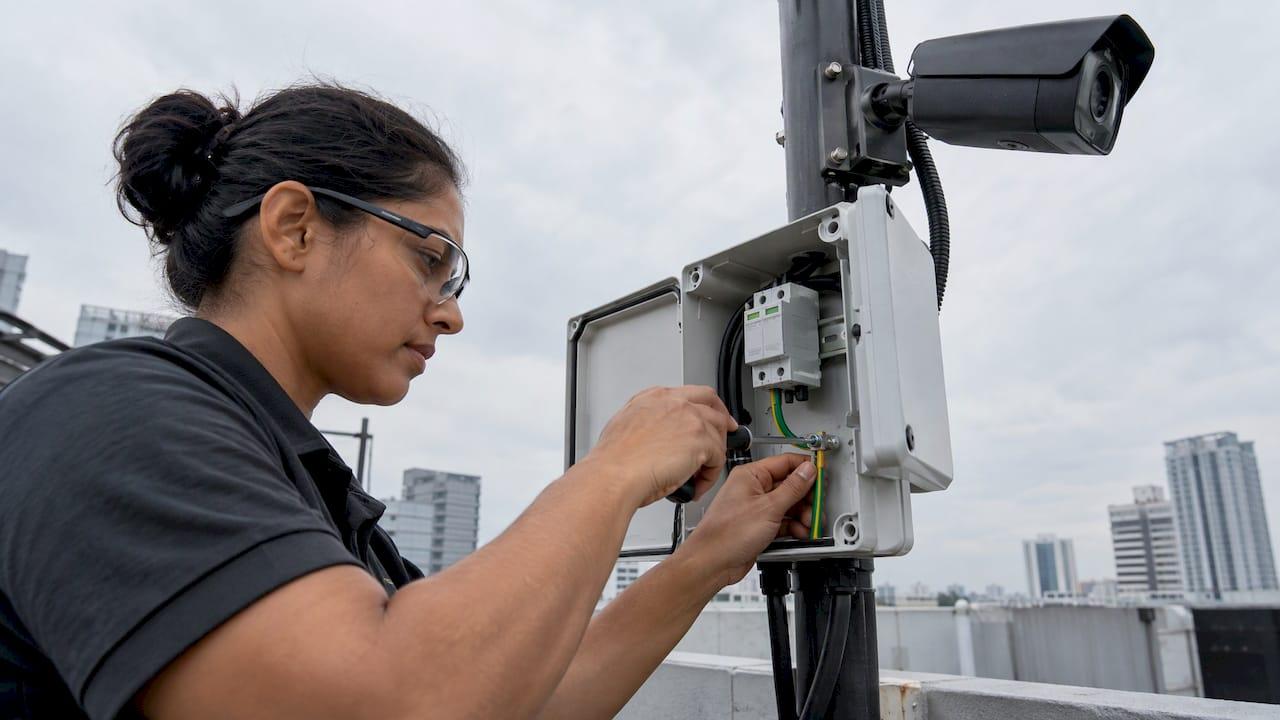
Surge Protection for CCTV: A Singapore Installer's Guide
How to protect CCTV from lightning and power surges in Singapore: which circuits need SPDs, where to fit them, which ratings to check, and how to earth them.

Contactless Visitor Check-In: A Practical Guide for Singapore Sites
How contactless visitor check-in works, which methods suit your site, and how to roll it out in Singapore with PDPA, access control and contractors in mind.

Visitor Management Policy: What to Include for Singapore Sites
Build a visitor management policy for a Singapore workplace: scope, check-in rules, PDPA and NRIC limits, retention, escorts, emergencies and review.
Let's Build YourSecurity Ecosystem.
Whether you're a System Integrator, Solution Provider, or an End-User looking for trusted advisory, our team is ready to help you navigate the BeyondSensor landscape.
Direct Advisory
Connect with our regional experts for tailored solutioning.