
How to run evacuation muster reporting and roll call on Singapore sites: who counts whom, what the report records, SCDF duties, and how to close the gaps.
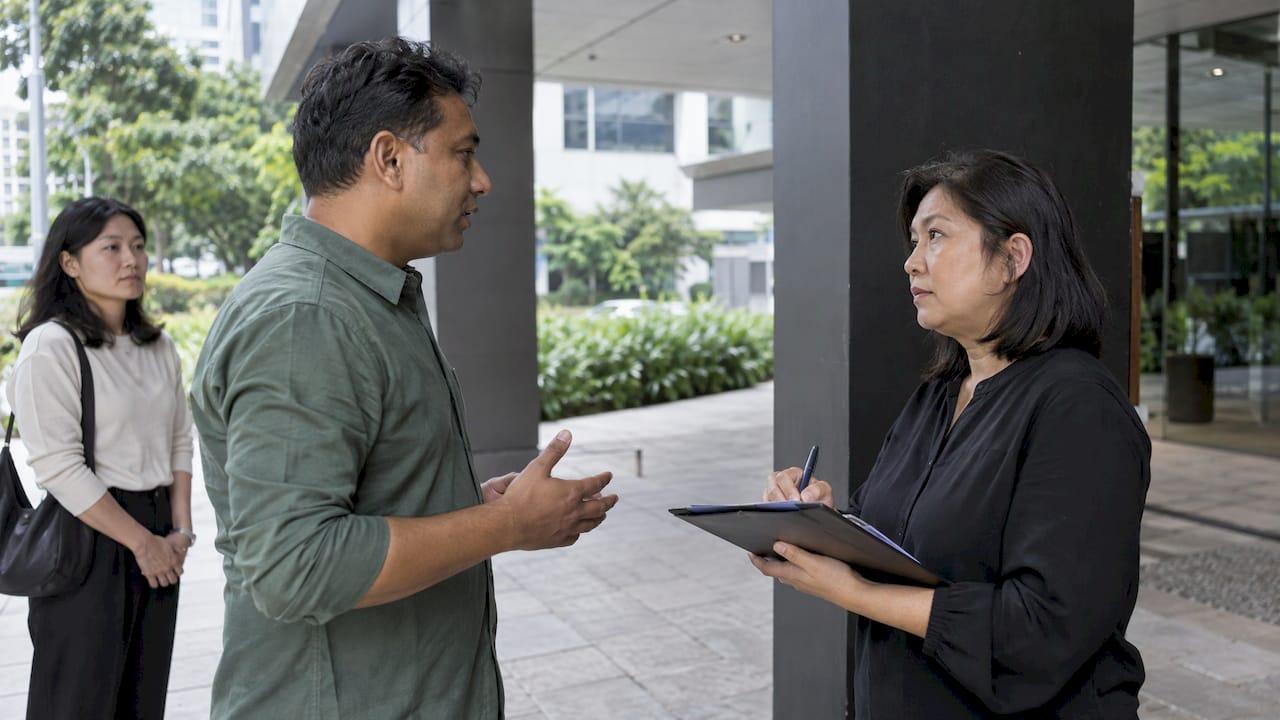
Evacuation Muster Reporting: Singapore Site Guide

An evacuation muster report is the record of who was on site when the alarm sounded, who reached the assembly area, and who was still unaccounted for, with the times and the actions taken. On a Singapore site it rests on three things: a current list of occupants (employees, contractors and visitors), wardens who roll-call against that list at the assembly area, and a single point that relays the number of missing persons to SCDF. The weakest link is almost always the list, not the roll call. Sites that treat visitor and contractor records as part of life safety, and not just as access control, produce reports that hold up in a drill and in a real incident.
This guide is written for security managers, facility managers, system integrators and agencies who design or run these processes. It covers what Singapore guidance expects, how the roll call works, what the report should contain, and what a reliable digital muster process needs from the systems underneath it.
TL;DR
- A muster report answers one question fast: who is safe, and who is not yet accounted for. It is not an attendance report.
- In Singapore, fire wardens report evacuation status to the Site Incident Controller, who tells the SCDF officer the number of persons missing.
- Fire Safety Managers must run fire drills at least twice per calendar year and report drill numbers and effectiveness in the annual fire safety report.
- The roll call is only as accurate as the occupant list. Visitors and contractors are where lists most often fail.
- Record the drill, the headcount, the discrepancies and the corrective actions every time, so the report is evidence and not a formality.
Table of Contents
- What an evacuation muster report is
- What Singapore guidance expects
- How the roll call works at the assembly area
- What the report should contain
- Why paper rosters break down
- What a reliable digital muster process needs
- A step-by-step routine for a Singapore site
- Perspective
- Bringing it together with BeyondSensor
- FAQ
- Sources
What an evacuation muster report is
Mustering is the structured process of gathering people at a designated assembly area after an evacuation and accounting for each of them. The report is the output: a timed record of the headcount against the expected population.
It differs from an attendance or timesheet report in three ways. It is built for minutes, not days. It must include everyone physically present, including people who never appear on a payroll. And its main output is a short list of names that someone has to act on.
There are two reports in practice. The first is the live status report, passed upward during the event: how many accounted for, how many missing, last known locations. The second is the after-action record, which feeds drill reviews, regulator submissions and internal audits. A good process produces both from the same data.

What Singapore guidance expects
Roles and reporting lines
SCDF's emergency response plan guidance for buildings of 8 to 30 storeys requires the Site Incident Controller to monitor evacuation status at the assembly point through reports from fire wardens, using the recommended report format in its appendix. The same controller reports the fire condition and the number of persons missing, if any, to the Civil Defence Officer on arrival at the Fire Command Centre.
SCDF's Effective Evacuation Procedures add that the Site Incident Controller reports the condition of the fire and the number of persons trapped in the fire area to the SCDF officer on arrival at the fire floor.
In practice, this means your muster design has to deliver one reliable number to one person, quickly. Every extra hand-off between wardens and that person is a delay and a chance for error.
Drills and the annual report
Under the Fire Safety (Fire Safety Managers) Regulations, a fire safety manager must conduct fire drills for occupants at least twice in every calendar year, or as directed by the Commissioner, and must prepare and execute the premises' Emergency Response Plan. The regulations also require an annual fire safety report each December covering the number of fire evacuation drills in the last 12 months and their effectiveness.
SCDF's e-FSM user guide describes a mandatory "Fire Evacuation Drills Conducted" section in the Annual Fire Safety Report module, where drill details are entered. If your drill records are structured, that entry is a copy job. If they are scattered across paper forms, it is a December scramble.
Which premises must appoint a Fire Safety Manager is set out in SCDF's Fire Certificate application form: certain public buildings, industrial buildings, foreign employee dormitories and hospitals meeting the listed thresholds. Check your own premises against the form.
Workplace records
The Workplace Safety and Health Act 2006 requires employers' safety measures to include procedures for dealing with emergencies, and the occupier must keep workplace records, including reports and particulars prepared under the Act, for at least 5 years and produce them to an inspector on request. A muster report that is stored, searchable and tamper-evident serves that obligation better than a clipboard in a drawer. Our note on audit log retention in Singapore covers how to set retention periods for this kind of record.
How the roll call works at the assembly area
Wardens and headcount
OSHA's evacuation guidance in the US offers a useful benchmark: one warden for every 20 employees is generally adequate, wardens may check offices and bathrooms before exiting, and a head count is taken at the assembly area. Anyone not accounted for is identified by name and last known location, and that information goes to the official in charge.
In Singapore, NUS's Fire Safety Manual shows the local pattern clearly. Fire wardens conduct a roll call of staff, students, guests and visitors at the assembly area using a Floor Register that records storey, unit, occupant names and present or absent status, then report to the Fire Safety Coordinator. Its drill analysis form asks whether persons with disabilities were accounted for and whether missing personnel were accounted for. The same manual notes that buildings with two or more storeys or more than 20 occupants must conduct an annual fire evacuation drill.

Who is on the list
The roll call has three populations, and each fails differently:
| Population | Typical list source | Common failure |
|---|---|---|
| Employees | HR roster, floor register | Out-of-date after moves, leave and hot-desking |
| Contractors | Contractor pass or permit records | Subcontractors who never signed in; pass issued for the week, not the day |
| Visitors | Reception log | Paper logs left at the lobby; no sign-out; hosts unaware |
| People needing assistance | Warden's own knowledge | Not recorded anywhere |
OSHA advises a method for accounting for non-employees such as suppliers and customers, often using visitor sign-in lists, with hosts or area wardens helping them out. The US CISA 2024 occupant emergency guide goes further: it requires a process to account for all employees, contractors and visitors, and suggests using automation such as badge-in and badge-out reports and mass notification systems.
SCDF's Evacuation Planning Guidelines say occupant registers should be kept updated as far as possible, with special attention to children, the elderly and persons with disabilities. For transient venues, it recommends information counters where people can report the whereabouts of anyone trapped. For a practical view of accounting for attendees and those who need assistance in busy venues, an event operations checklist shows how the same discipline applies from setup to review.
What the report should contain
SCDF's evacuation planning guidelines say the drill report should include the scenario, occupant participation, and total occupants and participants. That is the minimum. A report that serves operations, audit and the annual submission records more.
A practical template for a drill or real event:
- Event basics: date, premises, scenario, trigger (drill, alarm, real event), person in charge.
- Timeline: alarm time, first warden at assembly area, headcount complete, all-clear or hand-over to SCDF.
- Population: expected occupants split into employees, contractors, visitors, and the number needing assistance.
- Headcount: accounted for, unaccounted for, names and last known locations of anyone missing, and how each discrepancy was resolved.
- Performance: alarm and public address audibility, warden coverage, route obstructions, assembly area capacity.
- Corrective actions: owner, due date, closure evidence.
- Sign-off: Fire Safety Manager or Site Incident Controller.
This follows the structure of the US GSA's evacuation report and survey form, which captures the time from alarm to full evacuation, the number of employees and visitors in the area, whether the evacuation was orderly and how alarm systems performed, consolidated into a summary due the next business day. The Singapore regulatory frame is different, but the fields are a sound model for any site.
Two habits separate useful reports from filler. First, record the discrepancy and its resolution: "three unaccounted, all found at the alternate assembly area" teaches you about signage and capacity. Second, compare planned against actual. The point of a drill is the gap.
Why paper rosters break down
A paper floor register works when the population is stable and small. It strains when:
- Visitor and contractor numbers change hourly, so the list is stale before the alarm.
- The person holding the clipboard is the one who has to evacuate it.
- Multiple assembly areas each produce a separate count that someone must reconcile by phone.
- The report is retyped afterwards, which loses times and names.
CISA's guidance also stresses deconflicting assembly areas within a facility and with neighbouring facilities in dense urban areas, and considering soft-target threats at assembly points. That fits Singapore's clustered business parks and mixed-use towers, where several buildings may release people onto the same open space.
What a reliable digital muster process needs
A digital process is not a different philosophy. It is the same roll call with better inputs and a faster output. When you specify or integrate one, test it against these capabilities:
- A live occupant list. It reflects who is on site now, including visitors and contractors, not who was expected this morning.
- Sign-out discipline. A visitor who left at 2 pm must not appear as missing at 4 pm.
- Offline-tolerant roll call. Wardens need to mark people present from a device even if the network or building systems are affected.
- One consolidated count. Several assembly areas feed a single view for the Site Incident Controller.
- Last known location. For anyone unaccounted for, the last access point or zone gives responders something to act on.
- Assistance flags. Occupants who need help are marked in advance and checked explicitly.
- Automatic after-action record. Timestamps, headcounts and names are retained without retyping, and exportable for the annual fire safety report.
- Retention and audit trail. Records are kept for the period the occupier needs and show who changed what.
Each of these depends on data that already exists in the security stack: access control events, visitor registration, contractor passes, and, where deployed, occupancy analytics. Our guide to occupancy analytics explains how that population picture is built, and the visitor management policy and contractor access control guides cover the two groups that most often break the roll call.
A step-by-step routine for a Singapore site
- Define the population and the owner of each list. Name who maintains the employee roster, the contractor list and the visitor log, and how each is updated. This is the step where most muster failures begin.
- Map assembly areas to buildings and floors. Give each warden a floor or zone and an assembly area. Confirm capacity and an alternate area, and check them against neighbouring premises.
- Appoint wardens at a workable ratio. The OSHA one-in-20 figure is a starting point for planning, not a Singapore requirement; set your ratio from your ERP and your floor plates.
- Set the reporting line. Wardens report to the Site Incident Controller, who gives the missing-person count to SCDF on arrival. Write the message format into the ERP.
- Run drills at least twice a year. Vary scenarios: a daytime peak, a visitor-heavy event, a shift change. Record the headcount and discrepancies every time.
- Close the loop. Assign corrective actions, thank participants, and file the report where it can be found for the December submission and for an inspector.
- Review the lists, not just the routes. After each drill, ask how many names on the final list were wrong and why.
Perspective
Most muster failures we see discussed in the industry are data failures. The warden did the job; the list was wrong. A visitor never signed out, a contractor's pass was valid but the individual never registered, a count lived on one person's phone.
That is why we treat visitor records, access events and site dashboards as one system. BeyondVisitor is our automated visitor management system, and BeyondSecure and BeyondWatch give security teams a unified operations view and video analytics dashboards. When those layers share one picture of who is on site, the people who run an evacuation start from a list they can trust.
For integrators, the opportunity is to design the muster workflow once, across vendors, and validate it locally. We built our work around multi-vendor integration and localized technical validation for Southeast Asian deployments for exactly that reason.
Eumir
Bringing it together with BeyondSensor
If you are planning a muster process for a site, start from the visitor and contractor layer, because that is where your list is weakest. BeyondVisitor is our automated visitor management system, built to register and manage visitors without manual logbooks. For multi-vendor environments, our Solution Integration service helps connect the security platforms a site already runs into a coherent workflow.

To discuss how this fits your premises or your clients' sites, reach us through the BeyondSensor site.
FAQ
What is the difference between a muster report and a roll call?
The roll call is the act of checking names at the assembly area. The muster report is the record that results: expected occupants, those accounted for, those missing, timings and actions. The roll call feeds the live status passed to SCDF, and the report is kept for review and audit.
Who reports the missing-person count to SCDF in Singapore?
In SCDF's ERP guidance for buildings of 8 to 30 storeys, fire wardens report to the Site Incident Controller, who reports the fire condition and the number of persons missing to the Civil Defence Officer at the Fire Command Centre. Check your own ERP for the exact lines at your premises.
How often must we run evacuation drills?
A fire safety manager must conduct fire drills at least twice in every calendar year, or as the Commissioner directs. Details of the drills go into the annual fire safety report submitted each December. Premises that are not required to appoint a Fire Safety Manager should still check SCDF guidance for their building type.
How do we account for visitors and contractors?
Treat them as part of the occupant list, not an exception. Use a live visitor log with sign-out, link contractors to daily registration, and make hosts or area wardens responsible for escorting them to the assembly area. The roll call then checks visitors against the same list as staff.
How long should muster reports be kept?
Under the Workplace Safety and Health Act 2006, the occupier must keep workplace records, including reports prepared under the Act, for at least 5 years and produce them to an inspector on request. Confirm with your safety consultant which of your records fall under that requirement.
Sources
- SCDF Evacuation Planning Guidelines (2018)
- SCDF ERP evacuation guidelines, 8 to 30 storeys
- SCDF Effective Evacuation Procedures (FSM 2019)
- Fire Safety (Fire Safety Managers) Regulations
- SCDF e-FSM Enhanced User Guide
- SCDF Fire Certificate Application form
- Workplace Safety and Health Act 2006
- NUS Fire Safety Manual
- OSHA Evacuation Plans and Procedures eTool
- CISA Occupant Emergency Programs guide, 2024
- GSA Evacuation Report/Survey form
- Event operations checklist
Recommended
Read More Articles
CCTV Tender Specifications in Singapore: What to Write and Check
How to write or answer a CCTV tender specification in Singapore: camera, retention, network, analytics and acceptance requirements, with SPF, MOM, IMDA and PUB figures.
Alarm Deduplication for Security Teams: A Practical Guide
How alarm deduplication, correlation rules, severity mapping and escalation matrices work together to cut duplicate alarms without hiding the ones that matter.
Vehicle Classification Analytics: A Guide for Singapore Sites
How vehicle classification analytics and vehicle type detection work, which classes to use in Singapore, and how to plan camera placement, integration and data.
API Integration Security for Singapore Security Systems
How to secure API integrations between cameras, access control, visitor and analytics platforms in Singapore: threats, controls, PDPA duties and a rollout checklist.
Let's Build YourSecurity Ecosystem.
Whether you're a System Integrator, Solution Provider, or an End-User looking for trusted advisory, our team is ready to help you navigate the BeyondSensor landscape.
Direct Advisory
Connect with our regional experts for tailored solutioning.