
Discover defining intelligent sensor networks in 2026. Learn how these advanced systems enhance real-time monitoring for security and industry.

Defining Intelligent Sensor Networks: A 2026 Guide

TL;DR:
- Intelligent sensor networks are distributed systems of autonomous nodes that process data locally for real-time environment monitoring. They differ from traditional networks by embedding microprocessors, reducing latency, conserving energy, and enhancing privacy at each node. These advanced networks enable scalable, accurate, and efficient applications across security, industrial, and infrastructure sectors.
Intelligent sensor networks are defined as distributed systems of autonomous nodes that integrate sensing, local computation, and wireless communication to monitor physical environments and act on data in real time. Unlike passive data collectors, these networks process information at the point of capture. That distinction matters enormously for professionals designing security and infrastructure systems where latency and data integrity are non-negotiable. The industry standard term is wireless sensor network (WSN), though the "intelligent" qualifier specifically denotes nodes with embedded processing. Beyondsensor works at this intersection, building high-precision sensing solutions for physical security, industrial automation, and smart infrastructure across Southeast Asia.
What is defining intelligent sensor networks: core architecture
An intelligent sensor network is built from four physical components inside each node: a sensing unit, a microprocessor, a radio transceiver, and a power source. Sensor nodes range from shoebox-sized units to sub-millimeter devices, with costs spanning from a few dollars to several hundred per node depending on sophistication. That range reflects the breadth of deployment contexts, from sprawling utility grids to precision manufacturing cells.

The microprocessor is the defining element. An intelligent sensor must integrate a microprocessor within the same physical device. Sending raw data to an external processor disqualifies a node from being technically classified as intelligent. This distinction separates true intelligent distributed sensor systems from conventional telemetry setups.
Network topology shapes how nodes communicate. The three primary configurations are star, mesh, and hierarchical. Star topologies route all data through a central gateway, which creates a single point of failure. Mesh topologies allow nodes to relay data through each other, improving coverage and fault tolerance. Hierarchical designs cluster nodes under local aggregators before forwarding data upstream, which suits large deployments where bandwidth is constrained.
How data flows through the network
Data moves through four stages: sensing, local processing, wireless transmission, and central analysis. At the local processing stage, edge processing and compression at the node level reduce transmission load and extend battery life significantly. This is the operational core of what makes a network intelligent rather than merely connected.
- Sensing: The sensing unit captures a physical measurement, such as temperature, pressure, motion, or acoustic signature.
- Local processing: The onboard microprocessor filters noise, compresses data, and runs basic inference before transmitting.
- Wireless transmission: The radio transceiver sends processed data over protocols such as LoRaWAN, Zigbee, or NB-IoT.
- Central analysis: A cloud or on-premises platform aggregates data from all nodes for pattern recognition and reporting.
Precise timestamping and node placement are critical for synchronizing data from thousands of nodes. Without accurate temporal and spatial correlation, AI-driven predictive maintenance produces unreliable outputs.
Pro Tip: Deploy GPS-synchronized clocks or network time protocol (NTP) on gateway nodes to maintain sub-millisecond timestamp accuracy across large mesh deployments.
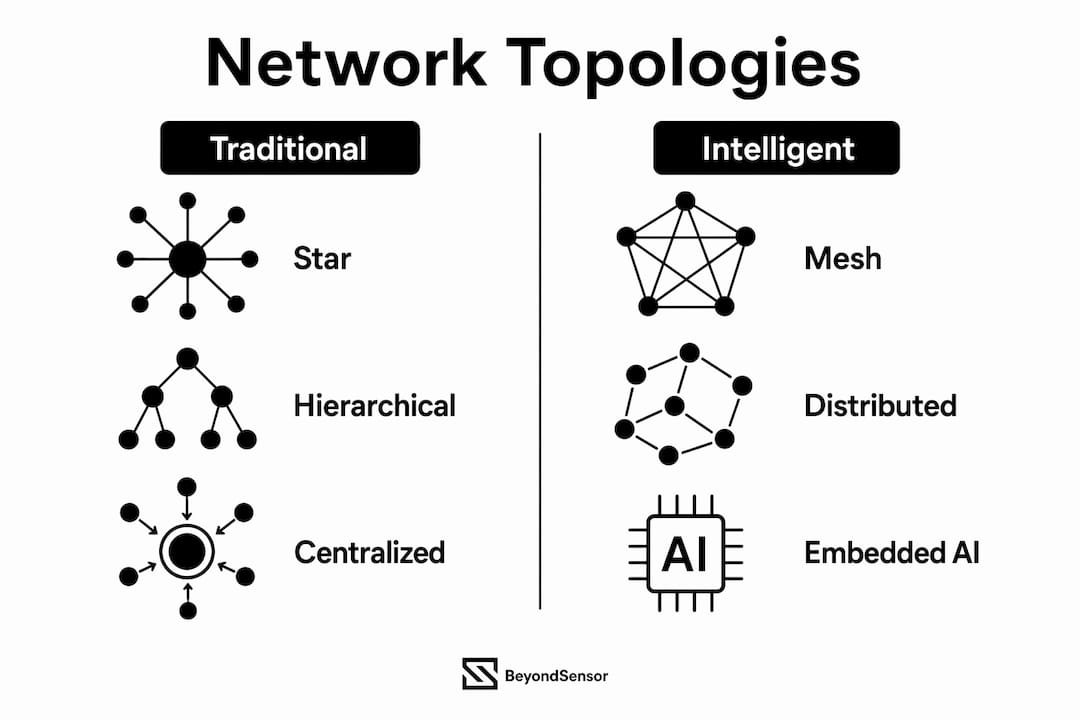
What differentiates intelligent sensor networks from traditional ones?
Traditional sensor networks send raw data to a central server for all processing. Intelligent networks process data locally, at the node level, before transmitting. That architectural shift produces measurable differences in latency, energy use, and privacy.
| Feature | Traditional sensor networks | Intelligent sensor networks |
|---|---|---|
| Data processing location | Central server | At the node (edge) |
| Latency | Higher, depends on network round-trip | Lower, local decisions are near-instant |
| Energy efficiency | Lower, continuous raw data transmission | Higher, only processed results are sent |
| Privacy | Raw data exposed in transit | Sensitive data stays local |
| AI capability | Limited, post-collection analysis only | Real-time inference at the node |
| Scalability | Constrained by bandwidth and server load | Scales with node count |
AI integration with intelligent sensing enables edge AI, which processes data locally to protect privacy and reduce the volume of data transmitted. That reduction directly lowers energy consumption and extends network operational life. For security professionals managing camera networks or perimeter sensors, this means fewer false alerts reaching the control room and faster local response.
The scalability difference is also structural. Traditional networks bottleneck at the central server. Intelligent networks distribute the processing burden, so adding 500 nodes does not proportionally increase server load. That property makes them the correct choice for large-scale infrastructure monitoring.
What are the primary applications and benefits of intelligent sensor networks?
Intelligent sensor network applications span industries where real-time physical awareness drives operational decisions. The benefits are consistent across sectors: lower costs, faster response, and better data quality.
A concrete example from utility management illustrates the scale of impact. Wireless sensor networks enabled a European city to reduce water loss by 20% through real-time leak detection and pressure monitoring. Real-time monitoring also extended the operational life of pumps and valves through predictive maintenance. That outcome represents both cost avoidance and infrastructure longevity, two priorities shared by every infrastructure stakeholder.
Key application areas include:
- Industrial manufacturing: Wireless sensor networks on manufacturing floors eliminate the high labor and material costs of wired installations and support faster production reconfigurability. A sensor node repositioned in minutes replaces a rewiring project that takes days.
- Physical security surveillance: Nodes with embedded vision processing, such as edge AI cameras, classify threats locally and send only verified alerts upstream. This reduces operator fatigue and improves detection accuracy.
- Environmental monitoring: Distributed nodes track air quality, soil moisture, and water levels across wide geographic areas without continuous human oversight.
- Smart infrastructure: Bridge stress sensors, pipeline pressure monitors, and electrical grid fault detectors all rely on intelligent sensor networks to flag anomalies before failures occur.
- Energy management in facilities: Occupancy and thermal sensors feed building management systems, cutting energy waste in real time.
The benefits of sensor networks in these contexts go beyond operational efficiency. Predictive maintenance data from sensor networks reduces unplanned downtime, which carries significant financial consequences in manufacturing and utilities. Sensor data management practices that unify data governance across platforms multiply these benefits by making cross-system correlation possible.
What technological advances are driving intelligent sensor networks forward?
AI is the most consequential force reshaping intelligent sensor network design in 2026. Optimizing sensors and AI simultaneously reduces energy consumption and latency more effectively than optimizing each component separately. That finding from Nature Sensors reframes how engineering teams should approach network design. Hardware and algorithm choices must be made together, not in sequence.
Sensor miniaturization through MEMS (microelectromechanical systems) technology has made it practical to embed processing capability into devices smaller than a grain of rice. MEMS sensors now appear in structural health monitoring, wearable industrial safety devices, and environmental sensing arrays that would have been physically impossible a decade ago.
Low-power wide-area networks (LPWAN) such as LoRaWAN and NB-IoT have extended the geographic reach of intelligent sensor deployments without requiring dense infrastructure. LoRaWAN nodes can transmit data over distances exceeding 10 kilometers on a single battery charge lasting years. NB-IoT operates over existing cellular infrastructure, making it practical for urban deployments where licensed spectrum is available.
Energy harvesting is removing the battery constraint entirely in some deployments. Nodes that draw power from solar, vibration, or thermal gradients can operate indefinitely without maintenance. That capability is particularly valuable in remote or hazardous locations where physical access is costly.
AI analytics for sensor networks are also enabling anomaly detection that learns from historical baselines rather than relying on static thresholds. A system that knows what "normal" looks like for a specific pump, at a specific time of day, in a specific season, catches faults that rule-based systems miss entirely.
Pro Tip: When designing intelligent sensor systems, select communication protocols and AI inference models at the same stage of the design process. Choosing LoRaWAN after selecting a high-bandwidth AI model creates an irreconcilable mismatch between data output and transmission capacity.
Emerging smart sensor applications in 2026 include multi-modal nodes that combine acoustic, thermal, and visual sensing in a single device. These nodes produce richer situational awareness than single-modality sensors and are becoming standard in high-value security and industrial environments.
Key takeaways
Intelligent sensor networks are the foundational architecture for real-time physical awareness in security, infrastructure, and industrial operations, and their value depends entirely on embedding computation at the node level.
| Point | Details |
|---|---|
| Embedded processing is non-negotiable | A node without an onboard microprocessor is not technically an intelligent sensor, regardless of connectivity. |
| Co-design sensors and AI together | Optimizing hardware and algorithms simultaneously reduces latency and energy use more than sequential design. |
| Topology determines resilience | Mesh topologies outperform star configurations for large deployments where fault tolerance matters. |
| Real-world impact is measurable | Real-time WSN monitoring cut water loss by 20% in a European city through leak detection and predictive maintenance. |
| LPWAN extends reach without wiring | Protocols like LoRaWAN and NB-IoT enable wide-area deployments on minimal power budgets. |
The part of intelligent sensor networks most teams get wrong
Most deployment failures I have seen do not come from bad hardware. They come from treating the sensor network and the AI layer as two separate projects with two separate teams. The hardware engineers select nodes based on sensing accuracy. The software team selects inference models based on benchmark performance. Neither group accounts for the data volume the AI model generates versus the bandwidth the chosen protocol can carry. The result is a network that works in the lab and fails in the field.
The second mistake is underestimating the governance challenge. Wireless sensor networks function as the invisible nervous system of smart infrastructure, and the real challenge is not hardware but building large-scale intelligent ecosystems capable of coordinated operation. Interoperability between sensor platforms, data formats, and analytics systems is where projects stall. A security agency running three different sensor vendors across a city cannot get unified situational awareness without a data governance layer that most procurement processes never budget for.
My honest view is that the teams who succeed treat network design as a systems problem, not a component selection problem. They define the decision the network needs to make first. Then they work backward to the sensor type, the processing requirement, the communication protocol, and the power budget. That sequence produces deployments that actually deliver on the promise of intelligent sensing.
— Eumir
Beyondsensor's approach to intelligent sensor deployments
Beyondsensor builds AI-driven sensing solutions specifically for system integrators and security agencies who need deployments that work at scale, not just in controlled environments.

The Beyondsensor platform combines high-precision sensor hardware with AI analytics designed for real-time responsiveness and privacy-first data handling. System integrators working across Singapore, Malaysia, and the Philippines get localized validation, ecosystem matchmaking, and technical support that generic platforms do not provide. Security agencies gain access to AI-enhanced perimeter monitoring and anomaly detection built on the same co-design principles that Nature Sensors identifies as the standard for next-generation intelligent sensing. The result is a deployment partner, not just a vendor.
FAQ
What is a smart sensor network definition?
A smart sensor network, formally called a wireless sensor network (WSN), is a collection of autonomous nodes that each combine a sensing unit, microprocessor, radio transceiver, and power source to collect, process, and transmit environmental data without human intervention.
How do sensor networks work at the node level?
Each node senses a physical parameter, processes the data locally using an onboard microprocessor, and transmits only the processed result over a wireless protocol such as LoRaWAN or NB-IoT. Local processing reduces transmission volume and extends battery life.
What are the main benefits of sensor networks in infrastructure?
The primary benefits are real-time anomaly detection, predictive maintenance, and reduced operational costs. A documented case shows WSNs cut urban water loss by 20% through continuous pressure monitoring and leak detection.
What features distinguish intelligent sensor networks from conventional ones?
Intelligent sensor networks process data at the node using embedded AI, which reduces latency, improves privacy, and lowers energy consumption compared to conventional networks that send all raw data to a central server for processing.
What is the role of edge computing in intelligent distributed sensor systems?
Edge computing moves data analysis from a central server to the sensor node itself. This reduces the time between sensing an event and acting on it, which is critical for security surveillance, industrial fault detection, and any application where milliseconds matter.
Recommended
- How to Secure Sensor Networks: 2026 IT Guide | News | BeyondSensor
- Emerging Smart Sensor Applications for Industry in 2026 | News | BeyondSensor
- Intelligent sensing deployment process: A guide for tech leaders | News | BeyondSensor
- Industrial Sensor Integration Workflow: 2026 Engineer's Guide | News | BeyondSensor
Read More Articles
RTSP Security Risks: Integrators Must Block Exposed Ports 554 and 8554
See how integrators can reduce RTSP security risks: close exposed ports 554 and 8554, secure camera access, and verify each deployment with practical checks.

Require MAEpp and X Accuracy Before You Buy People Counting Systems
Verify people counting accuracy by demanding MAEpp, X Accuracy, and directional-bias reports. Validate on-site with at least 100 events per direction...
30–90 Day Pilot Validates Redundant Camera Networks for Engineers
Standards led, practical steps for engineers to deploy redundant camera networks: MRP, dual homing, and aggregation patterns, commissioning checks, and...
30 Day Pilot Proves Video Analytics Accuracy for Security Teams
Validate video analytics accuracy with scenario tests, camera tuning, transfer learning and a 30 day edge first pilot for security teams.
Let's Build YourSecurity Ecosystem.
Whether you're a System Integrator, Solution Provider, or an End-User looking for trusted advisory, our team is ready to help you navigate the BeyondSensor landscape.
Direct Advisory
Connect with our regional experts for tailored solutioning.