
Discover why cybersecurity for sensing devices is crucial in 2026. Protect your industrial systems and prevent cyber attacks on critical data.

Why Cybersecurity for Sensing Devices Matters in 2026

TL;DR:
- Sensor devices are highly vulnerable because they lack security features due to hardware constraints and long operational lifecycles.
- Protecting these sensors requires network isolation, passive traffic monitoring, and advanced technologies like firmware attestation and AI anomaly detection.
Cybersecurity for sensing devices is the foundation of safe and reliable industrial and operational technology environments. Sensing devices, classified as Level 0 elements in operational technology (OT) and IoT architectures, sit at the physical edge of every critical system. They measure temperature, pressure, flow, and motion. They feed data directly into control systems that govern power grids, water treatment plants, and manufacturing lines. With over 24 billion active IoT and OT devices globally as of Q2 2026, the attack surface is enormous. Each unprotected sensor is a potential entry point. The importance of cybersecurity for devices at this level cannot be overstated.
Why are sensing devices inherently vulnerable to cyber attacks?
Sensing devices are not built with security in mind. They are built for accuracy, durability, and low power consumption. Security is an afterthought, and that gap is exactly what attackers exploit.
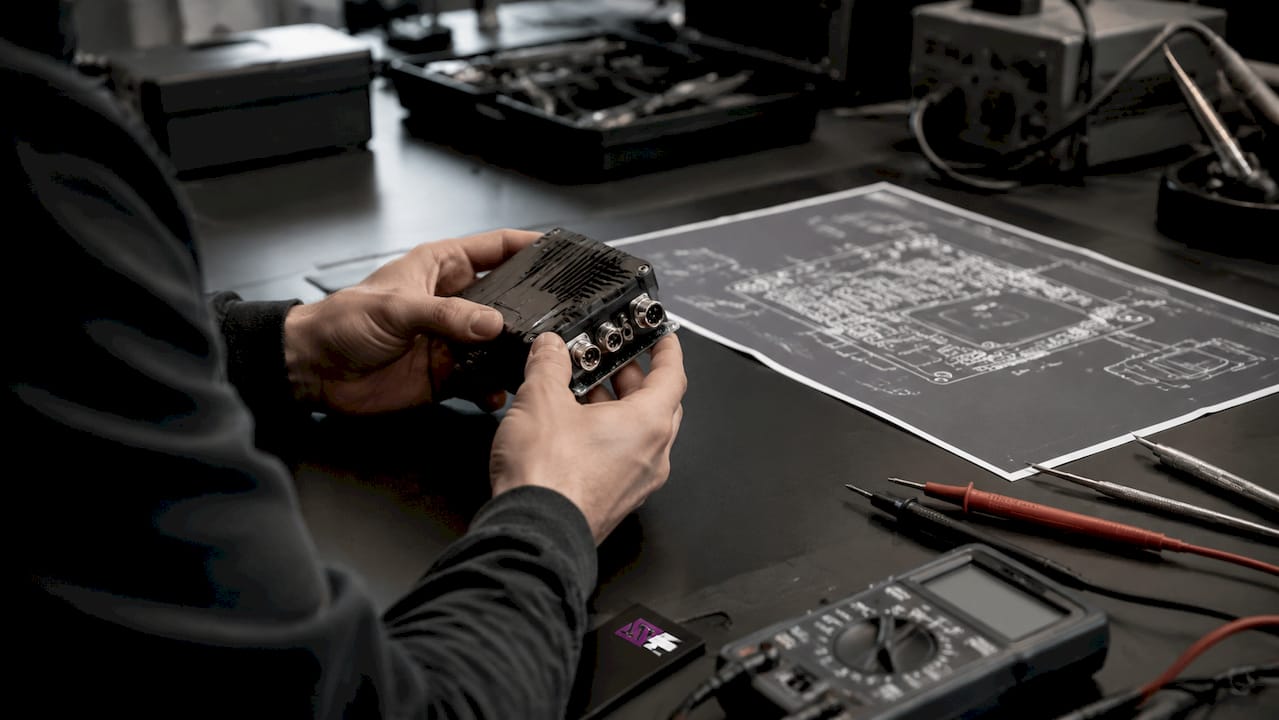
The core problem is hardware constraint. Most sensors lack the processing power to run endpoint security agents, antivirus software, or encryption libraries. Traditional IT security methods cannot be applied to these devices because the hardware simply cannot support them. A temperature sensor on a factory floor has no CPU headroom for a security stack.
Service lifecycles compound the problem. Industrial sensors routinely operate for 10 to 20 years without firmware updates. Patching schedules that IT teams take for granted do not exist in OT environments. A sensor deployed in 2010 may still run original firmware in 2026, carrying vulnerabilities that have been publicly documented for years.
Process sensor devices lack basic authentication, logging, and support for cyber forensic analysis. This makes them highly vulnerable to undetected attacks. When a sensor is compromised, there is often no audit trail. No log file. No alert. The attack is invisible until physical consequences appear.
Physical accessibility adds another layer of risk. Sensors installed in remote locations, outdoor enclosures, or unmanned substations can be physically tampered with. An attacker with brief physical access can install a rogue device, intercept communications, or inject false data directly into the signal chain.
- No onboard security agents due to hardware limits
- Infrequent or absent firmware patching over multi-decade lifecycles
- No authentication, logging, or forensic capability at the device level
- Physical exposure in remote or unmanned locations
- No separation between sensor data and control system commands in legacy deployments
Pro Tip: Map every sensor in your environment by firmware version and last patch date. Any device running firmware older than three years with no update path is a priority risk.
What are the risks of compromised sensing devices?
A compromised sensor does not just leak data. It corrupts the physical world. False data injection is the most dangerous attack vector specific to sensing devices. An attacker who manipulates a pressure sensor reading can cause a control system to open a valve, shut down a turbine, or trigger a safety alarm, all based on fabricated data.
The consequences follow a predictable pattern:
- False data injection: Sensor readings are manipulated to feed incorrect values into control logic, causing automated systems to take harmful physical actions.
- Safety system bypass: Sensors that trigger emergency shutdowns are silenced or spoofed, removing the last line of defense against equipment failure.
- Lateral movement: A compromised sensor on an isolated network segment becomes a foothold. Attackers use it to probe adjacent systems, escalate privileges, and move deeper into critical infrastructure.
- Supply chain compromise: Malicious firmware embedded at the manufacturing stage arrives pre-installed on devices before they ever reach your facility.
- Data integrity loss: Corrupted sensor telemetry invalidates operational records, compliance reports, and predictive maintenance models built on that data.
"Catastrophic cyber-physical events involving process sensors have often gone unrecognized as cyber-related due to a culture gap between IT security and engineering disciplines." — Control Global
That culture gap is not a minor organizational friction. It means real incidents go uninvestigated as security events. Engineers attribute sensor anomalies to hardware failure. IT teams never see the alert. The attacker remains undetected. Understanding sensor-level vulnerabilities in this context is the first step toward building a defense that actually works.
How can cybersecurity workflows be adapted for sensing devices?
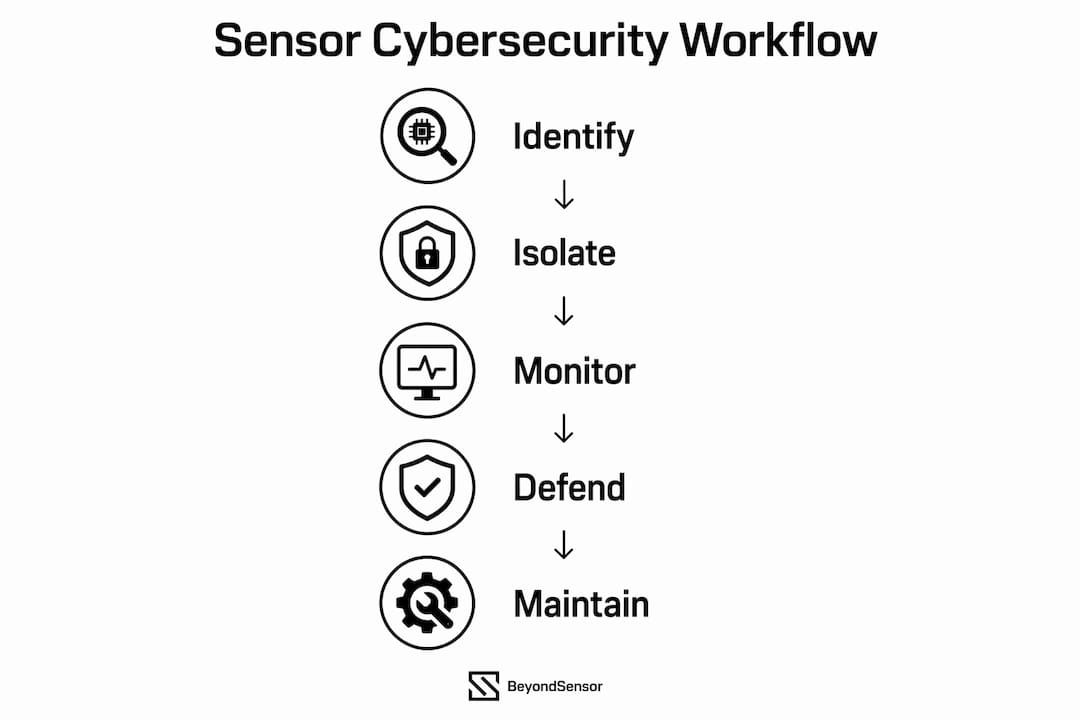
The cybersecurity workflow for sensors differs fundamentally from IT security practice. The answer is not to force IT controls onto OT hardware. The answer is to shift security enforcement to the network layer and build detection around behavior, not signatures.
Network-layer isolation
Security for IoT devices moves to the connectivity layer when the device itself cannot be hardened. Private, isolated networking using VLANs, unidirectional gateways, and strict firewall rules prevents lateral movement even when a sensor is compromised. The sensor cannot be patched, but its communications can be controlled.
Passive, protocol-aware monitoring
OT security requires passive monitoring rather than active intervention. Active scanning tools that work well in IT environments introduce latency that can disrupt real-time control processes. Protocol-aware passive monitoring reads traffic without injecting packets, preserving system determinism while still detecting anomalies.
Defense-in-depth for sensor networks
Industrial sensor networks require multiple defensive layers: network segmentation, encrypted communications where hardware supports it, regular patching where possible, and AI-driven anomaly detection. No single control is sufficient. Each layer compensates for the gaps in the others.
| Security approach | Best suited for | Key limitation |
|---|---|---|
| Network segmentation | All sensor environments | Does not protect against insider threats |
| Passive traffic monitoring | Real-time OT control systems | Cannot block attacks, only detect them |
| Firmware attestation | Devices with crypto hardware | Requires hardware support at manufacturing |
| AI anomaly detection | High-volume sensor telemetry | Requires baseline training period |
| Physical access controls | Remote and unmanned installations | Adds operational overhead |
Building a defensible program takes time. Deployment typically requires 4–6 weeks upfront, with ongoing maintenance averaging 2–4 hours per month. That commitment is modest relative to the operational risk of leaving sensors unprotected.
Pro Tip: Assign a named owner for each sensor zone in your network. Ownerless assets get patched last and monitored least. Accountability drives action.
Cross-disciplinary training is non-negotiable. IT security professionals need to understand OT engineering constraints. OT engineers need to recognize cyber indicators of compromise. Neither group alone has the full picture. Detailed guidance on securing sensor networks helps bridge that knowledge gap at the operational level.
What emerging technologies strengthen sensing device security?
The next generation of sensor security moves beyond network controls into the device and data layers. Several technologies are changing what is possible.
- Firmware attestation: Sensors compute SHA-256 hashes and sign firmware for cryptographic verification. Any tampering with firmware produces a hash mismatch that triggers an alert before the device boots. This closes the supply chain attack vector at the hardware level.
- Multi-modal physical-cyber correlation: Combining physical sensor anomalies with digital authentication failures enables reliable detection of sophisticated attacks. A vibration spike paired with an unexpected authentication request is a far stronger signal than either event alone.
- AI-driven anomaly detection: Deep learning models trained on normal sensor telemetry identify deviations that rule-based systems miss. AI never blinks. It processes thousands of data points per second and flags subtle drift patterns that human analysts would overlook.
- Zero Trust networking for IoT: Zero Trust applies the principle of least privilege to every device and communication path. Sensors authenticate before transmitting. Traffic is verified at every hop. No device is trusted by default, regardless of physical location.
- Hardware crypto accelerators: Purpose-built security chips embedded in next-generation sensors handle encryption and key management without taxing the main processor. This removes the hardware constraint that has historically blocked device-level security.
The intelligent sensing deployment process for these technologies requires careful planning. Retrofitting existing sensor fleets is harder than designing security in from the start. Decision-makers who specify security requirements at procurement gain a significant advantage over those who try to add security after installation.
Key Takeaways
Securing sensing devices is not optional. It is the prerequisite for safe, reliable, and trustworthy industrial and IoT operations at every scale.
| Point | Details |
|---|---|
| Sensors are inherently vulnerable | Hardware limits, long lifecycles, and no logging make sensors the weakest link in OT networks. |
| False data injection is the top risk | Manipulated sensor readings cause control systems to take harmful physical actions without any visible alert. |
| Security shifts to the network layer | Isolate sensors with VLANs and unidirectional gateways when the device itself cannot be hardened. |
| Passive monitoring preserves operations | Protocol-aware passive monitoring detects threats without introducing latency that disrupts real-time control. |
| Firmware attestation closes supply chain gaps | Cryptographic hash verification catches tampered firmware before a compromised device ever goes online. |
The culture gap no one talks about
I have spent years working at the intersection of physical security and digital infrastructure, and the single biggest obstacle to sensor cybersecurity is not technology. It is organizational culture.
IT security teams speak in CVEs, SIEM alerts, and patch cycles. OT engineers speak in process variables, ladder logic, and uptime requirements. These two groups rarely share a common vocabulary, and they almost never share a reporting line. The result is exactly what the research confirms: cyber-physical events at the sensor level go unrecognized as security incidents because no one person is looking at both the process data and the network traffic simultaneously.
The fix is not a new tool. The fix is a joint team. Put an OT engineer and an IT security analyst in the same room, reviewing the same dashboards. Run tabletop exercises that simulate sensor compromise, not just network intrusion. Make sensor security a shared accountability, not a handoff between departments.
The organizations I have seen get this right share one trait: they treat sensor security as an engineering discipline, not an IT checkbox. That mindset shift is worth more than any single technology investment.
— Eumir
Beyondsensor's AI-first approach to sensor protection

Beyondsensor builds sensor security programs for the environments where failure is not an option. The platform combines AI-driven anomaly detection with passive, protocol-aware monitoring designed specifically for industrial and IoT deployments. It does not disrupt real-time control processes. It watches, correlates, and alerts without adding latency to the systems that cannot afford it.
For system integrators responsible for deploying and maintaining sensor networks across critical infrastructure, Beyondsensor provides AI-powered sensor security solutions that align with defense-in-depth principles and regional compliance requirements across Singapore, Malaysia, the Philippines, and Southeast Asia. The platform supports the full deployment lifecycle, from initial network segmentation through ongoing anomaly detection and firmware integrity monitoring. Explore the full range of sensor security innovations to see what is possible for your environment.
FAQ
What makes sensing devices harder to secure than IT endpoints?
Sensing devices lack the processing power to run security agents, have no logging or authentication capabilities, and operate for decades without firmware updates. These constraints make standard IT security controls inapplicable at the device level.
What is false data injection in sensor security?
False data injection is an attack where an adversary manipulates sensor readings to feed incorrect values into a control system, causing automated physical actions based on fabricated data. It is the most dangerous attack vector specific to OT sensing environments.
How does passive monitoring protect sensing devices?
Passive, protocol-aware monitoring reads network traffic without injecting packets, detecting anomalies without adding latency to real-time control processes. This preserves system determinism while still providing threat visibility.
What is firmware attestation and why does it matter?
Firmware attestation uses cryptographic hash verification to confirm that sensor firmware has not been tampered with. Any modification to the firmware produces a hash mismatch, catching supply chain attacks before a compromised device goes online.
How long does it take to build a sensor security program?
A defensible sensor security program typically requires 4–6 weeks for initial deployment and approximately 2–4 hours per month of ongoing maintenance to keep defenses aligned with evolving threats.
Recommended
- Secure Sensing Explained: Defend Industrial & Environmental Ops | News | BeyondSensor
- Emerging Smart Sensor Applications for Industry in 2026 | News | BeyondSensor
- How to Secure Sensor Networks: 2026 IT Guide | News | BeyondSensor
- Top sensor security tips for safety & compliance 2026 | News | BeyondSensor
Read More Articles
RTSP Security Risks: Integrators Must Block Exposed Ports 554 and 8554
See how integrators can reduce RTSP security risks: close exposed ports 554 and 8554, secure camera access, and verify each deployment with practical checks.

Require MAEpp and X Accuracy Before You Buy People Counting Systems
Verify people counting accuracy by demanding MAEpp, X Accuracy, and directional-bias reports. Validate on-site with at least 100 events per direction...
30–90 Day Pilot Validates Redundant Camera Networks for Engineers
Standards led, practical steps for engineers to deploy redundant camera networks: MRP, dual homing, and aggregation patterns, commissioning checks, and...

30 Day Pilot Proves Video Analytics Accuracy for Security Teams
Validate video analytics accuracy with scenario tests, camera tuning, transfer learning and a 30 day edge first pilot for security teams.
Let's Build YourSecurity Ecosystem.
Whether you're a System Integrator, Solution Provider, or an End-User looking for trusted advisory, our team is ready to help you navigate the BeyondSensor landscape.
Direct Advisory
Connect with our regional experts for tailored solutioning.