
Discover what is edge sensing and how it transforms real-time data processing. Learn the benefits for security applications and architecture.

What Is Edge Sensing? A Technical Guide for Professionals

TL;DR:
- Edge sensing processes data locally at sensors to enable real-time decisions with under 10 milliseconds latency. It improves security by eliminating cloud transmission delays, protecting data privacy, and maintaining operation during network outages. Most teams underestimate its architectural importance, risking over-engineering and increased vulnerabilities.
Edge sensing is defined as the practice of processing data directly at the sensor or device level using embedded AI and local compute hardware, enabling real-time decisions with latency under 10ms. This approach eliminates the round-trip delay of cloud transmission, which is prohibitive for security and critical infrastructure applications. Platforms like EMASS ECS-DoT and Synopsys Edge AI represent the current generation of hardware purpose-built for this paradigm. For professionals deploying surveillance, intrusion detection, or facility monitoring systems, understanding edge sensing is no longer optional. It is the architectural foundation of any responsive, privacy-conscious security operation.
What is edge sensing and how does it work technically?
Edge sensing processes raw sensor signals locally through one of two primary computing architectures: in-sensor computing and near-sensor computing. In-sensor computing integrates processing logic directly within the sensing pixels, which minimizes data movement off the chip entirely. Near-sensor computing places a dedicated processor adjacent to the sensor, handling more complex AI inference tasks that require greater compute resources. Both architectures serve distinct use cases depending on the required processing depth and power budget.

The hardware enabling these architectures includes System-on-Chips (SoCs), Field-Programmable Gate Arrays (FPGAs), and Neural Processing Units (NPUs). Each component handles a specific stage of the data pipeline: raw signal acquisition, feature extraction, and inference output. FPGAs offer reconfigurability for evolving AI models, while NPUs deliver fixed-function acceleration for known workloads. Specialized AI SoCs like EMASS ECS-DoT combine audio and vision fusion with sub-1mW operation, making always-on intelligence viable for IoT and wearable deployments.
The data processing pipeline in an edge sensing system follows a structured sequence:
- Signal acquisition: The sensor captures raw data from the environment, whether optical, acoustic, thermal, or motion-based.
- Local conditioning: Onboard firmware filters noise, normalizes signals, and validates data quality before any inference runs.
- AI inference: An embedded model, often a quantized neural network, classifies or detects events directly on the device.
- Selective transmission: Only structured telemetry, anomalies, or confirmed events are forwarded upstream, reducing bandwidth consumption significantly.
- Protocol decoupling: Standard protocols like MQTT decouple backend integration from local control loops, preserving real-time responsiveness even during network saturation.
Pro Tip: When evaluating edge sensing hardware, check whether the SoC supports quantized INT8 or INT4 inference natively. Full-precision FP32 models will exceed the power budget of most always-on edge deployments.
Key benefits of edge sensing in security and operational environments
Real-time threat detection is the primary operational benefit of edge sensing technology. Localized edge computing avoids the delays and risks of cloud transmission, which is critical when a security system must trigger an alarm or lock a door within milliseconds of detecting an intrusion. Cloud-reliant systems introduce variable latency tied to network conditions, making them unreliable for time-sensitive responses. Edge sensing removes that dependency entirely.
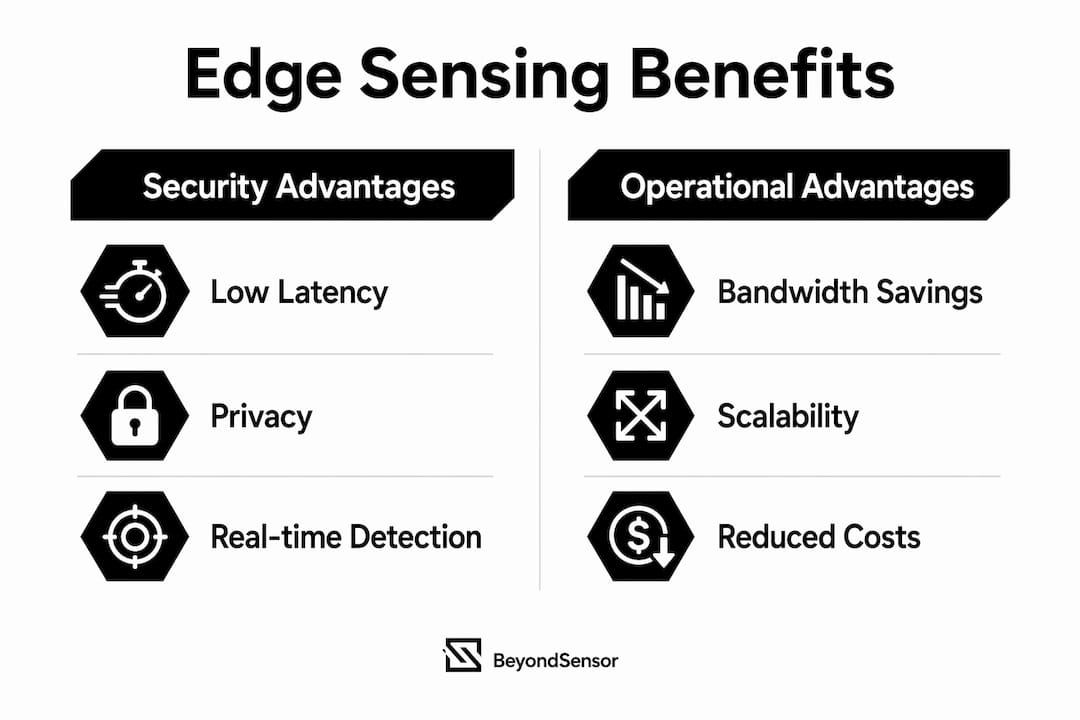
Data privacy is the second major advantage. When video feeds, acoustic data, or biometric signals are processed locally, personally identifiable information never leaves the facility. This is directly relevant for government agencies, healthcare facilities, and financial institutions operating under strict data residency regulations. The importance of edge sensing for compliance-driven environments cannot be overstated: local processing means local accountability.
The operational benefits extend well beyond privacy and speed:
- Reduced bandwidth consumption: Transmitting only structured events rather than raw video streams cuts network load by orders of magnitude.
- Lower energy use: Ultra-low-power systems operating below 1mW enable always-on monitoring without significant power infrastructure.
- Improved data quality: Local conditioning and validation at the sensor level means only relevant, trustworthy data reaches the backend, which directly improves alarm accuracy.
- Resilience to connectivity loss: Edge sensing systems continue operating during network outages because they do not depend on cloud connectivity for core decisions.
- Reduced false alarm rates: AI-driven data filtering at the edge validates events before transmission, cutting the false positive burden on security operations centers.
These benefits compound in large-scale deployments. A facility running 500 cameras with edge inference generates a fraction of the network traffic compared to a cloud-dependent equivalent. That reduction translates directly into lower infrastructure costs and faster incident response times.
Edge sensing vs. traditional cloud-based sensing
The architectural difference between edge sensing and cloud-based sensing determines every downstream performance characteristic. Edge sensing processes data at the collection point. Cloud-based sensing transmits raw data to a remote server for processing, then returns a decision to the device. That round trip introduces latency, bandwidth consumption, and a single point of failure.

The table below compares both approaches across the dimensions most relevant to security and operational deployments.
| Dimension | Edge sensing | Cloud-based sensing |
|---|---|---|
| Latency | Under 10ms for local inference | Hundreds of milliseconds, network-dependent |
| Data privacy | Data stays on device or local network | Raw data transmitted to external servers |
| Bandwidth use | Minimal; only events transmitted | High; continuous raw data streams required |
| Power consumption | Sub-1mW possible with specialized SoCs | Higher; continuous transmission draws more power |
| Offline operation | Full functionality without connectivity | Degraded or non-functional without network |
| Infrastructure cost | Higher upfront hardware cost | Lower hardware cost, higher recurring cloud fees |
| AI model updates | Requires firmware deployment to devices | Centralized updates, easier to manage at scale |
Cloud-based sensing remains appropriate for applications where historical analysis, large-scale model training, or cross-site correlation is the primary requirement. Edge sensing is the correct choice when response time, privacy, or network reliability is the binding constraint. For most physical security deployments, those three constraints apply simultaneously. Professionals evaluating sensing solutions for secure facilities should treat edge-first architecture as the default and cloud integration as a supplementary layer.
Advanced edge sensing techniques: multimodal fusion and AI-driven decisions
Multimodal sensor fusion is the most significant advancement in edge sensing systems over the past several years. Combining data from cameras, acoustics, and LiDAR with local AI algorithms running on FPGAs or SoCs produces a richer situational picture than any single sensor can provide. A camera may miss an intruder in low light, but an acoustic sensor and a thermal imager operating in fusion will not. The combined output is more reliable and generates fewer false alarms than any individual modality.
Local state estimation techniques further improve the accuracy of edge sensing systems. Kalman filters and neural estimators track object states across time using only local compute resources. These methods allow a sensor node to predict motion trajectories, classify behaviors, and flag anomalies without sending a single frame to the cloud. Task-driven sensing takes this further by using AI to adapt the sensing strategy dynamically. If a camera detects motion, the system can automatically increase acoustic sensor sampling rates and activate thermal imaging in the same zone.
The hardware enabling these advanced techniques is evolving rapidly:
| Technique | Hardware platform | Key capability |
|---|---|---|
| Multimodal fusion | FPGA or SoC | Combines vision, audio, and thermal in real time |
| Neural state estimation | NPU | Tracks object states locally without cloud uplink |
| Always-on inference | EMASS ECS-DoT | Sub-1mW audio and vision fusion for IoT devices |
| Hyperdimensional computing | Dense sensor arrays | Reduces interconnect overhead by 91.5% |
The reduction in interconnect complexity from hyperdimensional computing is a design advantage that most system architects overlook. Cutting wiring requirements by over 90% simplifies physical installation in dense sensor arrays and reduces failure points in the field.
Pro Tip: Deploy Kalman filter-based state estimators on edge nodes before adding neural estimators. Kalman filters are computationally cheap and handle linear motion well. Reserve NPU resources for the non-linear classification tasks where neural methods actually outperform classical approaches.
Embedded AI in security sensors enables autonomous, precise responses that remove human reaction time from the critical path entirely. For professionals designing next-generation security architectures, multimodal fusion at the edge is the technique that separates reactive systems from genuinely intelligent ones.
Key Takeaways
Edge sensing is the definitive architecture for security and operational environments where latency, privacy, and reliability cannot be compromised by cloud dependency.
| Point | Details |
|---|---|
| Core definition | Edge sensing processes data locally at the sensor using embedded AI, achieving latency under 10ms. |
| Two architectures | In-sensor computing embeds logic in pixels; near-sensor computing places processors adjacent to sensors for heavier AI tasks. |
| Security advantages | Local processing eliminates cloud transmission delays, protects data privacy, and maintains operation during network outages. |
| Multimodal fusion | Combining cameras, acoustics, and LiDAR on FPGAs or SoCs produces more reliable detections than any single sensor. |
| Power efficiency | Specialized SoCs like EMASS ECS-DoT operate below 1mW, making always-on intelligence viable at scale. |
Why I think most teams underestimate edge sensing architecture
Most professionals I speak with treat edge sensing as a performance upgrade rather than an architectural decision. That framing leads to poor deployment outcomes. When you treat edge processing as a bolt-on optimization, you end up with hybrid systems that inherit the worst properties of both cloud and edge models: high hardware cost with persistent cloud dependency.
The distinction between in-sensor and near-sensor computing matters more than most procurement teams realize. In-sensor computing is the right choice for always-on, low-power detection tasks. Near-sensor computing is the right choice when the AI model is complex enough to require dedicated NPU resources. Conflating the two leads to either underpowered nodes that miss events or overspecified hardware that burns through the power budget in days.
The privacy argument for edge sensing is also stronger than most security architects present it. Edge-centric sensing in critical infrastructure is not just about speed. It is about eliminating the attack surface that cloud transmission creates. Every byte of raw sensor data sent to a cloud endpoint is a byte that can be intercepted, subpoenaed, or leaked. Local processing removes that exposure entirely.
My advice for researchers and professionals evaluating edge sensing systems: start with the latency and privacy requirements, not the hardware catalog. Define the maximum acceptable response time and the data residency constraints first. The hardware selection follows naturally from those constraints. Teams that start with hardware and work backward to requirements almost always over-engineer the compute and under-engineer the communication architecture.
— Eumir
Beyondsensor's approach to edge sensing integration
Beyondsensor builds sensor-based security solutions specifically for the architectural demands that edge sensing creates. Their work with system integrators covers the full deployment stack, from hardware selection and AI model validation to regional compliance and field commissioning across Singapore, Malaysia, and the Philippines.

For professionals evaluating edge AI platforms, Beyondsensor's sensing innovations address the gap between laboratory-grade edge sensing performance and real-world security deployment. Their ecosystem includes tools for real-time edge AI processing, sensor integration support, and matchmaking between regional partners and end-users. Teams that need to move from architecture design to operational deployment will find that Beyondsensor's localized expertise reduces the validation cycle considerably.
FAQ
What is edge sensing in simple terms?
Edge sensing is the process of analyzing data directly at the sensor or device rather than sending it to a remote server. This enables real-time decisions with latency under 10ms, which cloud-based systems cannot match.
What is edge processing in sensors?
Edge processing in sensors refers to onboard computation that filters, conditions, and classifies raw sensor data locally. Only the relevant output, such as a confirmed event or anomaly, is transmitted upstream, which reduces bandwidth and improves response speed.
How does real-time edge sensing differ from cloud sensing?
Real-time edge sensing processes data on the device and responds in milliseconds. Cloud sensing transmits raw data to a remote server and waits for a response, introducing latency that makes it unsuitable for time-critical security applications.
What are the main applications of edge sensing in security?
Edge sensing powers surveillance cameras with onboard AI, intrusion detection systems, facility monitoring nodes, and access control systems. Each application benefits from local inference because response time and data privacy are binding requirements.
Why does the importance of edge sensing keep growing?
The shift toward edge-centric architectures is driven by three converging pressures: stricter data privacy regulations, the proliferation of IoT devices generating more data than cloud infrastructure can absorb, and the demand for sub-10ms response times in physical security systems.
Recommended
- How edge analytics transforms security outcomes | News | BeyondSensor
- Why Edge Computing in Security Matters in 2026 | News | BeyondSensor
- Essential sensing technology features for industrial security | News | BeyondSensor
- Secure Sensing Explained: Defend Industrial & Environmental Ops | News | BeyondSensor
Read More Articles
RTSP Security Risks: Integrators Must Block Exposed Ports 554 and 8554
See how integrators can reduce RTSP security risks: close exposed ports 554 and 8554, secure camera access, and verify each deployment with practical checks.

Require MAEpp and X Accuracy Before You Buy People Counting Systems
Verify people counting accuracy by demanding MAEpp, X Accuracy, and directional-bias reports. Validate on-site with at least 100 events per direction...
30–90 Day Pilot Validates Redundant Camera Networks for Engineers
Standards led, practical steps for engineers to deploy redundant camera networks: MRP, dual homing, and aggregation patterns, commissioning checks, and...
30 Day Pilot Proves Video Analytics Accuracy for Security Teams
Validate video analytics accuracy with scenario tests, camera tuning, transfer learning and a 30 day edge first pilot for security teams.
Let's Build YourSecurity Ecosystem.
Whether you're a System Integrator, Solution Provider, or an End-User looking for trusted advisory, our team is ready to help you navigate the BeyondSensor landscape.
Direct Advisory
Connect with our regional experts for tailored solutioning.