
Discover what smart infrastructure is and how it integrates technology to enhance urban planning. Unlock the future of city management today!

What Is Smart Infrastructure? A 2026 Guide for Planners

TL;DR:
- Smart infrastructure combines physical assets with sensors, AI, BIM, and real-time analytics for intelligent urban management. Effective deployment relies on strong governance, interoperability, and digital twin integration, not just technology.
Smart infrastructure is defined as the integration of physical assets with sensors, IoT devices, AI, Building Information Modeling (BIM), and real-time analytics to enable intelligent, adaptive management of urban and civil systems. The term "intelligent infrastructure" is the recognized industry standard for this concept, and both terms appear interchangeably across engineering and urban planning literature. What separates smart infrastructure from conventional construction is not the materials used. It is the closed loop of data collection, analysis, and automated response embedded directly into roads, buildings, bridges, energy networks, and utilities. Organizations from Ansys to the World Economic Forum now treat this integration as the baseline requirement for future-ready cities.
What is smart infrastructure built from? Core components explained
Smart infrastructure combines sensors, IoT devices, BIM, and real-time analytics to enable intelligent, real-time decisions that optimize physical infrastructure performance. Each layer serves a distinct function, and the system only works when all layers communicate with each other.
The core components are:
- Sensors and IoT devices. These are the data sources. Structural health sensors on bridges, air quality monitors in tunnels, and flow meters in water networks all feed continuous data streams into the system. Beyondsensor's work in sensor-based infrastructure monitoring demonstrates how high-precision sensing forms the foundation of any intelligent deployment.
- Building Information Modeling (BIM) and digital twins. BIM provides structured asset context including design specifications, material properties, and cost data. This context allows sensor readings to be mapped to specific components, turning raw numbers into maintenance decisions.
- Communication networks. 5G and cloud platforms carry data from sensors to analytics engines in near real time. Without low-latency connectivity, the feedback loop breaks.
- AI and real-time analytics. AI processes incoming data, identifies patterns, and triggers automated responses or alerts. This is where the system moves from monitoring to decision-making.
- Cyber-physical integration. The digital and physical layers must be coordinated. Smart infrastructure systems monitor, measure, analyze, communicate, and act across buildings, roads, bridges, energy grids, and utilities.
Pro Tip: Deploy BIM before adding sensors. Without a structured digital model of your asset, sensor data has no spatial or component context, and predictive maintenance decisions become guesswork at scale.
How does smart infrastructure differ from traditional infrastructure?

The difference is not digital connectivity. It is cognitive capability. Intelligent infrastructure embeds cognitive and adaptive functions directly into physical assets, enabling them to learn, decide, and adapt in real time. A traditional road sensor reports traffic volume. An intelligent road system detects an incident, reroutes signals, and notifies maintenance crews without human intervention.
Four operating principles define how intelligent infrastructure functions:
- Data acquisition. Sensors and IoT devices continuously collect physical measurements across the asset.
- Analysis. AI and analytics platforms process data to identify anomalies, trends, and failure precursors.
- Feedback. The system communicates findings to operators or triggers automated responses.
- Adaptability. The asset adjusts its behavior based on analysis, whether that means dimming lights, rerouting traffic, or isolating a faulty grid segment.
"Intelligent infrastructure marks a shift from passive connectivity to active learning and optimization, creating cognitive ecosystems analogous to the brain's role versus nerves." — World Economic Forum
This distinction matters for procurement. Planners who specify digital infrastructure without the AI and governance layers are building a nervous system without a brain. The IoT security and monitoring layer alone does not constitute intelligent infrastructure. The full stack requires AI-driven interpretation and adaptive control.
What are the best examples of smart infrastructure solutions?
Smart infrastructure applications span every major urban domain. The table below maps key sectors to their primary use cases and measurable outcomes.
| Sector | Application | Primary Outcome |
|---|---|---|
| Transportation | Incident detection, signal optimization | Reduced congestion and faster emergency response |
| Energy and utilities | Demand-responsive grid management | Lower peak load and reduced outages |
| Buildings | Environmental and occupancy monitoring | Energy savings and improved occupant safety |
| Water management | Leak detection and flow optimization | Reduced waste and faster fault isolation |
| Environmental monitoring | Air quality and flood risk sensing | Climate resilience and public health protection |
The EU-funded SMARTIN project illustrates transportation applications directly. SMARTIN combines real-time data, AI analytics, and predictive tools for early incident detection and optimized transport infrastructure operation, tested across multiple European cities. The project demonstrates that AI-driven analytics can shift transport management from reactive to predictive.
Smart buildings represent another high-impact domain. Sensors track occupancy, temperature, air quality, and energy consumption simultaneously. AI correlates these streams to adjust HVAC, lighting, and access control in real time. The result is a building that responds to its occupants rather than operating on fixed schedules.
Urban water networks benefit from the same principle. Acoustic sensors detect pipe leaks before they become failures. Flow analytics identify distribution inefficiencies. Cross-domain integration ties water, energy, and transport data together, giving city planners a unified operational picture rather than siloed dashboards.
What challenges do large-scale smart infrastructure deployments face?
Deploying smart infrastructure at scale requires more than technology selection. Sustainability benefits depend on interoperability, governance, and long-term data integration beyond the initial procurement decision. Most pilot projects succeed. Most programs that attempt to scale those pilots encounter governance failures, not technology failures.
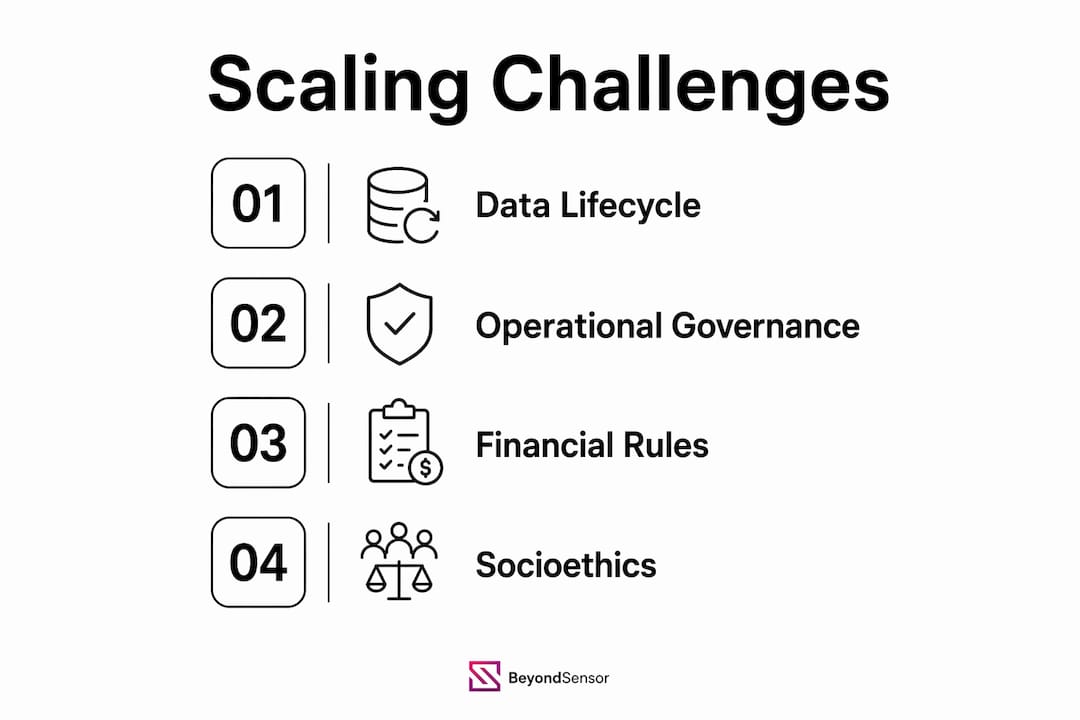
The core challenges fall into four categories.
Data lifecycle and interoperability present the first barrier. Sensors from different vendors produce data in different formats. Without agreed standards and integration architecture, data silos form quickly. Procurement teams must specify interface requirements and data retention policies before signing contracts, not after deployment.
Operational governance is the second challenge. Scaling beyond pilots requires cyber-physical systems with coordinated sensing, communication, analytics, and automated control layers, all governed by clear operational protocols. Technology alone does not create resilience. Defined ownership, escalation paths, and maintenance responsibilities do.
Financial and regulatory considerations add complexity. Long-term data management costs, cybersecurity compliance, and cross-agency ownership agreements require legal and financial frameworks that most infrastructure procurement processes are not designed to handle.
Socio-ethical factors round out the challenge set. Sensor networks in public spaces generate privacy concerns. Implementing smart infrastructure for sustainable urban development requires addressing interoperability and governance alongside climate resilience goals. Planners who treat these as secondary issues typically face community opposition or regulatory delays that stall deployment.
Pro Tip: Build a cross-agency data governance charter before the first sensor goes in the ground. Define who owns the data, who can access it, how long it is retained, and what happens when a vendor contract ends. This single document prevents the majority of scaling failures.
Key Takeaways
Smart infrastructure delivers measurable gains in efficiency, safety, and sustainability only when sensors, AI, BIM, and operational governance are deployed together as an integrated system.
| Point | Details |
|---|---|
| Definition is precise | Smart infrastructure integrates sensors, IoT, AI, BIM, and real-time analytics into physical assets. |
| BIM is non-negotiable | Without BIM providing asset context, sensor data cannot drive targeted maintenance decisions. |
| Four operating principles | Data acquisition, analysis, feedback, and adaptability define how intelligent infrastructure functions. |
| Governance drives scale | Technology pilots succeed; programs fail when data governance and interoperability are not planned upfront. |
| Applications are cross-domain | Transport, energy, buildings, water, and environmental monitoring all benefit from the same core architecture. |
Why governance is the real frontier in smart infrastructure
My experience working across infrastructure technology deployments in Southeast Asia has taught me one consistent lesson: the technology is rarely the problem. The governance is.
Planners and engineers spend months evaluating sensor specifications and AI platforms. They spend days on data ownership agreements. That imbalance is where programs stall. I have seen well-funded smart city pilots in Singapore and Malaysia deliver impressive dashboards that no one acts on, because no agency has clear authority to trigger a maintenance response based on what the system flags.
The World Economic Forum's framing of intelligent infrastructure as a "living ecosystem" is accurate, but it undersells the organizational complexity. A living ecosystem requires a metabolism. In infrastructure terms, that metabolism is the governance layer: who interprets the data, who owns the response, and who funds the ongoing operation after the project ribbon-cutting.
BIM is the piece most planners underestimate. A digital twin without BIM context is just a visualization. With BIM, every sensor reading maps to a specific beam, pipe, or circuit. That specificity is what turns monitoring into predictive maintenance. Without it, you are watching numbers change without knowing what to do about them.
The future I find genuinely exciting is multi-scale digital twins that connect building-level data to district-level and city-level models. AI-enhanced predictive models will eventually allow planners to simulate the downstream effects of a single infrastructure decision across an entire urban system before committing capital. That capability is closer than most procurement cycles acknowledge. The teams that build their data governance foundations now will be the ones positioned to use it.
— Eumir
Beyondsensor's approach to intelligent infrastructure sensing
Beyondsensor builds the sensor and AI layer that intelligent infrastructure programs depend on. Their solutions cover real-time monitoring, predictive maintenance, and adaptive decision-making across industrial, environmental, and urban security applications.

For system integrators and government agencies deploying smart infrastructure, Beyondsensor provides AI-driven analytics and sensor integration designed for the operational demands of large-scale programs. Their regional presence across Singapore, Malaysia, and the Philippines means deployments receive localized validation, not generic specifications. Teams building toward intelligent infrastructure can also review Beyondsensor's sensor and AI innovations to identify where high-precision sensing fits their specific asset portfolio. The security and AI-driven protection capabilities Beyondsensor delivers align directly with the cyber-physical integration requirements that large-scale smart infrastructure programs demand.
FAQ
What is the smart infrastructure definition?
Smart infrastructure is the integration of sensors, IoT devices, AI, BIM, and real-time analytics into physical assets such as roads, buildings, and energy networks to enable adaptive, data-driven management. The industry also refers to this as intelligent infrastructure.
How does smart infrastructure sensing work?
Sensors collect continuous physical measurements from assets, which are transmitted via 5G or cloud networks to AI analytics platforms that identify patterns and trigger automated responses or maintenance alerts. BIM provides the asset context that maps sensor data to specific components.
Why use smart infrastructure over traditional systems?
Traditional infrastructure operates on fixed schedules and reactive maintenance. Smart infrastructure uses real-time data and AI to detect failures before they occur, reduce energy consumption, and improve safety outcomes across buildings, transport, and utilities.
What are examples of smart infrastructure solutions in practice?
The EU-funded SMARTIN project applies AI and real-time analytics to transport incident detection across multiple cities. Smart buildings use occupancy and environmental sensors to adjust HVAC and lighting automatically. Urban water networks deploy acoustic sensors to detect leaks before pipe failure.
What is the biggest challenge in scaling smart infrastructure?
Governance and interoperability are the primary barriers. Technology pilots regularly succeed, but programs fail when data ownership, cross-agency coordination, and long-term integration architecture are not defined before deployment begins.
Recommended
- Streamline smart infrastructure security: a step-by-step guide | News | BeyondSensor
- The Role of Sensors in Infrastructure: 2026 Guide | News | BeyondSensor
- Emerging Smart Sensor Applications for Industry in 2026 | News | BeyondSensor
- Intelligent sensing deployment process: A guide for tech leaders | News | BeyondSensor
Read More Articles
RTSP Security Risks: Integrators Must Block Exposed Ports 554 and 8554
See how integrators can reduce RTSP security risks: close exposed ports 554 and 8554, secure camera access, and verify each deployment with practical checks.

Require MAEpp and X Accuracy Before You Buy People Counting Systems
Verify people counting accuracy by demanding MAEpp, X Accuracy, and directional-bias reports. Validate on-site with at least 100 events per direction...
30–90 Day Pilot Validates Redundant Camera Networks for Engineers
Standards led, practical steps for engineers to deploy redundant camera networks: MRP, dual homing, and aggregation patterns, commissioning checks, and...

30 Day Pilot Proves Video Analytics Accuracy for Security Teams
Validate video analytics accuracy with scenario tests, camera tuning, transfer learning and a 30 day edge first pilot for security teams.
Let's Build YourSecurity Ecosystem.
Whether you're a System Integrator, Solution Provider, or an End-User looking for trusted advisory, our team is ready to help you navigate the BeyondSensor landscape.
Direct Advisory
Connect with our regional experts for tailored solutioning.