
Discover what is multi-sensor integration and how it enhances security systems. Learn to implement it correctly for optimal performance.

What Is Multi-Sensor Integration for Security Pros

TL;DR:
- Multi-sensor integration aggregates raw data from different sensors into a unified, accessible environment, enabling reliable security operations. It differs from sensor fusion, which applies algorithms to produce decision support from normalized data. Proper integration is essential for accurate, fault-tolerant security systems, especially when using multiple sensor modalities.
Multi-sensor integration is defined as the infrastructure-level process of aggregating data from disparate sensors into a unified environment, giving security and technology systems a coherent, real-time picture of their operational space. Security professionals who confuse this process with sensor fusion routinely design systems that underperform or fail outright. Understanding what multi-sensor integration actually is, how it differs from fusion, and how to implement it correctly is the foundation of any reliable, high-performance security deployment.
What is multi-sensor integration and how does it work?
Multi-sensor integration is an infrastructure problem, not a computation problem. The process collects raw data streams from cameras, radar, LiDAR, motion detectors, infrared sensors, and environmental monitors, then routes them into a shared data environment where they can be accessed, logged, and acted upon. The goal at this stage is coherence and availability, not mathematical inference.
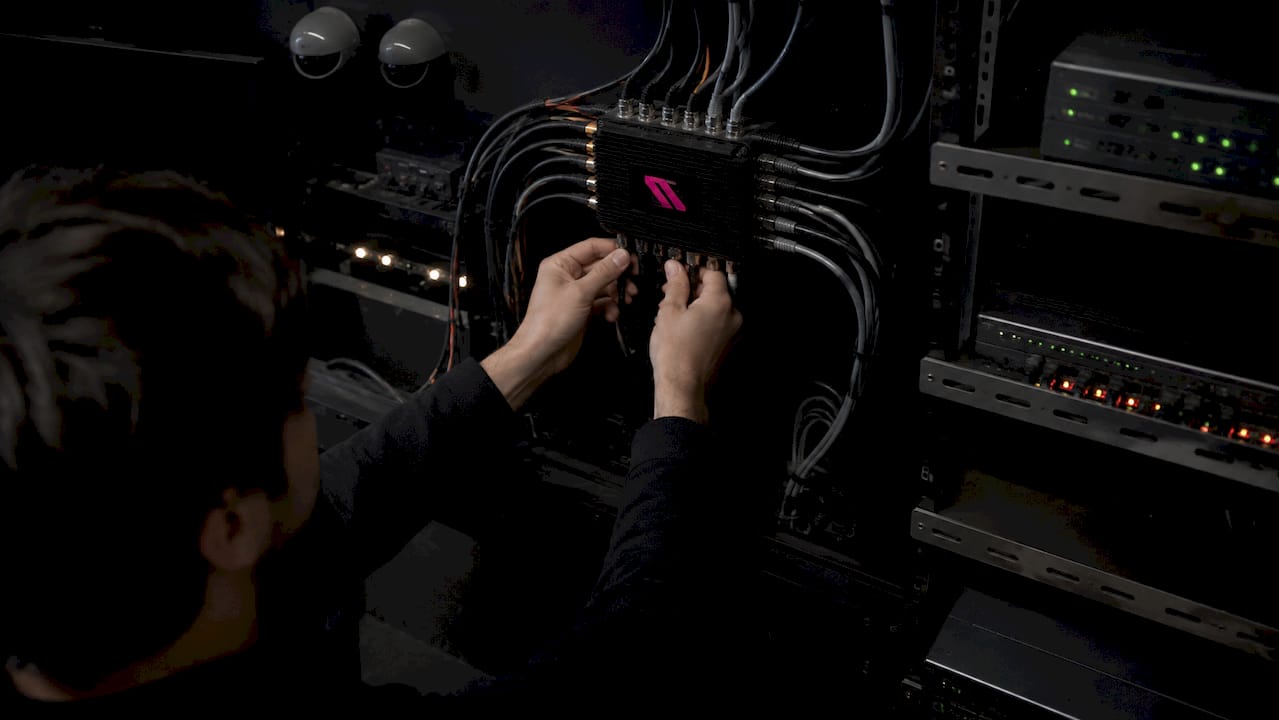
The technical backbone of integration typically includes middleware layers, APIs, and communication protocols such as CAN bus, I2C, and Ethernet. These components handle the translation of heterogeneous data formats into a common schema. Without this normalization step, downstream analytics and fusion algorithms receive incompatible inputs and produce unreliable outputs.
Multi-sensor networking extends this concept across distributed sites. A facility with access control readers, perimeter radar, and indoor cameras across multiple buildings requires a network architecture that synchronizes all data streams to a shared time reference. Latency mismatches as small as a few milliseconds can corrupt event correlation in high-speed security scenarios.
What is the difference between multi-sensor integration and sensor fusion?
The distinction between integration and fusion is the most misunderstood concept in sensor system design. Integration manages data infrastructure; fusion creates decision support. Treating them as interchangeable is the single most common cause of failed sensor projects.
| Dimension | Multi-sensor integration | Sensor fusion |
|---|---|---|
| Core function | Aggregates and normalizes data streams | Produces probabilistic situational estimates |
| Problem type | Infrastructure and data management | Computational estimation and inference |
| Output | Unified data environment | Fused situational model or decision |
| Algorithms used | Middleware, APIs, protocols | Kalman filtering, Bayesian inference |
| Complexity level | Moderate, engineering-focused | High, mathematically intensive |
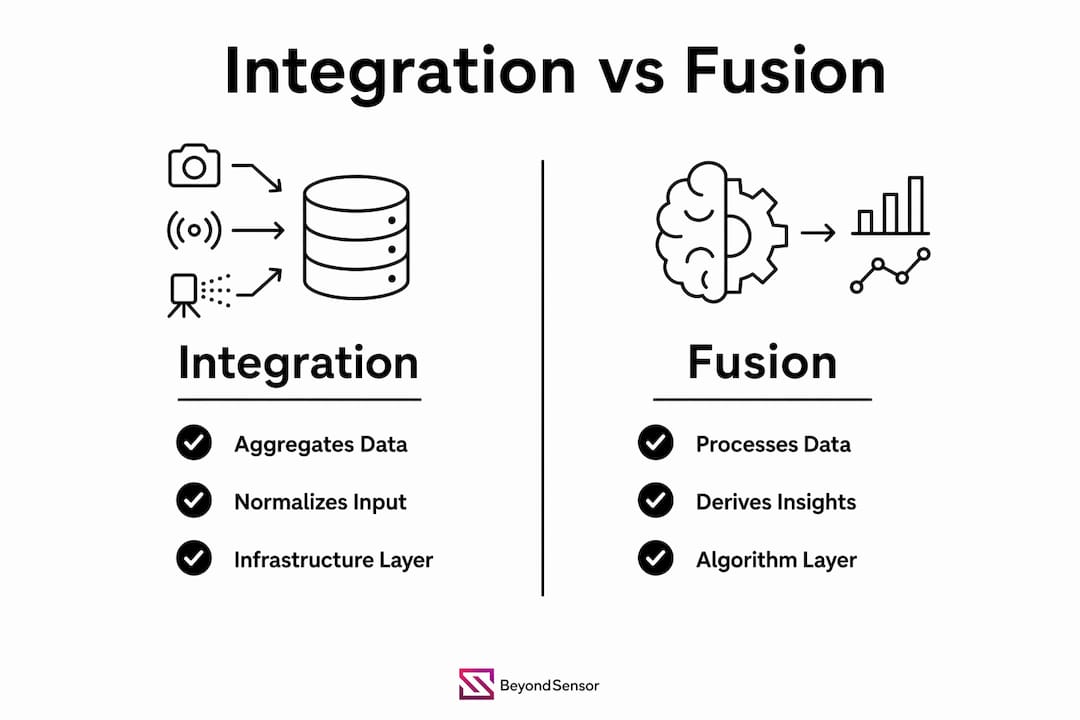
A building management system that logs temperature, motion, and access events into a single dashboard is performing integration. A system that uses Bayesian inference to estimate whether an anomaly is a genuine intrusion or an HVAC fault is performing fusion. Both are necessary, but they operate at different layers.
The IEEE and the JDL data fusion model both treat fusion as a multi-level process operating on pre-integrated data. The JDL model defines Level 0 through Level 4 fusion, each requiring clean, synchronized inputs that only a well-designed integration layer can provide.
Pro Tip: Design your integration layer first and document its data schema before writing a single line of fusion code. Retrofitting integration architecture after fusion logic is built costs significantly more time and budget.
What sensor modalities are commonly integrated in security systems?
No single sensor type is sufficient for unpredictable real-world environments. Each modality has specific blind spots, failure modes, and environmental sensitivities that only complementary sensors can cover.
Common sensor types integrated in security and technology deployments include:
- Cameras (visible light): High-resolution identification, but blind in darkness and degraded by fog or glare.
- Thermal infrared sensors: Detect heat signatures through darkness and light fog, but cannot resolve fine detail for identification.
- Radar: Reliable motion detection through rain, dust, and complete darkness, but produces no visual confirmation.
- LiDAR: Precise spatial mapping and object detection, but expensive and sensitive to heavy precipitation.
- Motion detectors (PIR): Low-cost perimeter alerting, but high false alarm rates from animals and environmental movement.
- Biometric sensors: Accurate identity verification at access points, but limited to controlled entry scenarios.
- Environmental sensors: Monitor temperature, humidity, and air quality, providing context that explains anomalous readings from other sensors.
The complementary nature of these modalities is what makes multi-sensor systems genuinely more reliable than any single sensor. A radar alert at a perimeter fence, cross-referenced with a thermal camera showing a human heat signature, produces a far more credible alarm than either sensor alone.
Data characteristics also vary significantly across modalities. Cameras generate high-bandwidth video streams. PIR sensors produce simple binary event signals. LiDAR outputs dense point clouds. A well-designed integration layer handles these differences in sampling rate, data format, and latency without losing temporal alignment.
What are the key architectures and techniques for multi-sensor integration?
Middleware, synchronization, signal processing, and edge computing are the four architectural pillars of any production-grade multi-sensor integration system. Each addresses a specific failure mode that emerges when heterogeneous sensors share a data environment.
-
Middleware and API design. Middleware translates proprietary sensor protocols into a common data format. ONVIF is a widely used standard for IP cameras. Custom APIs handle non-standard sensors. The middleware layer is where format normalization happens, and its design determines how easily new sensors can be added later.
-
Time synchronization. All sensors must share a common time reference. Network Time Protocol (NTP) or Precision Time Protocol (PTP) synchronizes clocks across devices. Without synchronization, event correlation across sensors is unreliable, and false alarm rates increase.
-
Data buffering and bandwidth management. High-bandwidth sensors like cameras and LiDAR can saturate network links. Buffering strategies, compression, and prioritized data routing prevent bottlenecks. Edge processing reduces the volume of raw data sent to central servers by filtering and pre-processing at the sensor level.
-
Edge computing and firmware design. Precise edge computing and careful firmware design are non-negotiable for real-time responsiveness. Processing data at the edge reduces latency and maintains system performance even when network connectivity is degraded.
-
Calibration and sensor interoperability. Sensors must be calibrated relative to each other so their data aligns spatially and temporally. A camera and a radar unit covering the same zone must agree on coordinate systems before their outputs can be meaningfully compared.
Pro Tip: Use a modular integration architecture that treats each sensor type as a plug-in module. This makes it straightforward to swap out a failing sensor or add a new modality without rebuilding the entire data pipeline.
How does multi-sensor integration reduce false alarms in security environments?
False alarms are the primary operational cost of poorly designed security systems. Multi-sensor integration reduces false positive and negative rates by weighting sensor outputs according to their calibrated reliability and cross-validating events across modalities before triggering an alert.
The mechanism works as follows:
- A PIR sensor detects motion and generates a potential alert.
- The integration layer queries the camera feed covering the same zone.
- The camera confirms or denies a human presence.
- The radar confirms directional movement consistent with a person.
- Only when two or more modalities agree does the system escalate the alert.
This cross-validation approach eliminates the majority of single-sensor false alarms caused by animals, environmental movement, or sensor noise. Security teams respond to fewer alerts, and each alert they do receive carries higher confidence.
"Cross-verification among sensors is key for fault tolerance, especially in safety-critical security environments." — Techietory, Why Do Robots Need Multiple Sensors?
Fault tolerance is the second major benefit. When one sensor fails or is obscured, the integration layer flags the gap and continues operating on data from the remaining modalities. A camera blinded by spray paint does not disable the entire perimeter system when radar and thermal sensors remain active. This redundancy is what separates a professional security deployment from a single-point-of-failure installation. For a detailed look at how sensor integration strategies apply to real security infrastructure, Beyondsensor's published guidance covers the operational specifics.
What challenges do security professionals face when implementing multi-sensor integration?
The complexity of managing heterogeneous sensor inputs is consistently underestimated. Security professionals who have deployed single-sensor systems often assume that adding more sensors scales linearly. It does not.
-
Timing and format inconsistency. Different sensors use different clocks, sampling rates, and data formats. Aligning them requires deliberate engineering, not just plugging devices into a shared network.
-
Hardware and firmware constraints. Older sensors may not support modern protocols or time synchronization standards. Integrating legacy hardware with new sensors requires custom adapters or protocol translators.
-
Power and computational resource limits. Edge devices have finite processing power. Running multiple sensor streams through a single edge node requires careful load balancing to avoid dropped data or processing delays.
-
Calibration drift. Sensors lose calibration over time. A camera that shifts slightly on its mount, or a radar unit affected by temperature changes, will produce data that no longer aligns with adjacent sensors. Regular recalibration schedules are mandatory, not optional.
-
Confusing integration with fusion. Many projects fail by treating a unified sensor dashboard as an intelligent automated system. A dashboard that displays all sensor feeds is integration. A system that automatically determines threat level from those feeds is fusion. Conflating the two leads to unrealistic expectations and underbuilt infrastructure.
Scalable systems separate these concerns from the start. The integration layer handles data collection, normalization, and routing. The fusion and analytics layer sits above it and consumes clean, synchronized data. This separation makes both layers easier to maintain, upgrade, and audit independently.
Key Takeaways
Multi-sensor integration is the foundational infrastructure layer that makes advanced security analytics, fault-tolerant operations, and reliable false alarm reduction possible.
| Point | Details |
|---|---|
| Integration vs. fusion | Integration manages data infrastructure; fusion produces probabilistic situational estimates from that data. |
| Sensor complementarity | No single modality covers all failure modes; combining cameras, radar, thermal, and LiDAR fills critical gaps. |
| Architecture essentials | Middleware, time synchronization, edge computing, and calibration are required for production-grade systems. |
| False alarm reduction | Cross-validating alerts across two or more sensor modalities eliminates the majority of single-sensor false positives. |
| Common failure point | Projects fail when teams conflate a unified data dashboard with an intelligent automated system. |
Why integration clarity determines project success
I have reviewed sensor system designs where the integration layer was an afterthought, built after the fusion algorithms were already written. Every one of those projects hit the same wall: the fusion logic was mathematically sound, but the data feeding it was misaligned, inconsistently formatted, and temporally unreliable. The fusion outputs were garbage because the integration layer was not designed to the same standard.
The industry is moving toward edge AI and Vision Language Models (VLMs) for real-time security analysis. That trend makes clean integration architecture more critical, not less. An AI model analyzing multi-modal sensor data is only as good as the data pipeline beneath it. If the integration layer drops packets, misaligns timestamps, or fails to normalize formats, the AI produces confident but wrong conclusions.
My practical advice: treat integration as a first-class engineering discipline. Assign dedicated resources to it. Document the data schema before touching fusion or analytics. And resist the pressure to demo a unified dashboard as proof that the system is "working." A dashboard is the beginning of integration, not the end of it. The real test is whether your system maintains accurate, synchronized, cross-validated data under real-world conditions, including sensor failures, network interruptions, and environmental interference.
The professionals who get this right build systems that last. The ones who skip it spend years patching a foundation that was never solid.
— Eumir
How Beyondsensor helps security teams build reliable sensor systems
Beyondsensor works with security managers, system integrators, and government agencies across Singapore, Malaysia, and the Philippines to design and deploy sensor-based security infrastructure that performs under real-world conditions.
Beyondsensor's platform covers the full integration stack, from hardware selection and firmware design to middleware architecture and advanced sensor deployment. Their team provides localized validation and technical support for regional deployments, ensuring that multi-sensor systems meet both operational requirements and compliance standards. Security professionals who want to understand how sensor fusion technology builds on a solid integration foundation will find Beyondsensor's published resources a practical starting point. For direct consultation on your next integration project, visit Beyondsensor.
FAQ
What is multi-sensor integration in simple terms?
Multi-sensor integration is the process of collecting data from multiple different sensors and routing it into a single, unified system. It is an infrastructure problem focused on data aggregation, normalization, and availability.
How is multi-sensor integration different from sensor fusion?
Integration aggregates and normalizes raw sensor data streams; fusion applies algorithms like Kalman filtering or Bayesian inference to that data to produce probabilistic situational estimates. Fusion depends on integration but operates at a higher computational layer.
Why do security systems need multiple sensors?
No single sensor type covers all environmental conditions and failure modes. Combining cameras, radar, thermal, and motion sensors provides cross-verification, fault tolerance, and coverage that no individual modality can match.
What are the biggest challenges in sensor integration?
Time synchronization, format normalization, calibration drift, and hardware compatibility are the most common technical obstacles. The most damaging non-technical challenge is confusing a unified data dashboard with a fully fused, intelligent security system.
Can multi-sensor integration work with legacy security hardware?
Yes, but it requires custom protocol adapters or middleware translators to bridge older proprietary formats with modern integration architectures. Legacy hardware integration adds cost and complexity, and recalibration schedules become more demanding.
Recommended
- Sensor Integration Strategies for Security and Efficiency | News | BeyondSensor
- Step-by-Step Security Integration: Advanced Sensor Guide | News | BeyondSensor
- Streamline physical security integration: 5 key steps | News | BeyondSensor
- Sensor Integration Architecture Explained for System Architects | News | BeyondSensor
Read More Articles
RTSP Security Risks: Integrators Must Block Exposed Ports 554 and 8554
See how integrators can reduce RTSP security risks: close exposed ports 554 and 8554, secure camera access, and verify each deployment with practical checks.
Require MAEpp and X Accuracy Before You Buy People Counting Systems
Verify people counting accuracy by demanding MAEpp, X Accuracy, and directional-bias reports. Validate on-site with at least 100 events per direction...
30–90 Day Pilot Validates Redundant Camera Networks for Engineers
Standards led, practical steps for engineers to deploy redundant camera networks: MRP, dual homing, and aggregation patterns, commissioning checks, and...
30 Day Pilot Proves Video Analytics Accuracy for Security Teams
Validate video analytics accuracy with scenario tests, camera tuning, transfer learning and a 30 day edge first pilot for security teams.
Let's Build YourSecurity Ecosystem.
Whether you're a System Integrator, Solution Provider, or an End-User looking for trusted advisory, our team is ready to help you navigate the BeyondSensor landscape.
Direct Advisory
Connect with our regional experts for tailored solutioning.