
Discover the role of data privacy in security. Learn how effective governance reduces risks and strengthens your security strategy.

The Role of Data Privacy in Security Strategy

TL;DR:
- Data privacy governs what data organizations collect, why, and how long they keep it. Proper privacy governance reduces breach risks, regulatory fines, and reputational damage. Treating privacy as a strategic asset can enhance market trust and streamline procurement processes.
Data privacy is defined as the governance framework that determines what data an organization collects, why it collects it, and how long it keeps it. This framework sits at the foundation of every effective security strategy. Without it, security teams protect data they should never have stored in the first place. The role of data privacy in security is not decorative compliance. It is the first line of defense against breaches, regulatory fines, and reputational damage. At least 375 million people in the U.S. were affected by data breaches in 2025. That number proves that technical security controls alone are not enough.
How does data privacy affect security risk management?

Privacy governance directly reduces breach probability and limits breach impact. Purpose limitation and retention schedules act as non-technical security controls by shrinking the volume of data that attackers can reach. Less data stored means fewer records exposed when a breach occurs.
Organizations that collect data without clear purpose create a compounding problem. Outdated records, duplicate files, and forgotten databases all expand the attack surface. Dormant or excessive data is a security liability, not just a compliance issue. Minimizing stored data reduces both external breach impact and insider threat risk.
Poor privacy governance also amplifies the severity of incidents that do occur. When a breach hits a system holding five years of unnecessary customer records, the legal exposure multiplies. Regulators measure harm by the volume and sensitivity of data exposed. Keeping only what you need, for only as long as you need it, is a concrete security measure.
Key privacy controls that reduce security risk include:
- Purpose limitation: Collect data only for a defined, documented reason. This prevents data sprawl across systems.
- Retention schedules: Delete or anonymize data after its useful life ends. Stale data is a target with no operational value.
- Data minimization: Collect the minimum fields required. Fewer data points mean fewer breach consequences.
- Access controls tied to purpose: Restrict who can reach data based on documented business need, not job title alone.
- Regular data audits: Map what data exists, where it lives, and whether its collection is still justified.
Pro Tip: Run a quarterly data inventory review. Identify datasets with no active business purpose and schedule them for deletion. This single practice reduces your attack surface faster than most technical controls.
What is the governance vs. enforcement split in data protection?
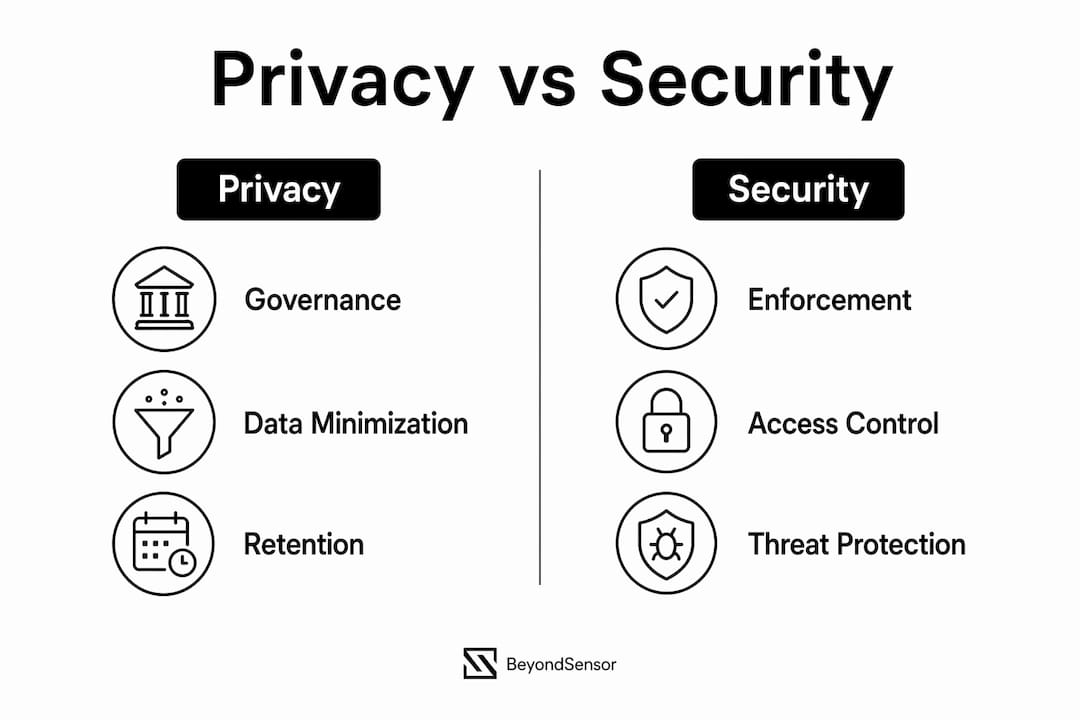
Privacy is the governance layer that defines what data should exist and how it may be used. Security is the enforcement layer that prevents unauthorized access to that data. These are distinct functions. Conflating them creates gaps in both compliance and protection.
The clearest way to understand the split is through two questions. Privacy asks: "Should we have this data at all?" Security asks: "How do we stop unauthorized access to the data we have?" When a single team answers both questions, one function almost always dominates. Security teams tend to focus on technical controls and treat privacy as a checkbox. Privacy teams tend to focus on policy and underestimate technical enforcement.
| Function | Core question | Primary controls |
|---|---|---|
| Data privacy | Should we collect and keep this data? | Purpose limitation, retention policy, lawful basis |
| Data security | How do we protect data from unauthorized access? | Encryption, MFA, access controls, monitoring |
| Overlap zone | Is our data handling both lawful and protected? | Privacy impact assessments, security audits |
Treating data protection as a subset of security increases regulatory risk. Organizations can lock every door technically and still face major fines because they cannot justify why they processed certain data. A Czech data protection authority issued a €1 million fine to Avast Software in 2024 for exactly this reason. The security was adequate. The lawful basis for processing was not.
Security provides the baseline necessary for privacy compliance, but privacy governance is needed to ensure lawful processing. Aligning these functions without merging them is the operational goal. Clear ownership prevents each team from assuming the other has covered a critical control.
Pro Tip: Assign a named owner to each data category in your organization. The privacy team owns the lawful basis and retention schedule. The security team owns the access controls and encryption. Document both in a shared data register so neither function operates blind.
How can privacy become a competitive advantage?
Companies now view data privacy as a growth strategy linked to brand value, customer trust, and market competitiveness. An analysis of 360 corporate announcements found that organizations framing privacy as a strategic asset outperformed peers on trust metrics. This is a measurable business outcome, not a philosophical position.
The mechanism is straightforward. Customers and partners increasingly evaluate vendors on their data handling practices before signing contracts. Government agencies and regulated industries require documented privacy programs as a procurement condition. Organizations that treat privacy as a governance discipline rather than a legal burden move faster through procurement cycles.
Privacy failures weaken security posture and business reputation simultaneously. Excessive data collection creates more attack surfaces. Each additional data point stored is a liability in a breach scenario. The organizations that collect less, document more, and delete consistently are the ones that recover fastest from incidents.
The concept of data sovereignty reinforces this point. When organizations treat personal data as a shared responsibility rather than an asset to exploit, they build governance structures that are harder to breach and easier to defend in regulatory proceedings. Privacy, viewed this way, is collective stewardship. It benefits the organization and the individuals whose data it holds.
Practical advantages of treating privacy as a strategic asset include:
- Faster enterprise sales cycles where privacy documentation is a procurement requirement
- Reduced regulatory scrutiny from authorities like the FTC, GDPR supervisory bodies, and HIPAA enforcement offices
- Lower breach remediation costs because less data is exposed when incidents occur
- Stronger partner relationships with system integrators and government agencies that require compliance evidence
- Improved employee trust when internal data handling policies are transparent and enforced
What practical steps align privacy and security teams?
Organizations succeed when security handles technical enforcement and privacy handles lawful purpose and retention policy. Collapsing these functions creates gaps that neither team catches. The fix is structural, not cultural.
-
Define ownership explicitly. Create a data register that lists every data category, its lawful basis, its retention period, and its access controls. Assign a named owner from the privacy team and a named owner from the security team for each category.
-
Map complementary controls. Privacy controls (purpose limitation, retention schedules, data minimization) and security controls (multi-factor authentication, encryption, network segmentation) address different risks. Document both sets side by side so gaps are visible.
-
Conduct joint audits. Run quarterly reviews where privacy and security teams assess the same data categories together. Privacy checks whether the data is still lawfully held. Security checks whether access controls remain appropriate. Neither team audits in isolation.
-
Implement privacy impact assessments before new projects. Any new data collection initiative should pass a privacy review before security architecture is designed. This prevents building secure systems around data that should never have been collected.
-
Train both teams on each other's frameworks. Security professionals benefit from understanding GDPR's lawful basis requirements and HIPAA's minimum necessary standard. Privacy professionals benefit from understanding how access logs and encryption work. Cross-training reduces the assumption that the other team has covered a gap.
-
Review policy exceptions regularly. Every policy exception is a potential breach point. Maintain a log of exceptions, the business justification, and a review date. Exceptions that outlive their justification become vulnerabilities.
Pro Tip: Use data analytics in security operations to identify access patterns that conflict with documented data purpose. If a dataset is accessed by teams outside its stated purpose, that is both a privacy violation and a security signal.
Key Takeaways
Data privacy and security are distinct but inseparable functions. Organizations that align both governance and enforcement reduce breach risk, regulatory exposure, and remediation costs simultaneously.
| Point | Details |
|---|---|
| Privacy is governance, security is enforcement | Keep these functions separate to avoid compliance gaps and technical blind spots. |
| Data minimization reduces attack surface | Storing only necessary data limits breach impact and insider threat exposure. |
| Conflating roles creates regulatory risk | Organizations can be technically secure yet face major fines for lacking lawful data processing justification. |
| Privacy drives competitive advantage | Documented privacy programs accelerate enterprise sales and reduce regulatory scrutiny. |
| Joint audits close coverage gaps | Privacy and security teams reviewing the same data together catch what neither catches alone. |
Why I think most organizations still get this backwards
After working across physical security deployments and digital infrastructure projects, the pattern I see most often is this: security teams are well-funded, well-staffed, and technically capable. Privacy teams are understaffed, treated as a legal function, and consulted after architecture decisions are already made. That sequence is the root cause of most compliance failures I have observed.
The uncomfortable truth is that a technically excellent security program built on top of unjustified data collection is a liability, not an asset. You can encrypt everything, enforce multi-factor authentication across every system, and still face a regulatory enforcement action because you kept data longer than your stated purpose required. The Czech authority's €1 million fine against Avast is not an outlier. It is a preview of where enforcement is heading globally.
What I have found actually works is treating privacy governance as a prerequisite, not a parallel track. Before any new sensor deployment, surveillance system, or data pipeline goes live, the privacy question must be answered first. What data will this system generate? Who is authorized to access it? When does it get deleted? Security architecture follows those answers. It does not precede them.
The organizations I have seen handle this well share one trait. They have a shared data register that both privacy and security teams maintain and review together. That single artifact forces the conversation that most organizations avoid. Physical security best practices and privacy governance are not in tension. They reinforce each other when the ownership structure is clear.
Privacy as collective stewardship is not a soft concept. It is an operational discipline that reduces your attack surface, speeds up your procurement cycles, and keeps regulators from making examples of your organization.
— Eumir
How Beyondsensor supports privacy-aware security programs
Security leaders building privacy-conscious programs need technology that is designed with data governance in mind from the start, not bolted on after deployment.

Beyondsensor builds sensor-based security solutions for system integrators, government agencies, and enterprise security teams across Singapore, Malaysia, and the Philippines. Their AI solutions for system integrators are designed to align technical enforcement with privacy governance requirements, so deployments meet both security and compliance standards from day one. Beyondsensor's security tools give security professionals the infrastructure to manage data collection, access controls, and retention policies within a single operational framework. For organizations that need scalable, compliant security architecture, Beyondsensor is a practical starting point.
FAQ
What is the role of data privacy in security?
Data privacy is the governance layer that defines what data an organization collects, why, and for how long. Security enforces protection of that data against unauthorized access. Both functions are required for a complete security program.
How does data privacy affect cybersecurity risk?
Privacy policies like purpose limitation and retention schedules reduce the volume of data at risk. Less stored data means smaller breach impact and fewer insider threat opportunities.
Why is it risky to treat privacy as a subset of security?
Organizations that treat data protection as a security subset can be technically secure but legally exposed. Regulatory fines follow when data is processed without a lawful basis, regardless of how well it is protected technically.
What are the best practices for data privacy in security programs?
The most effective practices are data minimization, documented retention schedules, joint privacy and security audits, and clear ownership of each data category across both teams.
How does privacy governance build competitive advantage?
An analysis of 360 corporate announcements found that organizations treating privacy as a growth strategy gained measurable trust and brand value advantages. Documented privacy programs also accelerate procurement with regulated-industry clients.
Recommended
- The Role of Data Analytics in Security Operations | News | BeyondSensor
- Security data analytics checklist: Boost facility safety | News | BeyondSensor
- Security compliance: why it matters and how to master it | News | BeyondSensor
- Physical security best practices: strategies for safer facilities | News | BeyondSensor
Read More Articles
RTSP Security Risks: Integrators Must Block Exposed Ports 554 and 8554
See how integrators can reduce RTSP security risks: close exposed ports 554 and 8554, secure camera access, and verify each deployment with practical checks.

Require MAEpp and X Accuracy Before You Buy People Counting Systems
Verify people counting accuracy by demanding MAEpp, X Accuracy, and directional-bias reports. Validate on-site with at least 100 events per direction...

30–90 Day Pilot Validates Redundant Camera Networks for Engineers
Standards led, practical steps for engineers to deploy redundant camera networks: MRP, dual homing, and aggregation patterns, commissioning checks, and...

30 Day Pilot Proves Video Analytics Accuracy for Security Teams
Validate video analytics accuracy with scenario tests, camera tuning, transfer learning and a 30 day edge first pilot for security teams.
Let's Build YourSecurity Ecosystem.
Whether you're a System Integrator, Solution Provider, or an End-User looking for trusted advisory, our team is ready to help you navigate the BeyondSensor landscape.
Direct Advisory
Connect with our regional experts for tailored solutioning.