
Discover why precision sensing matters for security operations. Learn how accurate data prevents costly failures and enhances safety.

Why Precision Sensing Matters for Security Operations

TL;DR:
- Precision sensing provides highly accurate and stable measurements essential for safe and reliable system decisions. Small sensor errors can lead to costly system failures by propagating through layered alarm and control logic. Advancements in nanometer sensors, quantum sensing, and sensor fusion now enable unprecedented accuracy, improving security and industrial operations.
Precision sensing is defined as the capture of highly accurate, stable measurements that drive reliable safety and operational decisions in industrial and security environments. When sensor data drifts even slightly, automated systems misread conditions, alarms fire incorrectly, and maintenance teams act on false signals. The importance of precision sensing shows up most clearly when things go wrong: a 1%–3% error in a single sensor reading can cascade through alarm logic and trigger a chain of costly failures. For security professionals and industrial decision-makers, understanding high-precision sensing explained in practical terms is not optional. It is the foundation of every automated system you trust.
Why precision sensing matters: the cost of small errors
Small sensor errors cause large operational failures. Sensor data errors of 1%–3% can shift maintenance decisions from corrective to counterproductive, triggering false interventions in industrial environments. A motor that reads slightly cooler than it actually runs may never receive the maintenance it needs until it fails completely.
The problem compounds because small deviations propagate non-linearly through layered alarm and maintenance logic. Each downstream system trusts the upstream reading. When that reading is wrong, every dependent decision inherits the error. In a facility security context, this means a perimeter sensor reporting slightly off-range temperature or motion data can suppress a real alert or generate dozens of false ones.
Error sources extend beyond the sensor hardware itself. Connector interfaces, electromagnetic interference, thermal cycling, and sensor aging all degrade measurement quality over time. A sensor that performs within specification on day one may drift significantly after six months of outdoor exposure or industrial vibration.
| Error magnitude | Typical operational impact |
|---|---|
| 0.5% deviation | Minor calibration flag; no immediate action required |
| 1%–3% deviation | False maintenance triggers; suppressed or spurious alarms |
| 3%–5% deviation | Incorrect process control decisions; elevated downtime risk |
| Above 5% deviation | System-level failures; safety incidents possible |
Pro Tip: Evaluate system-level precision, not just the component datasheet. A sensor rated at 0.1% accuracy can perform at 3% error in the field if the installation environment, cabling, and interface electronics are not accounted for.
What technologies are enabling ultra-high precision sensing?
The most significant advances in high-precision sensing come from three areas: nanometer-resolution sensors, quantum sensing, and sensor fusion. Each addresses a different failure mode in classical measurement systems.

Advanced industrial sensors now achieve nanometer-level resolution, with some capacitive sensors and laser interferometry systems reaching 0.1 nanometers. That level of accuracy meets the tolerances required in semiconductor lithography and precision robotics. For security professionals, the practical implication is that the same sensor physics enabling chip manufacturing now powers sub-millimeter intrusion detection and structural monitoring.
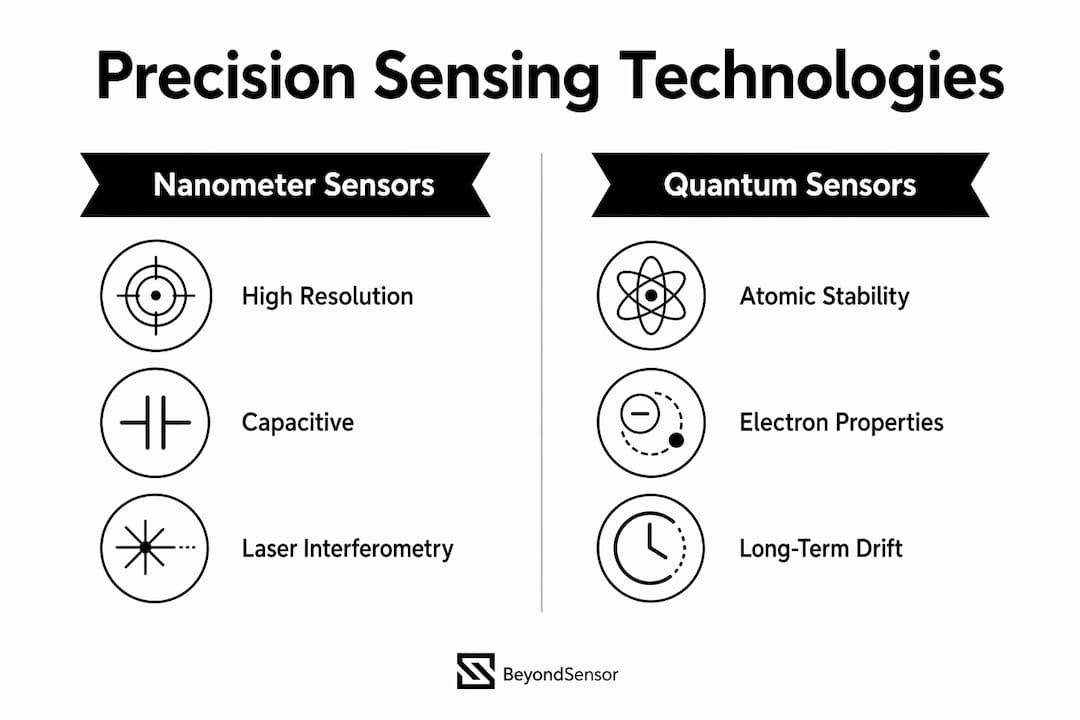
Quantum sensors take stability a step further. Quantum sensors use atomic and electron properties as ultra-stable measurement references, preventing the drift that plagues classical spring or coil sensors over time. Classical sensors require frequent recalibration under environmental stress. Quantum sensors reduce that burden significantly, making them attractive for long-term deployments in critical infrastructure.
Sensor fusion addresses the reliability gap in autonomous and complex environments. Autonomous mobility systems have shifted accuracy from meter-level to centimeter-level by combining inertial measurement, satellite positioning, and vision data. That same fusion principle applies directly to facility security monitoring, where combining radar, thermal, and optical sensors produces far more reliable detections than any single modality.
Key technologies and their practical benefits for security and industrial teams:
- Laser interferometry: Sub-nanometer displacement measurement for structural health monitoring and precision manufacturing
- Capacitive sensing: High-resolution, non-contact measurement ideal for harsh industrial environments
- Quantum sensors: Drift-free long-term stability for critical infrastructure and defense applications
- Sensor fusion (inertial + satellite + vision): Centimeter-level accuracy for autonomous navigation and perimeter surveillance in all-weather conditions
- Edge-integrated sensing: Real-time data processing at the measurement point, reducing latency and communication errors
Pro Tip: When evaluating new sensor technologies, ask vendors for long-term drift data under your specific environmental conditions, not just laboratory specifications. Quantum and fusion-based systems typically show far lower drift curves over 12-month periods.
Measurement science is decentralizing toward edge computing, placing precision closer to the decision point. This shift makes sensor data integrity the foundation of trust in automated systems, not a secondary concern.
How do speed and precision trade off in sensor design?
Speed and precision pull in opposite directions in sensor physics. Increasing sensor speed reduces measurement precision because faster sampling integrates less noise, producing noisier readings. Slower measurement cycles allow more signal averaging, which improves the signal-to-noise ratio and delivers more stable output.
This trade-off is not a flaw. It is a design parameter that security and industrial professionals must tune deliberately. A perimeter radar scanning for fast-moving intruders needs high update rates, even at the cost of some positional precision. A structural monitoring sensor measuring slow concrete deformation needs high accuracy, even if it only reports once per minute.
| Application type | Priority | Recommended setting |
|---|---|---|
| Perimeter intrusion detection | Speed | High update rate; accept wider positional tolerance |
| Structural health monitoring | Precision | Slow cycle; maximize signal averaging |
| Industrial process control | Balanced | Tune to process bandwidth; validate with redundant sensors |
| Autonomous vehicle navigation | Both | Sensor fusion to compensate for individual trade-offs |
| Environmental monitoring | Precision | Long integration windows; low-noise analog front end |
The practical guidance for decision-makers is straightforward. Define your application's critical failure mode first. If missing a fast event is catastrophic, prioritize speed. If acting on a false reading is catastrophic, prioritize precision. Most real-world deployments require a deliberate balance, and that balance should be documented in the system specification before procurement begins.
How does precision sensing improve security and industrial operations?
Precision sensing directly improves three operational outcomes: root cause analysis, predictive maintenance, and false alarm reduction. Each of these matters to security professionals and industrial managers for different reasons, but all three depend on the same underlying data quality.
Accurate sensor data makes root cause analysis faster and more reliable. When a security incident occurs, precise timestamps and measurement values from advanced sensor systems allow investigators to reconstruct exactly what happened and when. Imprecise data produces ambiguous timelines that slow investigations and complicate liability assessments.
Predictive maintenance depends entirely on detecting small deviations before they become failures. A vibration sensor that drifts 3% cannot reliably detect the early-stage bearing wear that typically presents as a 1%–2% change in vibration signature. Custom sensor and analog chip combinations can improve positioning repeatability sixfold in precision manufacturing environments. That same principle applies to any system where early detection of small changes prevents large failures.
False alarm reduction is the most direct benefit for security operations. Imprecise sensors generate spurious alerts that erode operator trust and cause genuine threats to be dismissed. Choosing the right sensing technology for each application reduces false positive rates and keeps security teams focused on real events.
Key practices for sustaining precision in deployed systems:
- Conduct baseline calibration at installation and document environmental conditions
- Schedule periodic recalibration intervals based on sensor type and operating environment
- Monitor sensor health metrics continuously, not just alarm outputs
- Correlate readings from multiple sensors to validate accuracy in real time
- Apply industry standards such as ISO 10012 for measurement management systems
Pro Tip: Correlate data from at least two independent sensor modalities before acting on a critical alert. A thermal sensor and a motion sensor agreeing on an event is far more reliable than either reading alone.
Key Takeaways
Precision sensing is the single most important factor determining whether automated security and industrial systems make correct decisions or costly mistakes.
| Point | Details |
|---|---|
| Small errors cascade | A 1%–3% sensor deviation can trigger false maintenance actions and suppress real security alerts. |
| Technology is advancing fast | Nanometer sensors, quantum sensing, and sensor fusion now deliver accuracy levels previously limited to laboratory settings. |
| Speed and precision trade off | Tune sensor parameters to your application's critical failure mode before procurement, not after deployment. |
| System-level precision matters | Field performance depends on installation quality, cabling, and environment, not just the sensor datasheet specification. |
| Multi-sensor correlation validates accuracy | Cross-checking two independent sensor modalities before acting on a critical alert significantly reduces false positives. |
Precision sensing: what I've learned from watching systems fail
I've spent years watching security and industrial teams invest heavily in sensor hardware, then lose most of that investment to poor installation practices and mismatched application settings. The most common mistake is treating precision as a component property rather than a system outcome. A sensor rated at 0.1% accuracy means nothing if the cable run picks up 60Hz interference from a nearby motor.
The second mistake is assuming that newer technology automatically solves the precision problem. Quantum sensors are genuinely impressive, and the drift reduction they offer is real. But they still require thoughtful integration. Edge AI integration is accelerating, and it does help correct for some drift in classical sensors using machine learning compensation. That is a meaningful improvement. It is not a substitute for getting the fundamentals right at installation.
What I tell decision-makers is this: your sensing infrastructure is only as trustworthy as its weakest measurement link. Sensor integration strategies that account for environmental stresses, interface quality, and maintenance schedules consistently outperform those that focus only on hardware specifications. Invest in the system, not just the sensor.
The shift toward edge computing in measurement science is the most important structural change happening right now. When precision data is processed at the point of measurement rather than sent to a central server, latency drops and data integrity improves. Security professionals who build their infrastructure around edge-integrated sensing today will have a significant operational advantage within the next three to five years.
— Eumir
Beyondsensor's precision sensing solutions for security teams
Beyondsensor builds sensing and AI solutions specifically for security agencies, system integrators, and industrial operators who cannot afford measurement errors in critical environments.

Beyondsensor's platform combines high-precision sensor hardware with AI-driven analytics, delivering reliable detections and validated data streams across physical security, industrial automation, and smart infrastructure deployments. Teams operating across Singapore, Malaysia, and the Philippines rely on Beyondsensor for localized expertise and field-validated system performance. Security agencies can explore tailored AI sensing solutions built for surveillance accuracy and operational safety. System integrators looking for deployment-ready tools and ecosystem support can access Beyondsensor's precision sensing tools directly.
FAQ
What is high-precision sensing?
High-precision sensing is the process of capturing measurements with minimal error and high repeatability, typically achieving resolutions at the nanometer level or better in advanced industrial applications. It is the foundation of reliable automated decisions in security and industrial systems.
Why does a small sensor error cause such large failures?
Small deviations propagate non-linearly through layered alarm and control logic, meaning a 1%–3% error at the sensor level can cascade into incorrect maintenance actions, suppressed alerts, or system shutdowns.
What are the main benefits of high-precision sensors?
The primary benefits are reduced false alarms, more reliable predictive maintenance, faster root cause analysis, and greater confidence in automated decision-making across security and industrial operations.
How do I choose between speed and precision in sensor settings?
Define your application's critical failure mode first. If missing a fast event is the primary risk, prioritize update rate. If acting on a false reading is the primary risk, prioritize measurement accuracy and signal averaging.
How does sensor fusion improve precision in security applications?
Sensor fusion combines data from multiple modalities, such as radar, thermal, and optical sensors, to produce detections that are more accurate and reliable than any single sensor can deliver. Autonomous systems using fusion have achieved centimeter-level accuracy even in adverse environmental conditions.
Recommended
- Sensing Solution Selection Guide for Security Pros | News | BeyondSensor
- Sensing tools guide: Types, accuracy, and security uses | News | BeyondSensor
- Top advantages of sensing solutions for secure facilities | News | BeyondSensor
- Secure Sensing Explained: Defend Industrial & Environmental Ops | News | BeyondSensor
Read More Articles
RTSP Security Risks: Integrators Must Block Exposed Ports 554 and 8554
See how integrators can reduce RTSP security risks: close exposed ports 554 and 8554, secure camera access, and verify each deployment with practical checks.

Require MAEpp and X Accuracy Before You Buy People Counting Systems
Verify people counting accuracy by demanding MAEpp, X Accuracy, and directional-bias reports. Validate on-site with at least 100 events per direction...
30–90 Day Pilot Validates Redundant Camera Networks for Engineers
Standards led, practical steps for engineers to deploy redundant camera networks: MRP, dual homing, and aggregation patterns, commissioning checks, and...

30 Day Pilot Proves Video Analytics Accuracy for Security Teams
Validate video analytics accuracy with scenario tests, camera tuning, transfer learning and a 30 day edge first pilot for security teams.
Let's Build YourSecurity Ecosystem.
Whether you're a System Integrator, Solution Provider, or an End-User looking for trusted advisory, our team is ready to help you navigate the BeyondSensor landscape.
Direct Advisory
Connect with our regional experts for tailored solutioning.