
Discover why adopt modular sensor systems for flexibility, cost savings, and faster operations. Upgrade components easily and reduce downtime today!

Why Adopt Modular Sensor Systems: A Guide for Engineers

Adopt modular sensor systems when your deployment demands lifecycle flexibility, measurable total cost of ownership (TCO) reduction, and faster field operations. The case is straightforward: modular architectures let you replace or upgrade individual components instead of entire units, which compresses downtime and defers large capital refreshes. Modular designs can cut recalibration costs by 5–10x and reduce customer downtime by approximately 90% compared with hardwired, non-modular solutions. That single data point reframes the procurement conversation entirely.
The three highest-impact reasons to adopt modular sensor systems:
- Lifecycle flexibility: Swap a failed sensing probe or signal-conditioning board without pulling the entire transmitter from service. Targeted replacement reduces both parts cost and the labor window for each service event.
- Edge and embedded processing: Placing compute logic at the module level creates scalable, intelligent sensing that adapts to dynamic environments without large system reconfiguration. Backend load drops; latency drops with it.
- Interoperability and lock-in avoidance: Standardized connectors and open protocols (Modbus, MQTT, I2C, RS-485) let you source sensing submodules from multiple vendors and integrate them into existing infrastructure without proprietary middleware.
Start with a defined pilot: set baseline KPIs for downtime, recalibration cost, and integration time before you commit to a full deployment.
Table of Contents
- What are the core benefits of modular sensor systems?
- How are modular sensor systems architecturally constructed?
- What does the lifecycle economics case look like for modular sensors?
- How do modular systems change day-to-day operations?
- Which protocols and standards keep modular sensor systems interoperable?
- Where do modular sensors deliver the clearest ROI?
- How do you pilot and procure a modular sensor system?
- How Beyondsensor approaches modular sensing design and deployment
- Key Takeaways
- The case for lifecycle thinking in sensor architecture
- Beyondsensor helps you move from evaluation to deployment
- Useful sources and further reading
What are the core benefits of modular sensor systems?
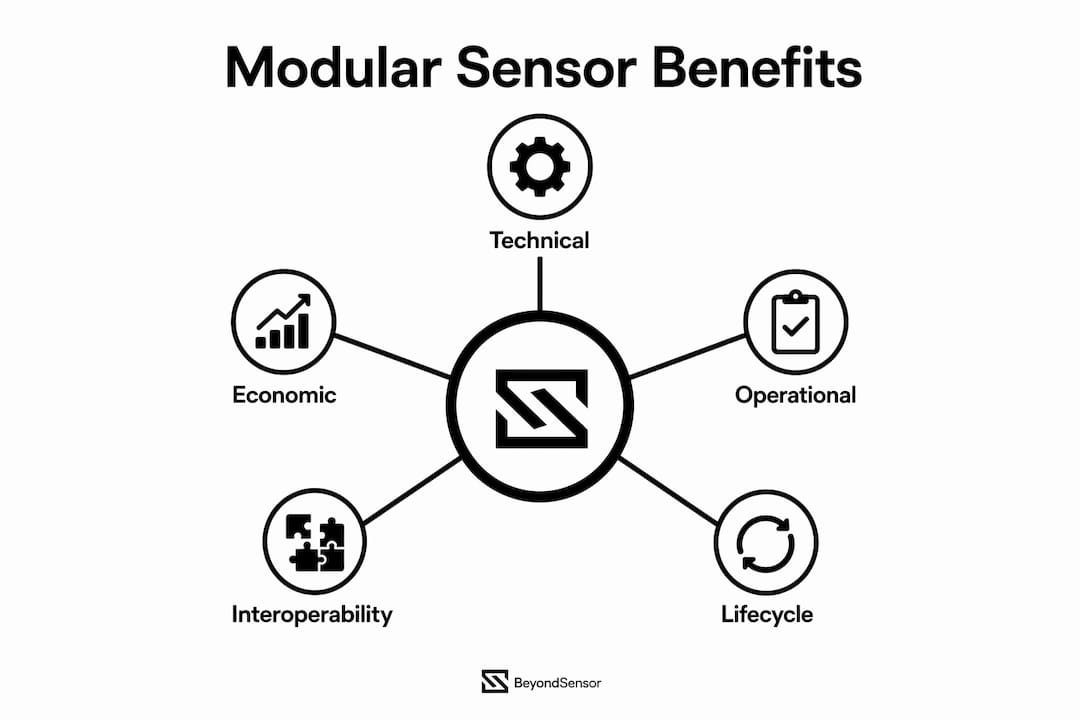
Modular sensor systems deliver advantages across three dimensions that matter to procurement, engineering, and operations simultaneously.
Technical advantages
Modular architectures separate the sensing probe from signal conditioning, local processing, and communications. That separation means you can upgrade firmware or swap an FPGA-based processing board without touching the physical sensing element. Modular sensor design divides functionality into interchangeable components, enabling lifecycle upgrades without replacing entire devices. For teams running surveillance, inspection, or environmental monitoring workloads, the ability to push a firmware update to a single module rather than recertifying an entire device is a concrete time and cost advantage.
Economic advantages
Lower lifecycle cost is the headline, but the mechanism matters. Targeted recalibration, smaller spare-part pools, and deferred capital refreshes each contribute. Over a 3–10 year deployment horizon, the compounding effect of avoiding full-unit replacements is significant. Choosing universal modular solutions early in a project turns recalibration into a predictable, low-impact operation rather than a recurring emergency.
Operational advantages
Field-service windows shrink when a technician swaps a module rather than decommissioning and rewiring a full device. Certification and redeployment are simpler because the transmitter or host unit stays in place. Spare-part policies become more granular: you stock modules by type rather than full assemblies, which reduces inventory carrying costs.

Pro Tip: When writing an RFP for modular sensor systems, include three procurement metrics explicitly: mean time to repair (MTTR) per module type, recalibration cycle cost per sensor point, and integration time for a new module type. Vendors who cannot answer these in their technical response are signaling a non-modular architecture dressed in modular language.
How are modular sensor systems architecturally constructed?
Understanding the physical and logical structure of a modular system helps architects map requirements to real hardware patterns before they write a line of specification.

Common architecture patterns
Four patterns appear consistently across industrial, environmental, and security deployments:
- Modular probe + transmitter: The sensing probe is physically detachable from the transmitter housing. Vaisala documents this pattern for data center HVAC monitoring, where interchangeable probes enable probe swaps for recalibration while keeping transmitters in service, preserving uptime and measurement continuity.
- Plug-in sensor boards: A base board hosts standardized slots for different sensing submodules (temperature, humidity, CO₂, particulate). Swapping a board changes the measurement type without rewiring.
- Edge node with replaceable sensing submodules: A local processing node handles communications and compute; the sensing element plugs into a defined interface. An MDPI study on multipurpose modular wireless sensor nodes shows this pattern lets developers reuse processing and communications subsystems while designing only the sensing module, accelerating time-to-deploy.
- Daisy-chained sensor chains: Multiple sensing nodes connect in series over a shared bus (RS-485, I2C), reducing cabling runs and simplifying topology for long linear deployments such as perimeter monitoring or conveyor lines.
Key module types
A complete modular sensor system typically includes six functional module types: sensing probe, signal conditioning, local processing/edge compute, communications/transceiver, power, and calibration. Each is independently replaceable. The calibration module deserves specific attention: isolating calibration logic to a dedicated module means a recalibration event touches only that module, not the sensing chain above it.
How embedded processing changes data flow
When processing logic lives on the module itself, raw sensor data is converted to a structured output before it leaves the device. Backend systems receive pre-processed readings rather than raw analog signals, which reduces bandwidth, simplifies data pipelines, and makes the system more adaptable in dynamic operational contexts. For surveillance and inspection workloads, this is a critical capability: a module that classifies an event locally sends an alert, not a stream.
Pro Tip: An architecture diagram for a modular sensor system should show five elements: physical connectors and bus/protocol labels, module boundaries, calibration workflow (which module triggers it, where the certificate is stored), power topology, and the data path from raw measurement to API output. If a vendor's diagram omits any of these, ask why.
What does the lifecycle economics case look like for modular sensors?
TCO for sensor systems has seven components: initial capital expenditure, installation labor, calibration and recalibration, spare-part inventory, downtime costs, upgrade/refresh cycles, and software/support. Modularity reduces cost in five of those seven.
Where modularity changes the numbers
Recalibration is the largest hidden cost in non-modular systems. Hardwired sensors can force full-product downtime lasting weeks per recalibration event; modular swaps compress that to days and fundamentally change TCO. The reduction in recalibration costs documented by Dracal is not a marginal improvement. It changes the financial model for any deployment with annual or biannual calibration requirements.
Spare-part inventory is the second lever. Stocking full sensor assemblies is expensive and space-intensive. Stocking individual modules by type reduces inventory value and allows a single spare pool to cover multiple sensor configurations.
Example TCO comparison
| TCO Component | Traditional (Non-Modular) | Modular System |
|---|---|---|
| Recalibration event | Full unit offline, weeks of downtime | Module swap, hours to days |
| Spare-part inventory | Full assemblies per sensor type | Modules by function, shared pool |
| Upgrade/refresh cycle | Full device replacement | Targeted module replacement |
| Installation labor | Bespoke wiring per device | Plug-and-play, reduced configuration |
| Software/firmware update | Full device recertification | Module-level update, isolated scope |
The table above is illustrative of the structural differences; actual figures will vary by deployment scale, industry, and vendor. The directional advantage of modularity holds across all five components.
Recalibration is not a maintenance line item — it is a system availability event. Modular architectures convert a weeks-long downtime risk into a hours-long swap operation, which is the single largest TCO lever in sensor-dense deployments.
How do modular systems change day-to-day operations?
The operational shift from traditional to modular sensor systems is most visible in three areas: installation, maintenance workflows, and spare-part policy.
Installation and deployment
Plug-and-play module interfaces reduce on-site configuration time. A technician connects a sensing probe to a transmitter using a standardized connector, the system identifies the module type, and configuration parameters load automatically. Compare that to bespoke wiring, where each sensor requires manual signal-range configuration and documentation. For large-scale deployments, the labor savings compound quickly.
- Reduced on-site configuration time per sensor point
- Lower required skill level for field installation (plug-and-play vs. wiring specialist)
- Faster commissioning: modules self-identify to the host system
- Reduced human error during deployment, a documented benefit of standardized modular architectures
Maintenance workflows
Targeted module swap is the core maintenance advantage. When a sensing probe degrades, a technician replaces that probe. The transmitter, processing board, and communications module stay in place. Field recalibration is possible for some module types; others require lab recalibration, but the logistics are simpler because only the module travels, not the full assembly.
Pro Tip: Establish a field vs. lab recalibration policy before deployment. Classify each module type by whether it can be field-calibrated with a portable reference standard or requires a controlled lab environment. This classification drives your spare-module pool sizing and your field-technician training requirements.
Spare-part policy and pilot KPIs
Right-sizing spares by module type rather than full devices reduces inventory carrying costs and simplifies logistics. A single spare sensing probe covers any transmitter in the same product family. During a pilot, track four operational KPIs:
- MTTR per module type: How long does a swap actually take in the field?
- Calibration lead time: From detection of drift to return to service, how many days?
- Field swap time: Clock the technician from arrival to verified operation.
- Required field-skill level: Can a generalist technician execute the swap, or does it require a specialist?
These four metrics give you the data to build a credible operational business case before full deployment.
Which protocols and standards keep modular sensor systems interoperable?
Interoperability is where modular sensor deployments succeed or fail at scale. The architecture may be modular, but if the communications layer is proprietary, you have rebuilt vendor lock-in at a different level.
Protocols and connectors to prefer
- Wired: I2C and UART/RS-485 for short-range intra-device communication; Modbus RTU/TCP for field-bus integration with PLCs and SCADA systems; standardized USB for bench and configuration interfaces.
- Wireless: MQTT over TLS for IoT and cloud-connected deployments; IEEE 802.15.4-based protocols (Zigbee, Thread) for low-power mesh networks; Wi-Fi 6 for higher-bandwidth edge nodes.
- Physical connectors: Prefer M12 circular connectors for industrial environments (IP67/IP68 rated); avoid proprietary locking mechanisms that require vendor-specific tooling.
The trade-off between wired and wireless is primarily about environment and latency. Wired modules offer deterministic latency and are immune to RF interference; wireless modules reduce cabling cost and enable deployments in locations where running cable is impractical.
Integration checklist for procurement
Before signing a purchase order, confirm the following from every modular sensor vendor:
- API and SDK documentation is publicly available or provided under NDA before contract signature.
- Firmware update process is documented: over-the-air (OTA) update support, rollback capability, and cryptographic signing of firmware images.
- Calibration certificates are issued in a machine-readable format (JSON, XML) and include module serial number, calibration date, and traceability to a national standard (NIST in the United States).
- Modules expose metadata: serial number, firmware version, calibration status, and health indicators via the standard interface.
Security and data integrity requirements
Modular architectures introduce a specific security surface: the module insertion point. A compromised or counterfeit module could inject false data into a security or safety system. Require the following from vendors:
- Secure module onboarding: Cryptographic attestation of module identity at insertion (hardware root of trust or certificate-based authentication).
- Firmware signing: All firmware images must be signed by the vendor's private key; the host system must verify the signature before executing.
- Data authenticity: Sensor readings transmitted over a network must be signed or transmitted over a mutually authenticated TLS channel.
Sensor integration strategies that skip these requirements create exploitable gaps in physical security and industrial safety systems.
Vendors who cannot provide a firmware signing policy in writing during procurement are not ready for security-critical deployments.
Where do modular sensors deliver the clearest ROI?
Four deployment categories consistently demonstrate the strongest return on modular sensor investment. Each has a different dominant value driver.
Industry and use-case mapping
| Industry / Use Case | Dominant Value Driver | Modular Advantage |
|---|---|---|
| Air quality monitoring networks | Flexibility, regulatory compliance | Swap sensing elements as standards change; plug-and-play urban sensor nodes reduce deployment time |
| Data center HVAC and environment | Uptime, calibration continuity | Probe swaps without transmitter removal; daisy-chained chains for dense rack monitoring |
| Industrial automation lines | Agility, faster feature rollout | Module-level upgrades enable new measurement types without line shutdown |
| Physical security and remote inspection | TCO, operational efficiency | Replaceable sensing submodules reduce truck rolls; edge processing on modules enables local event classification |
Deployment briefs
Air quality networks: Urban air quality monitoring requires dense sensor placement across varied environments. A modular plug-and-play architecture allows city agencies to swap electrochemical sensing elements as target pollutants change or as sensors reach end-of-life, without replacing the communications and power infrastructure. The role of sensors in infrastructure is expanding as regulatory requirements tighten, and modular designs are the only architecture that keeps pace with changing measurement mandates without full network replacement.
Data centers: Vaisala's documented approach to data center sensor selection treats modularity as a strategic choice: interchangeable probes enable calibration without removing transmitters from service, preserving measurement continuity during what would otherwise be a downtime event. For a facility running 24/7 SLA commitments, that continuity is directly tied to contract compliance.
Industrial automation: Modular sensor design enables lifecycle upgrades without replacing entire devices, which is the key to achieving agility on production lines where sensor replacement requires a line stop. Reusing pre-tested core modules (sensing, processing, communications) rather than designing from scratch for each deployment also reduces time-to-market for new measurement configurations.
Physical security and remote inspection: Replaceable sensing submodules reduce the frequency and cost of truck rolls for remote sites. When a module fails at a perimeter sensor node, a field technician replaces the module rather than the full assembly. Combined with sensor tech applications that leverage edge processing for local event classification, modular physical security systems deliver measurably lower operational cost per protected site.
How do you pilot and procure a modular sensor system?
A structured pilot with defined success criteria is the fastest path from evaluation to justified deployment. The checklist below is designed for teams scoping a vendor RFP or an internal proof-of-concept.
Procurement checklist
Required documentation from every vendor before shortlisting:
- API specification (version-controlled, with changelog)
- Calibration process documentation (field vs. lab, certificate format, NIST traceability)
- Spare-part list with lead times and minimum order quantities
- Firmware update policy (OTA support, signing, rollback)
- SLA terms: MTTR commitment, replacement module lead time, end-of-life notice period
- Security documentation: module authentication method, firmware signing policy, data integrity controls
Pilot plan template
- Define scope: Select 10–20 sensor points representative of your full deployment environment (indoor/outdoor, temperature range, vibration, RF environment).
- Set success metrics: MTTR target, integration time for a new module type, recalibration cost per point, and field-swap time.
- Establish baseline: Document current performance on all four metrics using your existing system before the pilot begins.
- Run the pilot for 60–90 days: Execute at least two planned maintenance events and one unplanned failure simulation (pull a module and measure response time).
- Assign roles: Designate a pilot lead, a field technician, and a systems integrator contact for each vendor in the evaluation.
- Define rollback criteria: If integration time exceeds baseline by more than 20%, or if a security requirement cannot be met, the vendor is disqualified.
- Document outcomes: Compare pilot metrics against baseline and against vendor SLA commitments. Use the delta to build the financial case for full deployment.
Questions to ask during vendor demos
- Can you demonstrate a live module swap and show the host system recognizing the new module automatically?
- How does your system handle a module with an expired calibration certificate — does it alert, block, or log?
- What is your firmware signing architecture, and can you provide a third-party audit report?
- Which third-party systems have you integrated with in the last 12 months, and can you provide a reference contact?
- What is your end-of-life policy for modules, and how much notice do customers receive before a module is discontinued?
Partnering with experienced system integrators for sensor deployment accelerates the pilot phase significantly, particularly for teams evaluating modular systems for the first time.
How Beyondsensor approaches modular sensing design and deployment
Beyondsensor designs sensor-based security and operational solutions with integration as the first constraint, not an afterthought. Every hardware configuration uses standardized connectors and documented interfaces, so system integrators and facility operators can add, replace, or upgrade sensing submodules without rearchitecting the host system.
The calibration workflow is end-to-end: Beyondsensor tracks calibration status at the module level, issues machine-readable certificates with NIST-traceable references, and surfaces calibration health through its unified security operations dashboard. That means a facility operator sees calibration status alongside live sensor data, not in a separate maintenance system.
Key deployment metrics Beyondsensor tracks with customers:
- Deployment time reduction: Customers moving from traditional hardwired sensor installations to Beyondsensor's modular configurations report faster commissioning, driven by plug-and-play module identification and pre-configured firmware profiles.
- Calibration cycle improvement: By isolating calibration to the module level, recalibration events affect only the module under service, not the full sensing chain.
- Downtime reduction: The approximately 90% downtime reduction documented for modular vs. non-modular architectures aligns with the operational outcomes Beyondsensor designs toward.
Beyondsensor's solutions span physical security, industrial automation, environmental monitoring, and smart infrastructure. For teams evaluating a modular sensor deployment, Beyondsensor offers a technical discovery process that maps your site constraints, existing infrastructure, and measurement requirements to a specific modular architecture before any hardware is specified. Request a technical discovery or integration assessment directly through the Beyondsensor team.
Key Takeaways
Modular sensor systems deliver measurable TCO reduction, faster field operations, and interoperability that traditional hardwired architectures cannot match across a 3–10 year deployment horizon.
| Point | Details |
|---|---|
| Recalibration is the largest TCO lever | Modular designs can cut recalibration costs by 5–10x and reduce downtime by approximately 90% compared with hardwired, non-modular systems. |
| Pilot with four KPIs | Measure MTTR, calibration lead time, field swap time, and required skill level before committing to full deployment. |
| Interoperability requires explicit procurement criteria | Require API specs, firmware signing policy, NIST-traceable calibration certificates, and module metadata exposure before shortlisting vendors. |
| Edge processing at the module level reduces backend load | Modules that classify events locally reduce bandwidth, simplify data pipelines, and improve system adaptability in dynamic environments. |
| Beyondsensor | Beyondsensor designs integration-first modular solutions with end-to-end calibration workflows and a technical discovery process for new deployments. |
The case for lifecycle thinking in sensor architecture
The conventional wisdom in sensor procurement is to optimize for unit cost at purchase. That framing is wrong for any deployment with a service life longer than two years. The real cost is in recalibration logistics, spare-part inventory, and the labor hours that accumulate every time a non-modular system forces a full-unit replacement for what should have been a five-minute swap.
What most procurement teams underestimate is the compounding effect of small operational inefficiencies. A single recalibration event that takes a sensor offline for two weeks is not just a maintenance cost. It is a gap in your data record, a compliance risk if the sensor is part of a regulatory monitoring network, and a signal to your operations team that the system is unreliable. Modular architectures do not eliminate maintenance. They change its character: from disruptive, full-system events to targeted, predictable swaps that field technicians can execute without specialist support.
The teams that get the most from modular sensor systems are the ones that treat modularity as a system-level architecture decision from day one, not a feature to evaluate at the component level. That means standardized connectors, documented interfaces, and a calibration workflow that is designed into the system before the first sensor is installed. The intelligent sensing deployment process starts with those decisions, not with hardware selection.
Beyondsensor helps you move from evaluation to deployment
Beyondsensor's modular sensor solutions give technical teams a concrete path from pilot to full deployment, without the integration friction that stalls most sensor projects. The difference is architecture: Beyondsensor builds every solution around standardized interfaces, end-to-end calibration tracking, and AI-powered analytics that surface actionable intelligence from your sensor network rather than raw data streams.

For teams in physical security, industrial automation, or environmental monitoring, Beyondsensor's technical discovery process maps your site constraints and existing infrastructure to a specific modular configuration before any hardware is committed. You get a deployment plan with defined KPIs, not a product catalog. Request your integration assessment at Beyondsensor and move your modular sensor evaluation forward with a team that has built these systems across security agencies, facility operators, and industrial sites.
Useful sources and further reading
| Source | Annotation | Sections Supported |
|---|---|---|
| Modular vs. non-modular: recalibration as OEM advantage (Dracal) | Quantifies 5–10x recalibration cost reduction and ~90% downtime reduction for modular vs. hardwired systems. Primary economic evidence. | Economic case, Operational impacts |
| Smart integrator's guide: choose the right sensor early (Dracal) | Frames early modular architecture selection as a long-term strategic investment that reduces recurring maintenance burden. | Implementation checklist, Beyondsensor perspective |
| The importance of modularity in data center sensor selection (Vaisala) | Documents probe-swap architecture for data center HVAC; recommends daisy-chaining and standardized connectors to reduce field complexity. | Technical architecture, Operational impacts, Use cases |
| Multipurpose modular wireless sensor node (MDPI Sensors) | Peer-reviewed study showing modular WSn architectures accelerate IoT time-to-deploy by reusing processing and communications subsystems. | Technical architecture, Implementation checklist |
| Architectures for modular smart sensor systems (PMC/NCBI) | Academic paper on module-level processing for adaptive sensing; supports edge compute benefits for surveillance and inspection. | Technical architecture, Use cases |
| A modular plug-and-play sensor system for urban air quality (PMC/NCBI) | Peer-reviewed deployment study of modular plug-and-play nodes for urban air quality networks; supports flexibility and regulatory compliance framing. | Use cases |
| Modular sensor design: key to next-gen industrial automation (Hantec) | Industry commentary on modular design enabling lifecycle upgrades without full device replacement; supports industrial automation use case. | Benefits overview, Use cases |
| Sensor modules definition (Symmetry Electronics) | Product-level definition of sensor modules as detachable sensing elements for embedded integration; useful for definitional grounding. | BLUF, Technical architecture |
| Benefits of sensors (Yokogawa Electric Corporation) | Industry material on sensors' role in real-time analysis and continuous monitoring across industries. | Benefits overview, Use cases |
Recommended
- Sensor Integration Strategies for Security and Efficiency | News | BeyondSensor
- Industrial Sensor Integration Workflow: 2026 Engineer's Guide | News | BeyondSensor
- How to Deploy Smart Sensors: A Practical 2026 Guide | News | BeyondSensor
- Sensor Integration Architecture Explained for System Architects | News | BeyondSensor
Read More Articles
RTSP Security Risks: Integrators Must Block Exposed Ports 554 and 8554
See how integrators can reduce RTSP security risks: close exposed ports 554 and 8554, secure camera access, and verify each deployment with practical checks.

Require MAEpp and X Accuracy Before You Buy People Counting Systems
Verify people counting accuracy by demanding MAEpp, X Accuracy, and directional-bias reports. Validate on-site with at least 100 events per direction...

30–90 Day Pilot Validates Redundant Camera Networks for Engineers
Standards led, practical steps for engineers to deploy redundant camera networks: MRP, dual homing, and aggregation patterns, commissioning checks, and...

30 Day Pilot Proves Video Analytics Accuracy for Security Teams
Validate video analytics accuracy with scenario tests, camera tuning, transfer learning and a 30 day edge first pilot for security teams.
Let's Build YourSecurity Ecosystem.
Whether you're a System Integrator, Solution Provider, or an End-User looking for trusted advisory, our team is ready to help you navigate the BeyondSensor landscape.
Direct Advisory
Connect with our regional experts for tailored solutioning.