
Discover why adaptive sensing is critical for AI in 2026. Learn how it enhances data efficiency and model performance for groundbreaking results.

Why Adaptive Sensing Is Critical for AI in 2026

Adaptive sensing is the decisive shift AI needed. Rather than scaling neural networks to brute-force their way through noisy, inconsistent data, adaptive sensing modulates sensor parameters at the input level, delivering cleaner signals before any model ever sees them. The result is striking: EfficientNet-B0 with adaptive sensing surpasses OpenCLIP-H, a model with 632 million parameters trained on 160 times more data, on vision tasks. That single empirical result reframes the entire model-scaling debate.
The core principle draws directly from biology. Your pupils contract in bright light and dilate in darkness without any conscious effort. Sensory neurons filter repetitive background signals before they reach the cortex, reducing bandwidth and energy consumption at the source. Artificial sensing systems have historically done the opposite: capture everything, digitize it, and let the model sort it out. Adaptive sensing closes that gap by embedding intelligence into the physical sensing layer itself.
Why does this matter now? Because the costs of model-centric AI are no longer theoretical:
- Efficiency gains: Smaller models with optimized sensor inputs match or exceed the accuracy of far larger counterparts, cutting compute requirements substantially.
- Noise mitigation: Dynamic parameter tuning at the sensor level reduces covariate shifts that model-level adaptation cannot fully recover once analog signals are digitized.
- Environmental sustainability: Reducing reliance on massive training datasets and large-scale inference directly lowers the energy footprint of AI deployment.
- Equitable access: Smaller, more efficient models lower the barrier to deploying capable AI in resource-constrained environments.
Why the model-centric AI paradigm is running out of road
The dominant AI playbook for the past decade has been straightforward: make the model bigger, feed it more data, and watch performance improve. That approach delivered genuine breakthroughs, but its costs have become hard to ignore.
Training and deploying large-scale models carries significant environmental and economic weight. Energy consumption for frontier model training runs into the gigawatt-hour range, and inference at scale compounds that burden daily. The economic cost concentrates capability in the hands of a small number of well-resourced organizations, limiting equitable access to AI advances. Researchers at NeurIPS 2025 argued explicitly that this trajectory is unsustainable and ethically problematic.
The technical ceiling is equally real. Static sensors impose a hard constraint: the analog-to-digital bottleneck means any information not captured at the hardware level is permanently lost to downstream algorithms. No amount of model sophistication recovers what the sensor never encoded. Post-hoc physics-based simulations cannot reconstruct the coupled environment-sensor dynamics once digitization has occurred.
Static sensor configurations also struggle with high-dimensional, noisy data. They cannot focus on the sparse, valid signal subsets that actually matter for a given task, which forces models to learn robustness to sensor noise rather than learning the task itself. The result is inflated model complexity and degraded generalization under real-world distribution shifts.
Key limitations of the model-centric paradigm:
- Irrecoverable information loss: Analog-to-digital conversion is a one-way door; sensor-level gaps cannot be patched algorithmically.
- Static sensor inflexibility: Fixed exposure, gain, and sensitivity settings perform poorly across varying lighting, weather, or environmental conditions.
- Covariate shift vulnerability: Domain shifts introduced by sensor heterogeneity across vendors and firmware versions are difficult to address through model scaling alone.
- Energy and compute overhead: Larger models require more training data, longer training runs, and heavier inference infrastructure.
- Concentration of capability: High resource requirements exclude smaller research groups and organizations in lower-income regions from participating in frontier AI.
How adaptive sensing actually works
Adaptive sensing treats sensor parameters as dynamic, co-optimized variables rather than fixed inputs the model must tolerate. Exposure, gain, sensitivity, sampling rate, and multimodal configuration all become levers that adjust in real time based on the task and the environment. The goal is to deliver model-friendly signals at the hardware level, before digitization locks in any information loss.
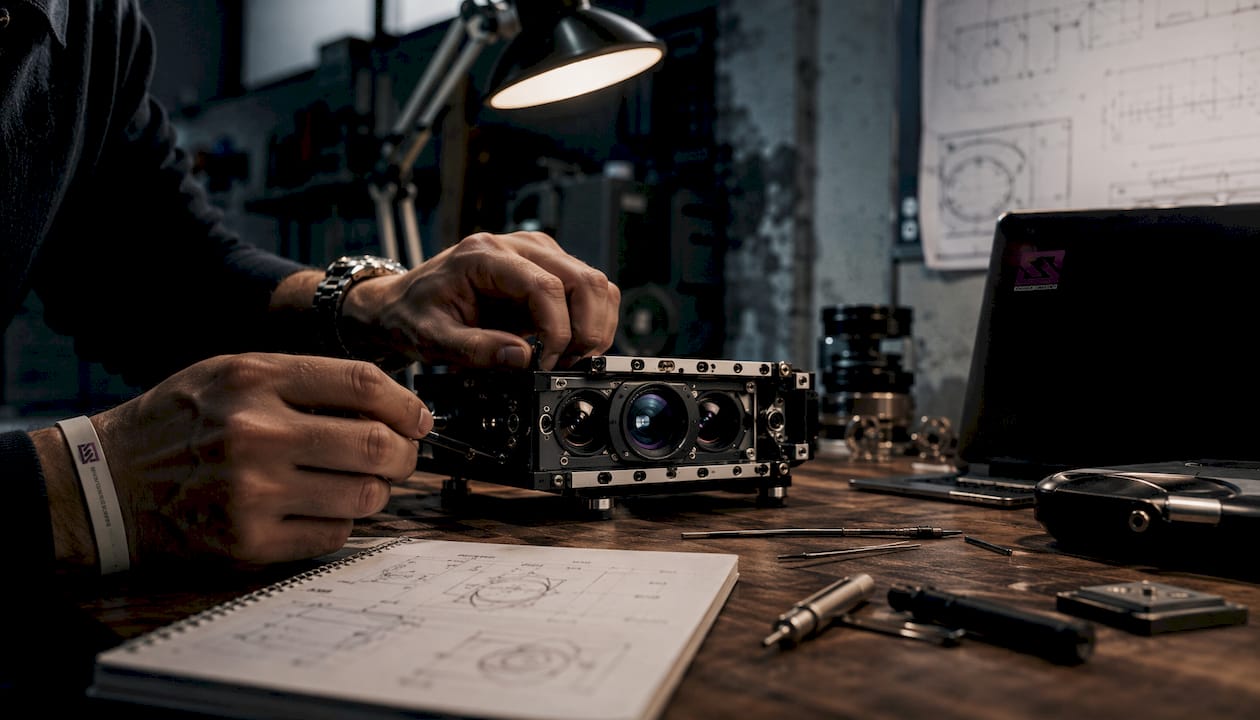
The biological analogy is precise, not decorative. Human sensory neurons modulate their responsiveness based on the frequency, intensity, and temporal pattern of incoming stimuli. Ion channel gating in receptor membranes drives tactile adaptation; photopigment bleaching and regeneration govern visual adaptation. These mechanisms filter redundant background signals at the sensory endpoint, reducing the bandwidth and energy required for central processing. Neuromorphic sensors and memristive transistors replicate this behavior in hardware, enabling artificial systems to achieve comparable adaptive filtering.
The technical architecture of adaptive sensing rests on co-designing sensor geometry with a measurement policy. Rather than optimizing hardware and algorithm separately, joint dynamic programming (joint-DP) treats both as a unified optimization problem. The sensor geometry determines what physical information is capturable; the Bellman-optimal measurement policy determines what to measure next, given what has already been observed. Differentiable dynamic programming provides the gradient signal needed to train the hardware design end-to-end alongside the inference model.
Pro Tip: When evaluating adaptive sensing implementations, check whether the system performs closed-loop feedback in real time or only adjusts parameters between sessions. True adaptive sensing requires continuous, frame-by-frame parameter updates, not batch recalibration.
Core mechanisms enabling adaptive sensing:
- Dynamic parameter tuning: Real-time adjustment of exposure, gain, and sensitivity based on environmental feedback.
- Closed-loop feedback control: Continuous sensing-inference-adjustment cycles that keep sensor output aligned with model requirements.
- Differentiable sensor design: End-to-end gradient-based co-optimization of sensor geometry and measurement policy via joint dynamic programming.
- Multimodal configuration management: Coordinated adjustment across camera, microphone, haptic, and other sensor modalities to handle heterogeneous environments.
- Sparse signal focusing: Directing sensing energy toward the valid signal subsets relevant to the current task, reducing noise and data volume simultaneously.
Empirical evidence: what adaptive sensing actually delivers
The performance case for adaptive sensing is grounded in direct comparison, not theoretical projection. A lightweight EfficientNet-B0 with 5 million parameters, paired with adaptive sensing, outperforms OpenCLIP-H with 632 million parameters trained on 160 times more data on image classification benchmarks. That result holds even as the adaptive model operates under a large reduction in model size relative to the Lens prototype baseline.
| Metric | Static sensing + large model | Adaptive sensing + small model |
|---|---|---|
| Model parameters | 632M (OpenCLIP-H) | 5M (EfficientNet-B0) |
| Training data requirement | 160× baseline | Baseline |
| Image classification accuracy | Lower (benchmark) | Higher (empirical result) |
| Compute cost | High | Substantially reduced |
| Environmental footprint | High | Lower |
The accuracy advantage comes from a specific mechanism: adaptive sensing mitigates covariate shifts at the hardware level, where they originate, rather than asking the model to learn robustness post-hoc. Hardware-level control directly reshapes raw measurements and preserves information that model-level adaptation cannot recover after digitization. Under semantic or content shifts, model-level adaptation remains more effective, so the two approaches are complementary rather than competing.
Adaptive sensing enables smaller, greener, and fairer AI systems by turning "sense better" into "learn less." Research presented at NeurIPS 2025 frames this not as an incremental improvement but as a paradigm-level shift with direct implications for sustainability, equity, and real-world deployment.
The sustainability dimension is concrete. Smaller models require less infrastructure to train and deploy. Reduced data requirements lower storage, preprocessing, and transfer costs. For organizations operating under energy or budget constraints, the efficiency gains from adaptive sensing translate directly into expanded deployment options.
Where adaptive sensing is already being applied
Embodied AI is the domain where adaptive sensing's advantages are most acute. Humanoid robots, micro-drones, wearable devices, and neural prostheses all operate under hard constraints on size, energy, and thermal dissipation. The traditional "bigger model, bigger dataset" approach hits a physical ceiling in these platforms. Adaptive sensing provides the complementary solution: by reshaping inputs at the hardware level, it delivers model-friendly signals that enable smaller networks to perform reliably in unstructured, changing environments.
Real-world deployment spans a wide range of sectors:
- Robotics and humanoids: Dynamic adjustment of camera exposure and haptic sensor sensitivity enables robots to operate across varying lighting and surface conditions without retraining.
- Healthcare and wearables: On-device adaptive sensing supports continuous physiological monitoring under energy constraints, adjusting sampling rates based on detected signal patterns.
- Autonomous driving: Sensor parameter adaptation to weather and lighting conditions reduces the domain shift burden on perception models, improving reliability in edge cases.
- Agriculture: Adaptive multispectral sensing adjusts to crop type, growth stage, and ambient light, enabling more accurate yield estimation and disease detection.
- Industrial automation: Real-time sensor reconfiguration in manufacturing environments handles vibration, temperature variation, and material changes without manual recalibration.
- Environmental monitoring: Adaptive acoustic and optical sensors adjust sensitivity thresholds based on ambient noise levels, improving detection accuracy for rare events.
- Physical security and surveillance: Frame-by-frame exposure and gain adjustment in camera systems reduces false alarms caused by lighting transitions, a direct application of adaptive security principles.
The common thread across all these applications is the same: static sensors force models to absorb variability that should have been handled at the source. Adaptive sensing moves that burden back to where it belongs.
Challenges you will face when adopting adaptive sensing
Adaptive sensing's advantages are real, but the path to deployment is not frictionless. Hardware-software co-design is genuinely complex. Optimizing sensor geometry jointly with a measurement policy requires expertise that spans photonics, embedded systems, control theory, and machine learning, disciplines that rarely share a team. The joint dynamic programming formulation scales to photonic topologies with more than 100,000 design pixels, which creates significant computational overhead during the design phase itself.
Real-time adaptation algorithms add another layer of difficulty. Closed-loop feedback must operate within the latency budget of the application. A surveillance camera adjusting exposure frame-by-frame has milliseconds to complete the adaptation cycle. Algorithms that work well in offline evaluation often fail to meet these constraints in deployment.
Practical and organizational challenges compound the technical ones:
- Standardization gaps: No widely adopted benchmarks exist yet for evaluating adaptive sensing systems across domains, making it difficult to compare approaches or validate claims.
- Privacy concerns: Adaptive sensors that continuously optimize based on environmental feedback can inadvertently capture more sensitive information than static sensors, raising data governance questions.
- Legacy system integration: Most deployed sensing infrastructure was designed for static operation. Retrofitting adaptive capability requires hardware replacement or significant firmware modification.
- Integration cost: Co-designed hardware-software systems are more expensive to develop and validate than off-the-shelf sensor plus model combinations.
- Algorithm maturity: Real-time adaptive algorithms for multimodal sensor configurations remain an active research area, with many approaches not yet production-ready.
Research is actively addressing these gaps. The NeurIPS 2025 position paper calls for standardized adaptive benchmarks, privacy-preserving adaptive sensing methods, and multimodal integration frameworks as priority research directions. Progress on differentiable dynamic programming is extending the co-design framework to increasingly complex sensor topologies.
Beyondsensor's perspective on adaptive sensing in security and industrial settings
Beyondsensor operates at the intersection of sensing research and real-world deployment, which gives the company a direct view of where adaptive sensing delivers measurable operational value. In physical security and industrial automation, the gap between laboratory performance and field performance is often traced back to a single cause: sensors configured for average conditions that encounter anything but average conditions.
Static camera systems in perimeter security, for example, are typically calibrated for daylight operation. At dawn, dusk, or under artificial lighting, exposure settings that worked at noon produce overexposed or underexposed frames that trigger false alarms or miss genuine threats. Adaptive sensing closes this gap by adjusting sensor parameters in real time, maintaining image quality across the full operational envelope without operator intervention.
Pro Tip: For security deployments, prioritize adaptive sensing systems that log parameter adjustment history alongside event data. This creates an auditable record that distinguishes genuine detection events from sensor-induced artifacts, which is critical for incident review and compliance.
Beyondsensor's approach to adaptive sensing in practice:
- Noise reduction at the source: Adjusting gain and sensitivity dynamically reduces the false alarm rate from environmental interference, including wind-driven vegetation, rain, and lighting transitions.
- Perimeter security reliability: Adaptive exposure management in camera arrays maintains detection accuracy across day-night cycles and adverse weather, directly supporting site security robustness.
- Industrial environment compensation: Sensors in manufacturing settings adapt to vibration, temperature drift, and electromagnetic interference, maintaining measurement accuracy without manual recalibration.
- On-device processing: Adaptive parameter adjustment at the hardware level reduces the volume of data sent to central processing, lowering bandwidth requirements and enabling faster local decision-making.
- Scalable deployment: Adaptive systems that self-calibrate to local conditions reduce the per-site configuration burden, making large-scale rollouts operationally feasible.
The practical outcome is a system that AI never needs to "fix" after the fact. When the sensor delivers a clean, task-appropriate signal, the model can focus on detection and classification rather than noise tolerance.
How adaptive sensing compares to traditional sensing methods
The contrast between adaptive and traditional sensing is sharpest under real-world operating conditions, where environments change and static configurations degrade.
Traditional sensors operate with fixed response characteristics: a camera has a set exposure time, a microphone has a fixed gain, a pressure sensor has a predetermined sensitivity range. These settings are chosen to perform acceptably across an expected range of conditions, which means they are rarely optimal for any specific condition. When conditions fall outside the expected range, performance drops and the model must compensate.
Adaptive sensing systems treat every parameter as a variable. Exposure adjusts frame-by-frame based on scene luminance. Gain responds to signal-to-noise ratio estimates. Sampling rate scales with detected signal complexity. The sensor actively tracks the task-relevant signal and suppresses everything else, which is precisely what biological sensory neurons do through ion channel gating and photopigment dynamics.
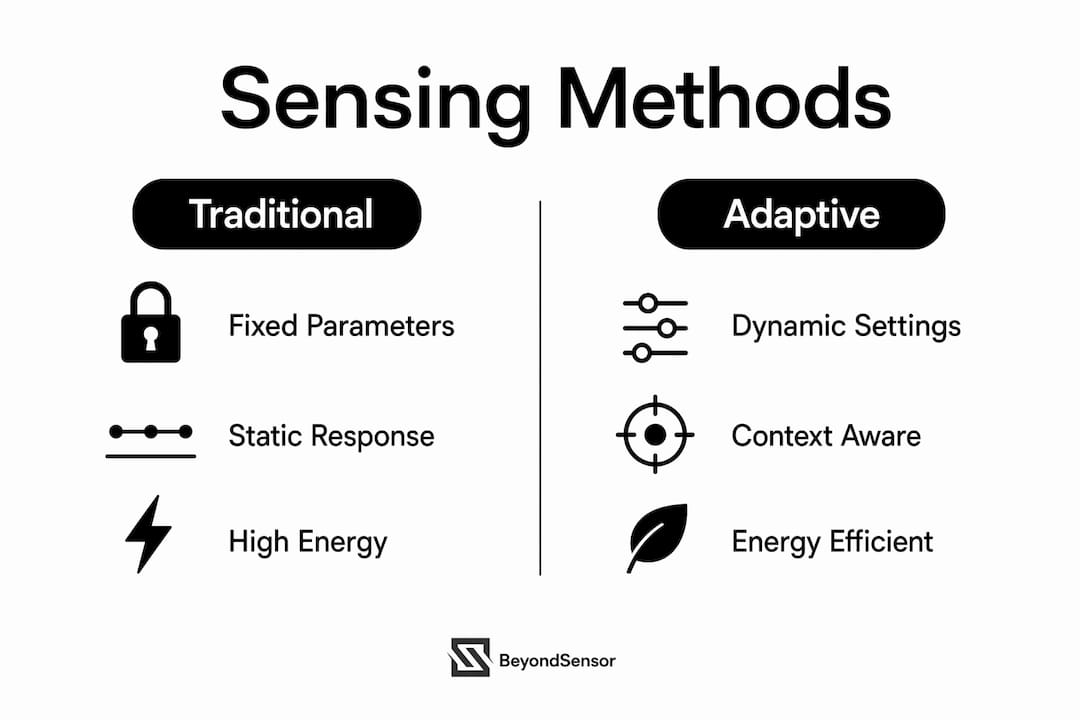
| Dimension | Traditional sensing | Adaptive sensing |
|---|---|---|
| Parameter configuration | Fixed at deployment | Dynamic, real-time adjustment |
| Response to environmental change | Degraded performance | Maintained or improved performance |
| Data volume | High (captures everything) | Reduced (focuses on relevant signals) |
| Model burden | High (model absorbs sensor variability) | Lower (sensor pre-processes for model) |
| Hardware complexity | Lower | Higher (co-design required) |
| Information recovery after digitization | Limited by static capture | Maximized through pre-digitization optimization |
The tradeoff is real: adaptive systems require more sophisticated hardware and co-design effort. But the performance and efficiency gains justify that investment in any application where environmental variability is the norm rather than the exception, which describes most real-world deployments.
Real-world deployments that show what adaptive sensing can do
The Lens prototype is the most cited empirical demonstration of adaptive sensing's impact. Designed as a test-time input adaptation system, Lens adjusts sensor parameters frame-by-frame to maintain high classification accuracy despite a 50-times reduction in model size compared to the baseline. The system significantly outperforms traditional auto-exposure methods, which are calibrated for human visual preference rather than model representation requirements. That distinction matters operationally: a sensor optimized for human viewing and a sensor optimized for machine inference make different parameter choices, and the machine-optimized version delivers better downstream accuracy.
In autonomous driving, adaptive sensing addresses one of the field's persistent challenges: sensor performance degradation in rain, fog, and low-light conditions. Static camera configurations calibrated for clear daylight produce degraded frames in adverse weather, forcing perception models to operate on data they were not trained to handle well. Adaptive exposure and gain management keeps frame quality within the model's training distribution, reducing the domain shift that causes accuracy drops in edge-case conditions.
Healthcare wearables present a different constraint profile. Devices like continuous glucose monitors and cardiac rhythm sensors operate under strict energy budgets. Adaptive sampling, which increases measurement frequency when signal complexity rises and reduces it during stable periods, extends battery life without sacrificing detection accuracy for clinically significant events. The Berkeley Wireless Research Center's adaptive intelligent sensing platform demonstrates this architecture at scale, integrating sensor, computation, and communication nodes in a heterogeneous mesh designed for biomedical and brain-machine interface applications.
Agricultural deployments show the breadth of the approach. Multispectral imaging systems that adapt their spectral sensitivity based on crop type and growth stage outperform fixed-configuration systems on disease detection and yield estimation tasks, particularly when field conditions vary across a single survey flight.
Where adaptive sensing research is headed next
The research agenda for adaptive sensing in 2026 centers on four interconnected priorities, each addressing a gap between current capability and the full potential of the paradigm.
Standardized benchmarks are the most immediate need. Without agreed evaluation frameworks, comparing adaptive sensing approaches across domains is unreliable. The NeurIPS 2025 position paper identifies this as a prerequisite for the field's maturation, and several research groups are actively developing domain-specific benchmark suites for robotics, medical imaging, and environmental monitoring.
Multimodal sensor integration is the next frontier. Most current adaptive sensing work focuses on single-modality systems, typically vision. Real-world embodied agents operate with cameras, microphones, haptic arrays, and proprioceptive sensors simultaneously. Co-optimizing adaptation policies across modalities, where adjusting one sensor's parameters affects what another sensor should prioritize, is an open and technically demanding problem.
Neuromorphic hardware will define the long-term architecture. Bioinspired neuromorphic sensors coupling sensory adaptation with on-chip cognition offer real-time perception performance that conventional digital hardware cannot match at equivalent energy budgets. Memristive devices and neuromorphic transistors are already demonstrating biologically plausible adaptation behaviors in laboratory settings; the path to production-scale deployment is a matter of manufacturing maturity rather than fundamental feasibility.
Privacy-preserving adaptive methods address a concern that grows as adaptive sensors become more capable. A sensor that continuously optimizes its capture parameters based on environmental feedback can inadvertently collect more sensitive information than a static sensor. Research into privacy-aware adaptation policies, which constrain parameter adjustment to avoid capturing personally identifiable information, is an active area with direct regulatory implications.
The trajectory is clear. Adaptive sensing moves from a research position to a foundational engineering discipline as the tools for co-design, real-time adaptation, and multimodal integration mature. For AI practitioners and system designers, the question is shifting from "should we adopt adaptive sensing?" to "how quickly can we integrate it?"
Key Takeaways
Adaptive sensing is the most direct path to smaller, more efficient, and more reliable AI systems in 2026, delivering accuracy gains that model scaling alone cannot achieve.
| Point | Details |
|---|---|
| Small models can outperform large ones | EfficientNet-B0 with adaptive sensing surpasses 632M-parameter OpenCLIP-H trained on 160× more data. |
| Sensor-level optimization is irreversible | Information lost at the analog-to-digital interface cannot be recovered by any downstream algorithm. |
| Biological systems prove the principle | Neuromorphic sensors and memristive transistors replicate ion channel-based sensory adaptation in hardware. |
| Real-world deployment demands it | Embodied AI platforms from drones to wearables face hard energy and size limits that model scaling cannot solve. |
| Research gaps remain | Standardized benchmarks, multimodal co-design, and privacy-preserving adaptation methods are active priorities for 2026. |
Recommended
- Explore emerging security technology trends for 2026 | News | BeyondSensor
- Understanding advanced sensing: boost security and efficiency | News | BeyondSensor
- Why Cybersecurity for Sensing Devices Matters in 2026 | News | BeyondSensor
- Adaptive security: reduce noise and boost protection | News | BeyondSensor
Read More Articles
RTSP Security Risks: Integrators Must Block Exposed Ports 554 and 8554
See how integrators can reduce RTSP security risks: close exposed ports 554 and 8554, secure camera access, and verify each deployment with practical checks.
Require MAEpp and X Accuracy Before You Buy People Counting Systems
Verify people counting accuracy by demanding MAEpp, X Accuracy, and directional-bias reports. Validate on-site with at least 100 events per direction...
30–90 Day Pilot Validates Redundant Camera Networks for Engineers
Standards led, practical steps for engineers to deploy redundant camera networks: MRP, dual homing, and aggregation patterns, commissioning checks, and...
30 Day Pilot Proves Video Analytics Accuracy for Security Teams
Validate video analytics accuracy with scenario tests, camera tuning, transfer learning and a 30 day edge first pilot for security teams.
Let's Build YourSecurity Ecosystem.
Whether you're a System Integrator, Solution Provider, or an End-User looking for trusted advisory, our team is ready to help you navigate the BeyondSensor landscape.
Direct Advisory
Connect with our regional experts for tailored solutioning.