
Learn what smart surveillance analytics is and how it transforms video data into actionable security insights for your team.

What Is Smart Surveillance Analytics for Security Teams

TL;DR:
- Smart surveillance analytics transforms passive video footage into structured, actionable security events using AI-powered detection and classification. It significantly reduces false alarms, enhances incident response, and streamlines forensic investigations by integrating detection with automated workflows across the perception, understanding, and action layers. Successful deployment depends on well-configured rule engines, structured event schemas, and effective integration, avoiding common pitfalls like vendor lock-in and overlooked operational processes.
Most security teams believe they have surveillance covered because they have cameras. They don't. Raw video is passive. It records everything and tells you nothing until something has already gone wrong. Smart surveillance analytics, the formal industry term is AI video analytics, is the intelligence layer that converts continuous video streams into structured, searchable, and actionable security events. It's the difference between a passive archive and an active detection system. This guide breaks down how it works, what it delivers, and what most deployments get wrong.
Key takeaways
| Point | Details |
|---|---|
| Analytics converts footage to events | Smart surveillance analytics turns raw video into structured data your systems and operators can act on immediately. |
| Three layers define the architecture | Perception, understanding, and action form the pipeline. Most failures happen at the action layer, not detection. |
| False alarms drop dramatically | AI-powered analytics can reduce false alarm rates from 85% to 16%, cutting unnecessary dispatches significantly. |
| Deployment tradeoffs are real | Edge, cloud, and hybrid models each carry latency, cost, and flexibility tradeoffs that must match your operational requirements. |
| Integration defines ROI | Standalone analytics rarely deliver full value. Connecting to sensors, access control, and response workflows multiplies outcomes. |
What is smart surveillance analytics: the full breakdown
Smart surveillance analytics converts raw camera video into structured events that security systems and operators can act on, search through, and audit. Traditional CCTV captures footage. Analytics interprets it.
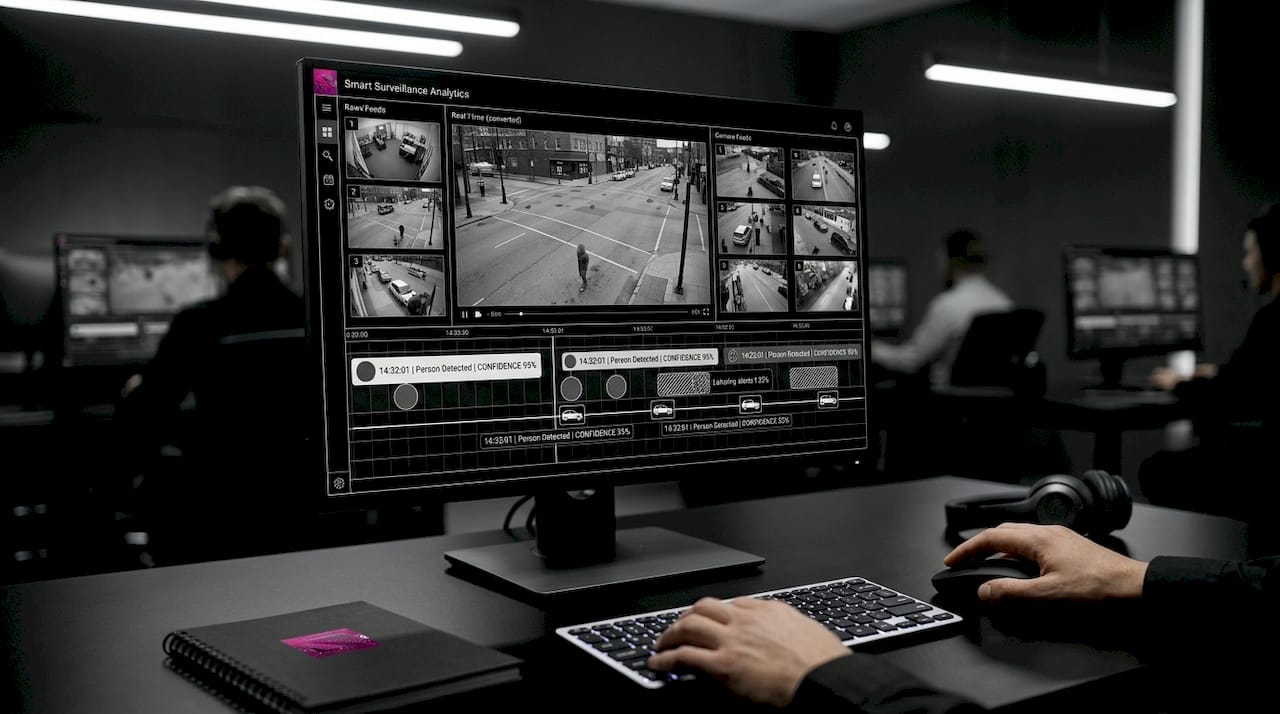
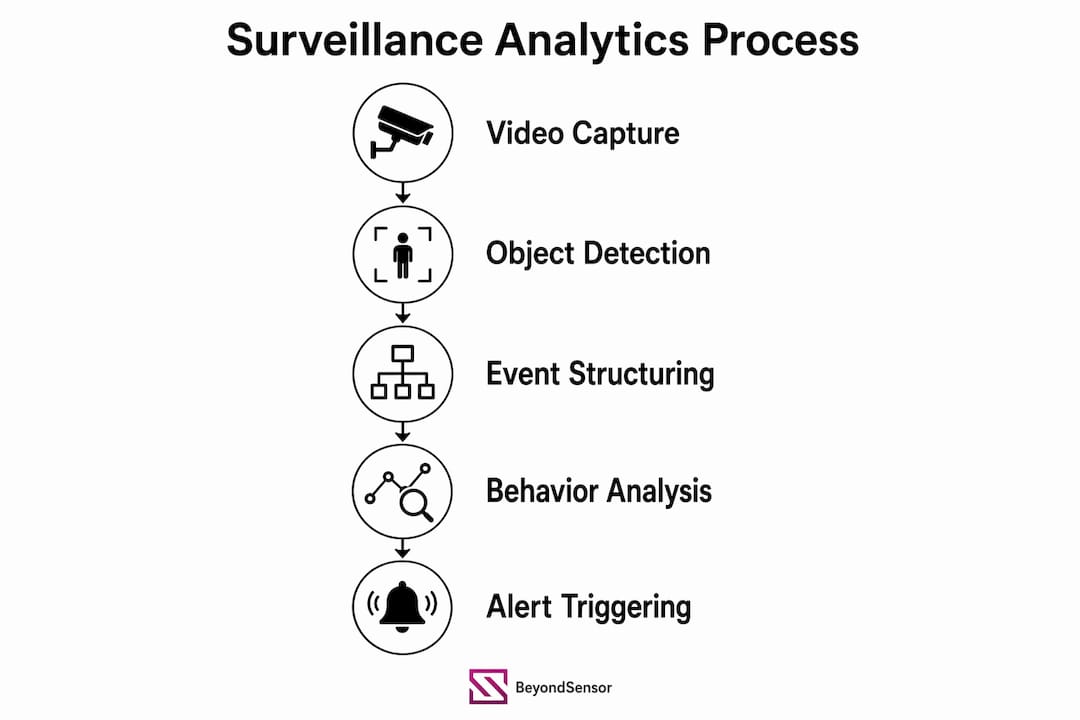
The analytic pipeline follows a logical sequence: capture, decode, detect, track, classify, notify, store, and search. Each stage transforms visual data into increasingly refined intelligence. At the capture stage, video frames are ingested from IP cameras or encoders. At detection, computer vision models identify objects of interest. At classification, those objects are labeled: person, vehicle, bag, or other defined categories. At notification, rules fire alerts to operators or downstream systems. At search, everything is indexed so investigators can pull specific events in seconds instead of hours.
Three conceptual layers describe how the system operates:
- Perception layer: The system answers "what is in the frame?" This includes object detection, multi-object tracking, facial recognition, and license-plate recognition.
- Understanding layer: The system answers "what is happening?" This covers behavior classification, loitering detection, crowd density analysis, and anomaly detection.
- Action layer: The system answers "what should happen next?" This is where alerts, automated responses, and forensic workflows execute.
The analytics primitives powering these layers each carry their own tradeoffs. Object detection, re-identification, and anomaly detection all involve balancing latency, accuracy, hardware requirements, and compliance constraints. Facial recognition, for instance, demands higher compute and triggers privacy regulations in many jurisdictions. License-plate recognition is computationally lighter but requires specific camera positioning and lighting conditions.
The most significant recent development is the emergence of Vision Language Models (VLMs) and agentic AI. VLMs and agentic AI enable automated multi-step workflows triggered by natural-language operator intent. An operator types "find every instance of a person entering the loading dock after 10 PM this week," and the AI automates detection, clip compilation, and report generation without manual frame review.
Pro Tip: When evaluating a smart surveillance platform, test the action layer first. Trigger a detection event and trace exactly what happens: which rule fires, what notification goes where, and how the event is logged for audit. Platforms that make this opaque will cost you operational efficiency and compliance integrity down the road.
How analytics improves security outcomes
The measurable benefits of intelligent surveillance solutions are substantial, and they span both security effectiveness and operational efficiency.
Start with the numbers that matter most to security operations teams. False alarm rates drop from 85% to 16%, incident response time improves by 68%, and forensic search operates up to 20 times faster with AI-powered analytics. Those aren't incremental gains. They represent a structural change in how security operations centers function.
The following improvements represent the most consistent outcomes organizations report after deploying AI-driven surveillance data analytics:
- Fewer unnecessary dispatches. When the system distinguishes a blowing tree branch from a person crossing a restricted line, guards respond to real events instead of noise. Dispatch reduction directly lowers labor costs and fatigue.
- Faster forensic investigation. Post-incident review that once required hours of manual scrubbing collapses to minutes. Investigators query by object type, time window, location, and behavior rather than watching footage linearly.
- Proactive threat detection. Behavior classification catches loitering, tailgating, and abandoned objects before they escalate. Reactive security becomes exception-based monitoring.
- ROI within a predictable window. 86% of users report ROI within 12 to 18 months, primarily through incident prevention and labor offset.
- Scalability without proportional headcount. Event-driven architectures decouple analytics producers from consumers, meaning alerts, dashboards, and forensic search tools each subscribe independently. You scale the system by adding cameras and consumers, not operators.
The integration dimension also matters. Effective intelligent security combines HD video, sensor networks, big data pipelines, and automated warning mechanisms into multi-layered systems. Analytics connected to access control, visitor management, and alarm panels creates a cohesive response fabric. Analytics running in isolation delivers partial value at best.
Edge and cloud hybrid deployments extend these benefits further. Sub-200 ms alert paths on edge hardware handle latency-sensitive detections locally, while cloud infrastructure manages retention, centralized forensic search, and model retraining. Security teams get both speed and scale without sacrificing one for the other.
Deployment challenges and common pitfalls
Understanding how smart surveillance works is one thing. Getting a deployment to deliver its promised value is another.
The most common failure points are predictable, and most are avoidable:
- Ignoring the action layer. Most platforms deliver solid perception and partial understanding but neglect rule engine depth and operator workflow design. Detection without a well-configured response workflow generates alerts nobody acts on.
- Vendor lock-in from on-camera analytics. Smart cameras and analytics platforms differ significantly. On-camera processing reduces bandwidth but can lock your workflow to a single vendor's ecosystem. Architects must plan integration points before committing to hardware.
- Underestimating storage costs. A single 4K camera using H.265 generates approximately 65 GB per day. One hundred cameras generate close to 195 TB per month before metadata. Codec selection and retention policy directly drive infrastructure cost.
- Privacy and compliance gaps. Analytics primitives like facial recognition require documented legal basis in many regions. Audit trails, data minimization policies, and access controls must be designed in from the start.
- Unstructured event outputs. Analytics outputs need to be event-first with structured payloads and audit logs. Ad-hoc alert formats make forensic search unreliable and compliance reporting manual.
Pro Tip: Before finalizing any analytics platform, request a sample structured event payload from the vendor. It should include object type, confidence score, bounding box coordinates, camera ID, timestamp, and an immutable event ID. If the vendor cannot produce this on request, their forensic and compliance capabilities will disappoint you in production.
The intelligent sensing technologies you select at the sensor layer also constrain what analytics can achieve. Low-resolution feeds, poor lighting compensation, and wide-angle distortion degrade detection accuracy regardless of model quality. Hardware and software must be evaluated as a system, not separately.
Practical applications and where the field is heading
Smart surveillance systems today operate across a range of high-stakes environments, and the application scope is expanding.
| Use Case | Current Capability | Emerging Development |
|---|---|---|
| Intrusion detection | Line crossing, zone entry alerts in real time | Agentic AI auto-escalation with audit trail generation |
| License plate monitoring | Real-time plate reads at entry/exit points | Cross-site correlation and behavioral pattern flagging |
| Crowd management | Density mapping and flow analysis | Predictive congestion alerts using historical patterns |
| Forensic investigation | Attribute-based search across recorded footage | Natural-language query with automated clip compilation |
| Anomaly detection | Rule-based behavioral flagging | Unsupervised learning for unknown threat patterns |
The integration of AI-powered analytics with sensor networks and big data pipelines is where the most significant capability jumps are occurring. Systems that previously required a human operator to interpret an alert are now executing multi-step responses automatically. A detected vehicle in a restricted zone at 2 AM can trigger gate lockdown, security notification, clip capture, and an incident report with no human in the loop until the report lands in an inbox.
Edge AI accelerators are compressing the cost and power requirements of on-device inference. What required a server-class GPU two years ago now runs on a compact edge appliance consuming under 15 watts. This makes high-accuracy analytics economically viable for mid-size facilities that previously couldn't justify the infrastructure.
The direction the field is moving toward is what practitioners call agentic surveillance, where the system not only detects and classifies but executes defined response workflows based on operator-defined intent. The operator sets the objective in natural language, and the system handles execution, logging, and escalation. AI never blinks, and increasingly, it no longer waits for instruction either.
My honest take on what makes analytics actually work
I've spent considerable time reviewing surveillance deployments across industrial, commercial, and critical infrastructure environments. The pattern that stands out most clearly is this: the technology is rarely the reason a project fails. The rule engine and operator workflow design are almost always the reason.
Every vendor demo shows detection working flawlessly. What demos don't show is the rule engine misconfigured to fire alerts on every moving pixel, or forensic search so poorly indexed that investigators still prefer to scrub footage manually. Detection models are increasingly commodity. The value lives downstream.
What I've learned from watching deployments succeed and fail is that the organizations getting the most out of surveillance data analytics invest in three things others skip. They design operator workflows before selecting hardware. They define structured event schemas before writing rules. And they treat integration with broader security architecture as a first-class requirement, not an afterthought.
The edge versus cloud debate is often presented as a binary choice. It isn't. The teams doing this well use edge for latency-sensitive alerting and cloud for retention, search, and model updates. Trying to do everything on-camera to save bandwidth usually means giving up the backend flexibility that makes forensic work and compliance reporting possible.
My final point: be skeptical of any platform that leads with camera specs and trails off when you ask about API structure and audit log format. The camera is the sensor. The analytics platform is the system. Know which one you're actually buying.
— Eumir
How Beyondsensor supports your analytics deployment
Beyondsensor works directly with system integrators and security agencies deploying AI-powered surveillance analytics across industrial, infrastructure, and physical security environments. The Beyondsensor platform is built for teams that need structured event outputs, flexible integration points, and hardware-software co-design that doesn't lock you into a single vendor's ecosystem. If your current or planned deployment needs stronger sensing foundations, sharper analytics pipelines, or regional compliance support across Southeast Asia, Beyondsensor's system integrator solutions are designed for exactly that scope. Explore the BeyondSecure innovation platform to see how these capabilities come together in production-ready form.
FAQ
What is smart surveillance analytics in simple terms?
Smart surveillance analytics is the software intelligence layer that converts raw video footage into structured, searchable security events. Instead of recording everything passively, it detects, classifies, and responds to defined activities in real time.
How does smart surveillance work technically?
The system runs a pipeline from video capture through object detection, tracking, and behavior classification, then fires rule-based alerts and stores structured event metadata for forensic search. Edge and cloud components typically split latency-sensitive alerts from centralized storage and analysis.
What are the main advantages of surveillance analytics over traditional CCTV?
The primary advantages include dramatically reduced false alarms, faster incident response, forensic search that collapses review times from hours to minutes, and proactive detection of threats before they escalate. Most deployments achieve measurable ROI within 12 to 18 months.
What is the biggest risk in deploying smart surveillance systems?
Vendor lock-in and a poorly designed action layer are the two most common failure points. On-camera analytics can restrict integration flexibility, and without well-configured rule engines and structured event outputs, even accurate detection fails to deliver operational value.
How do edge and cloud deployments differ in smart surveillance?
Edge deployments handle real-time alerting with sub-200 ms latency directly at the camera or local appliance. Cloud deployments manage long-term retention, centralized forensic search, and model retraining. Hybrid architectures use both, assigning tasks to whichever tier is best suited to the requirement.
Recommended
Read More Articles
RTSP Security Risks: Integrators Must Block Exposed Ports 554 and 8554
See how integrators can reduce RTSP security risks: close exposed ports 554 and 8554, secure camera access, and verify each deployment with practical checks.
Require MAEpp and X Accuracy Before You Buy People Counting Systems
Verify people counting accuracy by demanding MAEpp, X Accuracy, and directional-bias reports. Validate on-site with at least 100 events per direction...
30–90 Day Pilot Validates Redundant Camera Networks for Engineers
Standards led, practical steps for engineers to deploy redundant camera networks: MRP, dual homing, and aggregation patterns, commissioning checks, and...
30 Day Pilot Proves Video Analytics Accuracy for Security Teams
Validate video analytics accuracy with scenario tests, camera tuning, transfer learning and a 30 day edge first pilot for security teams.
Let's Build YourSecurity Ecosystem.
Whether you're a System Integrator, Solution Provider, or an End-User looking for trusted advisory, our team is ready to help you navigate the BeyondSensor landscape.
Direct Advisory
Connect with our regional experts for tailored solutioning.