
Discover what predictive security is and how it empowers security teams to prevent cyber threats before they strike. Stay proactive!

What Is Predictive Security? A Guide for Security Teams

TL;DR:
- Predictive security uses AI and behavioral analytics to forecast cyber threats before they materialize. It shifts organizations from reactive detection to proactive defense by identifying early behavioral signals and assigning risk scores. Successful implementation depends on high-quality data governance, workflow integration, and automated response measures.
Predictive security is defined as the use of AI, machine learning, and behavioral analytics to forecast cyber threats before they materialize into active attacks. Unlike traditional detection models that respond after a breach, predictive security systems analyze historical data, real-time telemetry, and behavioral patterns to produce early-warning signals and risk scores. Platforms like Dataminr, SentinelOne, and PRE Security represent the current generation of tools built on this model. The practical result is a shift from reactive firefighting to anticipatory defense, giving security teams the foresight to act before damage occurs.
What is predictive security and how does it differ from reactive models?
Reactive cybersecurity waits for an indicator of compromise (IOC) before triggering a response. An IOC is evidence that an attack has already occurred: a malicious file hash, a known bad IP address, or a flagged registry key. Predictive security operates on indicators of attack (IOAs) instead. IOAs are behavioral signals that suggest an attack is being prepared or is in early execution, well before any payload is delivered or data is exfiltrated.
SentinelOne describes this contrast clearly: traditional threat models react to known signatures, while predictive models focus on early behavioral anomalies and emerging attack tradecraft. This distinction matters because the average dwell time for a threat actor inside a network before detection is measured in days or weeks. Catching IOAs compresses that window dramatically.
The enabling technologies are machine learning models trained on large datasets of attack behavior, natural language processing applied to threat intelligence feeds, and graph analytics that map relationships between entities across an environment. These tools identify patterns that no human analyst could process at the required speed or scale.
- IOC-based detection: Triggers after a known threat signature is matched
- IOA-based prediction: Triggers on behavioral patterns suggesting pre-attack activity
- AI-driven baselining: Continuously models normal behavior to surface deviations
- Risk scoring: Assigns probability scores to assets and threat vectors, not just binary alerts
Pro Tip: When evaluating predictive security tools, ask vendors specifically how their models handle zero-day threats and novel attack techniques. A system trained only on historical signatures will miss the attacks that matter most.
What technologies power predictive security systems?
Predictive security systems combine several distinct technical layers. No single algorithm produces reliable threat forecasts. The architecture requires multiple data sources feeding into models that continuously refine their outputs.
The core components work in this sequence:
- Telemetry ingestion: Endpoints, network traffic, cloud workloads, and identity systems generate continuous data streams. The richer and more diverse the telemetry, the more accurate the behavioral baseline.
- Behavioral baselining: Machine learning models establish what normal activity looks like for each user, device, and application. Deviations from this baseline trigger anomaly scores rather than binary alerts.
- Threat intelligence correlation: External feeds covering dark web activity, vulnerability disclosures, and adversary infrastructure are mapped against internal telemetry to identify relevant exposure.
- Agentic AI investigation: Platforms like PRE Security deploy cybersecurity-trained language models and agentic AI to autonomously investigate flagged signals, reducing the time from detection to triage.
- Risk score generation: Outputs are prioritized risk scores and recommended actions, not raw alerts. This is what makes predictive outputs operationally useful rather than just analytically interesting.
The table below maps each technology layer to its function in a predictive security architecture:
| Technology layer | Primary function |
|---|---|
| Endpoint and network telemetry | Provides raw behavioral data for model training and real-time analysis |
| ML behavioral baselining | Detects deviations from normal activity patterns across users and systems |
| Threat intelligence feeds | Contextualizes internal signals with external adversary activity |
| Agentic AI triage | Autonomously investigates and prioritizes flagged signals without analyst intervention |
| Risk scoring engine | Converts model outputs into prioritized, actionable security decisions |

AI-powered analysis of multi-dimensional data streams is what separates predictive platforms from traditional SIEMs. A SIEM aggregates and correlates logs. A predictive system interprets behavioral context and assigns forward-looking probability scores.
How do SOCs operationalize predictive security?
Security Operations Centers face a structural problem: alert volume has grown faster than analyst capacity for years. Embedding predictive security into SOC workflows addresses this by shifting the analyst's role from alert triage to decision validation. The AI handles the first pass; the analyst handles judgment calls.
Tata Communications' 2026 SOC modernization work illustrates this shift. Their approach embeds AI for threat triage, signal correlation across hybrid environments, and real-time response recommendations. The result is a measurable reduction in analyst fatigue and faster mean time to respond. This is the practical model most mature SOCs are moving toward in 2026.
Operationalizing predictive security requires more than deploying a new tool. The following conditions determine whether a SOC realizes value from predictive outputs:
- Data governance discipline: Forecasts are only as reliable as the data feeding the models. Dataminr emphasizes that data identity, quality, and lineage must be rigorously managed to produce actionable intelligence.
- Workflow integration: Predictive outputs must connect directly to SOC playbooks. A risk score that sits in a dashboard without triggering a workflow adds no operational value.
- False positive tolerance: Predictive models detect precursors that may not mature into attacks. SOC teams need defined protocols for handling early warnings that do not escalate.
- Closed-loop measurement: Effective teams track whether forecasts translate into concrete mitigations and measure the resulting reduction in breach probability.
Pro Tip: Before deploying a predictive security platform, map your existing SOC playbooks to the tool's output types. If your workflows are built around IOC-based alerts, they will need restructuring to act on IOA-based risk scores.
The role of data analytics in SOC operations is not optional infrastructure. It is the foundation on which predictive capability is built. SOCs that treat analytics as a reporting function rather than an operational input will consistently underperform.
What are the benefits and limitations of predictive security?
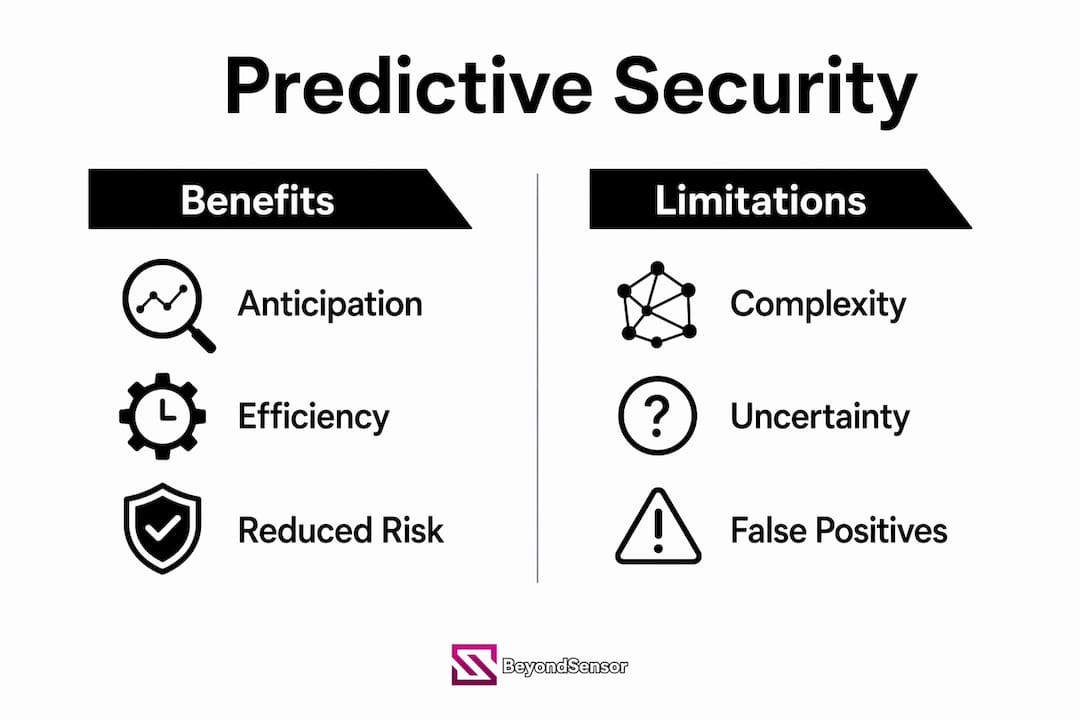
Predictive security delivers measurable advantages over reactive models, but it also introduces operational complexity that organizations must plan for honestly.
The core benefits are anticipatory defense, reduced breach impact, and operational efficiency. Dataminr frames predictive intelligence as answering the question "What will happen next?" rather than "What just happened?" That shift in orientation allows security teams to allocate resources toward likely attack vectors before an incident occurs, rather than scrambling to contain damage after the fact.
The limitations are equally real. Predictive models produce probability scores, not certainties. An early warning is not a guarantee that an attack will materialize. Gartner's framework distinguishes between predictive and preemptive security for this reason. Predictive security forecasts. Preemptive security links those forecasts directly to automated blocking and disruption actions. Without that automation layer, a predictive system produces intelligence that still requires human action to convert into defense.
| Dimension | Benefit | Limitation |
|---|---|---|
| Threat detection timing | Identifies IOAs before attack execution | Early signals may not mature into actual attacks |
| Analyst workload | AI triage reduces alert volume and fatigue | Requires workflow redesign and change management |
| Response speed | Risk scores enable faster, confident decisions | Automation dependency increases if human capacity is fixed |
| Data requirements | Richer telemetry improves forecast accuracy | Poor data governance degrades model reliability |
| Measurement | Outcomes trackable via breach probability reduction | Measuring prediction efficacy requires mature analytics capability |
Threat detection AI reaches its full potential only when predictive outputs connect to automated response actions. Organizations that deploy predictive intelligence without updating their response workflows will see limited return on the investment.
Key takeaways
Predictive security delivers its full value only when AI-driven forecasting connects to disciplined data governance, workflow-integrated response, and continuous measurement of breach probability reduction.
| Point | Details |
|---|---|
| Core definition | Predictive security uses AI and behavioral analytics to forecast attacks before they execute. |
| IOAs over IOCs | Focusing on indicators of attack catches threats earlier than signature-based detection. |
| SOC integration | Predictive outputs must connect to SOC playbooks to convert risk scores into defensive actions. |
| Data governance | Model accuracy depends on data quality, lineage, and identity managed at the source. |
| Automation linkage | Forecasts alone do not stop attacks; automated response actions complete the defense loop. |
The shift I keep watching in SOC operations
I have spent years watching security teams invest in intelligence platforms and then struggle to operationalize the outputs. The pattern repeats: a vendor demonstrates impressive detection rates in a proof of concept, the platform gets deployed, and six months later analysts are still triaging the same volume of alerts because nobody redesigned the workflow around the new signal types.
Predictive security does not fix a broken SOC. It amplifies whatever operational discipline already exists. Teams with mature data governance and well-documented playbooks will see genuine reductions in breach risk. Teams without those foundations will generate more sophisticated noise.
The question I hear least often from security leaders is the one that matters most: how will we measure whether our forecasts are actually reducing breach probability? Dataminr's practitioners are explicit that efficacy measurement, tracking whether forecasts translate into concrete mitigations, is what separates mature predictive programs from expensive dashboards.
The other shift worth watching is the move toward agentic AI in SOC workflows. Autonomous investigation and triage is not a future concept. Platforms like PRE Security are deploying it now. The organizations that will lead in 2027 are the ones building the governance frameworks today to manage AI agents operating at machine speed inside their security stack. The human role in the SOC is not disappearing. It is moving up the decision chain, and that requires a different kind of analyst than most teams currently employ.
— Eumir
How Beyondsensor supports predictive security operations

Beyondsensor builds the sensor-based infrastructure and AI analytics layer that predictive security systems depend on. From high-precision endpoint telemetry to intelligent sensing across industrial and physical environments, Beyondsensor's solutions feed the data pipelines that make behavioral baselining and anomaly detection reliable. Security teams and system integrators working to operationalize predictive security can access Beyondsensor's full suite of AI-driven tools designed for SOC integration, signal correlation, and automated triage. Whether you are building out a new predictive capability or hardening an existing architecture, Beyondsensor provides the sensing foundation and security tools that translate forecasts into defense.
FAQ
What is predictive security in simple terms?
Predictive security is a proactive approach that uses AI and machine learning to forecast cyber threats before they execute, rather than responding after an attack has occurred. It produces risk scores and early-warning signals based on behavioral patterns rather than known threat signatures.
How does predictive security differ from traditional cybersecurity?
Traditional cybersecurity detects threats using indicators of compromise, meaning evidence of an attack already in progress. Predictive security uses indicators of attack, behavioral signals that appear before execution, allowing earlier and more effective intervention.
What data sources does predictive security rely on?
Predictive security systems ingest telemetry from endpoints, network traffic, cloud environments, and identity systems, combined with external threat intelligence feeds. SentinelOne's models continuously compare current activity against behavioral baselines to surface emerging threats.
What is predictive maintenance in security systems?
Predictive maintenance in security refers to using sensor data and AI analytics to anticipate hardware or system failures in physical security infrastructure before they occur. This applies to cameras, access control systems, and sensor networks, where downtime creates exploitable gaps in coverage.
What are the biggest challenges in implementing predictive security?
The two primary challenges are data governance and workflow integration. Forecasts require high-quality, well-governed data to be reliable, and predictive outputs must connect directly to SOC playbooks to convert risk scores into defensive actions rather than unactioned intelligence.
Recommended
- How to Evaluate Security Threats: A Practical Guide | News | BeyondSensor
- Adaptive security: reduce noise and boost protection | News | BeyondSensor
- Why Advanced Threat Detection Matters for Security Teams | News | BeyondSensor
- Step-by-Step Security Integration: Advanced Sensor Guide | News | BeyondSensor
Read More Articles
RTSP Security Risks: Integrators Must Block Exposed Ports 554 and 8554
See how integrators can reduce RTSP security risks: close exposed ports 554 and 8554, secure camera access, and verify each deployment with practical checks.

Require MAEpp and X Accuracy Before You Buy People Counting Systems
Verify people counting accuracy by demanding MAEpp, X Accuracy, and directional-bias reports. Validate on-site with at least 100 events per direction...

30–90 Day Pilot Validates Redundant Camera Networks for Engineers
Standards led, practical steps for engineers to deploy redundant camera networks: MRP, dual homing, and aggregation patterns, commissioning checks, and...

30 Day Pilot Proves Video Analytics Accuracy for Security Teams
Validate video analytics accuracy with scenario tests, camera tuning, transfer learning and a 30 day edge first pilot for security teams.
Let's Build YourSecurity Ecosystem.
Whether you're a System Integrator, Solution Provider, or an End-User looking for trusted advisory, our team is ready to help you navigate the BeyondSensor landscape.
Direct Advisory
Connect with our regional experts for tailored solutioning.