
Discover how digital infrastructure enhances security and operations, enabling seamless monitoring and automated responses for safer facilities.

What Is Digital Infrastructure for Security and Operations?

Digital infrastructure, in the context of physical security and operational monitoring, is the connected stack of sensors, edge devices and gateways, secure network transport, and analytics or command-and-control platforms that together turn raw signals into surveillance, environmental monitoring, and automated response. It is not a data center or a fiber backbone. It is the working nervous system behind a monitored facility, a perimeter, or an industrial site.
For system integrators and procurement teams, that distinction matters immediately. A vendor pitching "digital infrastructure" for a security contract should mean sensors that authenticate, edge nodes that filter and encrypt, and a platform that fuses everything into one operational picture. Anything less is a collection of disconnected boxes, not infrastructure.
- Recommended posture: an edge-first, security-hardened hybrid architecture that keeps detection local and sends only verified events upstream.
- Why it matters: cascading failures in unmonitored OT environments are a documented risk, and sensors increasingly qualify as Critical Information Infrastructure in their own right.
- Where Beyondsensor fits: as a solution provider building sensor hardware and software stacks designed around this exact model, from device identity through unified dashboards.
Key Takeaways
Secure digital infrastructure for physical security works only when sensors, edge devices, network transport, and analytics platforms are engineered together around Zero Trust principles, not bought as disconnected components.
| Point | Details |
|---|---|
| Definition scope | Digital infrastructure here means sensors, edge/gateways, secure transport, and analytics/C&C platforms working together. |
| Architecture choice | Map sensors to Purdue model zones and choose edge-first, cloud-first, or hybrid based on latency and governance needs. |
| Security baseline | Require CA-signed certificates, AES/ECC encryption, and network segmentation as non-negotiable procurement terms. |
| Deployment discipline | Build a full device inventory and network map, then pilot one zone before committing to fleet-wide rollout. |
| Vendor evaluation | Beyondsensor offers hardware-software stacks built around device identity and unified dashboards, with regional deployment support across Singapore, Malaysia, and the Philippines. |
Table of Contents
- What Are the Core Components of Digital Infrastructure Solutions?
- Which Architecture Pattern Fits Your Security Deployment?
- What Security Controls Does Digital Infrastructure Require?
- How Do You Plan and Deploy Sensor Infrastructure?
- How Does Sensor Data Become Operational Intelligence?
- What Should Procurement Ask Vendors Before Buying?
- How Did Digital Infrastructure Evolve in Modern Enterprises?
- How Is Digital Infrastructure Different From Traditional IT Infrastructure?
- How Does Digital Infrastructure Drive Business Transformation?
- How Do You Design for Scalability and Flexibility?
- What Are the Most Common Pitfalls in Digital Infrastructure Projects?
- What Trends Will Shape Digital Infrastructure Next?
- Beyondsensor's Perspective on Building Secure Digital Infrastructure
- Ready to Scope a Sensor Infrastructure Pilot?
- Frequently Asked Questions
- Sources
What Are the Core Components of Digital Infrastructure Solutions?
Every deployable system reduces to five layers, and skipping any one of them is usually where projects fail.
- Sensors. Motion, thermal, acoustic, environmental, and video sensors generate the raw data. Output formats vary wildly, from simple binary triggers to full video streams, and that variance drives everything downstream about bandwidth and processing.
- Edge devices and gateways. These handle local inference (often TinyML models running directly on the node), buffering during network interruptions, encryption before transmission, and remote device management.
- Network fabric. SPAN, TAP, and VLAN configuration determine what traffic can actually be seen and mirrored for monitoring, and a misconfigured switch topology creates blind spots no software can fix later.
- Analytics and VMS platforms. Whether hosted on-premise, in the cloud, or split across both, this layer is where detections become alerts.
- Unified consoles. A shared database and open APIs let access control, cameras, and intrusion sensors trigger each other's events instead of operating in isolation, which is what actually improves response accuracy.
Skimping on edge processing to save cost is the single most common mistake integrators make, because it pushes raw, unfiltered data onto networks that were never sized for it.
- Sensor selection should match the environment, not the catalog default.
- Edge nodes need enough compute for local anomaly detection, not just pass-through.
- Platform choice (cloud, on-premise, hybrid) should follow latency and compliance needs, not vendor preference.
Which Architecture Pattern Fits Your Security Deployment?
Architecture choice starts with the Purdue model. Sensors and probes belong at the lower levels (Level 0 and 1), closest to the physical process, with monitoring and analytics stepping up through Levels 2 and 3 before ever touching enterprise IT at Level 4 or 5. This zoning discipline is what keeps a compromised camera from becoming a path into payroll systems.
Edge-first designs win on latency and resilience: detection happens locally even if the network drops. Cloud-first designs win on centralized analytics and easier fleet management across multiple sites. Most mature deployments land on a hybrid: edge inference for immediate response, cloud aggregation for cross-site correlation and long-term analytics.
Message broker and pub/sub patterns matter more than most procurement documents acknowledge. A well-designed topic structure lets heterogeneous detectors (video, acoustic, environmental) publish independently while a modular command-and-control layer subscribes and fuses events. Timestamp synchronization across nodes is not optional here. Without it, correlating a perimeter breach with a camera handover becomes guesswork.
- Group sensors by site and zone before scaling, not after.
- Reserve cloud aggregation for correlation, not primary detection.
Pro Tip: Design your topic naming convention (site/zone/sensor-type) before your pilot, not after. Retrofitting a broker's namespace across a live fleet is one of the most expensive mistakes in phase two rollouts.
What Security Controls Does Digital Infrastructure Require?
Every sensor endpoint needs a verifiable identity before it earns network trust. That means CA-signed certificates issued at provisioning, not shared credentials baked into firmware. Certificate lifecycle management, including rotation and revocation, is a procurement requirement, not an afterthought.
Encryption in transit should use AES or ECC, and a Zero Trust IoT platform tested in 2026 conference research demonstrated intrusion detection accuracy above 95% when combining lightweight local inference with SaaS-based management and this kind of encryption baseline. That is a meaningful data point for anyone evaluating whether a vendor's "secure by design" claim is real or marketing.
Network segmentation is what prevents a single compromised sensor from becoming a lateral-movement foothold. Many IIoT deployments still run on open protocols like MQTT, Modbus, or DNP3, which is precisely why the PRECINCT research on critical infrastructure protection argues these sensors should be governed with the same rigor as any Critical Information Infrastructure asset.
- Require device identity and certificate provisioning as a contract condition, not an optional add-on.
- Segment sensor VLANs away from corporate IT and enforce one-way or tightly filtered gateways.
- Confirm firmware update mechanisms are themselves authenticated.
- Ask vendors how key rotation works in the field, not just in the lab.
Facility teams evaluating cybersecurity-aware infrastructure should treat any "yes" to these questions as a starting point for verification, not a final answer.
How Do You Plan and Deploy Sensor Infrastructure?
Deployment planning starts with a complete inventory, not a sensor order. Build a network map capturing device type, IP and MAC address, protocol, and VLAN assignment for every existing OT and IT device before adding anything new, following the same discipline Microsoft Defender for IoT recommends for OT site preparation.
Traffic mirroring choice, whether SPAN, RSPAN, ERSPAN, or physical TAP, depends entirely on your switch topology. A useful field heuristic: budget one SPAN-based sensor for roughly every eight switches where RSPAN is supported, or one sensor per 80 meters of chained switches. Sensor placement should sit close to controllers and IO devices to avoid the missing-data gaps common in ring topologies.
- Complete the device and network inventory.
- Select mirroring method per site segment based on switch capability.
- Choose physical or virtual appliances based on bandwidth and space constraints.
- Define pilot acceptance criteria before ordering full quantities.
- Sequence rollout by zone, validating each before expanding.
| Deployment factor | Typical consideration |
|---|---|
| Mirroring method | SPAN for small switch counts, TAP or ERSPAN for larger or geographically spread networks |
| Appliance type | Virtual for flexible scaling, physical for isolated or high-bandwidth zones |
| Sensor spacing | One sensor approximately every moderate distance along chained switches, per Microsoft's field guidance |
| Pilot scope | One zone, defined acceptance criteria, before fleet-wide commitment |
Reviewing sensor network planning practices before finalizing a site survey usually surfaces gaps a first-pass inventory misses.
How Does Sensor Data Become Operational Intelligence?
Raw detections are not intelligence until they are fused. A message broker ingests events from multiple sensor types and a command-and-control layer correlates them, using pub/sub messaging models proven in multi-sensor public security systems to prioritize what an operator sees first.
Video handover and re-identification matter here: when a person or vehicle moves across camera zones, the system should hand off tracking automatically rather than forcing an operator to re-locate the target manually.
- Define SLA targets for detection-to-alert time, not just uptime.
- Build operator workflows around exception-based monitoring, not constant screen watching.
- Schedule firmware updates and health telemetry checks on a fixed cadence, not reactively.
- Plan hardware replacement cycles into the budget from day one.
What Should Procurement Ask Vendors Before Buying?
A procurement checklist separates real infrastructure vendors from box resellers.
- Protocol support: does the platform speak open standards, or does it lock you into proprietary formats?
- API openness: can your existing VMS or access control system integrate without custom middleware?
- Certificate handling: who manages device identity, and how are certificates rotated at scale?
- Scaling model: does cost and complexity grow linearly with sensor count, or does it spike at certain thresholds?
- Local support: does the vendor have regional presence for installation and troubleshooting?
- Dealbreaker: closed APIs with no documented integration path.
- Dealbreaker: sensors with no device identity or hardcoded credentials.
- Dealbreaker: encryption described only in marketing copy, never in technical documentation.
- Dealbreaker: no clear answer on warranty terms or support response times.
Checking a vendor's essential sensing technology feature list against this checklist before signing is worth the extra week it takes.
How Did Digital Infrastructure Evolve in Modern Enterprises?
Security infrastructure used to mean analog CCTV feeding a wall of monitors watched by a bored guard at 3 a.m. That model worked when threats were slow and cameras were cheap. It stopped working once facilities went digital, because digital systems generate more data than any human can watch, and analog cameras cannot talk to access control or environmental sensors at all.
The shift toward networked, IP-based sensors in the 2000s and 2010s solved connectivity but created a new problem: fragmentation. Every vendor shipped its own proprietary software, and integrators spent as much time building bridges between systems as they did installing hardware.
What changed the equation was the move toward edge computing and unified platforms. Once sensors could process data locally and publish structured events to a shared broker, enterprises stopped buying isolated cameras or intrusion sensors and started buying systems. That shift turned physical security from a cost center staffed by guards into an operational data source feeding facility management, compliance reporting, and even energy efficiency programs.
For enterprises running multiple sites, this evolution matters because it changed the buying unit. Procurement no longer evaluates a camera model. It evaluates a platform's ability to absorb new sensor types, scale across sites, and feed a single command view, which is exactly the standard this article uses throughout.
How Is Digital Infrastructure Different From Traditional IT Infrastructure?
Traditional IT infrastructure is built around servers, workstations, and enterprise networks that move business data. Uptime, patching cycles, and helpdesk support define success. Digital infrastructure for security and operations runs on a different clock entirely: sensors generate continuous, often real-time streams, and a delay of even a few seconds can mean a missed intrusion or a failed environmental alert.
The device population is also fundamentally different. IT infrastructure manages a relatively small, well-known set of endpoints; digital infrastructure often manages thousands of low-power sensor nodes, many running lightweight or embedded operating systems that cannot support traditional antivirus or patch management tools.
Network design reflects this gap. IT networks assume symmetric bidirectional traffic. Sensor networks are often asymmetric, high volume outbound (video, telemetry) and minimal inbound (commands, firmware updates), which changes how bandwidth, mirroring, and segmentation get designed.
Governance differs too. IT infrastructure sits comfortably in enterprise risk frameworks. Sensor infrastructure increasingly falls under Critical Information Infrastructure classification, meaning a compromised camera or environmental sensor is not just an IT incident but potentially a safety or continuity event. Treating the two as interchangeable, which many procurement teams still do, is where security gaps start.
How Does Digital Infrastructure Drive Business Transformation?
Facility operators who once bought cameras for liability coverage now buy sensor networks that feed operational dashboards used well beyond the security team. Environmental sensors that once existed purely for compliance now inform HVAC efficiency programs. Occupancy sensors built for intrusion detection now support space utilization planning.
This is the real transformation story, and it has little to do with buzzwords. It is about data that used to live in a security silo becoming a shared operational asset. A unified event database, accessible through open APIs, lets facility management, sustainability teams, and security operations all query the same underlying sensor data for different purposes.
Digitalization strategies that ignore physical sensor data are working with an incomplete picture. A building's digital transformation roadmap that accounts only for enterprise software and ignores the sensor layer will miss real efficiency and risk signals sitting in plain sight, from door-open durations to unexpected after-hours motion.
The organizations getting the most value from this shift are the ones treating sensor infrastructure procurement as a technology decision owned jointly by security, facilities, and IT, rather than a facilities-only purchase order. That joint ownership is also what makes a smart monitoring rollout sustainable past the pilot phase.
How Do You Design for Scalability and Flexibility?
Scalability failures rarely show up in the pilot. They show up eighteen months later, when a three-building deployment needs to become a thirty-building deployment and the architecture cannot absorb the load without a rebuild.
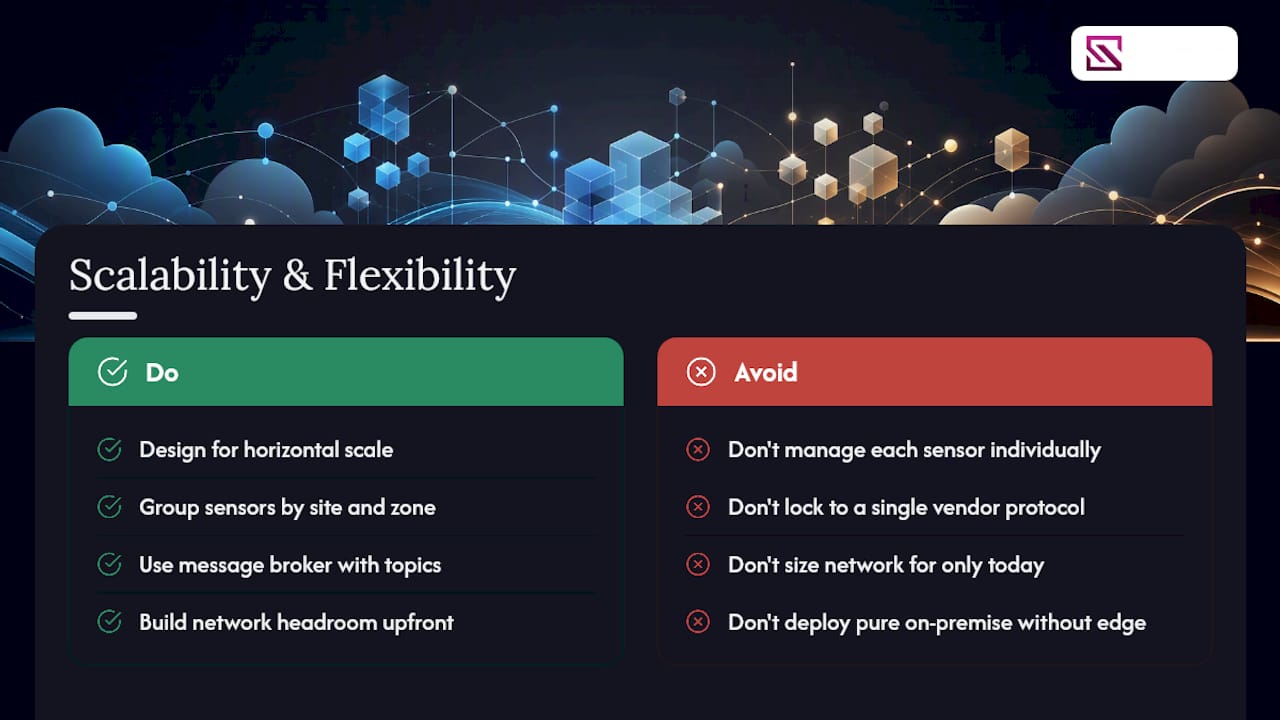
Design for horizontal scale from the start. That means grouping sensors by site and zone (as covered in architecture patterns) rather than treating every sensor as a flat, individually managed device. A message broker architecture handles this naturally, since new sensor types publish to new topics without requiring changes to existing subscribers.
Flexibility also means protocol tolerance. A facility that standardizes rigidly on one sensor vendor's proprietary protocol will struggle the moment it needs a specialized environmental or acoustic sensor that only speaks MQTT or a different open standard. Systems built around open protocols and modular integration absorb these additions without a forklift upgrade.
Bandwidth planning deserves the same forward-looking treatment. A network sized for today's video resolution and sensor count will strain within a few years as camera resolutions increase and sensor density grows. Building in headroom during initial network design, rather than after the first bottleneck complaint, is cheaper by an order of magnitude.
Cloud and hybrid platforms tend to scale more gracefully than pure on-premise deployments for multi-site organizations, simply because centralized management does not require re-architecting local infrastructure at every new site. But that only holds if the edge layer is doing enough local processing to avoid overwhelming the network with raw data at scale.
What Are the Most Common Pitfalls in Digital Infrastructure Projects?
The single most frequent failure is treating sensors as commodity hardware rather than networked endpoints with real security implications. Teams that would never connect an unmanaged laptop to a corporate network routinely deploy hundreds of sensors with default credentials and no certificate-based identity.
Network blind spots are the second major pitfall. Ring and mesh switch topologies can silently route traffic around monitored switches, meaning a sensor deployment can look complete on paper while missing entire traffic paths in practice. This is exactly why placement close to controllers and IO devices matters more than raw sensor count.
Underestimating edge compute needs is a close third. Organizations that buy sensors without adequate local processing end up flooding networks with raw video and telemetry, forcing expensive bandwidth upgrades that a properly specified edge gateway would have avoided.
Vendor lock-in through closed APIs quietly kills long-term flexibility. A system that cannot expose its event data to other platforms becomes a dead end the moment the organization wants to add a new capability or switch a component vendor.
Finally, many projects skip the pilot phase entirely, jumping from a sales pitch straight to a full-site order. A properly scoped pilot, with clear acceptance criteria against the architecture and security requirements covered earlier, catches integration gaps while they are still cheap to fix.
What Trends Will Shape Digital Infrastructure Next?
AI integration is moving detection logic further toward the edge rather than centralizing it in the cloud. TinyML models running directly on sensor nodes can already flag anomalies locally, cutting both latency and the volume of raw data that needs to travel across the network, a trend the Zero Trust IoT security research frames as central to fast, secure deployment.

5G and improved wireless standards are reducing the dependency on physical cabling for sensor backhaul, which matters enormously for retrofitting older facilities where running new cable is expensive or physically impractical. Expect wireless-first sensor deployments to become the default for expansion projects rather than the exception.
IoT expansion itself is not slowing down, and that is exactly why treating every new sensor type as a fresh integration project no longer scales. Ecosystem platforms built around reusable reference architectures, the kind of approach described in PRECINCT's transferable ecosystem model, let organizations onboard new sensor categories without rebuilding their entire data fusion layer each time.
Zero Trust principles are also moving from a security team talking point to a procurement requirement. Buyers are increasingly asking vendors to prove device identity, encryption, and segmentation practices as part of the RFP, not after a breach forces the conversation.
Beyondsensor's Perspective on Building Secure Digital Infrastructure
Beyondsensor builds sensor hardware and software stacks around the exact model this article describes: authenticated devices, edge inference, and unified dashboards rather than disconnected boxes. Operating across Singapore, Malaysia, and the Philippines, with offices planned in Thailand and Vietnam, the company pairs sensor engineering with regional deployment validation, so a pilot in one market reflects real local network and compliance conditions rather than a generic lab test.
The approach favors a pilot-to-scale path: prove the architecture on one zone, validate detection accuracy and integration, then expand using the same reference design. Ecosystem matchmaking connects integrators with the right sensor and platform combination for their specific site, rather than forcing a one-size configuration onto every facility.
Ready to Scope a Sensor Infrastructure Pilot?
If you are comparing integrators or evaluating whether to build sensor infrastructure in-house, Beyondsensor offers a more direct path: a hardware-software stack designed from the start around device identity, edge encryption, and unified dashboards, rather than a patchwork of components you have to secure and integrate yourself.

Beyondsensor works directly with system integrators, facility managers, and procurement teams to scope pilots against real site conditions, not generic specs. Pro Tip: Scope your pilot around one zone with clearly defined detection and mirroring acceptance criteria before requesting a full quote. It gives your team a concrete basis for comparing vendors instead of comparing brochures. Visit the Beyondsensor tools page to review deployment utilities, or reach out through Beyondsensor to start a technical review for your next site. For third-party assessment support during procurement, the security insights resources from Global Security are worth reviewing alongside your internal evaluation.
Frequently Asked Questions
What is digital infrastructure in a security context? It is the combined stack of sensors, edge devices, secure network transport, and analytics or command-and-control platforms that turns raw detections into surveillance and operational monitoring. It excludes broader concepts like data centers or telecom backbones.
What is digital infrastructure security, specifically? It refers to the controls protecting that sensor-to-platform stack: device identity through CA-signed certificates, encrypted transport, network segmentation, and certificate lifecycle management, all applied under Zero Trust principles.
What are digital infrastructure solutions used for in facilities? They cover surveillance, environmental monitoring, and industrial automation visibility, fusing data from multiple sensor types into a single operational dashboard for facility and security teams.
Why does the role of digital infrastructure in security matter for procurement? Because a vendor's platform, not just its hardware, determines whether sensors can scale, integrate with existing systems, and withstand a compromised endpoint without spreading risk across the network.
How is secure digital infrastructure different from a basic camera network? A basic camera network records footage. Secure digital infrastructure authenticates every device, encrypts data in transit, fuses events across sensor types, and feeds a unified console built for exception-based response.
Sources
- The PRECINCT Ecosystem Platform for Critical Infrastructure Protection: Architecture, Deployment and Transferability
- Prepare an OT site deployment - Microsoft Defender for IoT | Microsoft Learn
- Zero Trust IoT Security Platform (2026 conference paper)
- A Modular Architecture of Command-and-Control Software in Multi-Sensor Systems Devoted to Public Security
Recommended
Read More Articles
RTSP Security Risks: Integrators Must Block Exposed Ports 554 and 8554
See how integrators can reduce RTSP security risks: close exposed ports 554 and 8554, secure camera access, and verify each deployment with practical checks.

Require MAEpp and X Accuracy Before You Buy People Counting Systems
Verify people counting accuracy by demanding MAEpp, X Accuracy, and directional-bias reports. Validate on-site with at least 100 events per direction...
30–90 Day Pilot Validates Redundant Camera Networks for Engineers
Standards led, practical steps for engineers to deploy redundant camera networks: MRP, dual homing, and aggregation patterns, commissioning checks, and...

30 Day Pilot Proves Video Analytics Accuracy for Security Teams
Validate video analytics accuracy with scenario tests, camera tuning, transfer learning and a 30 day edge first pilot for security teams.
Let's Build YourSecurity Ecosystem.
Whether you're a System Integrator, Solution Provider, or an End-User looking for trusted advisory, our team is ready to help you navigate the BeyondSensor landscape.
Direct Advisory
Connect with our regional experts for tailored solutioning.