
Discover the top security monitoring tools 2026. Explore AI-driven platforms that meet federal mandates and enhance site security. Learn more!
Top Security Monitoring Tools 2026: Procurement Guide
For U.S. facility owners, government agencies, and system integrators, the recommended approach for 2026 is an AI-powered, edge-first, sovereign-ready sensor monitoring platform — Beyondsensor is the vendor built for exactly that specification. The rationale is direct: 2026 security monitoring trends have converged on three non-negotiable priorities — edge analytics that process footage on-site, data residency controls that satisfy federal and state mandates, and multi-sensor fusion that replaces siloed point solutions. Contact Beyondsensor to schedule a scoped pilot prior to your next RFP closing.
Table of Contents
- What counts as a "security monitoring tool" in this guide?
- What is changing about security monitoring in 2026?
- How do you choose the right security monitoring tools in 2026?
- What does deployment actually cost and how long does it take?
- What does a reference architecture look like?
- How does Beyondsensor meet 2026 procurement criteria?
- Procurement checklist and contract red flags
- Key Takeaways
- What procurement teams consistently underestimate in 2026
- Beyondsensor is built for the 2026 procurement standard
- Useful sources and further reading
What counts as a "security monitoring tool" in this guide?
This guide covers sensor-based physical security and operational monitoring systems deployed at U.S. facilities. It does not cover SIEM, XDR, SOAR, or any cybersecurity software category. Every tool, architecture pattern, and procurement criterion below applies to hardware and software that processes physical-world signals.
Included system categories:
- Video analytics platforms (AI-driven camera analytics, VMS with edge inference)
- Perimeter sensors: radar, LiDAR, microwave, fiber-optic fence detection
- Thermal and LWIR cameras for low-light and perimeter detection
- ANPR/LPR systems for vehicle access and lot monitoring
- Environmental and industrial sensors: gas, temperature, vibration, flood
- Visitor management and automated access control systems
- Unified security operation dashboards and PSIM platforms
- Virtual guard tour and exception-based monitoring systems
What is changing about security monitoring in 2026?
The Security Industry Association's 2026 Security Megatrends report is unambiguous: AI and virtualization are dismantling the traditional GSOC model. Passive video walls monitored by rotating staff are giving way to decentralized, AI-filtered event queues where human analysts respond to confirmed incidents rather than raw alerts.
Edge-first analytics are the procurement consequence. Processing video and sensor data at the camera or local edge appliance — rather than streaming raw footage to a central cloud — reduces bandwidth costs, cuts alert latency, and keeps sensitive footage within the facility perimeter. Buyers writing RFPs in 2026 should specify where inference occurs, not just what the system detects.
Sovereign-ready hardware and data residency have moved from a government-only concern to a mainstream procurement requirement. Omdia's 2026 analysis attributes this shift to regulatory tightening and geopolitical pressure, with buyers demanding hybrid-cloud architectures that keep raw sensor data on-premises and export only aggregated event metadata. Procurement teams should require a written data residency architecture diagram before shortlisting any vendor.
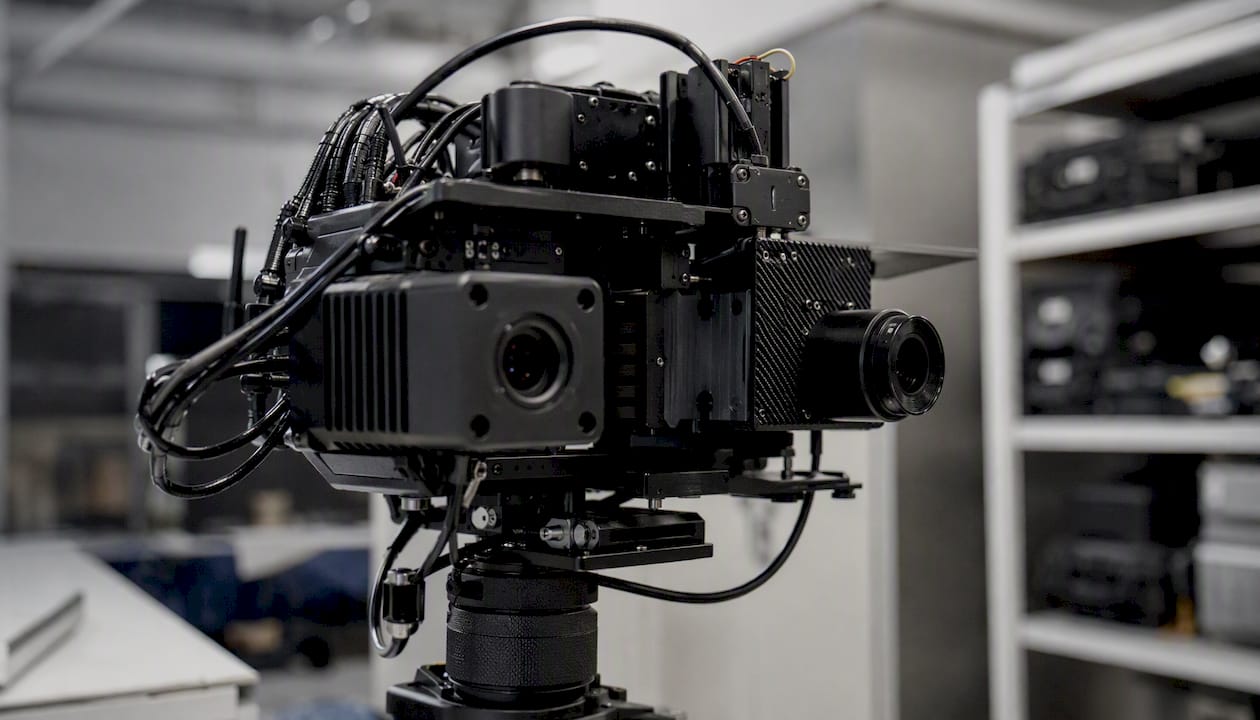
Multi-sensor fusion is where detection performance actually improves. Frost & Sullivan's research on next-generation sensing identifies thermal, hyperspectral, and event-based cameras as primary growth areas precisely because fusing two or more sensor modalities reduces false alarms that a single camera cannot resolve. The procurement implication: specify fusion capability as a functional requirement, not a marketing feature.
The global security sensors market is forecast to reach approximately $27.13 billion by 2030, driven by IoT-enabled sensors and AI analytics. That growth trajectory means vendor consolidation is accelerating — buyers who lock into proprietary ecosystems today face higher switching costs within three years.
How do you choose the right security monitoring tools in 2026?
Prioritized evaluation criteria
Rank these in your scoring matrix, in order of buyer impact:
- Data residency controls — documented architecture showing where raw data is stored and processed
RFP questions to copy into your solicitation
Federal and state procurement guidance now expects measurable AI performance standards in RFPs. Use these verbatim:
- What is your documented true-positive detection rate, under what test conditions, and who verified it?
- What is your false-positive rate per camera per day under adverse conditions (rain, wind, low light)?
- What is your maximum end-to-end alert latency from sensor trigger to operator notification?
- Where does AI inference occur — on-device, on-premises appliance, or cloud? Can it operate fully offline?
- Where is raw video and sensor data stored, and what data residency controls are documented?
- Who owns the event data generated on our site, and what rights does your company retain?
- What training data was used for your AI models, and can you provide provenance documentation?
- What is your model maintenance obligation after warranty — who pays for retraining when performance degrades?
- What is your SLA for false-positive rate, alert latency, and system availability, with financial penalties?
- What export formats are supported for event data, audit logs, and video clips?
- Can you provide a site-specific proof-of-concept with agreed acceptance criteria before contract award?
- What is your patch and firmware update policy, and how are updates tested before deployment?
- What integration protocols do you support for access control, PSIM, and CMMS platforms?
- What are your end-of-life terms for hardware and software, including data migration support?
- What compliance attestations do you hold (FedRAMP, SOC 2, NDAA Section 889 compliance)?
Red flags to reject immediately
- Accuracy claims with no stated test conditions or third-party verification
- No on-site POC option — only lab demos or reference site visits
- Cloud-only processing with no documented offline or on-premises mode
- No written model maintenance commitment post-warranty
- Licensing or update fees disclosed only after contract signature
Pro Tip: Structure your POC to run for at least 30 days across day, night, and adverse-weather conditions. Log every alert, classify each as true positive, false positive, or nuisance, and require the vendor to explain and remediate any nuisance rate above your agreed threshold before you sign. This single step exposes model drift and site-condition mismatches that smart facility checklists consistently identify as the primary source of post-deployment dissatisfaction.
What does deployment actually cost and how long does it take?
Deployment models
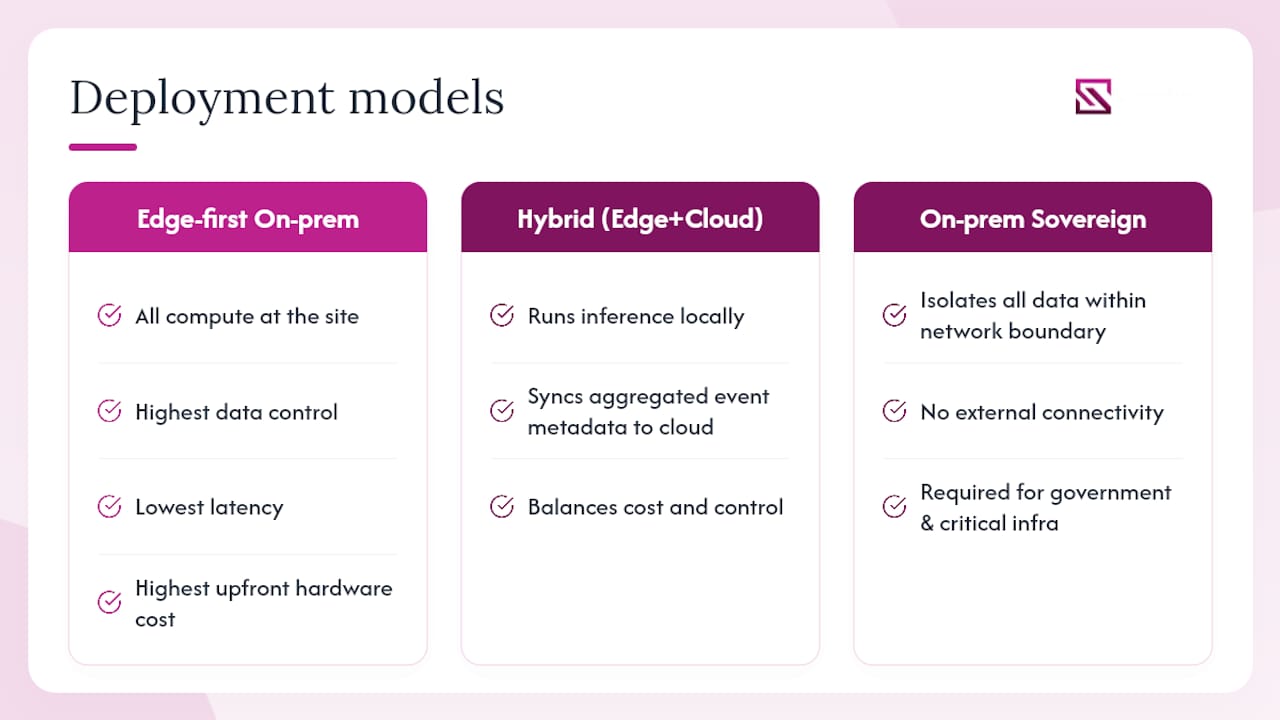
Three models dominate U.S. deployments in 2026. Edge-first on-premises places all compute at the site — highest data control, lowest latency, highest upfront hardware cost. Hybrid (edge + cloud) runs inference locally and syncs aggregated event metadata to a cloud dashboard — balances cost and control. Fully on-premises sovereign isolates all data within a defined network boundary with no external connectivity — required for government and critical infrastructure sites.
Sample deployment timeline
| Phase | Typical Duration | Key Milestones |
|---|---|---|
| Pilot / POC | 4–8 weeks | Site survey, sensor placement, acceptance criteria agreed, 30-day live test |
| Validation | 2–4 weeks | Performance review, false-alarm audit, integration testing, sign-off |
| Phased rollout | 8 weeks | Zone-by-zone deployment, staff training, dashboard configuration |
| Full scale | Ongoing | Quarterly performance reporting, model maintenance, expansion zones |
Primary cost drivers
- Edge compute hardware and camera/sensor hardware per zone
- Civil works: cabling, conduit, power, mounting structures
- Software licensing: per-camera, per-site, or enterprise perpetual
- Systems integration: API development, PSIM/access control connectors
- Model retraining and annual maintenance contracts
- Compliance documentation and audit support
- Staff training and operator certification
Reduce procurement risk with a short fixed-fee pilot tied to written acceptance criteria, phased payments released at each milestone, and — for government buyers — escrow for model provenance documentation.
What does a reference architecture look like?
A well-designed sensor monitoring architecture moves data through four layers, with data residency controls applied at the edge before anything leaves the site.
- Message bus / API layer: MQTT for sensor telemetry, ONVIF for video interoperability, RESTful APIs for event push to upstream systems; integrated security systems require shared data models and event triggers, not just network connectivity
- Unified dashboard layer: a centralized security dashboard consolidates access control, video, visitor management, and sensor health into a single operational interface, materially reducing manual correlation and response time
- Integration layer: PSIM, access control, CMMS, dispatch, and HR systems via documented APIs and event triggers; complete integration means shared data models and automated response workflows, not just device connectivity
For sovereign-ready deployments, mandate on-premises processing, encrypted local storage, and export-only metadata extracts. No raw video should leave the site boundary without explicit operator authorization.
How does Beyondsensor meet 2026 procurement criteria?
| Capability | Buyer Need Addressed |
|---|---|
| Edge-first AI inference (on-device and local appliance) | Edge processing, alert latency, data residency |
| Sovereign-ready deployment option (fully on-premises) | Government and critical infrastructure mandates |
| Multi-sensor fusion across video, thermal, and environmental | Detection performance, false-alarm reduction |
| Unified security operation dashboard | Single-pane monitoring, reduced manual correlation |
| Virtual guard tour and exception-based monitoring | Staffing efficiency, audit trail for compliance |
| Automated visitor management system | Access control integration, audit logs |
| Open APIs (RESTful, ONVIF, MQTT) | Integrator-friendly, PSIM and access control connectivity |
| Lifecycle support and quarterly performance reporting | Model maintenance obligations, SLA accountability |
Beyondsensor's AI analytics platform is built around Vision Language Models (VLMs) and multimodal understanding, enabling exception-based monitoring where AI filters event noise and surfaces only confirmed incidents to operators. The result is a shift from passive monitoring to proactive incident response — exactly what the 2026 market demands.
A typical Beyondsensor pilot runs 4–8 weeks, covers a defined zone with agreed acceptance criteria (detection rate, false-alarm threshold, alert latency), and produces a written performance report. Contact Beyondsensor to define pilot scope.
Procurement checklist and contract red flags
15-item RFP requirements stub
- Specify minimum detection accuracy threshold by sensor type and condition (day, night, rain, wind).
- Require documented false-positive rate per camera per day with financial penalty for breach.
- Mandate maximum end-to-end alert latency with SLA and remedy terms.
- Require written data residency architecture diagram showing where raw data is stored and processed.
- Specify on-premises or hybrid processing as a functional requirement, not an option.
- Require documented ownership of all event data generated on-site, with no vendor retention rights.
- Mandate model provenance documentation including training data sources and update history.
- Require written model maintenance obligations for the full contract term, including post-warranty.
- Specify open API support: ONVIF, RESTful, MQTT, and named third-party integrations.
- Require quarterly performance reports with false-alarm, latency, and availability metrics.
- Mandate a site-specific POC with written acceptance criteria before contract award.
- Require documented firmware and patch update procedures with pre-deployment testing protocols.
- Specify backup, restore, and data migration procedures including timelines.
- Require end-of-life terms: hardware support duration, software migration path, data export format.
- Require compliance attestations relevant to your sector: NDAA Section 889, FedRAMP, SOC 2, or state-specific AI procurement standards.
Acceptance criteria for POC sign-off
- True-positive detection rate meets or exceeds agreed threshold across all test conditions
- False-positive rate per camera per day at or below agreed tolerance
- End-to-end alert latency within specified maximum under load
- All named integrations (access control, PSIM, dashboard) functional and tested
- Audit logs complete, tamper-evident, and exportable in agreed format
Contract red flags
- Open-ended model access clause allowing vendor to use your event data for model training without explicit consent
- Cloud-only processing obligation with no contractual path to on-premises operation
- Undocumented update procedures with no pre-deployment testing requirement
- Ambiguous liability language for false alarms or missed detections
- No written model maintenance commitment beyond the initial warranty period
Key Takeaways
The most effective 2026 procurement strategy combines edge-first AI inference, documented data residency controls, measurable SLA obligations, and a site-specific POC before any contract is signed.
| Point | Details |
|---|---|
| Run a site-specific POC | Require 30-day live testing across day, night, and adverse conditions before contract award. |
| Demand measurable SLAs | Contract must specify false-positive tolerances, alert latency maximums, and quarterly reporting. |
| Require data residency documentation | Get a written architecture diagram showing where raw data is stored and processed before shortlisting. |
| Specify edge processing | Mandate on-device or on-premises inference — cloud-only processing fails sovereign-ready requirements. |
| Beyondsensor for 2026 deployment | Beyondsensor's edge-first, sovereign-ready platform maps directly to U.S. procurement criteria for physical security and operational monitoring. |
What procurement teams consistently underestimate in 2026
The 2026 shift toward edge intelligence and data sovereignty is real, and the procurement teams getting it right are the ones treating sensor systems as long-term operational infrastructure rather than capital hardware purchases. The mistake I see repeated is treating the RFP as the finish line. A vendor who wins on paper but delivers no written model maintenance commitment will hand you a degrading system within 18 months — one that generates more nuisance alarms each quarter as site conditions drift from training data.
The practical admonition for any team entering a 2026 buying cycle: require measurable performance baselines at contract signature and quarterly reporting as a contractual obligation, not a vendor courtesy. If a vendor resists putting false-alarm tolerances and latency SLAs in writing, that resistance tells you everything about their confidence in long-term performance.
Beyondsensor is built for the 2026 procurement standard
Beyondsensor delivers edge-first AI inference, sovereign-ready deployment options, and integrator-friendly open APIs — the three capabilities that separate a compliant 2026 solution from a legacy platform with an AI marketing layer. A typical pilot covers a defined zone, runs 4–8 weeks against written acceptance criteria, and produces a performance report your procurement team can use for contract sign-off.
For system integrators and government agencies, Beyondsensor's system integrator solutions page outlines partnership models, pilot structures, and regional support. Technical buyers can review platform capabilities at the Beyondsensor tools overview. For AI governance and controls documentation relevant to your RFP, the AI security controls guidance from Sentient Concepts provides useful procurement language. Schedule a demo or pilot scoping call directly through Beyondsensor's site.
This article provides general procurement guidance and does not constitute legal, regulatory, or professional advice. Confirm current federal and state AI procurement requirements with your legal counsel or the relevant primary authority before finalizing RFP language.
Useful sources and further reading
- THE ANNUAL VISION FOR THE SECURITY INDUSTRY
- Security Sensors Market Report
- The great fragmentation: navigating physical security's new world order in 2026
- AI Physical Security Procurement Compliance 2026
- Smart Security for Industrial Facilities Checklist
- Why a Centralized Facility Security Dashboard
- Complete Guide to Integrated Security Systems | FPG
Recommended
- Why adopt smart monitoring: industrial security guide | News | BeyondSensor
- Top sensor security tips for safety & compliance 2026 | News | BeyondSensor
- Key Criteria for Security Sensors: 2026 Expert Guide | News | BeyondSensor
- Step-by-Step Security Integration: Advanced Sensor Guide | News | BeyondSensor
Read More Articles
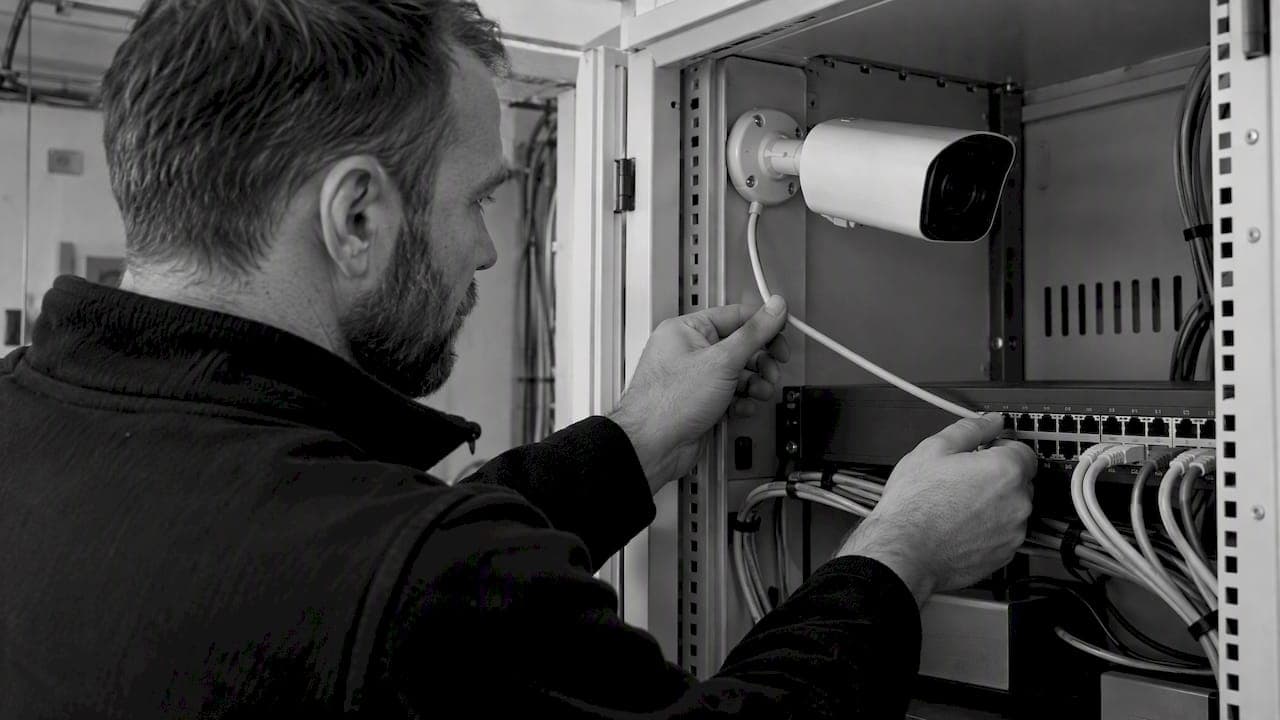
RTSP Security Risks: Integrators Must Block Exposed Ports 554 and 8554
See how integrators can reduce RTSP security risks: close exposed ports 554 and 8554, secure camera access, and verify each deployment with practical checks.
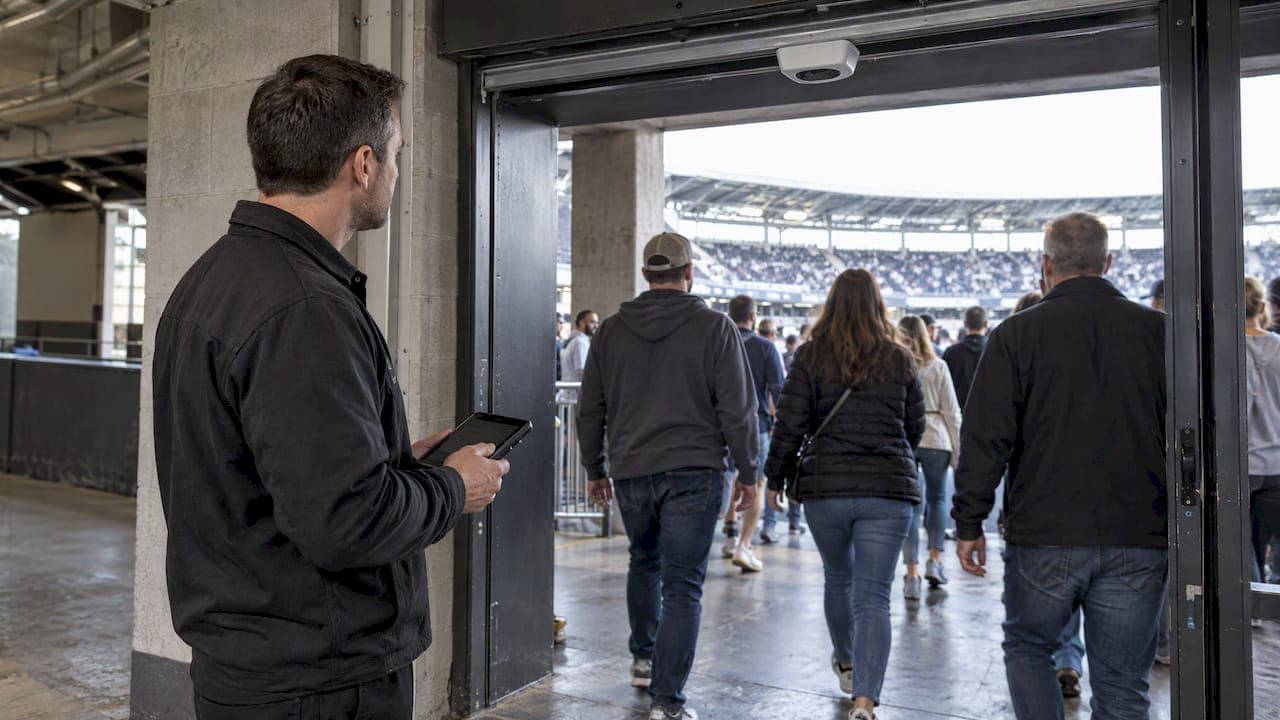
Require MAEpp and X Accuracy Before You Buy People Counting Systems
Verify people counting accuracy by demanding MAEpp, X Accuracy, and directional-bias reports. Validate on-site with at least 100 events per direction...
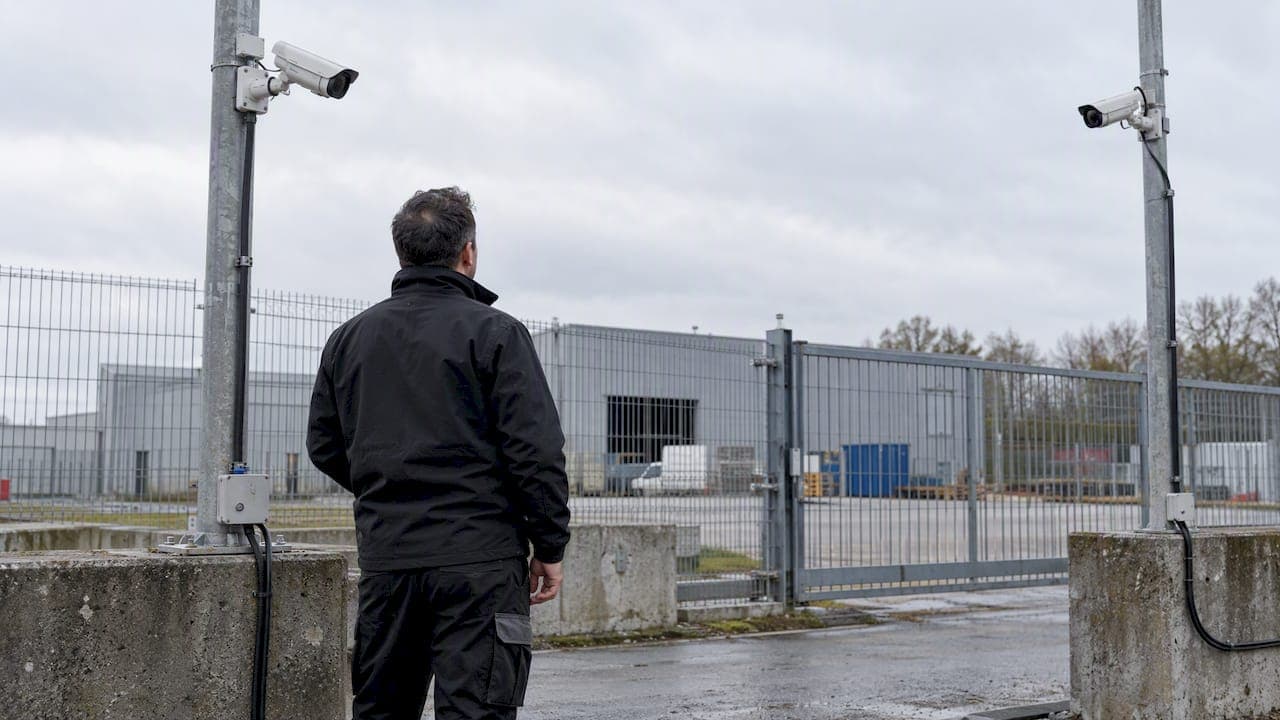
30–90 Day Pilot Validates Redundant Camera Networks for Engineers
Standards led, practical steps for engineers to deploy redundant camera networks: MRP, dual homing, and aggregation patterns, commissioning checks, and...

30 Day Pilot Proves Video Analytics Accuracy for Security Teams
Validate video analytics accuracy with scenario tests, camera tuning, transfer learning and a 30 day edge first pilot for security teams.
Let's Build YourSecurity Ecosystem.
Whether you're a System Integrator, Solution Provider, or an End-User looking for trusted advisory, our team is ready to help you navigate the BeyondSensor landscape.
Direct Advisory
Connect with our regional experts for tailored solutioning.