
Discover essential tips for secure infrastructure monitoring in 2026. Implement Zero Trust and key controls to safeguard your systems effectively.

8 Tips for Secure Infrastructure Monitoring in 2026

The single most important move in secure infrastructure monitoring is applying Zero Trust from the sensor to the cloud, backed by seven supporting controls that turn a pile of hardware into an actual security system. Facility owners and integrators who skip straight to buying cameras and door contacts routinely end up with expensive blind spots. Here are the eight priorities, in order:
- Zero Trust device identity across every sensor, gateway, and analytics endpoint
- Layered hardening combining perimeter, interior sensors, and video analytics
- Edge analytics to filter noise before it reaches an operator
- Encrypted telemetry using mTLS between gateways and the cloud
- Integrated ACS/IDS/VSS for correlated, evidence-rich alerts
- Documented SOPs and acceptance tests before go-live
- Vendor security lifecycle commitments, including firmware and patching policy
- Continuous testing against KPIs, including detection probability and invalid-alert rate
These aren't abstract ideals. Standards work like the NIST SP 800-171/CMMC implementation checklist and detection benchmarks around 95% probability with sub-weekly false-alert targets give you something concrete to procure against, not just aspire to.
Key Takeaways
Secure infrastructure monitoring works when Zero Trust device identity, layered sensor detection, and integrated alerting are backed by documented SOPs and measurable acceptance criteria.
| Point | Details |
|---|---|
| Apply Zero Trust everywhere | Give every sensor, gateway, and analytics endpoint its own verified identity and certificate. |
| Layer your detection | Combine hardening, perimeter sensors, interior sensors, and video analytics rather than relying on cameras alone. |
| Set measurable targets | Aim for 95%+ detection probability and invalid-alert rates under once weekly outdoors, once per quarter indoors. |
| Integrate before you scale | Correlate ACS, IDS, and VSS events so operators see one clear picture instead of three separate alarms. |
| Choose an end-to-end partner | Beyondsensor supplies sensor hardware, secure gateways, analytics tuning, and integration support built around these controls. |
Table of Contents
- Why and how to apply Zero Trust from sensor to cloud
- Layered detection: hardening, perimeter, interior sensors, and video
- How do you integrate ACS, IDS, and VSS without drowning operators?
- Secure networks and device lifecycle: what actually protects telemetry
- What operational practices make sensor monitoring actually work?
- How do you evaluate sensors and analytics before you buy?
- A prioritized checklist for your first 90 days
- How do you validate that the system actually works?
- How Beyondsensor supports secure monitoring from procurement to operations
- Sources
Why and how to apply Zero Trust from sensor to cloud
Every device in your monitoring stack, from a door contact to the analytics server crunching video, needs its own verified identity. That's the core of Zero Trust applied to physical security: nothing gets trust just because it sits on the "inside" network. Recent research on Zero Trust for interconnected environments makes the case plainly. Perimeter-based trust models assume that anything behind the firewall is safe, and that assumption breaks the moment a gateway gets stolen, cloned, or handed off to an integrator who no longer works on your account.
The practical version of this looks like:
- A hardware root of trust baked into each gateway and sensor
- Unique certificates issued per device, never shared across a batch
- Automated certificate rotation and revocation tied to your asset inventory
- Mutual TLS (mTLS) and device attestation wherever the hardware supports it
A stolen NVR or a rogue integrator credential becomes far less dangerous when every device has to prove its identity continuously, not just once at installation.
Pro Tip: Tie certificate issuance directly to your asset management system so a decommissioned sensor automatically loses its credentials the same day it's pulled from inventory. Manual certificate cleanup is where most Zero Trust programs quietly fail.
Layered detection: hardening, perimeter, interior sensors, and video
Layering hardening, intrusion sensors, and video analytics together cuts both breach probability and the false-alarm fatigue that makes teams start ignoring alerts. No single sensor type covers every scenario, and treating cameras as your only line of defense leaves gaps that motion and vibration sensors are built to close.
| Sensor type | Best use case |
|---|---|
| Door/hatch contacts | Point entry detection on doors, hatches, and access panels |
| PIR motion sensors | Interior room coverage, low-cost and reliable indoors |
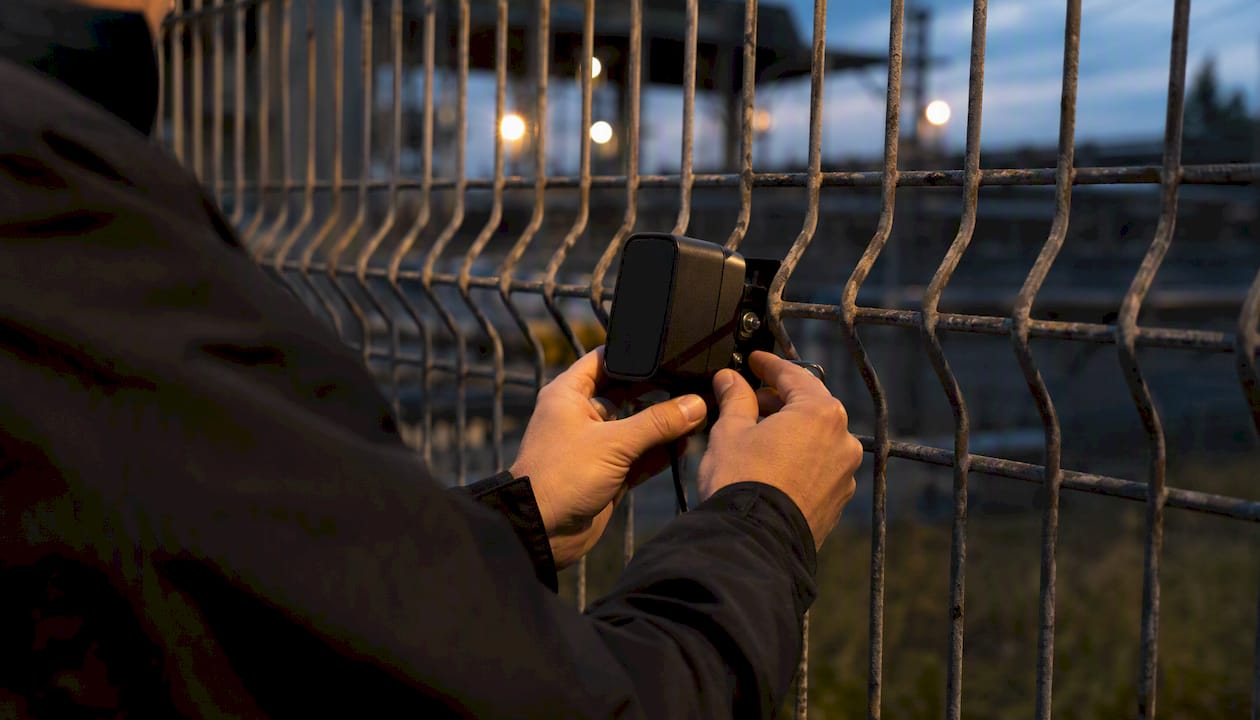
| Vibration/fence sensors | Perimeter fence lines and climb detection |
| Thermal cameras | Low-light or zero-light perimeter monitoring |
| LiDAR/radar | Large open perimeters where cameras alone create blind spots |
Sensor selection should be measured, not guessed. EPA's physical security monitoring guidance sets a detection probability target of 95% or higher, with invalid-alert benchmarks of fewer than one per week for exterior sensors and fewer than one every three months for interior sensors. Useful-life planning matters too: expect shorter service lives from PTZ cameras compared to fixed units under that same guidance.
Edge analytics earns its keep here. Classifying a shape as "raccoon" instead of "intruder" at the camera itself, rather than shipping every motion event to a central server, is what actually gets you under that weekly invalid-alert target.
How do you integrate ACS, IDS, and VSS without drowning operators?
Correlation is the answer, not more dashboards. A badge swipe, a forced-door alarm, and a camera feed mean very little apart, but together they tell an operator exactly what's happening in seconds. OCP's physical security white paper on ACS, IDS, and VSS integration frames this convergence as essential to real-time response, not a nice-to-have add-on.
Integration expectations worth writing into any RFP:
- Open APIs and standardized event schemas across all three systems
- Time synchronization across every device on the network
- Centralized logging that supports investigation after the fact
A practical checklist for your integration project:
- Confirm time sync across ACS, IDS, and VSS before go-live
- Define event correlation rules (badge + door forced-open + camera motion)
- Enable video pre-buffering so alarms capture footage from before the trigger
- Apply role-based access control (RBAC) to footage access
- Map retention policy to each security zone, not a single blanket rule
Secure networks and device lifecycle: what actually protects telemetry
Encrypt telemetry at the source, authenticate every endpoint, and manage device identity as an ongoing lifecycle task rather than a one-time install step. Guidance on securing OT-to-cloud predictive maintenance pipelines recommends mTLS between gateways and the cloud, paired with unique cryptographic identities per device so a compromised sensor can't impersonate its neighbors.
Network-level controls that support this:
- VLAN segmentation isolating sensor traffic from corporate IT networks
- Restrictive east-west rules so one compromised camera can't reach another
- PoE resilience planning and WAN backhaul options (cellular, fixed wireless) for remote perimeter sites
- Automated certificate expiry alerts tied to your asset inventory
- Offsite, encrypted backups of raw telemetry preserved unaltered for forensic review
That last point matters more than most teams realize. If analytics or dashboards get compromised, a pristine copy of raw sensor data is often the only way to reconstruct what actually happened.
Pro Tip: Treat certificates as managed infrastructure, not a one-time setup task. Automated issuance, rotation, and revocation tied to your asset inventory prevents the outages that happen when nobody remembers a certificate is about to expire.
What operational practices make sensor monitoring actually work?
Technology fails without operational discipline behind it. A facility can have flawless sensor coverage and still miss an intrusion if nobody has written down who gets notified, how fast they need to respond, or what happens if they don't answer.
Required elements for any operations plan:
- A tiered monitoring model distinguishing continuous coverage from periodic patrol checks
- Defined escalation roles with named backups, not just a shared inbox
- Response-time targets calibrated against your delay tactics (fencing, doors, distance to response)
- Law-enforcement coordination protocols where jurisdiction requires it
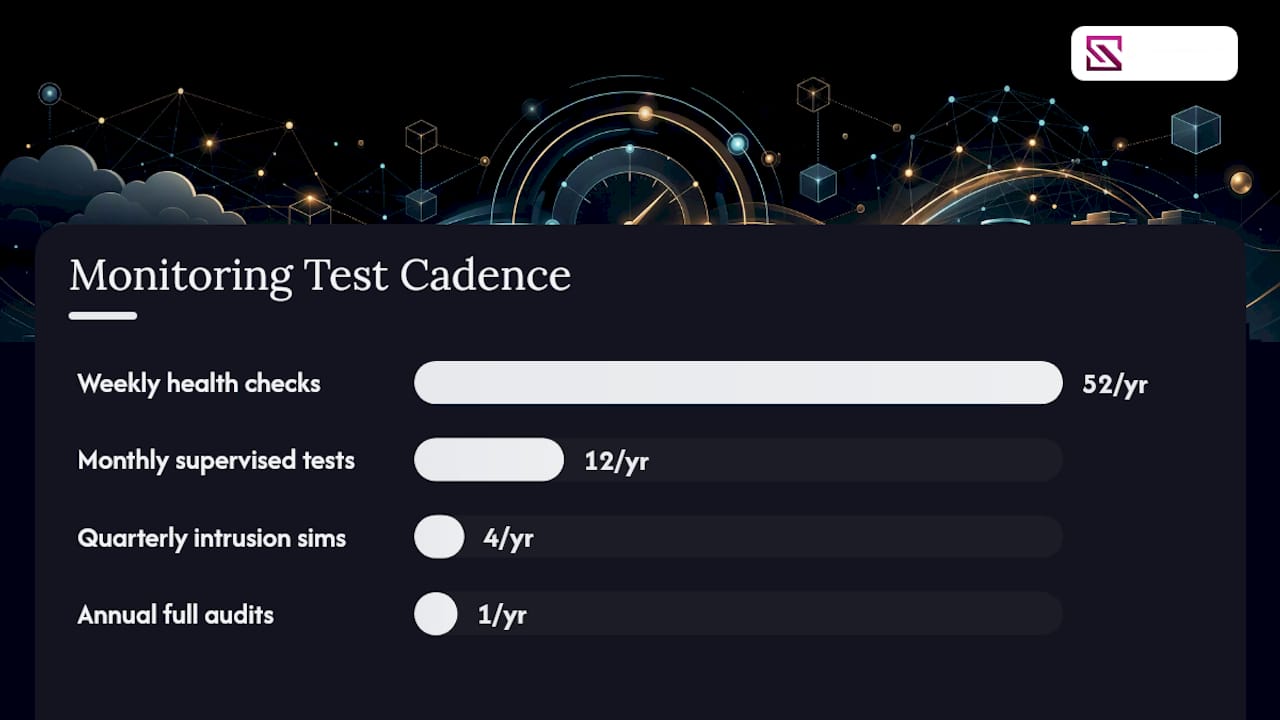
Testing cadence should be written into the contract, not left to memory:
- Weekly device health checks across all sensors and gateways
- Monthly supervised sensor tests, including walk-tests on motion coverage
- Quarterly perimeter intrusion simulations
- Annual full security audits with documented findings
An escalation flow should specify exactly who gets notified, through what channel, and which automated actions (like locking a door or triggering a strobe) are allowed to happen without a human in the loop.
How do you evaluate sensors and analytics before you buy?
Evaluate on five dimensions: detection probability, invalid-alert rate, environmental suitability, useful life, and lifecycle support. Skipping any one of these tends to surface as a maintenance headache eighteen months after installation.
Procurement criteria worth putting directly into your RFP:
- Documented detection specs and invalid-alert benchmarks, not marketing claims
- Maintenance and mean-time-to-repair (MTTR) expectations from the vendor
- Open API support and firmware update policy in writing
- Security features like secure boot and signed firmware updates
Edge analytics wins when bandwidth is limited or latency matters, since processing happens at the camera or gateway instead of a round trip to the cloud. Centralized analytics earn their place when you need cross-site correlation, comparing behavior patterns across ten facilities rather than watching one gate.
Pro Tip: Ask every vendor directly how they handle vulnerability disclosures and what their SLA looks like for critical firmware patches. A vague answer here tells you more than a glossy spec sheet.
A prioritized checklist for your first 90 days
A small set of acceptance gates keeps rollout risk manageable instead of discovering integration problems six months post-installation.
- [High] Complete zone mapping and assign sensors to each security zone
- [High] Issue device identity certificates and test mTLS connections
- [High] Verify integrated alert correlation across ACS, IDS, and VSS
- [Medium] Run detection walk-tests and measure invalid-alert rate
- [Medium] Validate video retention against your compliance requirements
- [Low] Document SOPs and run a tabletop escalation exercise
Acceptance gates worth building into any contract: a certificate issuance test, a detection walk-test, measured invalid-alert rate, video-to-event correlation verification, and retention validation against your written policy.
How do you validate that the system actually works?
Define your KPIs before deployment starts, then test against them rather than accepting a vendor's word that the system "performs well." Detection probability, invalid-alert rate, time-to-detect, time-to-acknowledge, and mean time to restore are the five numbers that matter most.
- Detection probability: target 95% or higher, per EPA's monitoring benchmarks
- Invalid-alert rate: under one per week exterior, under one per three months interior
- Time-to-detect and time-to-acknowledge: measured and logged, not estimated
- Mean time to restore: tracked after any sensor or gateway failure
A workable test plan includes walk tests along the perimeter, simulated intrusion scenarios, sensor health simulation under failure conditions, and end-to-end telemetry integrity checks confirming data arrives unaltered.
For audits, keep device manifests, certificate histories, event logs, video exports, and maintenance records organized and current. The NIST SP 800-171/CMMC implementation checklist maps this documentation directly to zones, which saves enormous time when an assessor asks for evidence.
How we prioritize controls in real projects
Detection and safety come first, then secure telemetry, then lifecycle management. That order isn't arbitrary. Phased rollouts and edge-first analytics for remote sites protect operations while the harder integration work happens in the background, and acceptance gates exist precisely so a half-finished rollout never gets treated as a finished one.
How Beyondsensor supports secure monitoring from procurement to operations
Beyondsensor builds the sensor hardware, analytics, and integration services that put every control above into practice, rather than leaving you to stitch together components from separate vendors. That matters because most rollout delays trace back to mismatched hardware and software promising compatibility that never quite arrives.

Working with Beyondsensor on a deployment typically covers:
- Sensor hardware selection matched to your environment and zone requirements
- Secure gateway provisioning with device identity and mTLS built in from day one
- Analytics tuning to hit your invalid-alert targets, not just detection minimums
- SOC and ACS/IDS/VSS integration support for correlated alerting
- Testing and audit support to generate the evidence your compliance team needs
If you're evaluating vendors for an upcoming procurement cycle or planning a pilot deployment, visit the Beyondsensor site to start a conversation about your specific site requirements.
Sources
- Recent 2026 research on Zero Trust for interconnected environments
- Designing Physical Security Monitoring, EPA enhanced security monitoring primer
Recommended
- Essential security checklist for infrastructure: 18 safeguards | News | BeyondSensor
- How to Secure Sensor Networks: 2026 IT Guide | News | BeyondSensor
- Security Solution Pitfalls to Avoid in 2026 | News | BeyondSensor
- Streamline smart infrastructure security: a step-by-step guide | News | BeyondSensor
Read More Articles
RTSP Security Risks: Integrators Must Block Exposed Ports 554 and 8554
See how integrators can reduce RTSP security risks: close exposed ports 554 and 8554, secure camera access, and verify each deployment with practical checks.

Require MAEpp and X Accuracy Before You Buy People Counting Systems
Verify people counting accuracy by demanding MAEpp, X Accuracy, and directional-bias reports. Validate on-site with at least 100 events per direction...
30–90 Day Pilot Validates Redundant Camera Networks for Engineers
Standards led, practical steps for engineers to deploy redundant camera networks: MRP, dual homing, and aggregation patterns, commissioning checks, and...

30 Day Pilot Proves Video Analytics Accuracy for Security Teams
Validate video analytics accuracy with scenario tests, camera tuning, transfer learning and a 30 day edge first pilot for security teams.
Let's Build YourSecurity Ecosystem.
Whether you're a System Integrator, Solution Provider, or an End-User looking for trusted advisory, our team is ready to help you navigate the BeyondSensor landscape.
Direct Advisory
Connect with our regional experts for tailored solutioning.