
Discover the vital role of sensors in infrastructure for 2026. Learn how integration transforms data into predictive maintenance solutions!
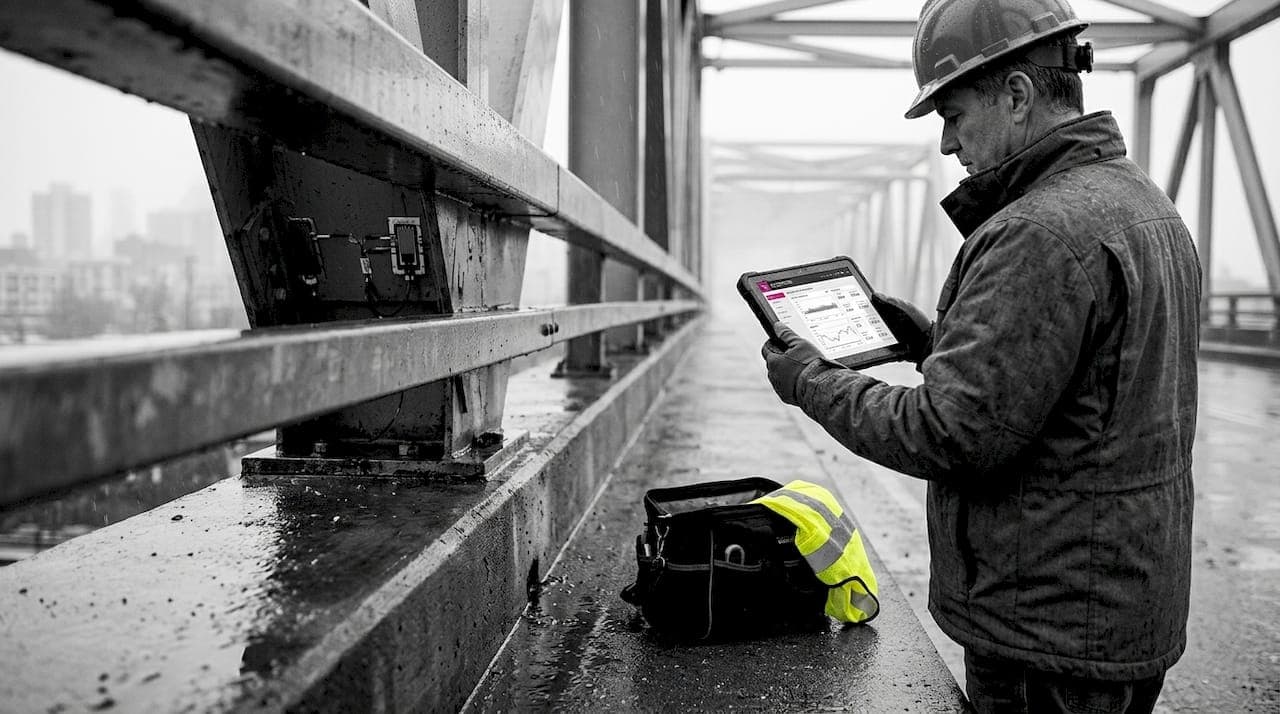
The Role of Sensors in Infrastructure: 2026 Guide
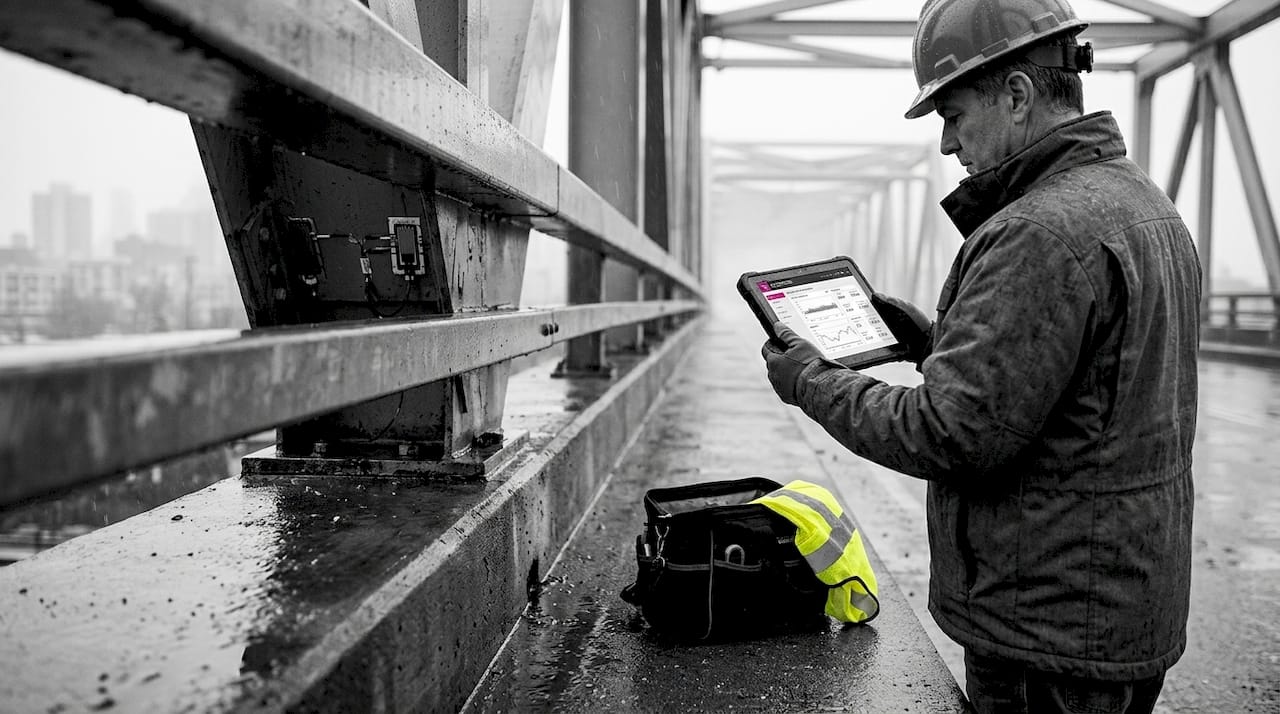
TL;DR:
- Effective infrastructure monitoring depends on integrating sensor data with AI, digital twins, and automated maintenance systems. Proper sensor placement, rugged outdoor enclosures, and seamless CMMS integration are essential to maximize value and reduce failure risks. Future trends focus on multi-sensor fusion, edge computing, and human-centric AI to enable smarter, more resilient infrastructure management.
Modern infrastructure professionals already know that sensors collect data. What most underestimate is how little that data matters without the right integration layer behind it. The role of sensors in infrastructure goes far beyond measurement. When sensor telemetry connects to IoT networks, AI analytics, and computerized maintenance management systems (CMMS), it shifts entire maintenance programs from reactive to predictive. This guide breaks down the sensor types, integration architectures, real-world applications, and deployment challenges that infrastructure engineers and project managers need to understand in 2026.
Table of Contents
- Key takeaways
- The role of sensors in infrastructure monitoring
- Integrating sensors into smart infrastructure ecosystems
- Applications and benefits across public infrastructure
- Challenges in deploying sensor networks
- Future trends in infrastructure sensing
- My take on sensor ROI in infrastructure projects
- What Beyondsensor offers for smart infrastructure teams
- FAQ
Key takeaways
| Point | Details |
|---|---|
| Sensors alone are not enough | True value comes when sensor data triggers automated maintenance workflows through CMMS integration. |
| Sensor type and placement both matter | Matching the right sensor modality to each physical parameter, and placing nodes strategically, determines system accuracy. |
| Integration with AI and digital twins | Connecting sensors to AI analytics and digital twin models shifts monitoring from periodic to continuous. |
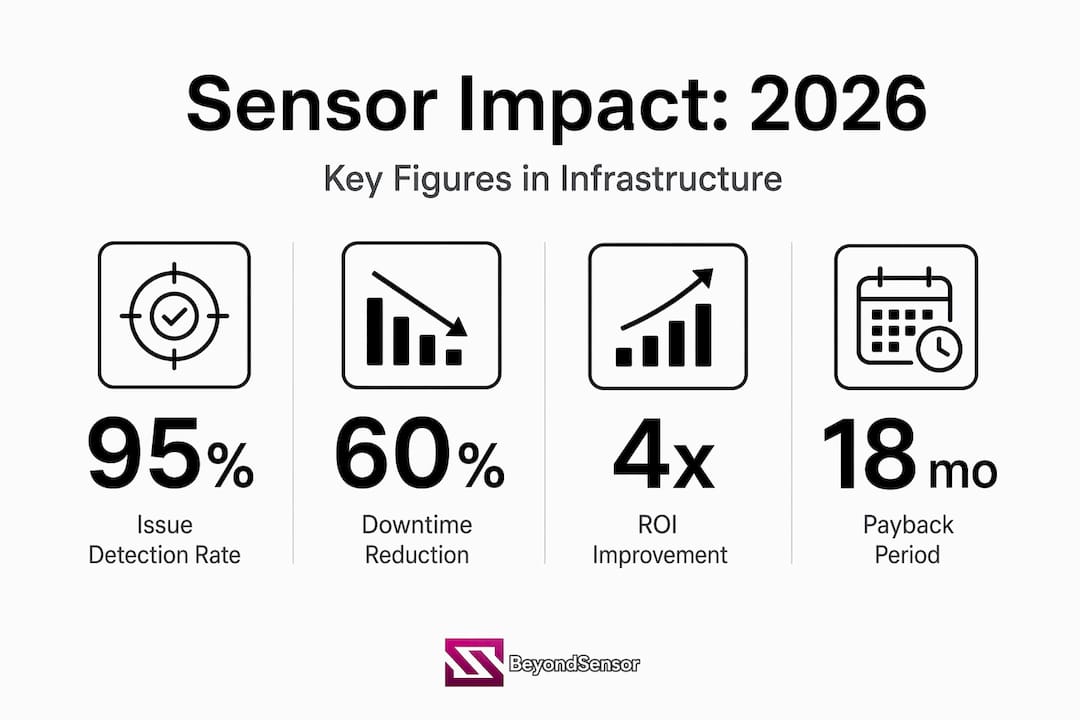
| Public infrastructure sees measurable gains | Sensor-enabled systems reduce issue detection latency to zero and improve resolution times by up to 90%. |
| Durability beats sensitivity outdoors | For outdoor infrastructure, environmental ruggedness is a more critical selection criterion than raw sensor sensitivity. |
The role of sensors in infrastructure monitoring
Sensors are the nervous system of any smart infrastructure project. They translate physical reality, whether that is stress in a bridge deck, temperature in an HVAC duct, or particulate concentration in urban air, into digital signals that systems can process and act on.
The main sensor modalities used in infrastructure monitoring fall into six categories:
- Fiber-optic sensors: Measure strain, temperature, and displacement along continuous cable runs. Ideal for long bridges, tunnels, and pipelines where point sensors would require thousands of individual nodes.
- Piezoelectric sensors: Convert mechanical stress and vibration into electrical signals. Widely used for detecting cracks, fatigue, and impact loads in structural members.
- Accelerometers and MEMS devices: Capture dynamic motion and vibration signatures. Critical for seismic monitoring and rotating equipment health checks.
- Acoustic emission sensors: Detect high-frequency stress waves produced by crack propagation. Particularly effective in concrete and steel structures under load.
- Environmental sensors: Monitor humidity, temperature, corrosion potential, and air quality. The role of environmental sensors in infrastructure is often underestimated until a corrosion failure or air quality incident triggers a costly shutdown.
- Ultrasonic sensors: Measure displacement and detect subsurface defects without physical contact. A real-world case using ultrasonic sensors with a 6TiSCH wireless network demonstrated practical bridge monitoring at low cost and with continuous coverage.
Each sensor category monitors distinct physical parameters. Piezoelectric sensors track microstrain and vibration amplitude. Accelerometers measure g-forces across defined frequency bands. Environmental sensors log time-series data on temperature gradients and relative humidity. Getting this pairing right matters as much as the hardware quality.
For outdoor infrastructure, sensor ruggedness over sensitivity is the primary selection criterion. Extreme thermal cycling, moisture ingress, UV degradation, and mechanical shock will destroy a precision lab-grade sensor within months. Specifying ingress protection ratings, operating temperature ranges, and corrosion-resistant enclosures should come before comparing sensitivity specifications.
Pro Tip: When specifying sensors for outdoor bridge or tunnel installations, prioritize IP67 or IP68 ratings and wide operating temperature ranges from the start. Retrofitting enclosures after installation costs far more than selecting the right hardware upfront.
Integrating sensors into smart infrastructure ecosystems
A sensor that reports data to a spreadsheet is not smart infrastructure. The real impact comes from what happens to that data after collection.
Here is how a mature sensor integration architecture is typically built:
- IoT-enabled wireless networks form the transmission backbone. Protocols such as LoRaWAN, Zigbee, and 6TiSCH allow sensors to relay readings in real time without the cost and rigidity of wired installations. IoT and digital twin integration enables real-time lifecycle tracking that periodic manual inspections simply cannot match.
- AI-powered anomaly detection sits above the network layer. Machine learning models trained on historical sensor data can distinguish normal operational variance from early-stage structural fatigue or equipment degradation. This is where predictive maintenance replaces scheduled inspection cycles.
- Digital twin models provide the virtual counterpart of the physical asset. When sensor data streams feed directly into a building information model (BIM) or a physics-based digital twin, engineers can simulate load scenarios, predict remaining service life, and schedule interventions before failure occurs.
- CMMS integration converts sensor alerts into work orders automatically. Without this final step, even well-designed sensor networks produce alert fatigue rather than results. Automated maintenance workflows are what separate sensor deployments that improve operations from those that create noise.
The shift from periodic inspections to continuous data-driven management is not incremental. It is architectural. Infrastructure teams that treat sensors as add-ons to existing inspection protocols capture maybe 20% of the available value. Teams that redesign their maintenance workflows around sensor telemetry capture the rest.
Pro Tip: Before selecting your sensor platform, map out the full data path from sensor output to maintenance work order. If there is no clear CMMS integration plan, the sensor hardware decision is premature.

Applications and benefits across public infrastructure
The role of sensors in public infrastructure spans every asset class that cities and agencies manage.
| Maintenance Dimension | Traditional Approach | Sensor-Enabled Approach |
|---|---|---|
| Issue detection | Scheduled visual inspection | Continuous automated monitoring |
| Detection latency | Days to months | Near zero |
| Work order generation | Manual after inspection | Automatic on threshold breach |
| Resolution time | Baseline | Up to 90% faster |
| Data for asset planning | Periodic reports | Continuous time-series records |

The performance gap in that table is not theoretical. IoT sensor and CMMS integration in smart city programs has demonstrated zero detection latency and 90% faster resolution compared to traditional workflows.
Practical applications across infrastructure types include:
- Bridge structural health monitoring: Fiber-optic and piezoelectric sensors continuously track load distribution, joint displacement, and fatigue accumulation. Threshold breaches trigger automated alerts before conditions become unsafe.
- HVAC systems in public buildings: Sensors monitor airflow, temperature differentials, filter pressure drop, and refrigerant levels. The HVAC sensor market is expanding at 6.4% CAGR through 2032 precisely because IoT-connected HVAC sensing delivers measurable energy savings and reduces equipment failure rates.
- Water and wastewater networks: Flow sensors and pressure transducers detect leaks and blockages in real time, replacing manual rounds that often miss developing problems between inspection cycles.
- Smart grids: Sensors monitor line temperature, load current, and fault conditions across distribution networks, enabling dynamic load balancing and faster fault isolation.
- Air quality monitoring: Environmental sensor networks in urban corridors provide the data cities need to comply with regulatory limits and to identify pollution sources before they generate public health incidents.
The sensing technology features that enable these applications are not uniform. Each use case demands a different combination of sensor modalities, sampling rates, communication protocols, and data retention policies.
Challenges in deploying sensor networks
Understanding the importance of sensors in infrastructure also means understanding why deployments fail. Several challenges consistently appear across projects.
- Suboptimal placement: Uniform distribution of sensors across a structure sounds logical but wastes nodes and misses critical measurement points. Multi-level placement hierarchies that combine boundary screening, zone enhancement, and precise critical-point monitoring detect damage more reliably while using fewer physical sensors and reducing installation cost.
- Durability failures: Engineers who select sensors based on sensitivity specifications rather than environmental ratings routinely experience early failures in outdoor deployments. Outdoor sensor ruggedness is not a secondary consideration. It is the primary one.
- Data overload without CMMS integration: A 200-sensor bridge monitoring system generating readings every 30 seconds creates millions of data points per day. Without automated threshold logic and CMMS integration to translate those readings into work orders, the data becomes a burden rather than an asset. Raw sensor data without CMMS consistently leads to information overload and alert fatigue among maintenance teams.
- Cybersecurity exposure: Connected sensor networks expand the attack surface of critical infrastructure. Communication protocols must include encryption, authentication, and intrusion detection as core requirements, not afterthoughts.
Pro Tip: Design your alert prioritization logic before you deploy a single sensor. Classify alerts by severity and asset criticality so that maintenance teams receive actionable, prioritized work orders rather than undifferentiated data streams.
Future trends in infrastructure sensing
The sensor technology used in infrastructure is advancing on several fronts simultaneously, and the trajectory points toward deeper integration and greater autonomy.
- Industry 5.0 human-centric frameworks: The next generation of infrastructure monitoring combines sensor data, AI analytics, and digital twins to augment human decision-making rather than replace it. Industry 5.0 bridge monitoring research demonstrates how this model improves both safety outcomes and sustainability metrics.
- Multi-sensor fusion and lightweight AI: Single-modality sensing is giving way to fused systems that combine acoustic, vibration, thermal, and visual data. Lightweight AI models running at the edge can process this fused data locally, reducing latency and bandwidth costs.
- Smart grid market expansion: The smart grid sensor market is projected to reach USD 2.49 billion by 2031 at an 18.7% CAGR, reflecting the scale of investment flowing into sensor-enabled grid modernization globally.
- Edge computing and hybrid cloud architectures: Processing sensor data at the edge, close to the physical asset, reduces transmission costs and improves resilience when network connectivity is intermittent. Hybrid cloud and edge approaches are becoming the standard architecture for large-scale infrastructure monitoring programs.
The impact of sensors on urban planning is becoming measurable in city budget cycles. Agencies that have deployed sensor networks across bridges, utilities, and public buildings report meaningful reductions in emergency repair spending as preventive interventions replace reactive ones.
My take on sensor ROI in infrastructure projects
I have reviewed a lot of sensor deployment projects, and the pattern of where value gets lost is remarkably consistent. Teams spend months evaluating sensor hardware and almost no time designing the integration layer that makes that hardware useful. The result is technically impressive monitoring systems that nobody acts on.
In my experience, the single highest-leverage decision in any infrastructure sensor program is not which sensor to buy. It is where you place the nodes and how alerts translate to work orders. Multi-level sensor placement strategies that prioritize critical structural junctions over uniform coverage routinely outperform denser, uniformly distributed networks at a fraction of the installation cost.
I have also seen projects fail because the team selected high-sensitivity laboratory-grade sensors for outdoor bridge applications. The sensors failed within 18 months due to thermal cycling and moisture ingress. The rugged, slightly less sensitive alternative specified by the contracting engineer would have lasted a decade.
My consistent advice: treat the CMMS integration and alert prioritization logic as core deliverables, not post-deployment tasks. If you want real-time monitoring to actually reduce your maintenance burden, the workflow design matters as much as the sensor hardware. Sensors that never trigger a work order are not saving anyone time or money.
— Eumir
What Beyondsensor offers for smart infrastructure teams

Infrastructure engineers and project managers working on sensor network design and integration can find direct support through Beyondsensor's AI-driven platform and system integrator services. Beyondsensor specializes in secure, scalable sensor ecosystems that connect hardware to real operational outcomes, from high-precision sensor specification through CMMS workflow automation. Their smart infrastructure security guide covers practical integration frameworks for teams deploying sensor networks across bridges, utilities, and public facilities. For teams evaluating full-stack sensing solutions, Beyondsensor's system integrator services provide AI-driven integration support, regional validation across Southeast Asia, and scalable deployment frameworks designed for complex public infrastructure programs.
FAQ
What is the primary role of sensors in infrastructure?
Sensors measure physical parameters such as strain, vibration, temperature, and corrosion in real time, enabling continuous structural health monitoring and predictive maintenance. Their full value is realized when sensor data integrates with IoT networks, AI analytics, and CMMS platforms to automate maintenance response.
How do sensors improve infrastructure maintenance workflows?
IoT-connected sensors reduce issue detection latency to near zero and can improve maintenance resolution times by up to 90% when integrated with CMMS systems that automatically generate prioritized work orders from sensor alerts.
What sensor types are most common in structural monitoring?
Fiber-optic, piezoelectric, accelerometer, and acoustic emission sensors are the most widely deployed for structural health monitoring. Environmental sensors measuring humidity, temperature, and corrosion potential are also standard in outdoor infrastructure applications.
Why does sensor placement matter more than sensor count?
Multi-level placement hierarchies that target boundary zones, regional enhancement areas, and critical structural points detect damage more reliably than uniformly distributed networks while using fewer nodes. Optimal placement reduces both installation cost and the risk of missing critical failure indicators.
What are the biggest risks in sensor network deployments?
The three most common failure points are poor placement strategy, selecting sensors based on sensitivity rather than environmental ruggedness, and failing to integrate sensor outputs into CMMS platforms. Without CMMS integration, raw sensor data typically produces alert fatigue rather than maintainable workflows.
Recommended
- How to Secure Sensor Networks: 2026 IT Guide | News | BeyondSensor
- Streamline smart infrastructure security: a step-by-step guide | News | BeyondSensor
- Top sensor security tips for safety & compliance 2026 | News | BeyondSensor
- How sensor technology drives smarter industrial automation | News | BeyondSensor
Read More Articles

Why Adaptive Sensing Is Critical for AI in 2026
Discover why adaptive sensing is critical for AI in 2026. Learn how it enhances data efficiency and model performance for groundbreaking results.

Securing Sensitive Facility Areas: A Practical Guide
Discover the essential guide to securing sensitive facility areas. Learn risk assessment, access control, and ongoing audits for effective protection.

List of Industrial Automation Challenges for Engineers
Discover the list of industrial automation challenges engineers face. Understand key obstacles to enhance efficiency and ROI in your projects.

How to Audit Sensing Infrastructure: 2026 Guide
Learn how to audit sensing infrastructure in 2026. Ensure accuracy, reliability, and compliance for your sensor networks. Read more!
Let's Build YourSecurity Ecosystem.
Whether you're a System Integrator, Solution Provider, or an End-User looking for trusted advisory, our team is ready to help you navigate the BeyondSensor landscape.
Direct Advisory
Connect with our regional experts for tailored solutioning.