
Explore the critical role of IoT in security for 2026. Discover how connected devices reshape defense strategies and enhance protection effortlessly.

The Role of IoT in Security: A 2026 Guide

TL;DR:
- IoT security extends threat detection across physical and digital environments, expanding attack surfaces and providing new visibility. Effective management requires network-based detection, lifecycle governance, and AI-driven techniques tailored for constrained, diverse devices and complex environments. Building unified asset inventories and deploying continuous, behavior-based monitoring enables organizations to detect breaches quickly and adapt to evolving IoT risks.
The role of IoT in security is to extend organizational defenses across physical and digital domains by connecting sensors, controllers, and networked devices into a unified detection and response architecture. Security professionals now manage environments where a single compromised IP camera or industrial controller can serve as a pivot point into core enterprise systems. IoT devices enlarge attack surfaces by acting as network entry points with potential physical safety impacts, according to CompTIA. NIST and Vectra have both published guidance confirming that IoT security demands a fundamentally different model than traditional IT defense. Understanding that model is the starting point for every security decision you make in a connected environment.
What is the role of IoT in security operations?
IoT's role in security is dual and inseparable. It expands the attack surface while simultaneously providing new detection capabilities through distributed sensor data, behavioral telemetry, and physical-layer visibility. Security teams that treat IoT purely as a liability miss the operational intelligence these devices generate. Those that treat them purely as sensors miss the real exposure they introduce.

Cyber and physical vulnerabilities interact in IoT environments in ways that traditional IT security models were never designed to handle. A vulnerability in a building management controller is not just a data risk. It can affect HVAC systems, access control, and physical safety simultaneously. This convergence is what makes IoT security a distinct discipline rather than a subset of conventional cybersecurity.
The impact of IoT on safety extends well beyond data confidentiality. In industrial and critical infrastructure settings, a compromised sensor can trigger false readings, disable alarms, or cause equipment failures with real-world consequences. Security professionals operating in these environments need frameworks that account for both the cyber and physical dimensions of every device they manage.
How does IoT expand attack surfaces and introduce unique vulnerabilities?
IoT devices introduce constraints that traditional IT security tools were not built for. Most run embedded operating systems with limited compute resources, making it impossible to install endpoint detection agents or apply standard patch management cycles. Many ship with default credentials, unencrypted firmware, and no mechanism for remote updates.
IoT vulnerabilities include both in-band and out-of-band types, a taxonomy that reflects how attackers can exploit network traffic directly or manipulate physical interfaces like serial ports, USB connections, and hardware debug pins. This dual attack surface is what separates IoT risk from conventional server or workstation risk. An attacker who gains physical access to a device in an unmonitored area can extract credentials or implant firmware without touching the network.
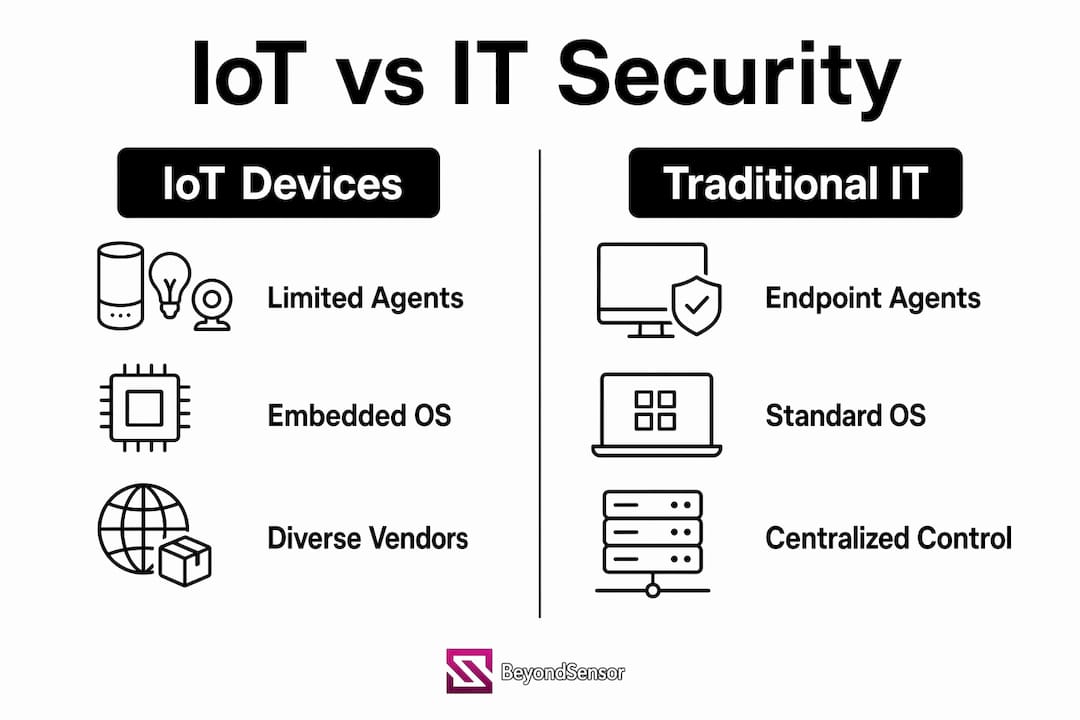
The table below compares IoT device risk characteristics against traditional IT endpoints to clarify where the exposure concentrates.
| Characteristic | IoT devices | Traditional IT endpoints |
|---|---|---|
| Endpoint agent support | Rarely available | Standard |
| Patch cycle frequency | Irregular or vendor-dependent | Regular, often automated |
| Default credential risk | High | Moderate |
| Physical attack surface | Significant | Limited |
| Network visibility | Requires passive monitoring | Agent-based telemetry available |
| Operational downtime tolerance | Often near-zero | Higher tolerance |
Diverse manufacturers compound the problem. A single industrial facility might run devices from dozens of vendors, each with different firmware update policies, security disclosure practices, and support lifecycles. This inconsistency makes unified asset management difficult and leaves security teams with blind spots that attackers actively exploit.
Pro Tip: Build a vendor security scorecard during procurement. Evaluate each IoT supplier on firmware update frequency, CVE disclosure history, and support lifecycle length before any device reaches your network.
How does network-level monitoring address IoT security gaps?
80% of IoT breaches start at the device level, according to Vectra, yet most IoT devices cannot host the endpoint agents that security operations centers rely on for detection. This means network traffic analysis is the primary mechanism for identifying compromised devices. Network detection and response (NDR) tools observe traffic patterns, flag anomalies, and provide the visibility that endpoint tools cannot.
Network segmentation using zones and conduits, as defined by IEC 62443 compliance frameworks, is the structural foundation of IoT network security. Zones group devices by function and trust level. Conduits define the permitted communication paths between zones, enforced by firewalls and traffic inspection policies. Without this structure, a single compromised IoT device can move laterally across an entire operational technology (OT) network unchecked.
Effective network-level IoT security strategies include the following practices:
- Passive traffic monitoring: Deploy agentless network sensors that capture device behavior without requiring software installation on the IoT device itself.
- Behavioral baseline profiling: Establish normal communication patterns for each device class, then alert on deviations such as unexpected outbound connections or unusual protocol usage.
- Micro-segmentation: Isolate device groups so that a breach in one zone cannot propagate to adjacent systems without crossing a monitored boundary.
- Encrypted traffic analysis: Use metadata and flow analysis to detect threats inside encrypted sessions without decrypting operational data.
- Continuous asset discovery: Maintain a live inventory of every networked device, including those that appear intermittently, to prevent unmanaged devices from creating blind spots.
For industrial IoT deployments, firewall segmentation in OT networks provides a practical framework for implementing inter-zone policies that limit lateral movement while preserving operational continuity. Security teams should treat segmentation not as a one-time configuration but as an ongoing governance process that adapts as devices are added or retired.
Pro Tip: Map every IoT device to a specific zone before deployment. Devices that do not fit an existing zone definition should trigger a security review, not a default network assignment.
What does IoT security lifecycle management require?
Security does not begin at deployment. NIST guidance on IoT manufacturer responsibilities establishes that foundational cybersecurity activities should occur before a device reaches the market, reducing the remediation burden on customers and system integrators. Secure-by-design principles, documented firmware update policies, and published vulnerability disclosure processes are baseline expectations, not optional features.
Managing IoT security across a device's full lifecycle requires a structured approach. The following steps reflect current best practice for security teams and procurement decision-makers:
- Pre-procurement assessment: Evaluate vendor security posture, including firmware update frequency, CVE history, and end-of-life support commitments.
- Secure onboarding: Change default credentials, disable unused services, and verify firmware integrity before connecting any device to the production network.
- Asset inventory registration: Log every device with its firmware version, network location, zone assignment, and responsible owner.
- Continuous monitoring: Apply network-based behavioral monitoring from day one, not after an incident occurs.
- Patch and update management: Establish a process for testing and deploying firmware updates, including a fallback procedure if an update causes operational disruption.
- End-of-life planning: Define retirement criteria and decommissioning procedures that include credential revocation, data sanitization, and network removal.
OT environments add complexity because many devices run for decades and cannot tolerate the downtime that a firmware update or reconfiguration requires. Security teams in these settings need compensating controls, such as network monitoring and physical access restrictions, to manage devices that cannot be patched on a standard cycle. Knowing how to secure sensor networks in these constrained environments is a distinct skill set that procurement policies alone cannot address.
What advanced techniques are strengthening IoT threat detection?
AI-driven detection is changing what is possible in IoT security. Generative AI intrusion detection systems have demonstrated recall of 0.999 and precision of 0.961 on simulated IoT network traffic, according to MDPI Electronics. These figures represent near-elimination of missed detections in controlled conditions, which translates to faster containment and fewer undetected intrusions in production environments.
The table below summarizes the advanced detection approaches now available to security teams.
| Technique | Mechanism | Key benefit |
|---|---|---|
| AI-driven NDR | Anomaly detection on network traffic flows | Detects unknown threat patterns without signatures |
| Federated learning | Local model training on edge nodes | Reduces latency and keeps sensitive data on-site |
| Firmware-based monitoring | Embedded forensic units observing bus traffic | Detects compromised nodes in legacy systems |
| Multimodal sensor fusion | Combines data from multiple sensor types | Improves situational awareness in cyber-physical environments |
| Zero-trust architecture | Continuous verification of device identity | Limits blast radius of any single compromise |
Federated learning frameworks like CyberFedEdgeAI achieve accuracy above 92% for IoT cyberattack detection while processing data locally on edge nodes, according to Springer Nature. This matters for organizations in regulated industries where sending raw operational data to a central cloud for analysis creates privacy and compliance risk. Edge intelligence keeps detection close to the source without sacrificing accuracy.
Firmware-based monitoring using distributed forensic units embeds detection directly into hardware, observing bus traffic to identify compromised nodes in legacy embedded systems. NIST describes this approach as particularly valuable in zero-trust architectures where device identity and behavior must be continuously verified rather than assumed. For security teams managing aging OT infrastructure, firmware-level visibility fills a gap that network monitoring alone cannot close. Understanding how AI transforms anomaly detection in these environments is now a practical requirement, not a future consideration.
Key takeaways
IoT security requires integrating network visibility, lifecycle governance, and AI-driven detection across both cyber and physical domains to manage the unique risks connected devices introduce.
| Point | Details |
|---|---|
| Dual role of IoT | IoT expands attack surfaces and provides detection capabilities simultaneously. |
| Network visibility is primary | Most IoT devices cannot run agents, making traffic analysis the core detection method. |
| Lifecycle security starts at procurement | Vendor assessment, secure onboarding, and end-of-life planning are all required steps. |
| Segmentation limits lateral movement | IEC 62443 zones and conduits prevent a single breach from spreading across OT networks. |
| AI and edge intelligence raise detection accuracy | Federated learning and firmware monitoring close gaps that traditional tools cannot address. |
Why IoT security demands a different mindset entirely
I have spent years working at the intersection of physical security and networked infrastructure, and the pattern I see most often is organizations applying IT security thinking to IoT environments and then wondering why their detection rates are poor. The instinct to reach for an endpoint agent or a signature-based scanner is understandable. It is what the industry trained most security professionals to do. But IoT does not respond to that playbook.
The devices that concern me most are not the ones with known CVEs. Those at least appear in vulnerability databases. The ones that keep me focused are the legacy sensors and controllers that have been running continuously for eight or ten years, have never been patched, and exist in no asset inventory. They are invisible to most security tools and completely exposed to anyone who knows where to look.
What actually works is treating the network as the sensor. When you cannot put an agent on a device, you watch what the device talks to, how often, and what protocols it uses. Deviations from that baseline are your signal. This is not a new idea, but the discipline required to maintain accurate behavioral baselines across hundreds or thousands of devices is something most organizations underestimate.
The future of IoT in security belongs to teams that build unified asset inventories across IT and OT, apply network-based detection as a first-class capability, and integrate AI not as a replacement for analyst judgment but as a force multiplier that handles volume so analysts can handle context. That combination is what separates organizations that detect breaches in hours from those that discover them months later.
— Eumir
How Beyondsensor supports IoT security integration

Beyondsensor builds sensor-based security solutions designed for the operational realities that security professionals and system integrators face in complex IoT and OT environments. The platform combines AI-driven threat detection with support for heterogeneous device ecosystems, giving teams the network visibility and behavioral analytics they need without requiring endpoint agents on constrained devices. For system integrators managing IoT deployments across industrial, infrastructure, and smart facility environments, Beyondsensor provides the hardware-software integration and regional validation that makes deployment reliable at scale. Explore Beyondsensor's security innovations to see how AI-powered detection applies directly to the IoT security challenges covered in this article.
FAQ
What is the role of IoT in security?
IoT's role in security is to extend threat detection and response across physical and digital domains by connecting sensors, controllers, and networked devices into a unified monitoring architecture. It simultaneously expands the attack surface and provides new visibility into physical environments that traditional IT tools cannot reach.
Why can't traditional endpoint security protect IoT devices?
Most IoT devices run embedded operating systems with insufficient compute resources to support endpoint detection agents. Network traffic analysis and behavioral monitoring are the primary detection methods for these devices, as confirmed by Vectra's finding that 80% of IoT breaches originate at the device level.
What is the role of IoT gateways in security?
IoT gateways serve as the enforcement point between device networks and enterprise systems, applying traffic inspection, protocol translation, and access control policies. They are a critical component of zone-and-conduit segmentation strategies under IEC 62443.
How does AI improve IoT threat detection?
AI-driven intrusion detection systems analyze network traffic patterns to identify anomalies without relying on known attack signatures. MDPI Electronics research shows generative AI models achieving recall of 0.999 and precision of 0.961 on IoT network traffic, making them significantly more accurate than rule-based detection alone.
What is the most important first step in IoT security lifecycle management?
Pre-procurement vendor assessment is the most critical first step. NIST guidance establishes that manufacturers should complete foundational cybersecurity activities before market release, and security teams should evaluate firmware update policies, CVE disclosure history, and end-of-life support commitments before any device reaches the network.
Recommended
Read More Articles
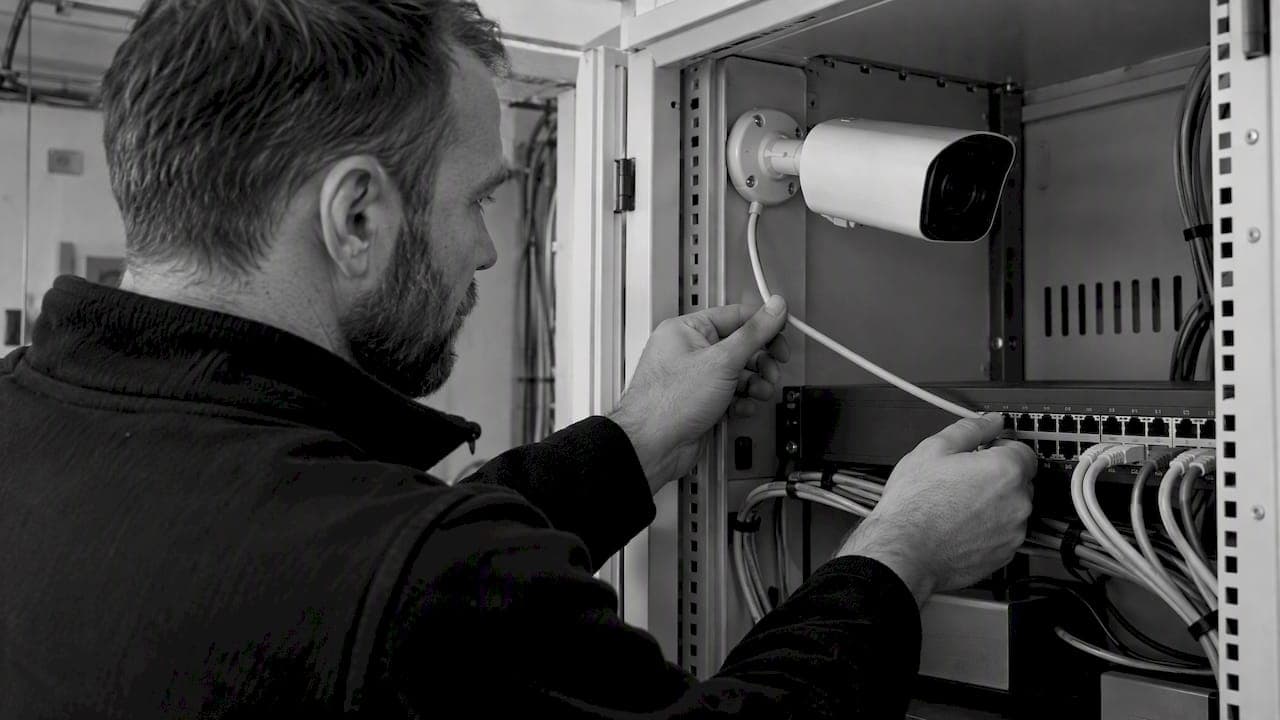
RTSP Security Risks: Integrators Must Block Exposed Ports 554 and 8554
See how integrators can reduce RTSP security risks: close exposed ports 554 and 8554, secure camera access, and verify each deployment with practical checks.

Require MAEpp and X Accuracy Before You Buy People Counting Systems
Verify people counting accuracy by demanding MAEpp, X Accuracy, and directional-bias reports. Validate on-site with at least 100 events per direction...
30–90 Day Pilot Validates Redundant Camera Networks for Engineers
Standards led, practical steps for engineers to deploy redundant camera networks: MRP, dual homing, and aggregation patterns, commissioning checks, and...

30 Day Pilot Proves Video Analytics Accuracy for Security Teams
Validate video analytics accuracy with scenario tests, camera tuning, transfer learning and a 30 day edge first pilot for security teams.
Let's Build YourSecurity Ecosystem.
Whether you're a System Integrator, Solution Provider, or an End-User looking for trusted advisory, our team is ready to help you navigate the BeyondSensor landscape.
Direct Advisory
Connect with our regional experts for tailored solutioning.