
Discover top surveillancezone.com.sg alternatives for system integrators. Explore options like Beyondsensor and open-source solutions that fit your needs.

SurveillanceZone.com.sg Alternatives for System Integrators

For enterprise rollouts in the United States, the strongest path is an integrator-managed, sensor-aware platform that handles data residency, SLA accountability, and multi-site analytics from day one. Beyondsensor fits that profile directly. For teams that need more deployment flexibility, three credible alternative approaches exist: self-hosted commercial VMS (such as Milestone XProtect or Blue Iris), edge-first open-source stacks (Frigate, Shinobi), and cloud-managed platforms with hybrid edge recording.
Each path carries real trade-offs:
- Integrator-managed (Beyondsensor): Full SLA coverage, sensor fusion, AI analytics, and data-residency controls. Best for critical infrastructure, multi-campus, and government-adjacent deployments.
- Self-hosted commercial VMS: Strong ONVIF and RTSP compatibility, perpetual licensing available, but operational burden falls entirely on your team.
- Edge-first open-source (Frigate, Shinobi): Low licensing cost, high configurability, but requires DevOps-level maintenance and is not enterprise-SLA-ready out of the box.
- Cloud-managed hybrid: Centralized oversight with local edge recording. Reduces WAN dependency but raises data-residency questions for regulated sites.
Pro Tip: Before shortlisting any platform, confirm ONVIF conformance certification and published RTSP endpoints. A vendor that cannot produce these in a pre-sales call will cost you weeks during integration.
Table of Contents
- Which alternative approach fits your deployment?
- Profiles of the main deployment approaches
- How to evaluate any alternative before you commit
- Technical considerations for US enterprise deployments
- What Beyondsensor delivers for system integrators
- Key Takeaways
- The operational load most integrators underestimate
- Beyondsensor handles sensors, analytics, and integration as one package
- Useful sources for further research
Which alternative approach fits your deployment?
Aggregator directories compile dozens of surveillance platforms, but they rarely verify enterprise SLAs, multi-site clustering, or US data-residency compliance. Use them for feature discovery, then verify directly.
| Dimension | Self-hosted commercial VMS | Edge-first open-source | Cloud-managed hybrid | Integrator-managed (Beyondsensor) |
|---|---|---|---|---|
| Best for | Single-campus, IT-staffed orgs | Cost-sensitive pilots, edge labs | Distributed retail, branch networks | Critical infrastructure, multi-site enterprise |
| Deployment model | On-premises | Edge / on-prem | Cloud + edge | On-prem, edge, or hybrid |
| Licensing shape | Perpetual or subscription | Open-source (free core) | Subscription (OpEx) | Solution-based (CapEx + SaaS options) |
| Core analytics | VMS, basic motion, plugin AI | Local AI inference (e.g., object detection) | Cloud AI, centralized dashboards | Sensor fusion, AI video analytics, unified SOC dashboard |
| Hardware compatibility | ONVIF, RTSP broad support | ONVIF, RTSP, edge AI appliances | ONVIF, RTSP, vendor-certified cameras | ONVIF, RTSP, proprietary edge devices |
| Scalability | Multi-site with clustering add-ons | Limited without custom engineering | Multi-site native | Multi-site, multi-tenant, role-based access |
| Support & SLAs | Vendor support tiers; no field SLA | Community support only | Vendor SLA; no field integration | Defined SLA with field support |
| US compliance | Varies by vendor; SOC 2 rare | No formal compliance posture | SOC 2 possible; data residency varies | Data-residency controls; compliance-ready |
CapEx vs. OpEx trade-off: Self-hosted VMS and edge stacks front-load hardware and engineering costs. Cloud-managed and integrator-managed models shift spend to recurring fees but reduce internal operational burden significantly.
Data residency note: Cloud-managed platforms may route video metadata through offshore infrastructure. For US federal-adjacent or regulated sites, confirm data-residency contractually before signing.
Regional aggregators list many local providers, but enterprise SLA variance across those vendors is wide. Treat aggregator shortlists as a starting point, not a procurement decision.
Profiles of the main deployment approaches
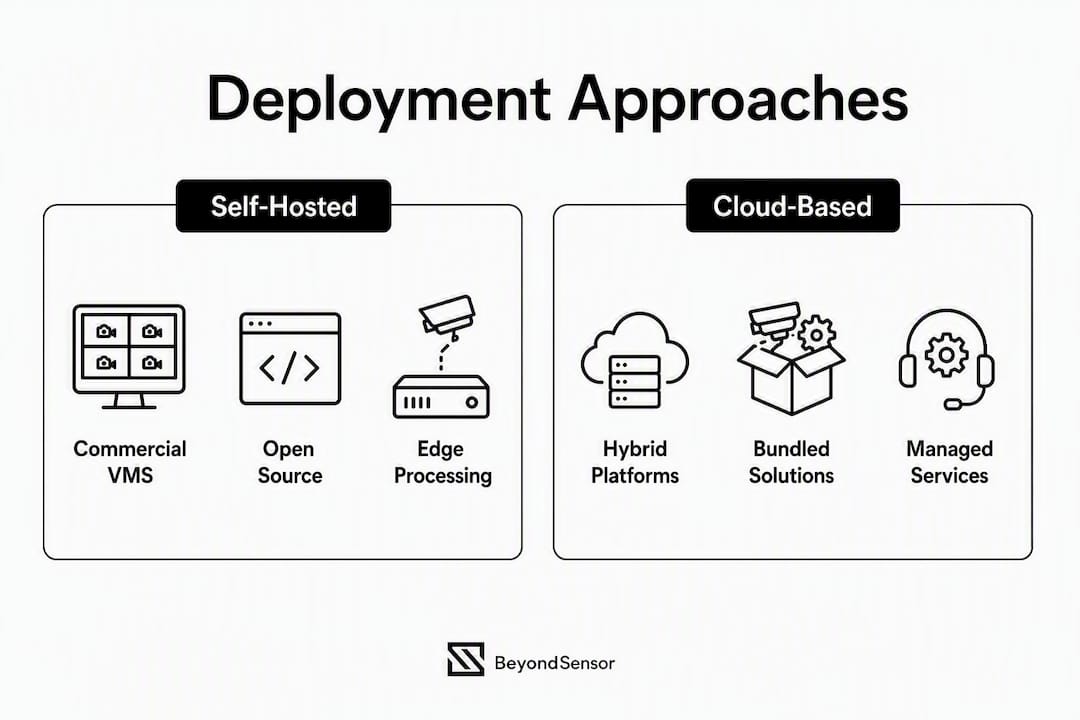
Self-hosted commercial VMS
Platforms like Milestone XProtect sit at the mature end of the on-premises VMS market. They offer broad ONVIF and RTSP camera compatibility, plugin-based AI analytics, and multi-site clustering. The self-hosted options suit organizations with dedicated IT security staff who can manage server infrastructure, licensing renewals, and firmware updates. Deployment typically requires NVR-grade servers, a segmented camera VLAN, and integration engineering for access control tie-ins.

Edge-first open-source stacks (Frigate, Shinobi)
Self-hosting communities rank Frigate highly for low-latency, on-device object detection using consumer or industrial GPU hardware. Shinobi offers a browser-based multi-stream interface with RTSP support. Both are cost-effective for pilots and small sites. The catch: neither ships with enterprise SLAs, and scaling beyond a handful of cameras demands packaging, provisioning automation, and ongoing dependency management. Think of them as DevOps projects, not turnkey products.
Pro Tip: If you pilot an open-source edge stack, build a health-check automation layer from day one. Camera provisioning, retention verification, and backup schedules that run manually at 10 cameras become unmanageable at 100.
Cloud-managed hybrid platforms
Hybrid platforms run local edge recording (reducing WAN load and latency) while pushing metadata, alerts, and dashboards to a cloud orchestration layer. They suit distributed retail chains and multi-branch corporate networks where centralized visibility matters more than strict data locality. The operational burden is lower than pure self-hosting, but integrators must still manage edge appliance firmware and validate that cloud data routing meets the client's residency requirements.
Integrator-managed bundled solutions
This model pairs hardware provisioning, software licensing, and ongoing support under a single contract. Beyondsensor operates in this space, delivering sensor hardware, AI-powered video analytics, and unified security operation dashboards as a coordinated package. For system integrators, the value is clear: one SLA, one escalation path, and a vendor that owns the integration outcome rather than handing it back to your team.
How to evaluate any alternative before you commit
Discovery phase
- Confirm ONVIF conformance and request published RTSP/RTMP endpoint documentation.
- Ask for API reference docs covering stream ingest, event hooks, and user/tenant management.
- Verify US data-residency commitments in writing, not just in marketing copy.
- Request a list of reference customers in comparable verticals (critical infrastructure, multi-campus, industrial).
Pilot phase
- Run a staged pilot on a single site with a defined rollback plan before touching production infrastructure.
- Test multi-site failover, retention policies, and alert routing under realistic load.
- Validate encryption in transit and at rest, and confirm key management ownership.
Scale and handover
- Require documented SLA response tiers (P1/P2/P3) with US field-support coverage.
- Confirm multi-tenant role model supports your client's org structure before scaling.
- Lock in firmware update cadence and spare-parts strategy in the contract.
Red flags that should stop shortlisting immediately:
- No published API documentation
- Proprietary, closed camera formats with no ONVIF path
- SLA language that excludes field response or caps liability below project value
- No US-based support contact or escalation path
Pro Tip: Aggregator pages are useful for feature discovery, but direct vendor verification of SLAs and API maturity is non-negotiable before any RFP award.
Technical considerations for US enterprise deployments
Network and security architecture decisions made early determine whether a deployment scales cleanly or creates maintenance debt.
- Network segmentation: Place all cameras on dedicated VLANs with QoS policies that prioritize video traffic. For multi-site deployments, size WAN links for peak concurrent stream counts, not average.
- Edge vs. centralized recording: Edge NVRs reduce WAN dependency and keep footage local during outages. Centralized NVRs simplify management but create single points of failure without redundancy planning.
- Encryption: Require TLS 1.2 or higher for all streams in transit. Confirm AES-256 encryption at rest for stored footage and metadata.
- Identity and access: Integrate with LDAP or Active Directory for user provisioning. Role-based access control must map to your client's org hierarchy before go-live.
- Audit logging: Every access event, configuration change, and alert acknowledgment should write to an immutable audit log. This is a baseline requirement for SOC 2-adjacent deployments.
- SIEM integration: Plan for syslog or API-based event forwarding to the client's SIEM from day one. Retrofitting this after deployment is expensive.
Staged rollouts with automated health checks are the single most effective way to reduce cutover risk across multi-site deployments. Automate camera provisioning, retention verification, and backup schedule validation before each site goes live. Manual checks at scale fail.
The infrastructure surveillance integration guide covers rollback planning and health-check automation in detail for facilities teams and integrators.
What Beyondsensor delivers for system integrators
Beyondsensor's model is built for integrators who need a single accountable partner across the full deployment lifecycle. The capability set covers:
- Sensor fusion and AI analytics orchestration: Combining video, environmental, and access-control sensor streams into a unified detection layer.
- Multi-site dashboards: Centralized visibility across distributed sites with role-based access and alert routing.
- Data-residency controls: Configurable storage and processing boundaries for US-regulated deployments.
- Technical utilities for integrators: Deployment planning tools, provisioning utilities, and API documentation designed for SI workflows.
- Defined support SLAs: Tiered response commitments with escalation paths, not community forums.
Integration examples span industrial automation sites (sensor fusion with process monitoring), multi-campus corporate rollouts (unified SOC dashboard with access control tie-ins), and environmental monitoring deployments (air quality and perimeter sensing combined with video analytics). In each case, Beyondsensor handles appliance provisioning, API integration, and ongoing support under a single contract.
The integrator-managed model shifts accountability from your team to the vendor. For regulated or high-consequence sites, that accountability transfer is worth more than any per-camera cost saving from a self-hosted alternative.
Key Takeaways
For enterprise procurement, the deployment model you choose determines your operational burden, data-residency posture, and SLA accountability for the life of the contract.
| Point | Details |
|---|---|
| Match model to operational capacity | Self-hosted VMS suits IT-staffed orgs; open-source edge stacks require DevOps maintenance; managed solutions reduce internal burden. |
| Verify before shortlisting | Confirm ONVIF conformance, published API docs, and US data-residency commitments before any RFP award. |
| Pilot with rollback plans | Run staged pilots with automated health checks on a single site before scaling to production infrastructure. |
| Data residency is contractual | Cloud-managed platforms may route data offshore; require written data-residency commitments for regulated US deployments. |
| Beyondsensor as managed alternative | Beyondsensor delivers sensor fusion, AI analytics, multi-site dashboards, and defined SLAs under a single integrator-ready contract. |
The operational load most integrators underestimate
The gap between a working demo and a production-grade deployment is almost always operational, not technical. Firmware lifecycle management, spare-parts logistics, and SLA language that actually holds up under a P1 incident are where projects quietly fail.
Open-source edge stacks are genuinely capable, but the integrators who succeed with them treat them as internal products, not vendor solutions. They maintain package repositories, automate health checks, and staff firmware update cycles. Most enterprise clients cannot support that model internally, which is why managed alternatives exist.
On negotiations: push vendors on three specifics. First, warranty coverage that includes on-site hardware replacement, not just RMA shipping. Second, a spare-parts commitment for edge appliances with a defined lead time. Third, SLA language that specifies field-response time, not just ticket acknowledgment. Ticket acknowledgment in four hours means nothing if the nearest field engineer is two days away.
Beyondsensor handles sensors, analytics, and integration as one package
Most integrators spend the first third of a project reconciling three separate vendor relationships: hardware supplier, software licensor, and support contractor. Beyondsensor collapses that into a single engagement, with system integrator-specific tooling and enterprise SLAs built in from the start.

The practical difference: your team focuses on client outcomes rather than vendor coordination. Beyondsensor covers sensor hardware, AI-powered video analytics, virtual guard tour systems, visitor management, and unified SOC dashboards under one contract. Deployment planning tools are available for integrators scoping multi-site rollouts. To discuss a pilot or request a technical briefing, contact Beyondsensor directly through the system integrators page.
Useful sources for further research
Verify SLA language, API documentation, and US availability directly with each vendor before procurement. Aggregator pages are starting points, not substitutes for due diligence.
| Source | What it offers |
|---|---|
| SaaSHub surveillance software list | Broad feature comparison across open-source and commercial platforms; useful for initial shortlisting |
| SoftwareSuggest VMS alternatives | Deployment model breakdowns and feature coverage for self-hosted and hybrid options |
| SelfHostYourself edge NVR guide | Ranked list of self-hosted projects including Frigate and Shinobi with deployment notes |
| Sitelike regional alternatives | Regional provider directory useful for identifying local vendor options |
| Beyondsensor integration guide | Technical deployment and rollback planning guide for facilities and integrators |
- Always request vendor API documentation and ONVIF conformance certificates directly, not through aggregator summaries.
- For US-regulated deployments, require written data-residency and SOC 2 documentation before contract execution.
- Cross-reference regional alternatives coverage to understand how SLA and support models vary across the vendor landscape.
Recommended
Read More Articles
RTSP Security Risks: Integrators Must Block Exposed Ports 554 and 8554
See how integrators can reduce RTSP security risks: close exposed ports 554 and 8554, secure camera access, and verify each deployment with practical checks.

Require MAEpp and X Accuracy Before You Buy People Counting Systems
Verify people counting accuracy by demanding MAEpp, X Accuracy, and directional-bias reports. Validate on-site with at least 100 events per direction...

30–90 Day Pilot Validates Redundant Camera Networks for Engineers
Standards led, practical steps for engineers to deploy redundant camera networks: MRP, dual homing, and aggregation patterns, commissioning checks, and...

30 Day Pilot Proves Video Analytics Accuracy for Security Teams
Validate video analytics accuracy with scenario tests, camera tuning, transfer learning and a 30 day edge first pilot for security teams.
Let's Build YourSecurity Ecosystem.
Whether you're a System Integrator, Solution Provider, or an End-User looking for trusted advisory, our team is ready to help you navigate the BeyondSensor landscape.
Direct Advisory
Connect with our regional experts for tailored solutioning.