
Discover how smart sensor platforms for physical security enhance response times, reduce false alarms, and unify system management for optimal safety.

Smart Sensor Platforms for Physical Security: 2026 Guide

TL;DR:
- Smart sensor platforms unify multimodal sensing and edge analytics to reduce false alarms and accelerate verification. Implementing edge-first processing with secure APIs and proper segmentation is essential for operational scalability. Beyondsensor offers integrator-focused solutions, supporting deployment, testing, and continuous system optimization.
Smart sensor platforms for physical security unify edge analytics, multimodal sensing, and centralized management into a single operational layer that cuts false alarms, accelerates verified response, and makes legacy access control and video systems operationally intelligent. For system integrators, the immediate takeaway is this: the platform you deploy must handle sensor fusion at the edge, not just in the cloud, or you will spend your maintenance budget chasing nuisance alerts.
Quick checklist for integrators starting a new deployment:
- Assess edge processing headroom before specifying hardware (target platforms with at least 100 TOPS for multi-sensor fusion)
- Confirm ONVIF and REST/Webhook support across every subsystem before signing the integration scope
- Segment sensor networks on dedicated VLANs from day one
- Map integration points to your client's VMS, PSIM, or SIEM before the site survey
- Reference NIST Cybersecurity Framework guidance for device lifecycle and segmentation requirements
- Evaluate Beyondsensor's edge AI platform early in the vendor shortlist
Table of Contents
- What does a smart sensor platform for physical security actually include?
- What are the four pillars of modern integrated physical security?
- How do smart sensor platforms integrate into an enterprise security stack?
- What operational benefits do intelligent sensor platforms deliver by vertical?
- What are the cybersecurity risks for smart sensor networks, and how do you mitigate them?
- What field deployment best practices should integrators validate on site?
- How should integrators select and evaluate smart sensor platforms?
- How Beyondsensor deploys a smart sensor platform in a U.S. enterprise environment
- What should integrators do next? A prioritized roadmap
- Key Takeaways
- The gap between what smart sensor platforms promise and what actually gets deployed
- Beyondsensor gives system integrators a direct path to edge AI deployment
- Useful sources and further reading
What does a smart sensor platform for physical security actually include?
A smart sensor platform is the hardware-software stack that collects raw physical-world data from multiple sensor types, runs inference at or near the source, and delivers structured, actionable events to your security operations layer. It is not a camera system with a dashboard bolted on. The platform owns five distinct technical responsibilities: sense, edge analytics, sensor fusion, event management, and API integration.
Component breakdown:
- Sensor types: RGB cameras, thermal imagers, solid-state 3D LiDAR sensors (including ONVIF/RTSP-compatible units capable of on-device processing and privacy-preserving anonymous 3D data streams), millimeter-wave (mmWave) radar, acoustic sensors, and environmental sensors (gas, temperature, humidity, vibration)
- Edge processor: An on-device compute module running inference locally. High-end deployments use hardware such as the NVIDIA Jetson AGX Orin (275 TOPS) for multi-model ensemble workloads
- Analytics stack: Object detection, classification, behavior analysis, and probabilistic uncertainty quantification models that suppress alerts when sensor input falls outside the model's trained distribution
- Gateway/collector: Aggregates telemetry from distributed sensors, normalizes event schemas, and forwards structured alerts
- Unified management layer: VMS, PSIM, or a purpose-built security operations dashboard that correlates events across subsystems
Edge vs. cloud processing trade-offs:
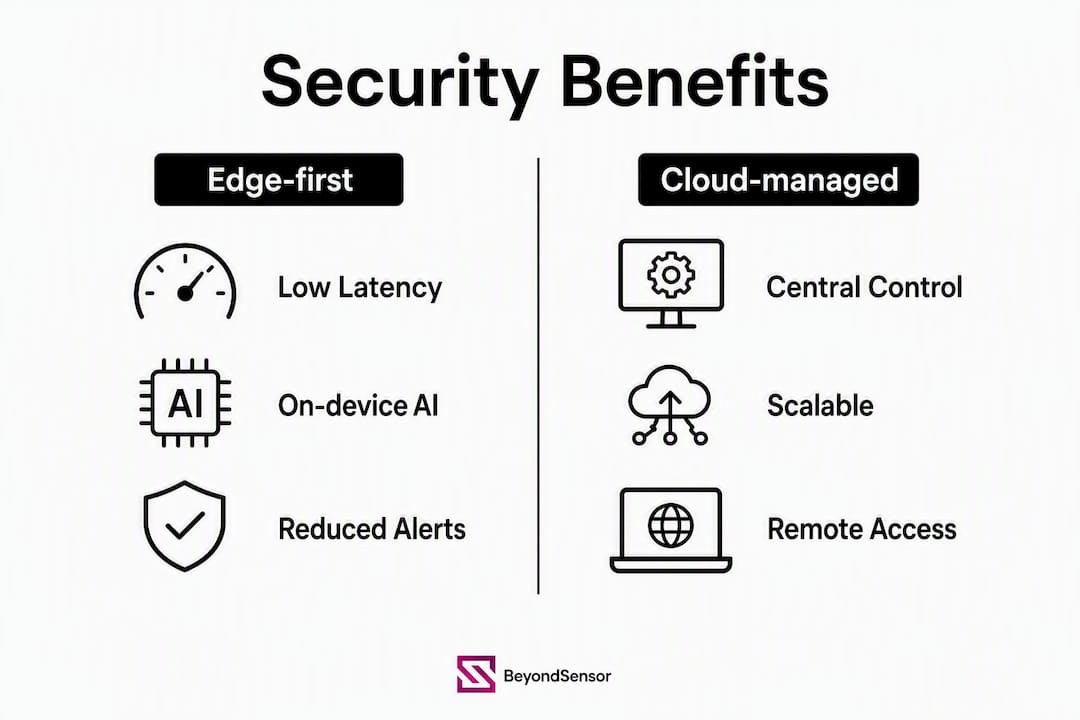
| Dimension | Edge-first | Cloud-managed |
|---|---|---|
| Latency | Sub-10 ms achievable | 100–500 ms typical round-trip |
| Privacy | Data stays on-site | PII may transit network |
| Resilience | Operates during WAN outage | Dependent on connectivity |
| Scalability | Hardware-bound per node | Elastic, lower CapEx per site |
| Maintenance | Firmware updates per device | Centralized update management |
The right architecture for most U.S. enterprise sites is edge-first with optional cloud management, not a pure cloud model. Latency, data sovereignty, and WAN resilience all favor keeping inference local.
What are the four pillars of modern integrated physical security?
Access control, video surveillance and analytics, smart sensors, and unified management are the four pillars every integrated physical security system must deliver. Each pillar has specific technical requirements that integrators must validate before committing to a platform architecture.
- Access control: Must expose event APIs (credential presented, door forced, tailgate detected) in real time, support RESTful or Webhook integration, and log events with millisecond-accurate timestamps for correlation. Tamper detection on readers and door contacts is non-negotiable on high-security perimeters.
- Video surveillance and analytics: Cameras must support ONVIF Profile S or T for interoperability. Edge analytics should run on-camera or on a local NVR to reduce bandwidth. The analytics layer needs to produce structured metadata (bounding boxes, object class, confidence score) rather than raw pixel streams for downstream fusion.
- Smart sensors: The sensor layer extends coverage beyond camera fields of view. LiDAR handles perimeter detection in darkness and adverse weather; thermal sensors detect body heat through smoke or fog; acoustic sensors flag gunshots or glass breaks; environmental sensors catch gas leaks or temperature anomalies before they become incidents. Advanced sensors add the contextual depth that cameras alone cannot provide.
- Unified management: A PSIM or unified operations dashboard correlates events across all four pillars into a single operator workflow. The platform must normalize event schemas from heterogeneous subsystems and support role-based access, audit logging, and escalation rules.
Use case example — tailgating detection: A door sensor flags an access event. The access control system logs a single credential swipe. The video analytics engine simultaneously detects two people in the frame. The unified management layer correlates the three events within 500 ms and raises a verified tailgating alert. No single pillar catches this alone.
How do smart sensor platforms integrate into an enterprise security stack?
The recommended architecture pattern is edge-first with optional cloud management. Inference runs locally, events are normalized at the edge, and the cloud layer handles fleet management, reporting, and long-term storage. This keeps latency low, keeps PII on-site, and keeps the system operational during WAN outages.
Data flow for a production deployment:
- Sensor captures raw data (video frame, point cloud, acoustic waveform, telemetry packet)
- Edge processor runs inference and applies uncertainty gating (suppresses low-confidence alerts)
- Structured event (object class, confidence, timestamp, location) is published to the local event bus
- Gateway normalizes the event schema and forwards to VMS, PSIM, or SOAR via REST/Webhook or MQTT
- Operator workflow receives a verified, contextualized alert with supporting evidence clips
- SIEM ingests the event log for audit and threat correlation
Standards and protocols to prioritize:
- ONVIF Profile S/T/G: Video interoperability across cameras, NVRs, and VMS platforms
- RTSP: Live and recorded video stream delivery for alarm verification
- MQTT/AMQP: Lightweight telemetry transport for high-frequency sensor data
- REST/Webhooks: Alert delivery and two-way API integration with access control and PSIM
- PTP/NTP: Hardware-level time synchronization across heterogeneous sensors to prevent drift and enable accurate event correlation
Integration testing checkpoints:
- Validate API contracts between each subsystem before go-live (schema, authentication, rate limits)
- Confirm event timestamps are synchronized to within 1 ms across sensor types
- Test end-to-end alert latency from sensor trigger to operator notification under peak load
- Verify VMS receives structured metadata, not just video streams, from analytics nodes
Pro Tip: Hardware-level time synchronization (PTP) is not optional for multi-modal fusion. Software timestamps drift under load, and a 50 ms offset between a LiDAR event and a camera frame is enough to break correlation logic and generate false positives.

What operational benefits do intelligent sensor platforms deliver by vertical?
The top benefits integrators can sell to clients are reduced false alarms, faster mean time to verification, predictive hazard detection, and privacy-preserving perimeter coverage. These are not theoretical. Sensor-driven security workflows consistently show that multimodal fusion with uncertainty gating is what separates operationally scalable deployments from systems that generate alarm fatigue.
High-value use cases by sensor combination:
- Perimeter intrusion (outdoor): LiDAR + thermal + RGB camera. LiDAR provides 3D position and velocity; thermal confirms human presence in darkness; camera provides visual verification. FMCW LiDAR focal-plane-array sensors have demonstrated detection ranges from 4 to 65 meters at frame rates suitable for security applications.
- Indoor theft and unauthorized access: Video analytics + access control event correlation. Behavior analysis flags loitering or unusual movement patterns; access control confirms whether the individual has valid credentials.
- Environmental hazard detection (warehouses, data centers): Gas sensors + thermal imagers. Gas sensors catch chemical leaks before they reach dangerous concentrations; thermal imagers identify overheating equipment racks or battery systems.
- Campus and facility perimeter: mmWave radar + camera. Radar detects movement through rain, fog, and dust where cameras lose effectiveness; camera provides verification.
- Government and regulated facilities: Sensor platforms for government environments must also address chain-of-custody logging and audit trail requirements alongside detection performance.
Representative performance metrics:
|---|---|---| | False-alert rate target typical in camera-only systems is reduced significantly with uncertainty gating in multimodal edge platforms | | Edge compute (TOPS) | 10–30 TOPS (camera NVR) | Edge compute capability equivalent to high-performance devices such as NVIDIA Jetson AGX Orin | | LiDAR detection range capable of up to several tens of meters using FMCW FPA technology | | Time synchronization precision is greatly improved using hardware PTP compared to standard software NTP | | Mean time to verification is reduced from several minutes with manual review to under a minute using automated event correlation |
Enterprise multimodal platforms using probabilistic uncertainty quantification running entirely at the edge aim to reduce false-alert rates to low single-digit percentages. That figure is the benchmark integrators should use when evaluating vendor claims.
What are the cybersecurity risks for smart sensor networks, and how do you mitigate them?
Treat every sensor node as a potentially hostile device until it has been provisioned, authenticated, and placed behind network controls. That single principle, drawn from zero-trust architecture, is the most important security posture shift integrators must make when deploying IoT-based physical security systems.
Mitigation checklist:
- Device identity and hardware root of trust: Only onboard devices that support cryptographic attestation. Avoid sensors with no secure boot or no hardware security module (HSM).
- Network segmentation: Place all sensor nodes on dedicated VLANs, isolated from corporate IT networks. Apply micro-segmentation rules that allow only necessary traffic (telemetry out, firmware updates in, management plane access restricted to jump hosts).
- Firmware lifecycle management: Establish a signed firmware update policy. Unsigned firmware is an attack vector. Schedule quarterly update reviews and automate deployment where the platform supports it.
- Encrypted telemetry: All sensor-to-gateway and gateway-to-cloud traffic must use TLS 1.2 or higher. Unencrypted MQTT on port 1883 is not acceptable in a production enterprise environment.
- Default credential elimination: Every sensor, gateway, and management console must have its default credentials rotated before network connection. This is the most commonly skipped step in rushed deployments.
- Incident response planning: Define a sensor-specific incident response playbook that covers device isolation, forensic preservation of edge logs, and notification procedures under applicable U.S. regulations.
Beyondsensor's sensor security and compliance guidance covers lifecycle management and U.S. privacy-aware deployment practices in detail, including considerations relevant to CCPA and HIPAA-adjacent environments.
Relevant standards: NIST Cybersecurity Framework (CSF) 2.0 provides the governance structure for device lifecycle, access control, and incident response. ISO 27001 applies where clients require formal ISMS certification.
Pro Tip: Monitor model drift as a security signal, not just a performance issue. If your uncertainty gating layer starts suppressing an unusually high percentage of alerts, that pattern can indicate sensor tampering, environmental change, or adversarial input — not just a calibration problem.
Nuisance alarm impact: The most common failure point in smart sensor deployments is nuisance alarm fatigue caused by naive threshold-based detection. Systems that apply probabilistic uncertainty quantification suppress alerts when the AI model encounters input outside its trained distribution, rather than forcing a binary alert decision on noisy or ambiguous data. This architectural choice is what separates operationally scalable platforms from systems that operators learn to ignore.
What field deployment best practices should integrators validate on site?
Build to operate, test to operate. Every commissioning decision you make in the field either reduces or multiplies your support burden over the life of the deployment. Beyondsensor's practical deployment guide covers commissioning steps, network planning, and field acceptance testing for enterprise environments.
Field deployment checklist:
- Site survey: Walk every sensor location with a RF spectrum analyzer and a network cable tester. Confirm line-of-sight, lighting conditions (for cameras), and obstructions (for LiDAR and radar) before finalizing mounting positions.
- Mounting height and angle: Cameras for behavior analytics typically require 3–4 m mounting height for accurate overhead perspective. LiDAR sensors for perimeter detection should be mounted to maximize horizontal field of view with minimal ground-plane clutter.
- Power: Confirm PoE budget per switch port before specifying cameras and edge compute nodes. High-power edge processors may require 802.3bt (PoE++) rather than standard 802.3af. For remote sensors, validate battery capacity against environmental temperature range and expected duty cycle.
- Environmental tolerance: Verify IP and IK ratings match the deployment environment. Outdoor sensors in northern U.S. climates must tolerate operating temperatures down to at least -40°F; coastal installations require corrosion-resistant enclosures.
- Tamper and concealment testing: Physically test tamper detection on every sensor before sign-off. Confirm that tamper events reach the management console within the SLA window.
- Acceptance testing: Run a structured detection test at each sensor location. Document detection rate, false-alert count, and end-to-end alert latency from sensor trigger to operator notification. Use the Beyondsensor sensor deployment guide for security professionals as a reference for POC acceptance criteria.
- Maintenance cadence: Schedule quarterly firmware reviews, annual sensor cleaning and recalibration, and semi-annual detection performance audits against baseline acceptance metrics.
Pro Tip: Benchmark multi-modal fusion latency using hardware-synchronized timestamps, not software logs. A system that reports 8 ms fusion latency in a lab environment may deliver 40 ms in the field if the edge processor is also running VMS encoding tasks. Isolate inference workloads from recording workloads on separate compute resources.
How should integrators select and evaluate smart sensor platforms?
Prioritize platforms that support multimodal fusion, on-device uncertainty gating, and standard APIs. Those three criteria eliminate the largest categories of deployment failure before you write a single line of integration code.
Procurement checklist:
- Integration APIs: ONVIF, REST, Webhooks, MQTT — all must be documented and versioned
- Edge compute headroom: minimum 100 TOPS for single-sensor analytics; 200+ TOPS for multi-sensor fusion workloads
- Security posture: hardware root of trust, signed firmware, TLS-encrypted telemetry, documented CVE response process
- Support SLAs: on-site response time, firmware patch turnaround, and escalation path for critical vulnerabilities
- VMS/PSIM interoperability: confirmed integration with the client's existing video management or physical security information management platform
- Licensing model: perpetual vs. subscription, per-device vs. per-site, and cloud management fees
- Scalability: confirmed architecture for multi-site fleet management without linear cost growth
Platform category comparison:
| Category | Typical capabilities | Limitations | Price shape |
|---|---|---|---|
| Entry-level field apps | Single-sensor analytics, cloud-dependent, basic alerting | No edge fusion, high false-alert rates, limited API | Low CapEx, high OpEx (cloud fees) |
| Mid-tier hybrid platforms | Edge + cloud, multi-sensor support, VMS integration | Limited uncertainty gating, moderate API depth | Moderate CapEx + subscription |
| Enterprise edge platforms | Full multimodal fusion, uncertainty gating, PSIM integration, fleet management | Higher CapEx, requires skilled integration | Higher CapEx, lower long-term OpEx |
TCO items integrators must model:
- Hardware refresh cycle (typically 5–7 years for edge compute nodes)
- Connectivity costs (cellular backup for remote sensors)
- Cloud management fees (per-device or per-site subscription)
- Monitoring manpower: how many operators per verified alert, and what is the cost of a false alert in operator time?
- Training and change management for security staff on new alert workflows
How Beyondsensor deploys a smart sensor platform in a U.S. enterprise environment
A Beyondsensor enterprise deployment for a U.S. multi-building corporate campus reduced verified alarm workload and shortened mean time to verification by replacing a camera-only system with a multimodal edge platform integrating video analytics, LiDAR perimeter detection, and environmental sensors.
Deployment architecture:
- Sensors deployed: RGB cameras with on-camera analytics, solid-state LiDAR units covering perimeter fence lines, thermal sensors at loading dock entries, and environmental sensors (temperature, gas) in server rooms and mechanical spaces
- Edge compute: Dedicated edge inference nodes per building, running multi-model analytics with probabilistic uncertainty gating to suppress low-confidence alerts before they reach the operations center
- Integrations: VMS integration via ONVIF Profile T for video; REST API integration with the client's existing access control platform for credential event correlation; MQTT telemetry feed to the client's SIEM for audit logging
- Time synchronization: PTP hardware sync across all sensor nodes to enable sub-millisecond event correlation between LiDAR, camera, and access control events
- Deployment timeline: Site survey and network planning (2 weeks), hardware installation and commissioning (3 weeks), integration testing and acceptance (2 weeks), staff training (1 week)
Acceptance KPIs negotiated at POC stage:
- False-alert rate below 5% of total alerts generated (measured over 30-day pilot)
- End-to-end alert latency under 90 seconds from sensor trigger to operator notification
- System uptime above 99.5% over the pilot period
- Zero unresolved tamper events during the pilot window
Beyondsensor's sensor deployment guide for security professionals documents the POC metrics and acceptance criteria framework used in this type of engagement.
What should integrators do next? A prioritized roadmap
Invest in edge-first multimodal platforms when latency, privacy, or false-alarm rates are the client's primary pain points. That covers the majority of U.S. enterprise deployments in 2026.
Step-by-step roadmap:
- Site audit: Document existing sensor inventory, network topology, VMS/PSIM platform, and current false-alert rate. Establish a baseline before specifying any new hardware.
- Define POC success criteria: Agree with the client on measurable KPIs before the pilot starts. Recommended set: false-alert rate, end-to-end alert latency, system uptime, and operator handling time per verified alert.
- Pilot deployment: Deploy a single-zone multimodal configuration covering the highest-risk area. Run for 30 days against the agreed KPIs. Document every deviation from baseline.
- Integration validation: Confirm API contracts, event schema normalization, and time synchronization before expanding to additional zones.
- Scale plan: Use pilot metrics to project hardware, connectivity, and monitoring costs across the full site. Revise TCO model before committing to full deployment.
POC metrics to measure:
- False-alert reduction vs. baseline (target: 50% or greater reduction)
- End-to-end alert latency (target: under 90 seconds)
- System uptime (target: 99.5% or higher)
- Operator handling time per verified alert (target: under 3 minutes)
Key Takeaways
Edge-first multimodal sensor platforms with probabilistic uncertainty gating are the most operationally effective architecture for U.S. enterprise physical security deployments in 2026.
| Point | Details |
|---|---|
| Edge-first architecture wins | On-device inference keeps latency under 10 ms and keeps PII on-site, outperforming cloud-dependent models on both dimensions. |
| Uncertainty gating is the differentiator | Platforms that suppress low-confidence alerts reduce false-alert rates to sub-3%, eliminating the alarm fatigue that undermines operator trust. |
| Standards compliance is non-negotiable | ONVIF, REST/Webhooks, MQTT, and PTP time sync are the minimum interoperability requirements for any enterprise integration scope. |
| TCO requires full lifecycle modeling | Hardware refresh, cloud fees, connectivity, and operator time per alert must all be modeled before committing to a platform architecture. |
| Beyondsensor as deployment partner | Beyondsensor provides multimodal edge AI platforms, deployment services, and POC tooling purpose-built for system integrators in U.S. enterprise environments. |
The gap between what smart sensor platforms promise and what actually gets deployed
The industry conversation around intelligent security platforms tends to focus on detection capabilities: detection ranges, TOPS counts, model accuracy. Those numbers matter. But the gap between a platform that performs in a lab and one that holds up in a real enterprise environment is almost always an integration and operations problem, not a sensor problem.
The deployments that fail do so because the integration scope was underspecified. An integrator commits to connecting a new sensor platform to a legacy VMS without validating the API contract, or assumes software timestamps are sufficient for multi-modal fusion, or skips network segmentation because the project timeline is tight. The sensors work. The system does not.
The non-obvious priority for integrators in 2026 is uncertainty calibration during seasonal and environmental changes. A model trained on summer conditions will behave differently in winter, when lighting angles shift, foliage disappears, and ground reflectivity changes. Plan a recalibration window at each seasonal transition. It is a 4-hour site visit that prevents months of elevated false-alert rates and the operator trust erosion that follows.
Beyondsensor gives system integrators a direct path to edge AI deployment
System integrators working on U.S. enterprise physical security projects face a specific problem: the gap between a vendor's feature list and a production-ready, integrated deployment is where projects stall. Beyondsensor closes that gap with a platform built for integrators, not just end-users.

Beyondsensor's offering for system integrators includes edge AI sensor platforms with multimodal fusion, video analytics dashboards, virtual guard tour systems, automated visitor management, and unified security operations dashboards. Every component is designed for integration: documented APIs, ONVIF compliance, and deployment tooling that reduces commissioning time. The system integrator platform includes POC support, technical deployment planning, and access to Beyondsensor's ecosystem of regional partners and integration specialists.
For integrators ready to move from evaluation to deployment, Beyondsensor's deployment tools and utilities provide commissioning scripts, acceptance testing frameworks, and configuration templates. Request a POC consultation directly through the system integrator page to define success criteria and timeline with Beyondsensor's technical team.
Useful sources and further reading
- NIST Cybersecurity Framework (CSF) 2.0 — governance structure for IoT device lifecycle, segmentation, and incident response in U.S. enterprise environments
- ONVIF standards and profiles — interoperability specifications for cameras, NVRs, and VMS platforms (Profile S, T, G)
- FMCW LiDAR focal-plane-array research — peer-reviewed data on 4D imaging LiDAR detection ranges (4–65 m) and frame rates for security applications
- Why advanced sensors are essential for physical security — Beyondsensor overview of operational advantages for enterprise security contexts
- How to deploy smart sensors: a practical guide — commissioning checklist and network planning guidance for integrators
- Sensor deployment guide for security professionals — POC metrics, acceptance criteria, and commissioning scripts
- Sensor security and compliance tips — lifecycle management and U.S. privacy-aware deployment practices
- Smart facility integration ideas — practical integration patterns between sensor platforms and facility management workflows
- Beyondsensor system integrator platform — deployment support, POC tooling, and ecosystem resources for integration teams
This article provides general technical and operational guidance for system integrators. Regulatory requirements, compliance obligations, and applicable standards vary by client environment, industry vertical, and jurisdiction. Confirm current requirements with a qualified legal, compliance, or cybersecurity professional before deployment.
Recommended
- Top sensor security tips for safety & compliance 2026 | News | BeyondSensor
- Physical security compliance: standards and sensor tech guide | News | BeyondSensor
- Key Criteria for Security Sensors: 2026 Expert Guide | News | BeyondSensor
- Optimize physical security workflows with advanced sensors | News | BeyondSensor
Read More Articles
RTSP Security Risks: Integrators Must Block Exposed Ports 554 and 8554
See how integrators can reduce RTSP security risks: close exposed ports 554 and 8554, secure camera access, and verify each deployment with practical checks.

Require MAEpp and X Accuracy Before You Buy People Counting Systems
Verify people counting accuracy by demanding MAEpp, X Accuracy, and directional-bias reports. Validate on-site with at least 100 events per direction...
30–90 Day Pilot Validates Redundant Camera Networks for Engineers
Standards led, practical steps for engineers to deploy redundant camera networks: MRP, dual homing, and aggregation patterns, commissioning checks, and...

30 Day Pilot Proves Video Analytics Accuracy for Security Teams
Validate video analytics accuracy with scenario tests, camera tuning, transfer learning and a 30 day edge first pilot for security teams.
Let's Build YourSecurity Ecosystem.
Whether you're a System Integrator, Solution Provider, or an End-User looking for trusted advisory, our team is ready to help you navigate the BeyondSensor landscape.
Direct Advisory
Connect with our regional experts for tailored solutioning.