
For integrators: redundant CCTV comms with dual path links, warm standby NVRs, 15–30 minute UPS sizing and failover tests.
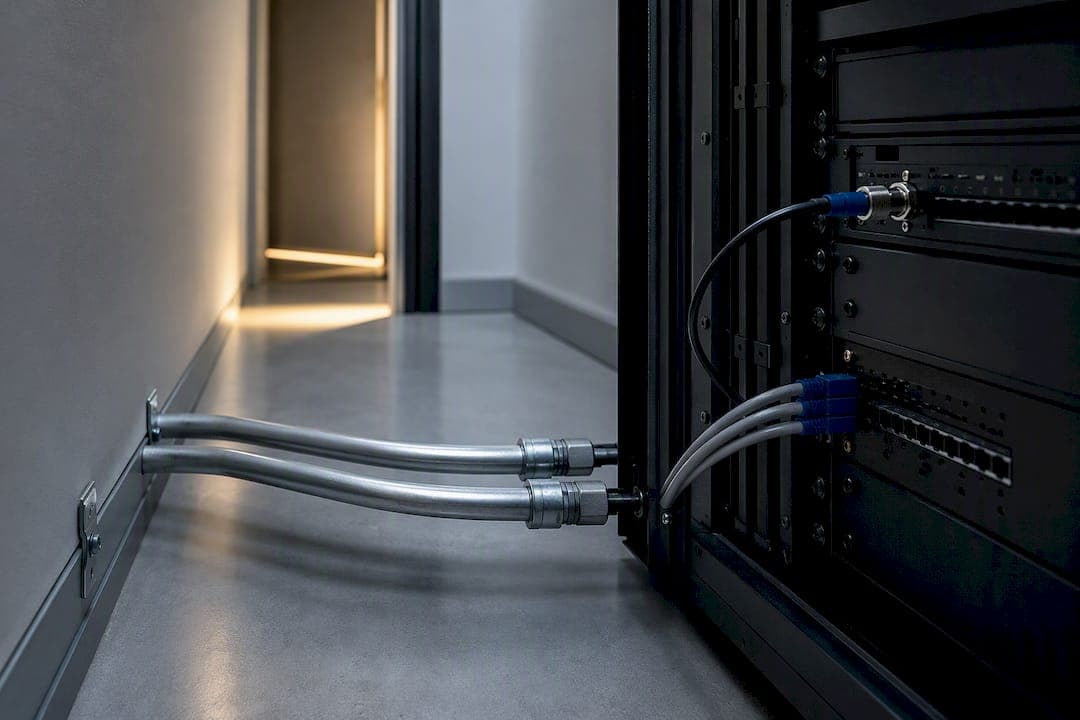
Dual Path and Warm Standby: Redundant CCTV Comms for Integrators
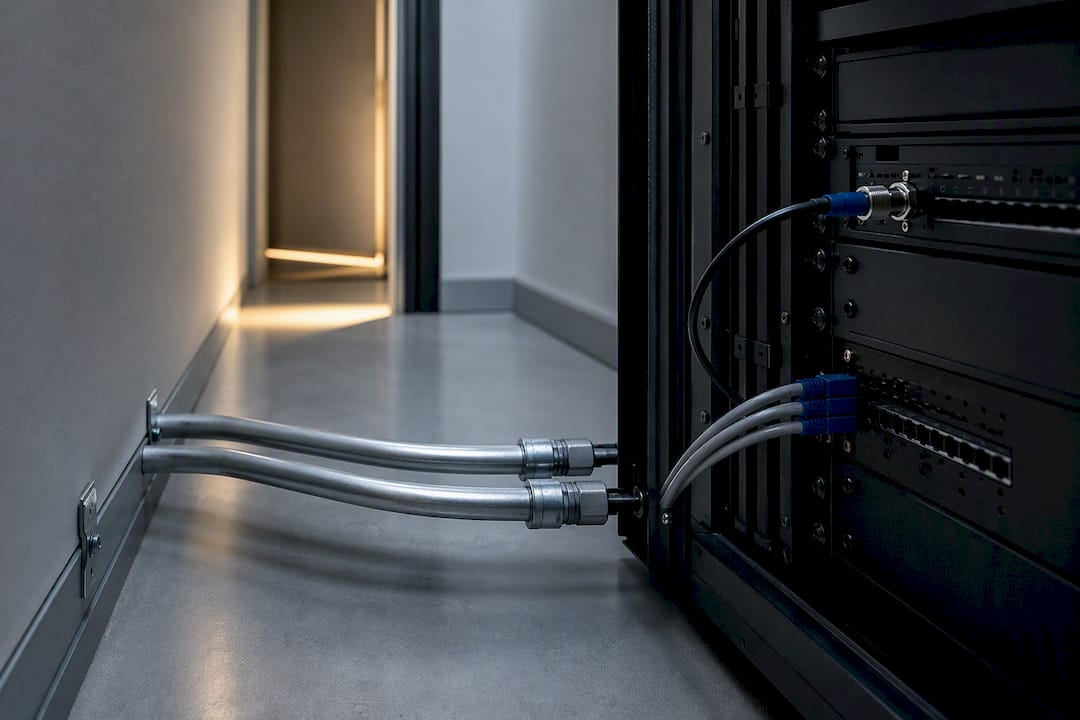
Redundant communications in CCTV means keeping video, alerts, and control traffic moving even when one link, one carrier, or one path fails. The practical default for designers is a physically and logically independent dual-path connection, paired with recorder and storage redundancy and edge recording at the camera. Beyondsensor builds these architectures for integrators who need surveillance networks that survive a cut cable, a dead switch, or a carrier outage without a blind window.
TL;DR:
- True redundancy requires physically and logically independent communication paths, such as diverse fiber routes or multi-network cellular SIMs, to prevent shared failure points.
- Regular failover testing at least annually confirms that switching between primary and backup resources occurs seamlessly, with documented results and minimized data gaps.
- Layered redundancy, including network topology like ring or LACP-bonded links, dual-switch uplinks, and NVR failover modes, is essential to prevent single points of failure inside the building.
- Storage redundancy should match camera count with appropriate RAID levels, and edge recording at cameras provides total isolation if network or recorder fails.
- Costs and ongoing maintenance for redundancy solutions vary widely; prioritizing link-layer and network diversity provides the best risk reduction for investment.
Table of Contents
- What Do "Redundancy" and "Failover" Actually Mean in CCTV?
- How Should You Architect Communication Paths for CCTV?
- Which Network Designs Prevent a Single Switch From Taking Cameras Offline?
- What NVR Failover and RAID Levels Actually Prevent Recording Gaps?
- How Much UPS Runtime and Generator Backup Does a Site Actually Need?
- How Often Should You Test CCTV Failover, and What Should You Test?
- What Should Go on a Redundant CCTV Design Checklist?
- What Regulatory Requirements Apply to Surveillance System Redundancy?
- How Do You Secure a Redundant Communication Path Without Creating a New Weak Point?
- Does Redundancy Actually Cost You Bandwidth or Latency?
- How Much Should You Budget for Redundant CCTV Systems?
- Why Does Overlapping Camera Coverage Matter as Much as Comms Redundancy?
- What Do Integrators Get Wrong About Redundancy in the Field?
- How Beyondsensor Helps Design and Validate Redundant CCTV Architectures
- Sources
What Do "Redundancy" and "Failover" Actually Mean in CCTV?
Redundancy and failover get used interchangeably in spec sheets, and that sloppiness causes real design mistakes. Redundancy means that a parallel, working alternative exists before anything breaks: a second fiber run, a second NVR, a second power feed, all live and ready. Failover is what happens after a failure: the automated (or manual) switch to that standby resource. You cannot have failover without redundancy, but you can absolutely have redundancy that never triggers a clean failover because nobody tested the switchover logic.
The concept designers miss most often is independence. A single point of failure is any component whose failure takes the whole system down, and two "separate" cables running through the same conduit share exactly that kind of failure point. Genuine communication-path redundancy requires paths that are both physically and logically independent — different routes, different carriers or media, and ideally different termination points at the building.
Common failure scenarios worth designing against:
- Conduit damage from construction, rodents, or corrosion severing a fiber run.
- A carrier-side outage taking down cellular backhaul across an entire cell sector.
- A core switch failure isolating an entire camera VLAN.
- A misconfigured routing update silently dropping traffic without an alarm.
Each scenario points to a different layer of the network, which is exactly why redundancy has to be planned per layer rather than bolted on as one generic "backup line."
How Should You Architect Communication Paths for CCTV?
The link layer is where most redundancy plans either earn their keep or quietly fail. Wired options give you bandwidth and stability: diverse fiber routes entering the building from two different directions, or a leased line running parallel to your primary fiber. The catch is cost and civil works. Diverse entry points mean trenching, permitting, and often a second telecom demarcation, which is why many sites settle for a single fiber path and call it done. That's the gap cellular fills.
Cellular-based redundancy has matured fast. Multi-network IoT SIMs paired with industrial dual-SIM routers now provide always-on connectivity for remote or hard-to-wire sites, automatically failing over between carriers when one network degrades. For sites without a wired option at all, this combination, plus a properly specified high-gain antenna, has become the practical standard rather than a stopgap.
A private APN isolates your camera traffic on the carrier's network away from public internet exposure, which matters for compliance and for keeping bandwidth predictable. A VPN over a standard SIM is cheaper and easier to deploy but leans on internet routing you don't fully control. Fixed public IP addressing earns its cost when you need guaranteed inbound access for remote VMS polling or third-party monitoring integration; otherwise a private APN with outbound-initiated VPN tunnels is usually the tighter, more secure choice.
Operationally, get these details right before commissioning:
- SIM IMEI lock so a stolen SIM can't be repurposed in another device.
- APN isolation to keep camera traffic off shared public routing.
- QoS tagging prioritizing video streams over best-effort traffic on shared links.
- MTU sizing matched to your video codec's packet profile to avoid silent fragmentation.
The hybrid model, primary fiber with cellular failover, is the sensible default for most commercial sites: full bandwidth under normal conditions, automatic fallback the moment the primary path drops.
Pro Tip: Order your failover SIM from a different underlying network than your primary carrier uses for management traffic. Two SIMs from resellers on the same physical tower still share that tower's outage risk.
Which Network Designs Prevent a Single Switch From Taking Cameras Offline?
Link-layer redundancy is wasted if a single switch failure inside the building still drops half your cameras. Network topology has to assume hardware dies.
- Ring topology connects switches in a loop so traffic can reach any node from two directions; if one link breaks, traffic simply reroutes the other way around the ring.
- Link aggregation (LACP) bonds multiple physical links between switches into one logical connection, so losing one cable degrades bandwidth rather than killing connectivity outright.
- Dual-NIC recorders connect to two separate switches, meaning an NVR keeps recording even if one switch fails entirely.
- Redundant uplinks between equipment closets avoid a single riser cable becoming the whole building's chokepoint.
Loop prevention matters the moment you introduce ring topology or redundant uplinks, because those designs create physical loops that would otherwise flood the network. Spanning Tree Protocol (STP) handles this but converges slowly, sometimes 30 to 50 seconds, which is an eternity of dropped frames for live video. Rapid STP (RSTP) or Multiple STP (MSTP) converge in a few seconds and are the better fit for any camera network larger than a handful of switches.
Segmentation deserves its own line item. Camera VLANs, management VLANs, and any storage replication traffic should sit on separate logical segments with QoS policy prioritizing live video streams above replication and management chatter. On the physical side, insist on cabling diversity and conduit separation between your primary and redundant runs, and document exactly where the service provider's handover point sits, because that's usually the one segment outside your direct control.
What NVR Failover and RAID Levels Actually Prevent Recording Gaps?
Storage and recorder redundancy is where "we have a backup" claims get tested against reality. Three NVR failover modes cover most deployments:
- Cold standby: a spare NVR sits powered off, ready to be manually swapped in. Cheapest option, but expect minutes of recording loss during the swap.
- Warm standby: the backup NVR stays powered and synced, taking over automatically or with minimal intervention. This is the sensible baseline for mid-sized commercial sites.
- Active-active: two or more NVRs record simultaneously, eliminating the handover gap entirely. Reserve this for critical infrastructure or regulated environments where any recording gap is unacceptable.
RAID configuration should scale with camera count and risk tolerance. RAID 1 suits small deployments of a few cameras. RAID 5 is the reasonable baseline for most commercial installs. RAID 6 or RAID 10 becomes the right call for larger or higher-risk deployments, since a layered approach pairing RAID with backups, NVR failover, and edge recording is the safer default for demanding sites. RAID 6's extra parity drive matters for larger camera deployments, where rebuild windows on a failed drive stretch long enough that a second failure during rebuild becomes a real risk.
Edge recording via microSD at the camera closes the gap that network and NVR redundancy can't: total network isolation. A camera recording locally keeps its footage even if every path back to the NVR is down, and selective cloud replication of high-priority streams gives you an offsite copy for disaster recovery without paying to replicate every camera's continuous feed.
Retention planning ties all of this together. Storage sizing depends on retention days, bitrate per camera, and your continuous versus event-triggered recording mix; getting that math wrong is the single most common reason storage arrays fill up faster than the integrator promised. Beyondsensor's CCTV data retention guide walks through sizing these numbers correctly before procurement, not after the array runs out of headroom.
How Much UPS Runtime and Generator Backup Does a Site Actually Need?
Power redundancy is the layer people underspend on because it's invisible until the lights go out. A per-rack UPS covering switches, NVRs, and cellular routers is more practical than per-device units, which multiply battery maintenance without meaningfully improving reliability.
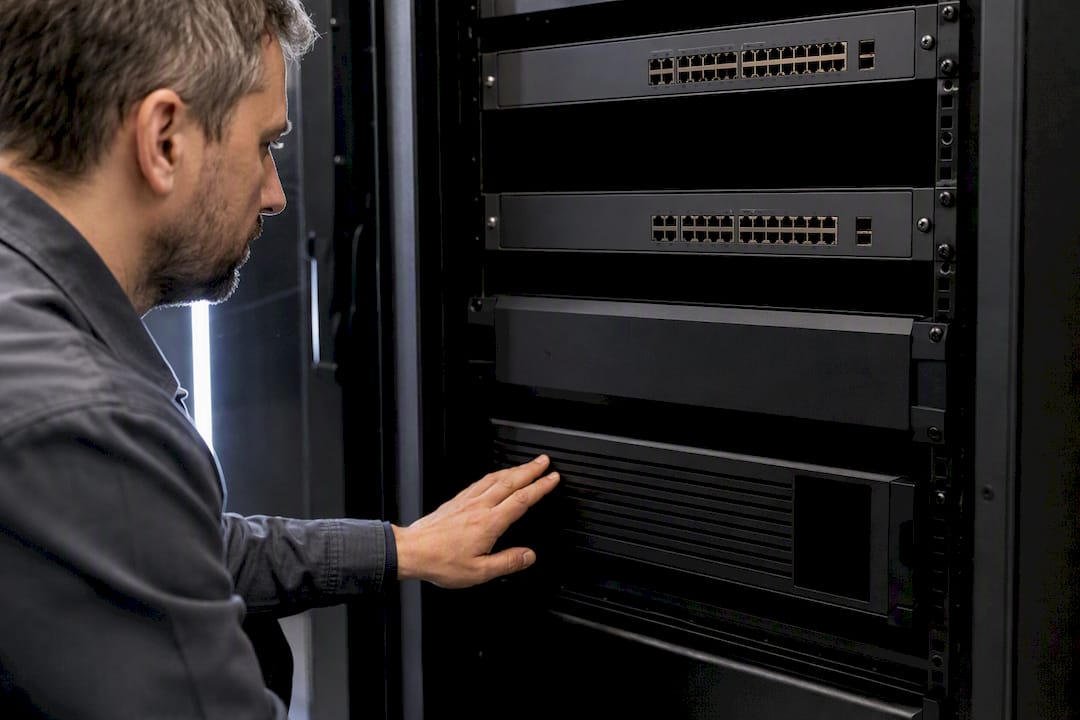
A 15 to 30 minute UPS hold time is the typical target for commercial sites, enough to ride out a short outage or trigger a controlled shutdown before batteries deplete. For retail, manufacturing, and warehouse sites where outages routinely outlast that window, generator handover through an automatic transfer switch is the appropriate next layer, rather than a bigger UPS bank.
Key power resilience items:
- Automatic transfer switches to hand load to a generator without manual intervention.
- Controlled NVR shutdown scripts triggered at a defined battery threshold, since an uncontrolled power cut mid-write is a common cause of RAID corruption.
- SNMP monitoring of UPS battery health and runtime, feeding power alarms directly into VMS alerting so a degrading battery shows up before it fails during an actual outage.
How Often Should You Test CCTV Failover, and What Should You Test?
A redundant path nobody has switched to is a theory, not a system. Failover needs to be tested against realistic failure conditions, not just designed on paper, because configuration drift, expired credentials, and firmware mismatches quietly break failover paths that worked fine at commissioning.
- At commissioning, run a full failover test: pull the primary path, confirm the secondary takes over, and measure the actual gap in recording or alerting.
- Quarterly, run partial tests on individual components, one switch, one SIM, one NVR, rotating through the architecture so nothing goes untested for a full year.
- Annually, run a full simulated outage across every layer at once, since isolated component tests can miss interactions between simultaneous failures.
VMS health monitoring should run synthetic-stream tests continuously, checking that each camera's feed is actually reaching storage, not just that the camera responds to ping. Set alerting thresholds tight enough to catch a degrading link before it fails outright, a rising latency trend usually shows up well before a hard outage.
Change management closes the loop: document a firmware patching policy with defined maintenance windows, and keep a current architecture diagram showing every redundant path so the next technician isn't reverse-engineering the design during an actual outage.
Pro Tip: Require your integrator to hand over documented failover test results, not just a diagram, as part of commissioning. A diagram shows intent; a test result shows the system actually does what the diagram claims.
What Should Go on a Redundant CCTV Design Checklist?
Specification and procurement go smoother with a checklist organized by layer, since it's easy to nail the network design and forget to spec UPS hold time, or vice versa.
- Link: dual-carrier IoT SIM plus industrial dual-SIM router, or diverse fiber plus cellular failover.
- Network: ring topology or LACP-bonded uplinks, RSTP/MSTP loop prevention, VLAN segmentation for camera and management traffic.
- Recorder: warm standby minimum for commercial sites, active-active for critical or regulated sites.
- Storage: RAID level matched to camera count, edge recording at the camera, selective cloud replication for priority streams.
- Power: per-rack UPS with 15 to 30 minute hold time, generator handover for sites with frequent extended outages.
- Testing: documented commissioning test, quarterly partial tests, annual full failover simulation.
| Layer | Minimum viable spec | Upgrade trigger |
|---|---|---|
| Link | Dual-SIM router, single carrier | Multi-carrier SIM once site is deemed critical |
| Network | LACP-bonded uplinks | Ring topology once switch count exceeds three |
| Recorder | Warm standby NVR | Active-active for regulated or critical sites |
| Storage | RAID 5 | RAID 6 or RAID 10 past 32 cameras |
| Power | UPS, 15 minute hold | Generator handover past 30 minute typical outage risk |
Require acceptance tests from any supplier before sign-off: a documented failover trigger, a measured recording gap (or confirmation of zero gap on active-active systems), and UPS runtime verified under real load, not nameplate rating.
What Regulatory Requirements Apply to Surveillance System Redundancy?
Regulatory frameworks rarely spell out redundancy in equipment terms, but they impose obligations that redundancy is often the only practical way to meet. Data protection regulations that govern surveillance footage typically require retention integrity, meaning footage has to remain available and unaltered for its defined retention period. A recording gap caused by a failed NVR with no failover isn't just an operational miss, it can become a compliance gap if that footage was needed for an incident review or a legal request.
Industry-specific rules compound this. Financial institutions, critical infrastructure operators, and government facilities frequently sit under sector-specific security standards that mandate continuous monitoring and documented incident response capability, both of which assume the surveillance system itself stays operational through a disruption. Banks in particular have long treated any communication outage as an unacceptable risk category, and the physical path diversity and dual-carrier practices developed for high-security financial sites apply directly to commercial CCTV redundancy planning.
Insurance and contractual obligations add a second layer. Many commercial leases and insurance policies for high-value sites specify minimum surveillance uptime or retention standards, and a documented redundancy architecture, tested on a schedule, is usually the evidence an insurer or auditor wants to see. Compliance requirements vary meaningfully by jurisdiction, sector, and site classification, so designers should confirm the specific retention periods and uptime obligations that apply to a given facility rather than assuming a generic standard covers every case. Treat redundancy design and compliance documentation as the same project, not two separate ones.
How Do You Secure a Redundant Communication Path Without Creating a New Weak Point?
A second communication path is only a security asset if it's built to the same standard as the primary one. A cellular failover link that skips encryption because "it's just a backup" is a soft target, and attackers increasingly probe secondary paths precisely because they're assumed to be lower priority.
Every path, primary and redundant, should carry traffic through an encrypted tunnel, whether that's a site-to-site VPN, a private APN with carrier-level isolation, or TLS at the application layer for VMS communication. Private APNs deserve particular attention here: they route cellular camera traffic away from the public internet entirely, which meaningfully shrinks the attack surface compared to a SIM routing through public IP space, even with a VPN layered on top.
Credential and certificate management is the part teams forget once a redundant path is live. If your primary and failover paths use separate VPN tunnels or separate APN accounts, both need current certificates and rotated credentials, not just the one that gets touched during routine maintenance. An expired certificate on a failover path you haven't tested in months is a common way redundancy silently breaks.
SIM security matters as much as network encryption. IMEI locking prevents a stolen SIM from being repurposed in an unauthorized device, and this control belongs on every SIM in the architecture, not only the primary. Segment redundant paths on their own VLANs or logical networks too, so a compromise of the failover route can't pivot laterally into the primary network or the recorder infrastructure.
Does Redundancy Actually Cost You Bandwidth or Latency?
Redundancy adds overhead, but the size of that overhead depends heavily on the failover mode you choose, and it's smaller than most designers expect for anything short of active-active recording.
A cold or warm standby path sits idle or lightly synced most of the time, consuming negligible bandwidth until an actual failover event. Active-active NVR configurations are the exception: recording the same streams to two devices simultaneously roughly doubles the bandwidth consumed on that segment, which is exactly why active-active gets reserved for critical sites rather than deployed everywhere by default.
Ring topology and LACP-bonded links generally have neutral or positive latency impact under normal conditions, since traffic simply has more available paths to take. The latency cost shows up specifically during a failover event: STP's 30 to 50 second convergence window creates a real gap in connectivity, while RSTP or MSTP typically converge in a few seconds, a difference that matters enormously for live monitoring even if recording itself doesn't drop a frame thanks to buffering.
Cellular failover paths carry their own latency profile, generally higher and more variable than wired fiber, which is fine for a backup path carrying alert traffic and lower-resolution failover streams, but worth accounting for if you expect full-resolution live viewing to continue uninterrupted during a cellular failover event. QoS tagging that prioritizes video traffic over replication and management chatter keeps this overhead from compounding into visible frame drops on the primary network.
How Much Should You Budget for Redundant CCTV Systems?
Redundancy costs money at every layer, and the honest budgeting conversation is about where that spend delivers the most risk reduction per dollar, not about achieving redundancy everywhere at once.
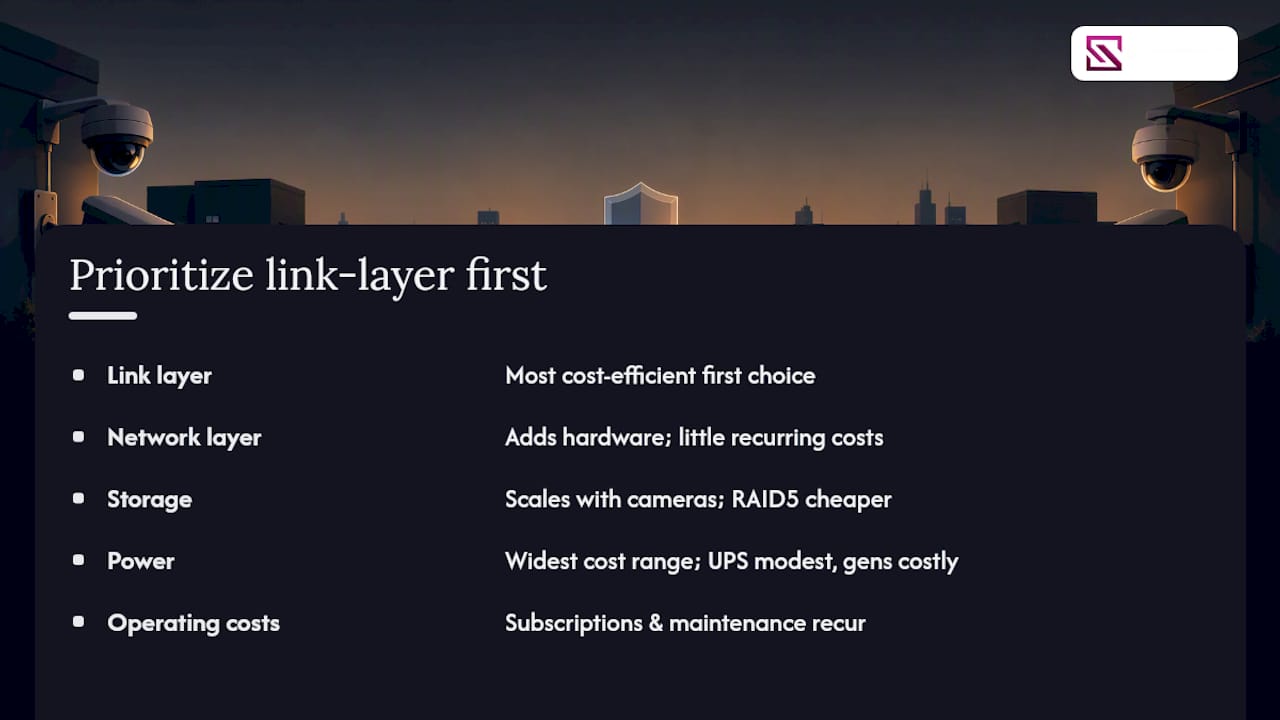
Link-layer redundancy tends to be the most cost-efficient tier to add first. A dual-SIM industrial router with a multi-network IoT SIM plan costs a fraction of trenching a second fiber entry point, and for most commercial sites it closes the largest single point of failure, the single physical connection to the outside world, at relatively low cost.
Network-layer redundancy adds hardware cost (a second switch, additional uplink cabling) but little ongoing expense once installed. Recorder and storage redundancy scales with camera count and chosen RAID level; RAID 5 baseline costs meaningfully less than RAID 6 or RAID 10, which is why matching RAID level to actual camera count and risk tolerance, rather than defaulting to the highest tier everywhere, keeps budgets realistic.
Power redundancy has the widest cost range: a rack UPS is a modest one-time cost, while generator handover with an automatic transfer switch is a significant capital line item usually justified only for sites with genuine extended-outage risk. Ongoing costs matter as much as capital costs here. Multi-carrier SIM plans, cloud replication storage, and UPS battery replacement cycles all carry recurring fees that should be budgeted as operating expense, not treated as a one-time procurement line. The sites that get burned financially are usually the ones that budgeted the hardware but not the subscription and maintenance costs that keep it working.
Why Does Overlapping Camera Coverage Matter as Much as Comms Redundancy?
Communication and recording redundancy protect footage you've already captured. Scene redundancy protects against never capturing it in the first place, and it's the layer most site surveys skip.
Overlapping camera coverage means two or more cameras cover the same critical zone from different angles, so a single camera failure, a vandalized lens, an obstructed view, a dead unit, doesn't create a total blind spot at an entry point or asset location. This matters most at chokepoints: main entrances, loading docks, and high-value storage areas deserve overlapping coverage even on sites where budget limits redundancy everywhere else.
Positioning overlapping cameras well requires the same attention to lighting and field-of-view planning as any single-camera placement. Beyondsensor's lighting specification guide for CCTV covers the vertical-lux planning that keeps overlapping cameras from both underperforming in the same shadowed zone, which defeats the purpose of overlap entirely.
Scene redundancy also has a compliance angle: many incident investigations rely on multiple angles to establish what actually happened, and a single-camera blind spot at the moment a comms path or recorder fails is exactly when overlap earns its cost. Budgeting for overlapping coverage at your three or four highest-risk zones, rather than spreading a thin single-camera layout everywhere, is usually the better allocation of a limited camera budget.
What Do Integrators Get Wrong About Redundancy in the Field?
The most common mistake is assuming two cables in the same conduit counts as redundancy. It doesn't. A backhoe or a rodent takes out both at once, and the "redundant" path fails at the exact moment it was supposed to save you. Physical path diversity has to be verified, not assumed from a network diagram that looks correct on screen.
The second mistake is sizing RAID for camera count and ignoring rebuild windows. A RAID 5 array with a failed drive can take many hours to rebuild on a large system, and a second drive failure during that window causes total data loss. That risk is exactly why RAID 6 exists for larger deployments, yet it gets skipped to save a few dollars per drive bay.
The third, and most avoidable, mistake is skipping simulated failover tests after commissioning. Procurement should always specify demonstrable failover testing and a documented SLA, not just a redundancy diagram. If a site's requirements exceed straightforward dual-path and RAID design, involve a specialist integrator early. That's cheaper than discovering the gap during a real outage.
— Eumir
How Beyondsensor Helps Design and Validate Redundant CCTV Architectures
Beyondsensor works directly with system integrators to specify, design, and validate redundant CCTV comms rather than leaving it to a generic network diagram. That means real architecture design covering dual-path connectivity, NVR failover mode selection, and RAID sizing matched to your actual camera count, plus VMS health monitoring tooling that catches degrading links before they become full outages.

For sites where physical path diversity or carrier redundancy hasn't been verified, or the architecture predates any documented failover test, Beyondsensor offers a technical audit that checks exactly the gaps integrators miss most often: shared conduits, undersized RAID for camera count, and untested failover triggers. From there, commissioning support includes the documented failover testing this article recommends as standard practice, not an afterthought. If you're a system integrator specifying a new deployment or auditing an existing one, start with a technical audit through Beyondsensor's security agency solutions page to get a documented redundancy assessment before your next procurement cycle.
Sources
Recommended
Read More Articles
Open Standards, Edge Resilient Access Control: 5 Steps for Integrators
Five practical steps for security integrators to build open standards, edge resilient access control systems and avoid costly rework.

10 Step Camera Cybersecurity Hardening Checklist for Security Teams
A prioritized 10 step camera cybersecurity checklist for security teams: inventory devices, patch firmware fast, segment networks, enforce unique...
3 Pilot KPIs Security Teams Need for Perimeter Intrusion Detection
Practical PIDS guidance for security teams: demand three pilot KPIs, 15–30 second verification SLAs, and vendor questions that cut false alarms.

Make License Plate Recognition Work: Camera Geometry, IR Lighting
Deployment-first advice to make license plate recognition work: camera geometry, IR lighting, site tests, and a practical acceptance checklist to raise...
Let's Build YourSecurity Ecosystem.
Whether you're a System Integrator, Solution Provider, or an End-User looking for trusted advisory, our team is ready to help you navigate the BeyondSensor landscape.
Direct Advisory
Connect with our regional experts for tailored solutioning.