
Discover the must-have industrial security features that protect your facilities. Enhance safety, ensure compliance, and mitigate risks today!

Must-Have Industrial Security Features for Facilities

TL;DR:
- Industrial sites face unique security challenges due to legacy OT systems, expansive perimeters, and strict compliance standards. Prioritizing risk-based features like zone segmentation, physical-digital security integration, and MFA is essential, with continuous monitoring enhancing overall defense. Organizational alignment and governance are crucial to effectively implement security measures and prevent common breakdowns.
Industrial sites face a threat environment that general commercial properties simply do not. Between legacy operational technology (OT) systems that cannot be patched, physical perimeters spanning acres, and compliance obligations tied to frameworks like IEC 62443 and CISA standards, selecting the right must-have industrial security features is one of the most consequential decisions a security professional will make. Many organizations still lack dedicated OT security programs, leaving critical infrastructure exposed to threats that well-chosen features can stop cold. This guide cuts through the noise and gives you the practical breakdown you need.
Table of Contents
- Key takeaways
- 1. Establishing criteria for must-have industrial security features
- 2. Perimeter and physical security controls
- 3. Network segmentation for OT environments
- 4. Multi-factor authentication and access governance
- 5. Industrial surveillance technology and video analytics
- 6. Continuous monitoring and anomaly detection
- 7. Prioritization framework: comparing features by risk, cost, and compliance
- My take on where industrial security implementation actually breaks down
- How Beyondsensor supports your industrial security program
- FAQ
Key takeaways
| Point | Details |
|---|---|
| Risk-based feature selection | Prioritize features using IEC 62443 zone segmentation and CISA compliance criteria before purchasing any technology. |
| Physical and digital security are inseparable | Perimeter controls, access badges, and network firewalls must work as one integrated system, not separate programs. |
| MFA is non-negotiable for OT remote access | CISA CPG 2.0 requires phishing-resistant MFA or compensating controls including full removal of remote access. |
| Continuous monitoring multiplies every other control | Anomaly detection combined with segmentation drastically reduces breach impact and speeds up containment. |
| Phased implementation beats no implementation | Start with the highest-risk zones and add features in layers rather than waiting for full-budget approval. |
1. Establishing criteria for must-have industrial security features
Before you evaluate any product or technology, you need a scoring framework. Buying features without one is how facilities end up with expensive cameras pointed at low-risk zones while the control room has no network monitoring at all.
The IEC 62443 standard provides the clearest starting point. It organizes security requirements around risk levels, separating assets by criticality rather than treating every device the same. Start there. Layer in CISA's Secure Connectivity Principles, which specify that all OT connectivity must be logged and monitored, and that architectures must define zones with explicit controls.
Evaluate every candidate feature against four criteria:
- Regulatory alignment: Does it satisfy IEC 62443, CISA CPG 2.0, or your sector's specific compliance requirements?
- Risk mitigation impact: Does it reduce the probability or consequence of your most likely threats?
- Operational feasibility: Can it be deployed without disrupting production processes or causing unsafe conditions?
- Compensating control value: If direct patching or MFA enforcement is impossible on legacy OT, does this feature reduce that exposure?
Personnel training and governance must be on this list too. Technology without trained operators and documented procedures degrades fast. The security checklist for infrastructure published by Beyondsensor covers all 18 foundational safeguards worth cross-referencing against your own evaluation.
Pro Tip: Build your feature priority list before talking to any vendor. Walk the site, map your OT zones, and document your highest-consequence threat scenarios first. That pre-work will prevent you from getting sold a solution to a problem you do not actually have.
2. Perimeter and physical security controls
Physical security is where industrial security must-haves often get underestimated. A sophisticated network monitoring system provides zero value if an unauthorized person can walk through an unlocked gate and physically manipulate a PLC.
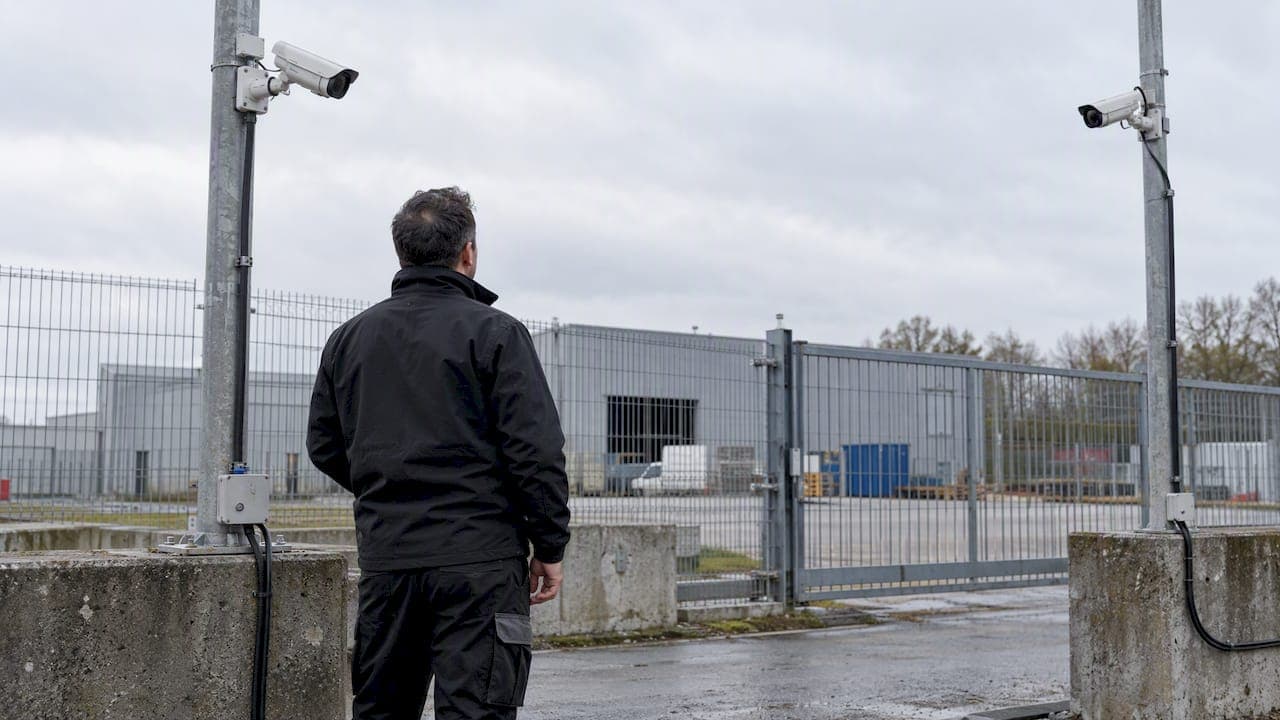
Effective perimeter security for industrial sites requires fencing, controlled gates, sensors, and video surveillance working as an integrated layer. Electronic access control on all gates, with badge or biometric readers, creates an auditable entry log that physical keys cannot provide. Intrusion detection sensors, both passive infrared and vibration-based, catch attempts to breach fencing before anyone reaches a building.

Video surveillance deserves particular attention. Coverage must extend to blind spots that a motivated intruder would exploit. Think perimeter corners, loading docks, utility access points, and transformer yards. Evidence-quality resolution matters: footage that cannot identify a face or a license plate is operationally useless for incident response.
Common physical security technologies compared:
- Magnetic locks and electronic strikes: Reliable and cost-effective, but require backup power planning to fail secure, not fail open.
- Badge-based access systems: Strong audit trail, easy to revoke, scalable across large sites with multiple access points.
- Biometric readers: Higher assurance but higher cost and maintenance; best suited for highest-security zones like server rooms and control rooms.
- IP-connected cameras with analytics: Generate far more investigative value than analog systems and integrate with central monitoring platforms.
The physical security best practices guide from Beyondsensor lays out the deployment logic for each of these elements across different facility layouts.
Pro Tip: Conduct a "red team walk" of your own perimeter once a year. Walk the fence line looking for gaps, test gate response times, and verify every camera angle from the attacker's perspective rather than the operator's.
3. Network segmentation for OT environments
Network segmentation is not a nice-to-have. It is the architectural foundation that determines whether a breach stays isolated or cascades across your entire facility. The IEC 62443 zones and conduits model groups assets with similar security requirements into zones and controls all traffic between them through defined conduits with explicit rules and logging.
Here is how the major segmentation approaches compare across industrial environments:
| Approach | Protection level | Complexity | Best suited for |
|---|---|---|---|
| Flat OT network (no segmentation) | Minimal | Low | Small, low-risk facilities only |
| IT/OT network separation | Moderate | Medium | Sites moving from legacy flat networks |
| Zone and conduit model (IEC 62443) | High | Medium-high | Facilities with mixed criticality assets |
| Purdue model with enforced DMZ | Very high | High | Large industrial sites with strict compliance needs |
| Micro-segmentation per device class | Maximum | Very high | Critical infrastructure and high-value targets |
Industrial firewalls and access control lists enforce least-privilege communication between zones. Legacy OT devices that lack native authentication require proxy or firewall enforcement points to authenticate on their behalf. This is a non-obvious but critical point: legacy devices without native auth create invisible gaps unless the zone boundary actively compensates for them.
Remote access is where segmentation frequently breaks down in practice. CISA CPG 2.0 mandates phishing-resistant MFA for all remote OT accounts. Where MFA cannot be deployed, compensating controls must include removing remote access entirely or significantly increasing segmentation and credential management rigor. Jump hosts with enforced MFA and full session logging represent the minimum acceptable architecture for any remote OT access.
4. Multi-factor authentication and access governance
MFA is the single control that appears across every major regulatory framework governing industrial security. NIST SP 800-82 specifies MFA combined with session logging and recorded access as mandatory for OT remote access, not optional. Yet it remains one of the most commonly missing controls at industrial sites.
The practical challenge is that many OT systems were built before MFA was technically feasible on the endpoint itself. The solution is to enforce MFA at the access gateway rather than the device. A dedicated jump host or privileged access workstation sits between the remote user and the OT network, enforcing authentication and recording all session activity before any traffic reaches a sensitive system.
Access governance extends beyond authentication. Role-based access control, regular access reviews, and credential lifecycle management are the processes that keep MFA effective over time. An MFA system that still has thirty stale contractor accounts active from a project two years ago has a serious governance failure underneath a technically correct control.
5. Industrial surveillance technology and video analytics
Modern industrial surveillance technology goes well beyond recording footage. AI-driven video analytics now provide real-time alerts on perimeter breaches, unauthorized personnel in restricted zones, vehicle anomalies, and even behavioral patterns that suggest insider threat activity.
The key shift is from passive recording to active detection. A traditional CCTV system creates evidence after an incident. An analytics-enabled system generates an alert during the incident, giving your security team time to respond before damage occurs. For facilities with large perimeters and small security teams, this is the difference between catching an intrusion and reviewing footage the next morning.
Thermal cameras add a layer that standard optical cameras cannot match. They detect human presence in complete darkness, through light fog, and across distances that would make optical identification difficult. Pairing thermal detection with optical cameras for identification coverage gives you detection range plus evidence quality in a single perimeter system.
Pro Tip: Do not deploy video analytics without first defining your alert use cases in writing. Undefined analytics configurations generate so many false positives that operators stop responding to alerts within weeks. Specify exactly which behaviors should trigger which response procedures before you configure a single rule.
6. Continuous monitoring and anomaly detection
Segmentation combined with continuous monitoring produces a defense posture that is meaningfully stronger than either control alone. Monitoring fills the detection gap that segmentation cannot close on its own, alerting on new devices, protocol deviations, unusual scan patterns, and unexpected remote access attempts.
For OT environments, a SIEM (Security Information and Event Management) system must be configured to understand industrial protocols like Modbus, DNP3, and EtherNet/IP. A generic enterprise SIEM will miss OT-specific anomalies entirely, because it has no baseline understanding of what normal industrial communication looks like.
Key monitoring capabilities your environment needs:
- Asset discovery and inventory: You cannot monitor what you do not know exists. Automated OT asset discovery builds the baseline.
- Protocol anomaly detection: Alerts on commands or traffic patterns that deviate from established operational baselines.
- New device detection: Any unrecognized device attempting to communicate within a zone should generate an immediate alert.
- Remote access monitoring: All sessions logged with user identity, timestamps, and commands executed.
- Integration with physical security events: Correlating a badge access event with a simultaneous network login attempt from the same account builds far richer incident context.
AI-driven anomaly detection has advanced to the point where it can distinguish between a legitimate maintenance action and a probe that mimics one. AI never blinks, and in a 24/7 production environment, that matters more than any human review cycle.
7. Prioritization framework: comparing features by risk, cost, and compliance
Not every facility can deploy every control simultaneously. Here is how to compare the top must-have security features across the dimensions that matter for budget justification and phased implementation.
| Feature | Compliance value | Risk reduction | Operational impact | Relative cost |
|---|---|---|---|---|
| OT network segmentation | Very high | Very high | Medium | Medium |
| MFA for remote OT access | Very high | High | Low | Low |
| Perimeter fencing and access control | High | High | Low | Medium |
| Video surveillance with analytics | Medium | High | Low | Medium-high |
| Continuous OT monitoring and SIEM | High | Very high | Low | High |
| Jump host with session logging | High | High | Low | Low |
| Thermal cameras for perimeter | Medium | Medium | Low | High |
| Physical intrusion detection sensors | Medium | Medium | Low | Low-medium |
For facilities with limited budgets, start with MFA for remote access, basic IT/OT network separation, and perimeter access control. These three controls address the highest-frequency attack vectors at the lowest relative cost. Add OT-aware monitoring and video analytics in phase two once the architectural foundation is solid.
CISA's compensating controls guidance is explicit: where you cannot deploy MFA immediately, increase segmentation and credential management to reduce exposure until you can. Compensating controls are not a permanent solution. They are a structured interim that keeps risk manageable while you close the gap.
Pro Tip: Document your phased implementation plan formally and get sign-off from facility management. A written, approved plan protects your security program if a breach occurs during the transition. It demonstrates due diligence even when full deployment is not yet complete.
My take on where industrial security implementation actually breaks down
I have reviewed enough industrial security programs to say this with confidence: the gap between what gets planned and what gets deployed is almost always a people problem, not a technology problem.
The most common pattern I see is a well-designed segmentation architecture that never gets fully enforced because the OT team and the IT team could not agree on firewall rules without disrupting production. Both teams are right about their own priorities, and nobody with sufficient authority resolves the conflict. The result is a firewall that exists in the documentation and passes open in practice.
What actually closes that gap is not a better product. It is a joint OT-IT security governance committee with a mandate, a documented escalation path, and a facility leader who treats security as an operational requirement rather than an IT department project. Technology is the easy part. Organizational alignment is where most programs succeed or fail.
The other pattern worth naming: remote access governance that erodes over time. A facility will deploy a jump host with MFA, and within eighteen months it has thirty exceptions for contractors and vendors who "needed faster access." Remote access governance failures are the most common entry point for industrial network breaches, and they almost always start with a reasonable-sounding one-time exception.
Training and documented procedures are not soft skills. They are security controls. An operator who knows what a suspicious login alert means and how to escalate it is more valuable than a SIEM with no one paying attention to it.
— Eumir
How Beyondsensor supports your industrial security program

Beyondsensor builds the sensing and monitoring infrastructure that makes the features described in this article operational rather than theoretical. Their AI-enabled monitoring tools integrate directly with OT network architectures, supporting the zone-based detection and anomaly alerting that IEC 62443 and CISA compliance require. The security and monitoring tools available through Beyondsensor cover physical sensing, video analytics, and network anomaly detection within a single platform designed for industrial environments. For system integrators deploying these solutions across multiple facilities, the integrator solutions portal provides deployment resources and regional compliance guidance across Singapore, Malaysia, the Philippines, and Southeast Asia. Beyondsensor also documents their sensing technology innovations for teams that need to evaluate technical specifications against specific compliance requirements before committing to a deployment architecture.
FAQ
What are industrial security features?
Industrial security features are the physical, network, and procedural controls that protect industrial facilities, OT systems, and critical assets from unauthorized access, sabotage, and cyber threats. They include perimeter controls, network segmentation, MFA, video surveillance, and continuous monitoring.
Why is MFA required for OT remote access?
CISA CPG 2.0 and NIST SP 800-82 both require MFA for remote OT access because credentials alone are insufficient protection against phishing and credential theft targeting industrial control systems. Where MFA is unavailable, facilities must restrict or remove remote access entirely.
What is the IEC 62443 zones and conduits model?
The IEC 62443 zones and conduits model groups OT assets by security level and controls all traffic between groups through defined conduits with explicit rules and logging. It is the foundational architecture for defense-in-depth in industrial network security.
How do I prioritize security features with a limited budget?
Start with MFA for remote OT access, basic IT/OT network separation, and perimeter access control. These three controls address the most common attack vectors at the lowest cost, then layer in OT monitoring and advanced video analytics as budget allows.
What makes OT monitoring different from standard IT monitoring?
OT monitoring must understand industrial protocols like Modbus, DNP3, and EtherNet/IP to detect anomalies accurately. A generic IT SIEM will not recognize normal OT communication patterns, generating both false positives and missed detections in industrial environments.
Recommended
- Essential sensing technology features for industrial security | News | BeyondSensor
- Physical security best practices: strategies for safer facilities | News | BeyondSensor
- How automation strengthens industrial security operations | News | BeyondSensor
- Security data analytics checklist: Boost facility safety | News | BeyondSensor
Read More Articles
RTSP Security Risks: Integrators Must Block Exposed Ports 554 and 8554
See how integrators can reduce RTSP security risks: close exposed ports 554 and 8554, secure camera access, and verify each deployment with practical checks.

Require MAEpp and X Accuracy Before You Buy People Counting Systems
Verify people counting accuracy by demanding MAEpp, X Accuracy, and directional-bias reports. Validate on-site with at least 100 events per direction...
30–90 Day Pilot Validates Redundant Camera Networks for Engineers
Standards led, practical steps for engineers to deploy redundant camera networks: MRP, dual homing, and aggregation patterns, commissioning checks, and...
30 Day Pilot Proves Video Analytics Accuracy for Security Teams
Validate video analytics accuracy with scenario tests, camera tuning, transfer learning and a 30 day edge first pilot for security teams.
Let's Build YourSecurity Ecosystem.
Whether you're a System Integrator, Solution Provider, or an End-User looking for trusted advisory, our team is ready to help you navigate the BeyondSensor landscape.
Direct Advisory
Connect with our regional experts for tailored solutioning.