
Singapore playbook for security teams to pilot PDPA safe loitering detection analytics with edge processing and false alarm reduction.
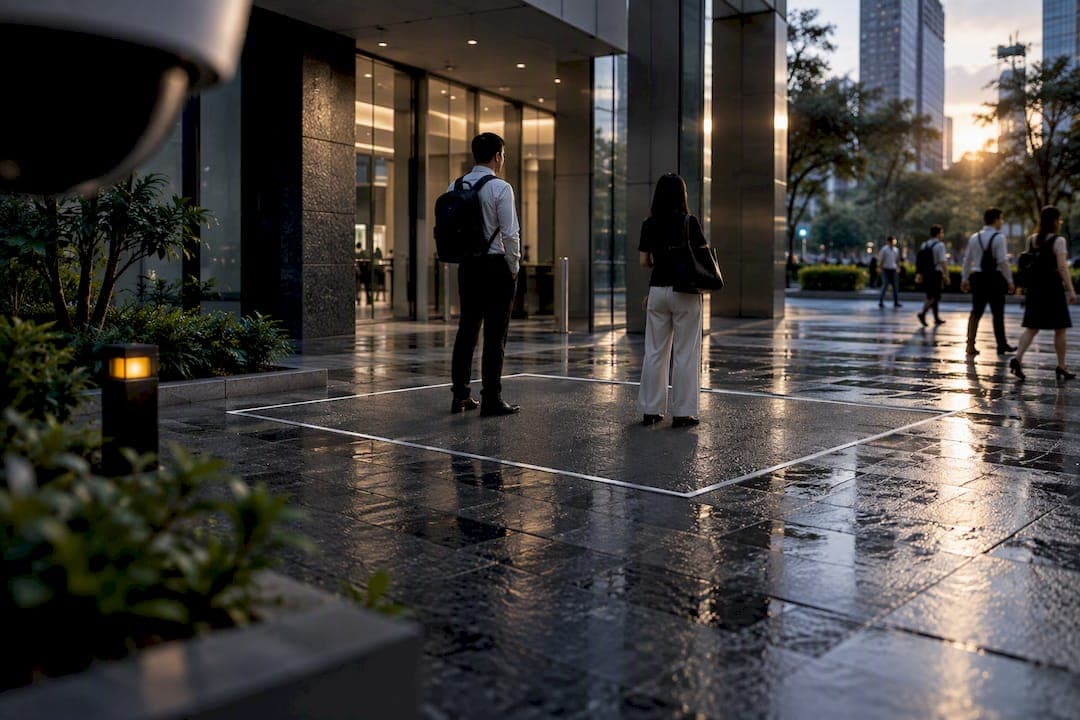
Singapore Security: 2 week Pilot for Loitering Detection Analytics

The most reliable approach to loitering detection analytics combines scene-calibrated rule-based analytics with trajectory tracking, layering in supervised machine learning only where labeled incident data exist. Edge-first processing and anonymization keep privacy risk and latency low. None of it works without SOC or SIEM integration and deliberately tuned alert thresholds, since an untuned system produces enough false alarms to make security teams start ignoring it.
TL;DR:
- Only calibrated, scene-specific rule-based analytics combined with trajectory tracking provide reliable loitering detection without excessive false alarms.
- Accurate detection requires cameras with sufficient pixel resolution and proper perspective calibration, especially in wide-area zones.
- Regular tuning of sensitivity, dwell time, and filters is essential to minimize false positives and maintain operator trust.
- Privacy compliance under Singapore's PDPA mandates anonymization, explicit data minimization, and strict retention policies for all video analytics systems.
- Running a short, well-planned pilot is critical to validate system performance, calibration, and privacy safeguards before full deployment.
Table of Contents
- What Is Loitering Detection Analytics and How Does It Work?
- How Do Camera Placement and Sensor Choice Affect Accuracy?
- How Do You Reduce False Positives in Loitering Alerts?
- What Are the PDPA Requirements for Loitering Analytics?
- How Do You Move From Pilot to Full Deployment?
- What BeyondSensor's Pilots Reveal About Real-World Deployment
- Get a Working Pilot Running on Your Site
- Where to Verify These Standards and Findings
- Sources
- FAQ
What Is Loitering Detection Analytics and How Does It Work?
Loitering detection has no single industry standard definition. Most systems define it operationally: a person or object remains inside a defined zone longer than a set dwell time, combined with contextual signals like erratic movement or repeated path crossings. That combination matters because dwell time alone flags benign behavior, too. A parent waiting for a school pickup and a person casing a loading dock both stand still for the same three minutes.
Security teams generally choose from four detection approaches, often blending two or more:
- Rule-based video analytics (VA) uses include and exclude polygons, timers, and object filters. It deploys fast and suits simple, predictable scenes like entrances or perimeters.
- Trajectory analysis tracks movement in world coordinates or normalized space, flagging dwell time alongside irregular paths, backtracking, or repeated loops.
- Supervised machine learning models trained on labeled incident footage improve accuracy meaningfully, but they need governance, retraining schedules, and enough representative data to avoid bias toward whatever scenes trained them.
- Thermal and LiDAR sensing replace or supplement optical cameras in low-light or privacy-sensitive zones, since neither produces a recognizable face.
A WACV 2024 study on trajectory-based loitering detection found that trajectory analysis paired with supervised models like Random Forest and MLP outperformed simple geometric rule sets, though only when calibration and labeled data were solid to begin with.
How Do Camera Placement and Sensor Choice Affect Accuracy?
Detection accuracy starts with geometry, not software. A camera that cannot resolve a human figure at sufficient pixel density will feed unreliable data into any analytics engine downstream, no matter how sophisticated the model behind it.
Follow this sequence when planning or auditing a site:
- Confirm pixel footprint. A person needs to occupy enough pixels across the frame for tracking algorithms to hold a consistent identity as they move. Wide-angle cameras covering large courtyards routinely fail this test at the frame edges.
- Calibrate for perspective. Cameras mounted at an angle compress distant objects, which causes dwell-time miscalculation and false alarms near the horizon line. Depth-aware calibration corrects for this distortion before rules ever fire.
- Decide edge versus cloud early. Edge processing cuts latency and keeps raw footage off centralized servers, which directly supports data minimization. Cloud processing still has a role, mainly for model training and multi-site pattern analysis at scale.
- Add thermal or LiDAR where optical cameras struggle. Crowded plazas, unlit loading areas, and privacy-restricted zones like locker rooms are natural fits for sensors that never capture an identifiable face in the first place.
Pro Tip: Run a lens test with a person walking the full width of your intended zone before committing to a mounting height. If they shrink to fewer than roughly enough pixels tall to maintain consistent tracking at the far edge, move the camera closer or add a second unit rather than fighting the gap with software.
Environmental mitigation, like adjusting for glare, foliage movement, and seasonal lighting shifts, belongs in the same calibration pass. Skipping it is the single most common reason a system performs well in testing and poorly in production.
How Do You Reduce False Positives in Loitering Alerts?
False positives are the reason most loitering systems get quietly disabled within months of installation. CrowdStrike's research on behavioral analytics notes that behavioral detection is genuinely effective at catching anomalies, but it stays vulnerable to false alarms unless sensitivity and confidence thresholds get tuned deliberately rather than left at factory defaults.
Vendor configuration guides from established camera manufacturers point to a consistent set of levers:
- Alarm tolerance time sets the minimum dwell duration before a rule fires, filtering out momentary stops.
- Sensitivity and confidence thresholds control how aggressively the system flags borderline cases.
- Small-object and swaying-object filters strip out false triggers from blowing debris, foliage, or shadows.
- Individual versus group detection modes change how the system treats a queue of five people versus one person standing alone.
- Day and night profiles apply separate threshold sets, since low-light footage behaves differently even with infrared assistance.
Test every configuration change against recorded footage before it goes live, using visual confirmation tools to verify the system flags what a human operator would flag.
Consistent metrics, not gut feel, determine whether tuning worked. Track precision (how many flagged events were real), recall (how many real events got caught), F1-score (the balance between the two), false alarm rate per camera per day, and processing latency from event to alert. A useful benchmark: if your false alarm rate sits high enough that operators start dismissing alerts without reviewing them, the threshold is wrong regardless of what the accuracy number on paper says. Supervised models need scheduled retraining as scenes change, seasons shift, and new incident types get labeled.
What Are the PDPA Requirements for Loitering Analytics?
Any system capturing identifiable individuals through video falls under Singapore's Personal Data Protection Act, and the PDPC's advisory guidelines set out the baseline obligations. Organizations must notify individuals of the purpose of collection, minimize what they gather, and apply anonymization wherever the analytics task allows it. Business-improvement and research exceptions exist, but they come with safeguards attached, not a blanket pass.
Build your privacy posture around these practices:
- Anonymize by design. Blur faces at the edge, output trajectory-only or thermal data where the use case permits, and discard raw footage once metadata extraction is complete.
- Set explicit retention limits rather than defaulting to "keep everything." Pair this with a documented CCTV data retention policy so retention decisions survive staff turnover.
- Run a motivated intruder test. The PDPC frames re-identification risk this way: assume a determined party wants to re-identify anonymized data, and assess whether your safeguards would actually stop them.
- Lock down vendor contracts. Require encryption in transit and at rest, deletion guarantees on contract termination, and clear documentation of how any model was trained on your data.
None of this is optional paperwork. A loitering system that cannot answer "who can access this footage and for how long" is a liability sitting on top of a security tool.
How Do You Move From Pilot to Full Deployment?
A structured pilot separates systems that work from systems that merely demo well. Rushing straight to full deployment without a validation phase is the most expensive mistake a facility team can make, because retrofitting calibration and privacy controls across ten sites costs far more than fixing them at one.
- Design the pilot. Pick one or two representative scenes, define your KPI targets up front, decide the edge versus cloud split, and confirm the data-minimization approach before a single camera goes live.
- Calibrate and test. Complete perspective calibration, set day and night profiles, and log false alarms for a defined window, typically a few weeks, typically several, adjusting thresholds as real-world data accumulates.
- Integrate operationally. Route alerts into your SOC or SIEM platform with enriched context (camera ID, zone, dwell time, snapshot), and build an operator verification step before any alert triggers a physical response.
- Write the runbook. Document a triage matrix, escalation contacts, a review cadence for retraining models, and clear go or no-go criteria before scaling past the pilot sites.
| Pilot phase | Typical duration | Primary output |
|---|---|---|
| Short proof of concept | 2 weeks | Feasibility and site-fit validation |
| Extended pilot | a few weeks, typically several | False-alarm baseline and threshold tuning |
| Production rollout | Ongoing | SOC integration and performance review cadence |
Teams that skip the pilot phase entirely tend to discover their calibration problems the same week executives start asking why the alert queue is full of parked delivery vans.
What BeyondSensor's Pilots Reveal About Real-World Deployment
Short proof-of-concept engagements consistently prove the same three things: edge-first processing holds up under real network conditions, calibration errors surface almost immediately once live foot traffic hits the zone, and anonymized outputs satisfy compliance reviewers without sacrificing detection quality.

The recurring pitfalls are just as consistent. Teams leave factory-default sensitivity settings in place, sample too few hours of footage to capture real variation across shifts and weather, and treat retention policy as an afterthought instead of a design input.
What separates a smooth rollout from a frustrating one is scope discipline: a small, genuinely representative pilot, with the SOC team involved from week one rather than handed a finished system to operate.
— Eumir
Get a Working Pilot Running on Your Site
Beyondsensor is the direct route to a loitering analytics deployment that is tuned and compliant from day one, not a generic camera add-on retrofitted with detection software after the fact. Where off-the-shelf rule-based tools leave calibration and PDPA safeguards to your internal team, Beyondsensor pairs edge-first analytics with hands-on integration support, so the anonymization, retention, and SOC routing decisions get made during setup instead of during an incident review.

Engagement starts small and stays low-risk: a short proof of concept, an extended pilot running a few weeks, typically several to build a real false-alarm baseline, edge-first fusion for sites with tight latency or bandwidth constraints, and full SOC integration once thresholds are validated. Facility teams and system integrators can also work through Solution Integration for end-to-end deployment support. If your site has a loitering problem you have not been able to tune your way out of, request a proof of concept and find out whether a combined rule-and-trajectory approach fits your zones before committing to anything permanent.
Where to Verify These Standards and Findings
For technical and compliance detail beyond this guide, consult the PDPC's advisory guidelines on anonymization and retention, the Singapore Police Force's TR 69 standard for building video-analytics deployment, and GovTech's Video Analytics System overview for a government-grade reference point on scalable analytics.
Sources
- PDPC — Advisory Guidelines on the PDPA for selected topics
- SPF — VSS standard for buildings (TR 69)
- CrowdStrike — Behavioral analytics overview
FAQ
What Is Loitering Detection Analytics?
Loitering detection analytics is software that flags when a person or object remains in a defined zone beyond a set dwell time, often combined with movement patterns like repeated path crossings. Methods range from rule-based zone timers to trajectory analysis and supervised machine learning, as detailed in trajectory-based research from WACV 2024.
How Do You Reduce False Alarms in Loitering Detection?
Adjust alarm tolerance time, sensitivity thresholds, and object filters, then validate every change against recorded footage before it goes live. CrowdStrike's behavioral analytics research notes that untuned thresholds are the main driver of alert fatigue in behavioral security tools.
Is Video-Based Loitering Detection Legal Under Singapore's PDPA?
Yes, provided the organization notifies individuals of the purpose, minimizes data collection, and applies anonymization where feasible, per the PDPC's advisory guidelines. Business-improvement and research exceptions exist but require documented safeguards, not blanket use.
How Long Should a Loitering Analytics Pilot Run?
A short proof of concept typically runs about a few weeks to confirm site feasibility, while a full pilot for threshold tuning and false-alarm baselining usually takes a few weeks, typically several. Pilot and edge-first deployments typically follow this same phased timeline.
What Does Beyondsensor Charge for a Loitering Analytics Pilot?
Beyondsensor does not publish fixed pricing for pilots or integration work on its site; current terms are available on request through its Solution Integration page. Costs depend on site count, sensor mix, and whether SOC integration is included in scope.
Recommended
Read More Articles
RTSP Security Risks: Integrators Must Block Exposed Ports 554 and 8554
See how integrators can reduce RTSP security risks: close exposed ports 554 and 8554, secure camera access, and verify each deployment with practical checks.
Require MAEpp and X Accuracy Before You Buy People Counting Systems
Verify people counting accuracy by demanding MAEpp, X Accuracy, and directional-bias reports. Validate on-site with at least 100 events per direction...
30–90 Day Pilot Validates Redundant Camera Networks for Engineers
Standards led, practical steps for engineers to deploy redundant camera networks: MRP, dual homing, and aggregation patterns, commissioning checks, and...
30 Day Pilot Proves Video Analytics Accuracy for Security Teams
Validate video analytics accuracy with scenario tests, camera tuning, transfer learning and a 30 day edge first pilot for security teams.
Let's Build YourSecurity Ecosystem.
Whether you're a System Integrator, Solution Provider, or an End-User looking for trusted advisory, our team is ready to help you navigate the BeyondSensor landscape.
Direct Advisory
Connect with our regional experts for tailored solutioning.