
Discover how Industry 4.0 sensing explained can transform your factory operations, boosting productivity and reducing costs effectively.

Industry 4.0 Sensing Explained for Smart Factory Leaders

TL;DR:
- Industry 4.0 sensing leverages intelligent sensors with embedded processing and wireless connectivity to convert physical parameters into real-time digital intelligence, enabling significant operational gains. These sensors support predictive maintenance, quality control, and security by providing structured, on-device data filtering and reliable communication protocols like MQTT and OPC-UA. Effective deployment relies on strategic failure mode mapping, phased implementation, integration with enterprise systems, and robust security measures, ensuring measurable ROI and resilience.
Industry 4.0 sensing is defined as the deployment of smart sensors with embedded processing, wireless connectivity, and on-device analytics to convert physical parameters into real-time digital intelligence across manufacturing operations. These sensors form the technical backbone of smart manufacturing, and plants using sensor-based programs see 30–50% productivity gains with defect rates below 200 PPM and maintenance costs 33% lower than conventional facilities. The IoT sensors market reflects this momentum, valued at $23.9 billion in 2025 and projected to reach $99.2 billion by 2030. For decision-makers, understanding how sensing technology works is no longer optional. It is the prerequisite for every meaningful operational improvement in a modern factory.
What is Industry 4.0 sensing and why does it matter?
Industry 4.0 sensing refers to the integration of intelligent sensors into manufacturing environments where they do far more than collect raw data. Unlike traditional passive sensors that simply transmit analog signals to a central controller, smart sensors integrate sensing, processing, and communication in a single unit. An embedded microcontroller or digital signal processor (DSP) performs local filtering, threshold detection, and feature extraction before any data leaves the device. This architecture reduces network load, cuts latency, and makes the sensor itself a decision-capable node rather than a passive data pipe.
The parameters these sensors monitor span the full range of machine health indicators: vibration, temperature, acoustic signatures, pressure, flow rate, current draw, and magnetic field strength. Each parameter maps to a specific failure mode. A triaxial accelerometer detecting abnormal vibration on a motor bearing gives maintenance teams days or weeks of warning before catastrophic failure. A temperature sensor flagging thermal drift in a hydraulic circuit prevents fluid degradation that would otherwise go unnoticed until a seal fails. Factories integrating these environmental sensors reduce unexpected downtime by 30–50%, with documented cases such as a food mixer operation that cut downtime by 45% and recovered its investment within months.
The broader importance of sensing in Industry 4.0 technologies lies in what it enables downstream: predictive maintenance, quality control, energy optimization, and safety compliance. Sensor data feeds digital twins, machine learning models, and enterprise resource planning (ERP) systems. Without accurate, high-frequency sensor input, none of those higher-order capabilities function reliably.
What are the key types of smart sensors used in smart factories?
Smart manufacturing relies on a defined set of sensor categories, each targeting specific physical phenomena and failure modes.
- Triaxial accelerometers measure vibration across three axes simultaneously, making them the standard tool for bearing health monitoring, imbalance detection, and resonance analysis on rotating equipment.
- Temperature sensors (thermocouples, RTDs, infrared arrays) track thermal profiles across motors, gearboxes, electrical panels, and process fluids. Infrared arrays add non-contact surface mapping for high-voltage or moving components.
- Pressure and flow sensors monitor hydraulic and pneumatic circuits, detecting leaks, blockages, and pressure drops that indicate pump wear or valve degradation.
- Acoustic emission sensors capture ultrasonic sound signatures from friction, micro-cracking, and fluid turbulence. They detect faults at frequencies inaudible to human operators, often weeks before vibration signatures become detectable.
- Magnetic and current sensors track motor current draw and magnetic field anomalies to identify electrical faults, winding degradation, and load imbalances without physical contact with live components.
- MEMS (Micro-Electro-Mechanical Systems) sensors combine multiple sensing modalities in a single chip, enabling multi-parameter monitoring in space-constrained installations. Optical sensors, including LiDAR and photoelectric variants, add dimensional and positional data for quality inspection and robotic guidance.
The defining capability of modern smart sensors is on-device data filtering via embedded DSPs and microcontrollers. A vibration sensor sampling at 25.6 kHz generates enormous raw data volumes. On-device Fast Fourier Transform (FFT) processing reduces that to a compact frequency spectrum, transmitting only the meaningful signal rather than raw waveforms. This is what makes large-scale sensor networks practically deployable.
Pro Tip: When selecting sensors for a new installation, map failure modes first and equipment lists second. A bearing failure on a $50,000 compressor warrants a triaxial accelerometer and acoustic sensor in combination. A simple conveyor belt motor may need only a single-axis vibration sensor and a current monitor.

How do communication protocols and data architectures support sensing networks?
Sensor data is only valuable when it reaches the right system at the right time. The communication layer connecting sensors to analytics platforms determines whether your sensing investment delivers real-time decisions or delayed reports.
| Protocol | Primary Use | Strengths | Limitations |
|---|---|---|---|
| MQTT | Sensor-to-edge and edge-to-cloud telemetry | Lightweight, low bandwidth, handles thousands of nodes | Limited data modeling; requires complementary protocol for context |
| OPC-UA | PLC/SCADA to enterprise integration | Rich data modeling, built-in security, vendor-neutral | Higher overhead; less suited for constrained devices |
| HTTP/REST | Cloud API integration | Universal compatibility | Too heavy for high-frequency sensor telemetry |
| Modbus | Legacy PLC communication | Widely supported | No native security; limited scalability |
MQTT is favored for manufacturing IoT because its publish-subscribe model handles thousands of sensors without polling overhead, making it efficient for high-density deployments. OPC-UA complements MQTT by providing structured data modeling for PLC and SCADA integration with enterprise platforms, adding authentication and encryption that MQTT alone does not enforce.
The data processing architecture follows a three-tier model: device edge, fog computing (local gateways and on-premise servers), and cloud. Edge computing tiers coordinate data processing to balance latency, bandwidth, and analytic capability. Time-critical decisions, such as shutting down a machine when vibration exceeds a threshold, happen at the device or fog tier in milliseconds. Long-term trend analysis, fleet-wide benchmarking, and AI model training happen in the cloud where compute resources are unconstrained. A hybrid architecture keeps sensitive operational data on-premise while using cloud resources for analytics that do not require sub-second response. For a detailed breakdown of how these layers connect, the sensor integration architecture guide from Beyondsensor covers the full stack from device to enterprise.
Pro Tip: Segment your sensor network from your corporate IT network using a dedicated industrial DMZ. This prevents a compromised IT endpoint from reaching production sensor data, and it prevents sensor traffic from saturating business-critical bandwidth.
What are best practices for deploying sensor networks in Industry 4.0?
Effective deployment is where most Industry 4.0 sensing programs succeed or fail. The technical choices matter, but the strategic sequencing determines whether you see ROI in months or years.
-
Map failure modes, not equipment lists. Strategic sensor placement targeting failure modes rather than general equipment coverage improves ROI and prevents overspending on low-value monitoring. Start with the assets whose failure costs the most in downtime, scrap, or safety risk.
-
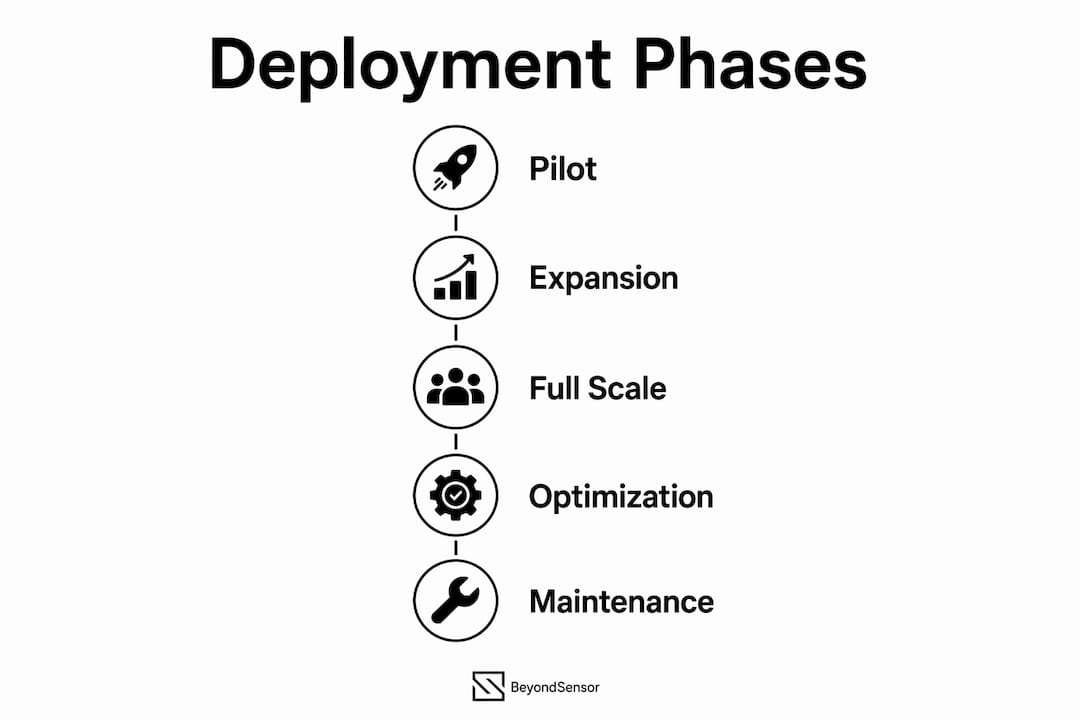
Start with a contained pilot. Phased deployment with 5–15 sensors per critical asset, beginning with the highest downtime-cost equipment, maximizes early ROI and narrows the scope to a manageable validation exercise. Typical programs start with 500 to 1,500 sensors and expand to 2,000 to 5,000 as value is proven.
-
Collect baseline data before setting thresholds. False alerts are common early in vibration and temperature sensor deployments. A three-month tuning period is standard before detection models reach stable, reliable performance. Rushing threshold configuration produces alert fatigue that undermines operator trust in the system.
-
Integrate with CMMS and ERP from day one. Sensor data alone is insufficient. Value emerges when sensor alerts automatically generate work orders in a Computerized Maintenance Management System (CMMS) or trigger quality holds in an ERP. Without this integration, data sits in a dashboard that no one acts on.
-
Account for brownfield constraints. Retrofit wireless sensors avoid the cost and disruption of cable runs in existing facilities. The average cost for a wireless vibration and temperature sensor is $215 per asset, and sensor prices have dropped over 60% since 2020. One prevented bearing failure typically pays back an entire pilot program.
| Deployment Phase | Sensor Count | Primary Goal |
|---|---|---|
| Pilot | 50–150 sensors | Validate ROI on highest-risk assets |
| Expansion | 500–1,500 sensors | Scale proven use cases across facility |
| Full deployment | 2,000–5,000+ sensors | Fleet-wide predictive maintenance and quality |
Pro Tip: Before purchasing sensors, audit your data infrastructure. A sensor network generating 200 GB per day across 100 machines requires a data pipeline, storage strategy, and analytics platform that can handle that volume. Buying sensors before the data architecture is ready is the most common and most expensive mistake in IIoT deployments.
For a structured approach to connecting sensors to enterprise systems, the industrial sensor integration workflow guide covers the full engineering process from device selection to ERP connectivity.
How does sensing technology strengthen security and operational resilience?
Smart sensors are not only operational tools. They are security assets. In a cyber-physical environment, the integrity of sensor data directly determines the integrity of every automated decision the factory makes.
- Tamper detection and self-diagnostics. Modern smart sensors include self-test routines that verify sensor health at startup and during operation. Smart sensors improve security through tamper detection, encrypted communications, and self-diagnostics that maintain operational integrity even under adverse conditions.
- Encrypted communication. Sensors transmitting unencrypted data over wireless networks create attack surfaces that adversaries can exploit to inject false readings or intercept process data. TLS encryption over MQTT and OPC-UA's built-in security model address this at the protocol level.
- Environmental hazard detection. Gas sensors, smoke detectors, and flood sensors integrated into the same network as process sensors give operations teams a unified view of both machine health and facility safety. A single platform monitoring vibration on a compressor and hydrogen concentration in the surrounding area provides a level of situational awareness that siloed systems cannot match.
- Anomaly detection for cyber-physical threats. Sensors monitoring power consumption and network traffic patterns can flag deviations that indicate either equipment degradation or a cyberattack affecting process behavior. This dual-use capability makes sensing infrastructure a first line of defense in industrial security architectures.
- Secure integration with physical security systems. Sensors feeding access control, perimeter monitoring, and surveillance platforms create a unified security posture. Beyondsensor's approach to industrial security sensing connects these domains into a single operational picture rather than treating them as separate systems.
The secure sensor network protocols required for this level of resilience, specifically MQTT and OPC-UA working in tandem with network segmentation, are now considered baseline requirements for any Industry 4.0 deployment handling sensitive process or safety data.
Key takeaways
Industry 4.0 sensing delivers measurable operational and security value only when smart sensors are paired with the right protocols, data architecture, and workflow integration from the start.
| Point | Details |
|---|---|
| Smart sensors outperform passive sensors | Embedded processing reduces data volumes and enables on-device decisions without cloud dependency. |
| Protocol pairing is non-negotiable | MQTT handles high-frequency telemetry; OPC-UA adds structured, secure enterprise integration. |
| Phased deployment maximizes ROI | Start with 50–150 sensors on highest-risk assets before scaling to thousands across a facility. |
| Baseline tuning prevents alert fatigue | Allow three months of data collection before finalizing detection thresholds to reduce false positives. |
| Sensing is a security layer, not just an ops tool | Tamper detection, encryption, and anomaly monitoring make sensors foundational to industrial security. |
Why most sensing deployments underperform, and what actually fixes it
I have seen a consistent pattern across industrial sensing programs: the technology works, but the deployment strategy does not. Teams buy sensors based on equipment lists rather than failure modes, connect them to dashboards no one monitors, and declare the pilot a success because the data is flowing. Six months later, the sensors are still running, but no maintenance behavior has changed.
The fix is not better sensors. It is better integration. The moment a vibration alert automatically creates a work order in a CMMS and assigns it to a technician, the ROI becomes real and measurable. Until that connection exists, you have an expensive monitoring system, not a predictive maintenance program.
The second issue I see consistently is data volume without data discipline. Extensive sensor deployments generate 200 GB per day per 100 machines. Most of that is noise. The teams that succeed are the ones that define, before deployment, exactly which signals matter and what actions those signals should trigger. They tune aggressively during the first three months and they resist the temptation to monitor everything.
My advice to decision-makers considering an Industry 4.0 sensing investment: treat the sensor network as infrastructure, not a product. The sensors themselves are commodities at this point, with prices down over 60% since 2020. The value is in the architecture, the integration, and the discipline to act on what the data tells you. AI and digital twin integration will amplify that value significantly over the next three years, but only for organizations that have already built a clean, reliable sensor data foundation.
— Eumir
How Beyondsensor supports intelligent Industry 4.0 sensing deployments

Beyondsensor builds sensor integration platforms designed specifically for industrial environments where security and operational reliability are non-negotiable. Their solutions support MQTT and OPC-UA natively, enabling real-time anomaly detection at the edge while feeding structured data to cloud analytics and enterprise systems. For system integrators deploying sensing networks across manufacturing facilities, Beyondsensor provides the hardware-software architecture, security protocols, and regional validation that complex industrial IoT environments require. From brownfield retrofits to greenfield smart factory builds, their AI-driven sensing solutions cover the full deployment lifecycle, from sensor selection through secure integration and ongoing monitoring.
FAQ
What is Industry 4.0 sensing?
Industry 4.0 sensing is the use of smart sensors with embedded processing and wireless connectivity to monitor physical parameters such as vibration, temperature, pressure, and acoustics in manufacturing environments. These sensors convert physical data into digital intelligence that drives predictive maintenance, quality control, and operational decisions.
How do smart sensors differ from traditional sensors?
Traditional sensors transmit raw analog signals to a central controller for processing. Smart sensors perform on-device filtering, feature extraction, and threshold detection using embedded microcontrollers or DSPs, reducing data volumes and enabling faster local decisions.
Which communication protocol is best for industrial IoT sensing?
MQTT is the preferred protocol for high-frequency sensor telemetry due to its lightweight publish-subscribe model. OPC-UA complements it by providing structured data modeling and built-in security for integration with PLC, SCADA, and enterprise platforms.
How long does it take to see ROI from a sensor deployment?
ROI timelines vary, but phased deployments starting with the highest-risk assets typically recover investment within months. A single prevented bearing failure can pay back an entire pilot program, and sensor hardware costs have dropped over 60% since 2020, lowering the break-even threshold significantly.
How do smart sensors contribute to factory security?
Smart sensors contribute to factory security through tamper detection, encrypted communications, and self-diagnostics that maintain data integrity. They also enable anomaly detection for both equipment failures and cyber-physical threats, making them a foundational element of industrial security architecture.
Recommended
- Industrial Sensor Integration Workflow: 2026 Engineer's Guide | News | BeyondSensor
- Emerging sensing innovations guide for security leaders | News | BeyondSensor
- Secure Sensing Explained: Defend Industrial & Environmental Ops | News | BeyondSensor
- Sensor Integration Architecture Explained for System Architects | News | BeyondSensor
Read More Articles
RTSP Security Risks: Integrators Must Block Exposed Ports 554 and 8554
See how integrators can reduce RTSP security risks: close exposed ports 554 and 8554, secure camera access, and verify each deployment with practical checks.

Require MAEpp and X Accuracy Before You Buy People Counting Systems
Verify people counting accuracy by demanding MAEpp, X Accuracy, and directional-bias reports. Validate on-site with at least 100 events per direction...
30–90 Day Pilot Validates Redundant Camera Networks for Engineers
Standards led, practical steps for engineers to deploy redundant camera networks: MRP, dual homing, and aggregation patterns, commissioning checks, and...

30 Day Pilot Proves Video Analytics Accuracy for Security Teams
Validate video analytics accuracy with scenario tests, camera tuning, transfer learning and a 30 day edge first pilot for security teams.
Let's Build YourSecurity Ecosystem.
Whether you're a System Integrator, Solution Provider, or an End-User looking for trusted advisory, our team is ready to help you navigate the BeyondSensor landscape.
Direct Advisory
Connect with our regional experts for tailored solutioning.