
Discover why choose integrated security systems for your facility. Boost safety, streamline responses, and deter threats effectively!

Why Choose Integrated Security Systems for Facilities

TL;DR:
- Integrated security systems unify access control, video, and alarms into a centralized platform, enhancing response speed and operational efficiency. They automate event correlation and reduce false alarms, lowering costs and strengthening insurance claims management. Facility managers should audit their existing tools, define event rules, and choose platform-agnostic integrators to ensure seamless, scalable deployment.
Integrated security systems are defined as unified platforms that combine access control, video surveillance, intrusion alarms, and real-time monitoring into a single, centrally managed architecture. For facility owners and managers, the question of why choose integrated security systems has a direct answer: fragmented tools create blind spots, slow response times, and administrative overhead that unified platforms eliminate. Monitored systems deter 83% of burglars on alarm activation and cut burglary incidents by 50% compared to unmonitored properties. That figure alone reframes security from a compliance checkbox into a measurable operational asset.
Why choose integrated security systems for safety and threat response
The core safety advantage of integrated security solutions is automated event correlation. When a standalone access control panel denies an entry attempt, it logs the event and stops there. An integrated platform links that denial to the nearest camera feed, triggers an alert to the security command center, and timestamps the full sequence in a single incident record. Security teams gain situational awareness in seconds rather than minutes.
Integrated systems reduce emergency response times by up to 40% compared to fragmented setups. That gap exists because operators no longer toggle between separate apps or call multiple vendors to piece together what happened. Every relevant data point surfaces in one interface, and the system flags correlations automatically.
The benefits of security systems built on unified architectures extend to false alarm reduction as well. Standalone sensors generate alerts without context. An integrated platform cross-references a motion trigger against access logs and camera feeds before escalating, which means fewer false positives consuming your team's attention.
- Automated event correlation links access denials, camera footage, and alarm triggers into a single timestamped incident record.
- Centralized alerting routes notifications to the right personnel without manual handoffs between systems.
- Cross-sensor validation reduces false alarms by confirming events across multiple data sources before escalating.
- Real-time situational awareness gives command center operators a complete picture of any developing incident.
Pro Tip: Configure your integrated platform to auto-escalate any access denial that occurs outside business hours and is not followed by a valid credential within 60 seconds. This single rule catches a significant share of unauthorized entry attempts without generating noise during normal operations.
"True integration requires unified event correlation, not just shared cabling, to provide actionable intelligence instead of isolated alerts." — American Alarm
What operational efficiencies do integrated security solutions deliver?
Stand-alone security devices create fragmented management with multiple vendors, separate apps, and no automatic event correlation. The result is increased security blind spots and slower incident resolution. Facility managers running three or four separate systems routinely spend more time coordinating between vendors than they do analyzing actual security data.

A unified management interface changes that calculus. Security teams monitor access control, video, and alarms from one screen, which reduces cognitive load and accelerates decision-making. Reducing mental load on operators through unified interfaces directly improves security decision quality and operational responsiveness. This is not a soft benefit. It translates to faster containment of incidents and fewer errors under pressure.
Vendor fragmentation also drives up total cost of ownership. When a camera goes offline in a standalone setup, you call the camera vendor. When the access panel fails, you call a different vendor. A single point of accountability for system maintenance reduces downtime and speeds up issue resolution across the entire security stack.
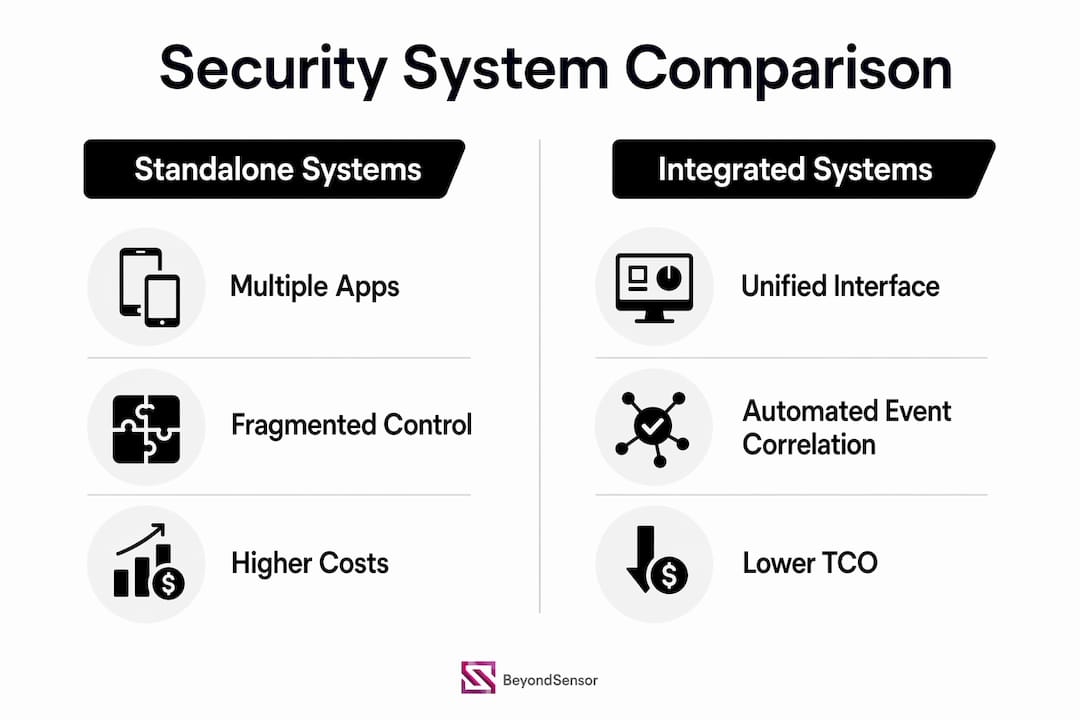
The financial case extends to insurance. Professionally monitored integrated systems qualify for premium discounts of 5% to 15%, translating to up to $300 in annual savings on average premiums. For a mid-size commercial facility carrying $5,000 or more in annual property insurance, those discounts compound meaningfully over a three to five year system lifecycle.
| Factor | Standalone systems | Integrated systems |
|---|---|---|
| Management interface | Multiple apps and portals | Single unified dashboard |
| Vendor accountability | Fragmented across providers | Single point of contact |
| Event correlation | Manual and delayed | Automated and real-time |
| Insurance discount eligibility | Limited | 5%–15% premium reduction |
| Incident documentation | Siloed records | Cross-correlated incident logs |
Pro Tip: When calculating total cost of ownership, include staff hours spent on vendor coordination and manual incident reporting. Most facilities undercount this by 30% or more, which makes integrated systems look more expensive than they actually are.
Why usability and system integration matter for security management
Security technology fails at the human layer more often than the hardware layer. An operator managing six separate portals, each with its own alert logic and interface, will miss events. Unified command interfaces prevent operator overload and reduce the errors that fragmented dashboards introduce.
The advantages of integrated security become most visible during high-pressure incidents. When an alarm triggers at 2 a.m., your on-call manager needs one login, one screen, and one clear sequence of correlated events. The alternative, calling the camera vendor, then the access control vendor, then cross-referencing two separate logs, costs minutes that matter in a real emergency.
Effective usability in integrated platforms follows a clear hierarchy:
- Single sign-on access to all subsystems eliminates credential management across multiple portals.
- Correlated event timelines display access logs, video clips, and alarm triggers in chronological sequence on one screen.
- Role-based permissions let facility managers see everything while limiting front-desk staff to relevant alerts only.
- Mobile command access gives security leads full situational awareness from any location, not just the control room.
- Audit trail generation creates automatic records of every operator action, supporting accountability and post-incident review.
Facilities that compare legacy fragmented setups against modern integrated platforms consistently report that usability improvements drive faster adoption among security staff. Technology that operators actually use is technology that protects your facility.
How integrated systems strengthen insurance claims and risk management
Correlated incident data from integrated platforms strengthens insurance claims documentation and speeds up settlements. When a theft or vandalism event occurs, a standalone setup produces a camera recording from one vendor and an access log from another. Linking those records manually takes time and introduces gaps that insurers scrutinize.
An integrated system generates a single incident record that timestamps the access event, links the corresponding video segment, and logs the alarm trigger in sequence. That package is what insurers need to process claims quickly and without dispute.
- Cross-correlated evidence combines video, access logs, and alarm data into one timestamped incident file.
- Automated documentation removes the manual step of assembling records from separate systems after an incident.
- Mitigation credits from insurers reward facilities that demonstrate proactive, monitored security infrastructure.
- Audit-ready records support both insurance claims and internal post-incident reviews without additional data gathering.
"System-generated correlated data automates comprehensive incident documentation, a force multiplier for risk management and insurance claim success." — Sentry Security
The risk management value extends beyond individual claims. Facilities with documented, integrated security histories present lower risk profiles during policy renewals. That track record supports negotiating better terms, not just discounts on existing premiums.
What steps should facility managers take when choosing integrated security solutions?
Selecting and implementing integrated security solutions requires a structured approach. Jumping straight to vendor selection without assessing your current environment leads to over-specified systems, integration gaps, and wasted capital.
- Audit your existing security stack. Map every active tool, including cameras, access panels, alarm systems, and monitoring contracts. Identify which systems share no data with others. Those gaps are your integration priorities.
- Define your event correlation requirements. Determine which combinations of events should trigger alerts. Access denial plus motion detection plus after-hours timing is a common starting rule set for commercial facilities.
- Select a platform-agnostic integrator. Vendors locked to proprietary hardware limit your options as your facility evolves. Platform-agnostic integrators connect best-of-breed components without forcing you into a single manufacturer's ecosystem.
- Address cybersecurity from the start. Modern integrated platforms incorporate cybersecurity by design, treating cameras, access panels, and monitoring endpoints as network assets requiring protection. Engaging a cybersecurity partner like NullVector during the design phase prevents vulnerabilities from being built into your physical security architecture.
- Train your security team before go-live. Integrated systems deliver their full value only when operators understand how to read correlated event timelines and act on unified alerts. Plan for at least two structured training sessions before full deployment.
For a detailed walkthrough of the implementation process, the step-by-step integration guide from Beyondsensor covers how to sequence subsystem connections and validate event correlation at each stage.
Pro Tip: Request a live simulation during vendor demonstrations. Ask the vendor to trigger an access denial event and show you exactly how the system correlates it with video and alarm data in real time. If they cannot demonstrate this in under 30 seconds, the integration is not as deep as advertised.
Key takeaways
Integrated security systems deliver measurable advantages over standalone setups because unified event correlation, centralized management, and automated documentation work together to reduce response times, lower costs, and strengthen risk management outcomes.
| Point | Details |
|---|---|
| Event correlation is the core advantage | Automated linking of access, video, and alarm data cuts response times by up to 40%. |
| Unified management reduces operator errors | A single interface prevents the cognitive overload that fragmented portals create under pressure. |
| Insurance discounts are real and quantifiable | Professionally monitored integrated systems qualify for 5%–15% premium reductions annually. |
| Vendor consolidation lowers total cost | Single-point accountability reduces downtime and eliminates the overhead of managing multiple contracts. |
| Implementation requires structured planning | Auditing current tools and defining event correlation rules before vendor selection prevents costly gaps. |
The case for treating security as an operational asset
I have spent years working alongside facility managers who view security spending as a necessary cost to minimize. That framing is the single biggest obstacle to getting real value from integrated systems.
The facilities that extract the most from integrated security solutions are the ones that treat the platform as operational infrastructure, not a line item to be cut at renewal. When you integrate access control with video and alarms, you are not just buying protection. You are building a data layer that informs staffing decisions, validates incident reports, and supports insurance negotiations with documented evidence.
The misconception I encounter most often is that integration is only for large campuses or enterprise facilities. That is wrong. A mid-size commercial building with three entry points and a modest camera system gains the same proportional benefits from unified event correlation as a 50-floor tower. The complexity scales, but the principle does not change.
What I find consistently overlooked is the cybersecurity dimension. Physical security systems are network endpoints. A camera with default credentials is an attack surface. Facilities that integrate physical and cyber security from the design phase, rather than bolting on network protection afterward, operate with significantly lower risk profiles. This is where the next generation of integrated platforms is heading, and early adopters are already seeing the operational and insurance benefits.
Security is not a cost center. It is an operational asset that pays returns in deterrence, efficiency, and documented risk reduction. The numbers support that position, and the technology to act on it exists today.
— Eumir
See how Beyondsensor supports integrated security for facility managers
Beyondsensor builds sensor-based security platforms designed for facility owners and managers who need unified control across access, video, and environmental monitoring systems. The platform connects hardware and software into a single operational layer, giving security teams correlated event intelligence without the overhead of managing multiple vendor relationships. Beyondsensor operates across Singapore, Malaysia, and the Philippines, with regional expertise that translates directly into compliant, locally validated deployments. If you are evaluating integrated security solutions for your facility, explore the system integrator platform to see how Beyondsensor structures end-to-end integration for facilities at any scale.
FAQ
What is an integrated security system?
An integrated security system is a unified platform that connects access control, video surveillance, intrusion alarms, and monitoring into one centrally managed architecture. Unlike standalone devices, integrated systems correlate events across subsystems automatically to generate actionable alerts.
How much faster is emergency response with integrated systems?
Integrated systems reduce emergency response times by up to 40% compared to fragmented setups, because operators receive correlated alerts from a single interface rather than piecing together data from multiple sources.
Do integrated security systems lower insurance premiums?
Yes. Professionally monitored integrated systems qualify for insurance premium discounts of 5% to 15%, which translates to up to $300 in annual savings on average property insurance premiums.
What is the biggest risk of using standalone security devices?
Standalone systems lack event correlation and centralized control, which creates security blind spots and delays incident response. Fragmented vendor accountability also increases system downtime and complicates issue resolution.
How should facility managers start the integration process?
Start by auditing your existing security tools to identify gaps where systems share no data. Then define your event correlation rules and select a platform-agnostic integrator before committing to hardware. The Beyondsensor integration guide outlines each step in sequence for facility-scale deployments.
Recommended
Read More Articles
RTSP Security Risks: Integrators Must Block Exposed Ports 554 and 8554
See how integrators can reduce RTSP security risks: close exposed ports 554 and 8554, secure camera access, and verify each deployment with practical checks.
Require MAEpp and X Accuracy Before You Buy People Counting Systems
Verify people counting accuracy by demanding MAEpp, X Accuracy, and directional-bias reports. Validate on-site with at least 100 events per direction...
30–90 Day Pilot Validates Redundant Camera Networks for Engineers
Standards led, practical steps for engineers to deploy redundant camera networks: MRP, dual homing, and aggregation patterns, commissioning checks, and...
30 Day Pilot Proves Video Analytics Accuracy for Security Teams
Validate video analytics accuracy with scenario tests, camera tuning, transfer learning and a 30 day edge first pilot for security teams.
Let's Build YourSecurity Ecosystem.
Whether you're a System Integrator, Solution Provider, or an End-User looking for trusted advisory, our team is ready to help you navigate the BeyondSensor landscape.
Direct Advisory
Connect with our regional experts for tailored solutioning.