
Discover how sensors improve operational efficiency in 2026. Unlock hidden insights to reduce costs, cut downtime, and enhance productivity!

How Sensors Improve Operational Efficiency in 2026

TL;DR:
- Smart sensors enable real-time data conversion that uncovers previously invisible operational losses and optimizes productivity.
- They shift maintenance from reactive to predictive, significantly reducing downtime and maintenance costs through condition monitoring.
Smart sensors are devices that combine physical signal detection, edge processing, and connectivity to convert raw operational data into decisions that reduce waste, cut downtime, and lower costs. Understanding how sensors improve operational efficiency is no longer optional for operations managers. It is the foundation of competitive manufacturing, facility management, and industrial automation in 2026. Technologies from Mitsubishi, Semtech's LoRaWAN platform, and TeepTrak's OEE benchmarking tools now give operations teams the data resolution needed to act on losses that were previously invisible. One AI-driven sensor deployment reduced unplanned downtime from 8.2% to 4.9% and cut annual maintenance costs by 45% from a $5.1M baseline. That is the scale of impact now within reach.
How sensors improve operational efficiency by revealing hidden losses
The most significant efficiency gains from sensors in operations do not come from monitoring what you already know. They come from capturing what manual processes miss entirely.

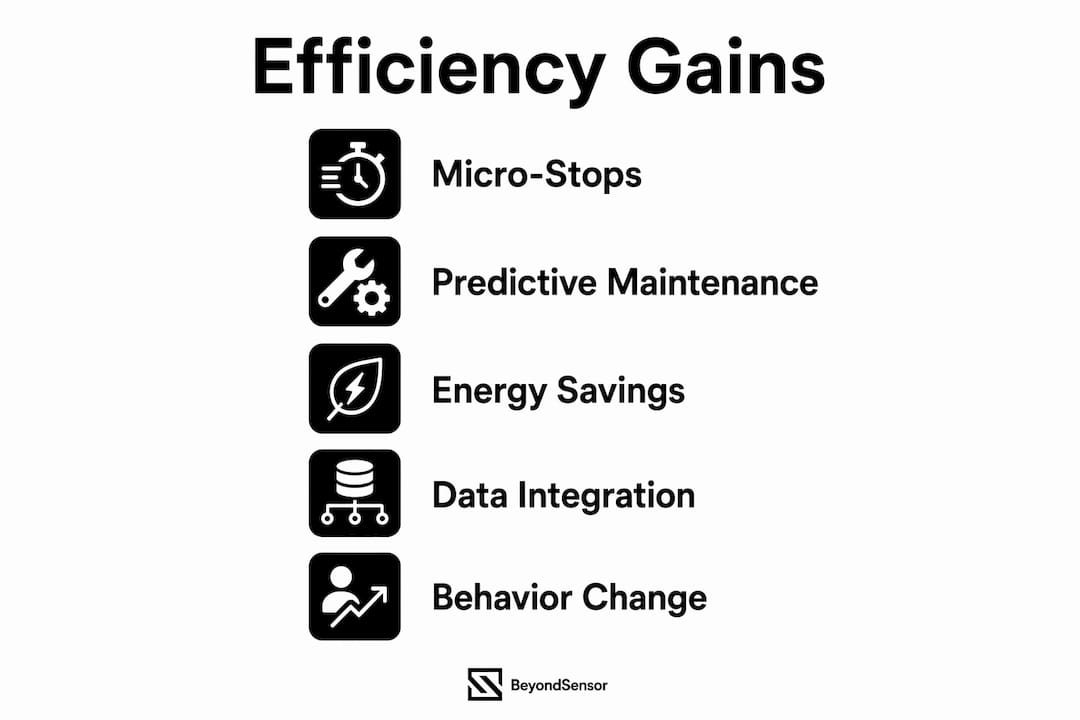
Micro-stops, defined as unplanned stoppages under five minutes, are the clearest example. Operators rarely log them. Shift supervisors rarely see them. Yet micro-stops under 5 minutes account for 18 to 38% of total production losses across plants. A sensor capturing a 30-second jam on a conveyor line does what no clipboard ever will. It timestamps the event, logs the duration, and feeds it into an OEE calculation without human interpretation.
The accuracy gap between manual and sensor-based measurement is significant. TeepTrak's 2026 benchmark data across 450 plants found that operators over-report OEE by 10 to 18 percentage points due to missing micro-stops and inflated cycle times. That gap means operations teams are making investment and scheduling decisions based on numbers that do not reflect reality. Sensor data corrects the baseline.
The table below shows how sensor-based monitoring compares to manual logging across key loss categories:
| Loss type | Manual log capture | Sensor-based capture |
|---|---|---|
| Micro-stops under 5 min | Rarely captured | Captured from 30 seconds |
| Speed losses | Estimated | Measured against cycle time |
| Planned downtime accuracy | Often inflated | Timestamped precisely |
| Shift-to-shift variation | Averaged out | Tracked per event |
| OEE reporting accuracy | Overstated by 10-18 pts | Baseline-accurate |
Once accurate data is in place, the operational response changes. Teams stop debating whether a problem exists and start identifying its root cause. Vibration sensors on motors, current sensors on drives, and vision sensors on assembly lines each capture a different dimension of the same process. Together, they build a picture that manual observation cannot replicate.
- Vibration sensors detect bearing wear and imbalance before failure
- Current sensors identify motor loading anomalies and efficiency drops
- Temperature sensors flag thermal stress in electrical panels and process equipment
- Vision sensors catch defect patterns and speed deviations in real time
Pro Tip: Set your sensor sampling rate to capture stops as short as 30 seconds. Anything coarser and you will miss the micro-stop category that drives the largest OEE gaps in most plants.
What role does predictive maintenance play in enhancing efficiency?
Fixed-schedule maintenance is a blunt instrument. You replace parts on a calendar, not on condition. Sensors change that equation entirely by shifting maintenance from time-based to condition-based, which is the formal industry term for predictive maintenance (PdM).
Condition-based maintenance uses continuous sensor streams to detect machine health anomalies before they become failures. Vibration sensors identify bearing degradation weeks before a breakdown. Thermal cameras and infrared sensors spot electrical hotspots that precede arc faults. Acoustic sensors detect cavitation in pumps that no visual inspection would catch. Each of these signals, when processed through analytics, gives maintenance teams a specific, time-bounded window to act.
The business case is concrete. AI-driven sensor analytics at one manufacturing facility flagged failures 14 to 28 days in advance with 92% accuracy, compressing the production planning freeze from 14 days down to 1 day. That single change restructures how an entire operation schedules labor, materials, and capacity. The efficiency gain is not just in the maintenance department. It propagates across the whole production system.
Here is how a structured predictive maintenance program using sensors typically unfolds:
- Baseline data collection. Deploy vibration, thermal, and current sensors on critical assets. Run for 30 to 60 days to establish normal operating signatures.
- Anomaly threshold setting. Define alert thresholds based on manufacturer specs and observed variance. Avoid thresholds so sensitive they generate false positives.
- Alert routing. Connect sensor alerts to your CMMS (Computerized Maintenance Management System) so work orders generate automatically when thresholds are breached.
- Intervention tracking. Log every maintenance action triggered by a sensor alert. Compare against historical failure rates to validate the model.
- Continuous refinement. Adjust thresholds and add sensor types as failure patterns become clearer over time.
Semtech's LoRaWAN wireless network supports this architecture at scale. LoRaWAN sensors offer up to 10 years of battery life with minimal infrastructure, which means you can instrument remote assets, outdoor equipment, and legacy machinery without running new cable. That removes the installation cost barrier that has historically slowed PdM adoption.
Pro Tip: Start predictive maintenance pilots on your highest-consequence assets first, not your most accessible ones. The ROI case is stronger when you prevent a failure that would cost $50,000 in downtime versus one that costs $500.
How do sensors contribute to energy and resource optimization?
Energy is one of the largest controllable costs in industrial operations, and most facilities manage it with monthly utility bills rather than real-time data. IoT sensors change that by making energy consumption visible at the asset, zone, and process level simultaneously.
A 2026 PLOS ONE study on industrial solar microgrids demonstrated what real-time sensor monitoring delivers in practice. IoT-based load management reduced current draw from 2.94 A to 2.72 A, a 7.48% reduction, and cut power consumption from 278.40 W to 213.10 W, a 23.46% reduction. These numbers came from automated load shedding triggered by sensor data, not from operator decisions. The system identified noncritical loads during peak demand periods and shed them automatically, reducing stress on the grid and extending equipment life.
The applications extend well beyond microgrids:
- HVAC optimization. Occupancy sensors and CO2 sensors adjust ventilation and cooling based on actual building use, not fixed schedules. Facilities running sensor-driven HVAC consistently report 15 to 30% reductions in HVAC energy spend.
- Lighting control. Presence sensors and daylight sensors eliminate the energy waste of lighting unoccupied zones. In large warehouses and manufacturing floors, this is a measurable line item.
- Process utility monitoring. Flow sensors and pressure sensors on compressed air systems detect leaks that would otherwise go unnoticed for months. Compressed air leaks in industrial facilities typically waste 20 to 30% of total compressed air output.
- Peak demand management. Current sensors on high-draw equipment feed into automated control systems that stagger start-up sequences, reducing peak demand charges on utility bills.
The connection to sustainability goals is direct. Operations teams under pressure to report Scope 2 emissions reductions now have a credible measurement and control mechanism. Sensor data provides the audit trail that sustainability reporting requires. You can also explore how sensor tech applications support both safety and energy efficiency goals in facility environments.
What practical considerations maximize sensor implementation impact?
Deploying sensors without a clear architecture plan produces data lakes, not decisions. The technical choices you make at the start of a sensor project determine whether you get real-time control or a dashboard nobody checks.
The first decision is edge versus cloud processing. Edge computing in sensor systems reduces data volume, network latency, and cybersecurity risk by processing data locally before transmitting. For time-sensitive applications like motor protection or safety interlocks, edge processing is not optional. A sensor that must round-trip to the cloud before triggering an alert introduces latency that can mean the difference between catching a fault and experiencing a failure. Local processing enables immediate automated responses without that dependency.
The second decision is network technology. Each option involves real tradeoffs:
| Network type | Range | Power use | Latency | Best for |
|---|---|---|---|---|
| LoRaWAN | Long (km) | Very low | Seconds | Remote assets, battery sensors |
| NB-IoT | Long (km) | Low | Seconds | Wide-area cellular coverage |
| Wi-Fi | Short (100m) | Medium | Milliseconds | High-bandwidth, indoor sensors |
| Bluetooth/BLE | Very short | Very low | Milliseconds | Wearables, proximity sensors |
| 5G | Medium | High | Milliseconds | High-speed, mobile assets |
The third consideration is measurement integrity. Sensor sampling and thresholds must be tuned to capture the specific loss events relevant to your process. A sampling rate that misses sub-minute stops will produce the same blind spots as a manual log. This is not a set-and-forget configuration. It requires validation against known events during commissioning.
Wireless sensors with multi-year battery life support scalable Industry 4.0 implementations without the installation overhead of wired networks. For operations teams piloting sensor projects, this reduces upfront commitment and allows rapid iteration across asset types.
Pro Tip: Before selecting a network technology, map your assets by criticality and location. High-criticality indoor assets warrant Wi-Fi or wired connections for low latency. Remote or battery-powered assets are natural fits for LoRaWAN or NB-IoT.
Key takeaways
Sensors improve operational efficiency by converting physical signals into precise, real-time data that closes the gap between what operations teams assume is happening and what is actually occurring on the floor.
| Point | Details |
|---|---|
| Micro-stop detection is foundational | Sensor-based OEE monitoring captures losses under 5 minutes that manual logs miss entirely. |
| Predictive maintenance reduces downtime | Condition-based maintenance triggered by sensor data cuts unplanned failures and extends asset life. |
| Energy savings are automated | Real-time IoT sensors enable automated load shedding that reduces power consumption by over 23%. |
| Edge processing is non-negotiable for speed | Local data processing eliminates cloud latency for time-sensitive control and safety applications. |
| Network choice determines scalability | LoRaWAN and NB-IoT support large-scale, low-cost sensor deployments across remote and legacy assets. |
Why the data loop matters more than the sensors themselves
I have seen operations teams invest in sensor hardware, build dashboards, and then watch efficiency metrics stay flat for six months. The sensors were working. The data was accurate. The problem was that nobody had defined what to do when an alert fired.
Sensors alone do not create efficiency. Gains come from closing the feedback loop, where sensor data triggers a specific, timely response integrated into the workflow. That sounds obvious until you are standing in a plant where a vibration alert goes to an email inbox that maintenance checks twice a day. The sensor did its job. The system failed.
The most underrated early win from sensor deployment is not the data itself. It is the behavior change that comes from operators seeing real numbers for the first time. When a team discovers their line is running at 61% OEE instead of the 79% they reported, that visibility alone drives improvement before any automation is in place. I have watched that moment happen, and it is more powerful than any algorithm.
My advice: before you add more sensors, define the decision each sensor is meant to support. What threshold triggers an alert? Who receives it? What action is required within what timeframe? Build that decision framework first, then deploy the hardware. The advanced sensing technologies guide from Beyondsensor covers this integration logic well for security and operational contexts.
Do not let perfect be the enemy of useful. A single vibration sensor on your most critical asset, connected to an alert that pages your maintenance lead directly, will deliver more value than a 200-sensor deployment with no clear response protocol.
— Eumir
How Beyondsensor helps you act on sensor data

Beyondsensor builds AI-powered sensor solutions designed for operations teams that need more than raw data. The platform connects sensor inputs across industrial automation, environmental monitoring, and physical security into a single decision layer, giving you the real-time visibility and automated responses that drive genuine efficiency gains. Whether you are a system integrator deploying sensor networks at scale or an operations manager building your first predictive maintenance program, Beyondsensor's system integrator solutions provide the architecture, analytics, and support to make sensor data work. Explore the latest sensor innovations to see how AI-driven sensing is reshaping operational excellence across Southeast Asia and beyond.
FAQ
How do sensors improve operational efficiency?
Sensors convert physical signals into real-time digital data that enables faster decisions, automated responses, and predictive maintenance. The efficiency gain comes from closing the loop between data collection and operational action.
What is the definition of operational efficiency sensors?
Operational efficiency sensors are devices that monitor equipment, energy, and process variables continuously to provide the data needed to reduce waste, downtime, and resource consumption. They combine sensing, edge processing, and connectivity to deliver actionable operational intelligence.
How do sensors help detect hidden production losses?
Sensor-based OEE monitoring captures micro-stops as short as 30 seconds, revealing losses that account for 18 to 38% of total production time and are routinely missed by manual logging.
What wireless technology is best for industrial sensor networks?
LoRaWAN is the leading choice for remote and battery-powered assets, offering kilometer-range coverage and up to 10 years of battery life. Wi-Fi and 5G are better suited for high-bandwidth or low-latency applications indoors.
How much energy can sensors save in industrial operations?
A 2026 PLOS ONE study found that IoT sensor-driven load management reduced industrial power consumption by 23.46% through automated shedding of noncritical loads during peak demand periods.
Recommended
- Defining operational efficiency in security: insights & best practices | News | BeyondSensor
- How sensor technology drives smarter industrial automation | News | BeyondSensor
- Top sensor security tips for safety & compliance 2026 | News | BeyondSensor
- Explore emerging security technology trends for 2026 | News | BeyondSensor
Read More Articles
RTSP Security Risks: Integrators Must Block Exposed Ports 554 and 8554
See how integrators can reduce RTSP security risks: close exposed ports 554 and 8554, secure camera access, and verify each deployment with practical checks.

Require MAEpp and X Accuracy Before You Buy People Counting Systems
Verify people counting accuracy by demanding MAEpp, X Accuracy, and directional-bias reports. Validate on-site with at least 100 events per direction...
30–90 Day Pilot Validates Redundant Camera Networks for Engineers
Standards led, practical steps for engineers to deploy redundant camera networks: MRP, dual homing, and aggregation patterns, commissioning checks, and...
30 Day Pilot Proves Video Analytics Accuracy for Security Teams
Validate video analytics accuracy with scenario tests, camera tuning, transfer learning and a 30 day edge first pilot for security teams.
Let's Build YourSecurity Ecosystem.
Whether you're a System Integrator, Solution Provider, or an End-User looking for trusted advisory, our team is ready to help you navigate the BeyondSensor landscape.
Direct Advisory
Connect with our regional experts for tailored solutioning.