
Explore defining surveillance analytics. Discover how AI-driven insights enhance security and decision-making in real time.

Defining Surveillance Analytics: A Professional's Guide

What is surveillance analytics?
Surveillance analytics is the application of AI-driven software, machine learning algorithms, and advanced data processing to raw surveillance data, producing actionable intelligence that drives security and operational decisions. Rather than passively recording events for later review, modern systems analyze video streams in real time to detect patterns, classify behaviors, and trigger alerts without waiting for a human operator to notice something is wrong.

The industry term most professionals use is surveillance data analytics, though you will also encounter "video analytics" and "intelligent surveillance" depending on the vendor and context. All three describe the same core process: converting unstructured sensor and video data into structured, decision-ready intelligence.
At its foundation, surveillance analytics does three things:
- Captures raw data from cameras, IoT sensors, access control systems, and environmental monitors
- Processes that data through AI algorithms for object detection, behavioral analysis, and anomaly recognition
- Delivers findings through dashboards, automated alerts, and reports that operations and security teams can act on immediately
The shift from passive recording to proactive intelligence is what separates surveillance analytics from traditional closed-circuit television. AI never blinks, never loses focus, and never misses a pattern buried across thousands of hours of footage.
Table of Contents
- How does surveillance analytics turn raw data into decisions?
- What types and techniques does surveillance analytics cover?
- Where is surveillance analytics applied in security and operations?
- What are the benefits, challenges, and ethical considerations?
- How Beyondsensor approaches surveillance analytics solutions
- Beyondsensor gives you a direct path from sensors to operational intelligence
- Key Takeaways
How does surveillance analytics turn raw data into decisions?
The data pipeline starts at the sensor layer. Cameras, access readers, environmental monitors, and IoT devices continuously generate streams of unstructured data. That raw feed carries no inherent meaning until AI algorithms process it.
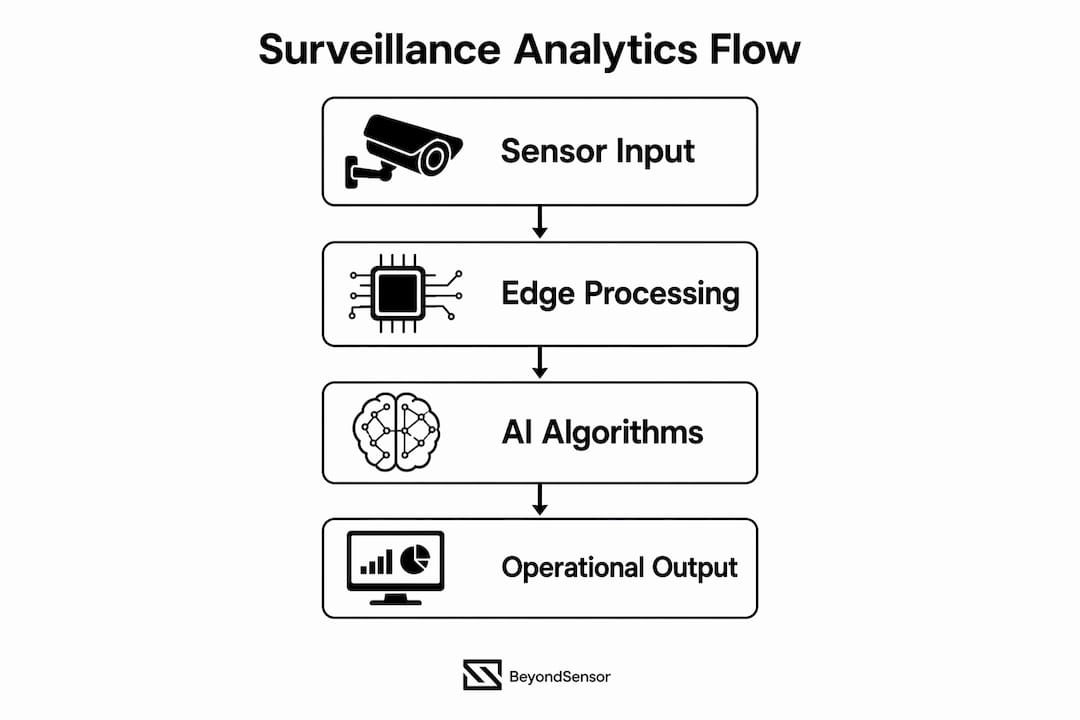
Processing happens at one of two points in the architecture. Edge processing runs inference directly on local hardware, close to the data source, which reduces latency and keeps response times tight for time-critical alerts. Cloud processing routes data to centralized infrastructure, enabling deeper, more complex AI models at the cost of higher bandwidth requirements and some added latency. Hybrid architectures combine both: edge nodes handle real-time filtering and immediate alerts, while the cloud handles longer-term pattern analysis and model training.
Once data reaches the processing layer, AI algorithms take over. Object detection identifies people, vehicles, and assets within a frame. Behavioral analysis tracks movement patterns and flags deviations from established norms. Event classification groups detected activities into categories, such as unauthorized access, crowd formation, or workflow bottleneck, so the system knows what kind of response to trigger.
Pro Tip: When evaluating a surveillance analytics deployment, ask vendors whether their edge nodes retain local storage for regulatory compliance. Under many US frameworks, data retention and audit trails are mandatory, and a system that relies solely on cloud connectivity creates a compliance gap during network outages.
The output layer is where analytics becomes operationally useful. Dashboards give security and operations teams a live view of flagged events. Automated alerts push notifications to mobile devices or control rooms the moment a threshold is crossed. Scheduled reports aggregate trend data for management review. Together, these outputs close the loop between raw sensor data and human decision-making.
What types and techniques does surveillance analytics cover?
Surveillance analytics is not a single technology. It spans four distinct categories, each with its own data sources, analytic methods, and objectives.
Physical security surveillance is the most familiar category for US security professionals. It uses video cameras, access control readers, and motion sensors to monitor facilities, detect intrusions, and track asset movement. The Department of Homeland Security recognizes video analytics systems as tools that automate tasks traditionally performed by human operators, including object detection and classification to protect critical assets.
Syndromic surveillance operates in the public health domain. The CDC's National Syndromic Surveillance Program uses the BioSense Platform to integrate electronic health records and community health data for early detection of disease outbreaks and environmental health threats. The analytic goals here are epidemiological, not physical security, which is why conflating the two categories leads to misaligned technology choices and governance frameworks.
Digital and cyber surveillance analytics monitors network traffic, user behavior, and endpoint activity to detect intrusions, data exfiltration, and insider threats. The data sources are logs and packets rather than video feeds, but the underlying analytic techniques, anomaly detection, pattern recognition, and behavioral baselining, are structurally similar to physical surveillance analytics.
Environmental monitoring applies sensor analytics to air quality, temperature, chemical presence, and infrastructure stress. Industrial facilities and smart city deployments in the US increasingly combine environmental sensors with physical security cameras to get a unified operational picture.
Across all four categories, the core techniques include:
- Object detection: Identifies and classifies specific entities within a data stream, from a person in a restricted zone to a vehicle running a red light
- Behavioral analysis: Tracks movement and activity patterns over time, flagging deviations that suggest risk or inefficiency
- Anomaly detection: Establishes a statistical baseline for normal operations and surfaces events that fall outside it
- Predictive analytics: Uses historical pattern data to forecast likely future events, such as peak crowd density or equipment failure windows
- Biometric recognition: Matches facial features, gait, or other physical identifiers against known databases for access control and investigation
The underlying technology stack typically includes deep learning models, computer vision frameworks, and data visualization tools that translate model outputs into formats operations teams can interpret without a data science background.
Where is surveillance analytics applied in security and operations?
The applications span industries, and the US market is one of the most active deployment environments globally, driven by smart city investment, federal security mandates, and enterprise demand for operational efficiency.
Crime detection and physical security remain the anchor use case. Law enforcement agencies and private security operations use real-time video analytics to identify unauthorized access, detect weapons, and flag suspicious behavior before an incident escalates. Exception-based monitoring means operators only review footage when the system has already identified something worth their attention.
Traffic monitoring is one of the fastest-growing application areas in US cities. Intelligent transportation systems use surveillance analytics to detect congestion, identify bottlenecks, and automate incident reporting. The result is faster emergency response and measurable reductions in commute delays.
Retail analytics applies the same object detection and behavioral analysis techniques to customer flow, shelf interaction, and loss prevention. A retailer tracking dwell time in specific store zones can adjust product placement based on real movement data rather than survey estimates.
Industrial surveillance monitors production lines, equipment status, and worker safety compliance. A manufacturing facility can use video analytics to detect when a worker enters a hazardous zone without proper protective equipment, triggering an immediate alert rather than discovering the violation during a manual audit.
Public safety and smart infrastructure tie these threads together. US cities deploying integrated surveillance networks use analytics in surveillance to coordinate responses across agencies, monitor public spaces during large events, and feed data into emergency management systems.
Surveillance analytics has also evolved from forensic review to a proactive operational tool. Organizations now use the same camera infrastructure that once served only security to optimize staffing levels, measure workflow efficiency, and identify process bottlenecks, without installing any additional hardware.
What are the benefits, challenges, and ethical considerations?
The operational benefits are concrete. AI and machine learning enable real-time threat detection, predictive analytics, behavioral analysis, and automated alerts, reducing the manual workload on security teams and improving response times. Organizations that previously needed a team of operators watching dozens of screens can redirect that labor to higher-value tasks while the system handles routine monitoring.
Operational efficiency gains extend beyond security. Staffing optimization, workflow analysis, and compliance monitoring all benefit from the same data infrastructure, which means the return on investment calculation for a surveillance analytics deployment includes operational savings, not just security outcomes.
The challenges are equally real. Privacy concerns top the list for most US organizations. Biometric data collection, behavioral profiling, and continuous monitoring of employees or members of the public raise significant legal and ethical questions under frameworks like the Illinois Biometric Information Privacy Act and various state-level privacy statutes. The SPED Process Guide (Surveillance, Privacy, and Ethical Decision-Making) offers a structured framework for organizations evaluating new surveillance analytics deployments, mapping the sophistication of existing surveillance technology against the privacy rights context of the deployment environment.
Additional challenges include:
- Data governance: Large-scale surveillance generates enormous data volumes. Without clear retention policies, access controls, and audit trails, organizations face both compliance risk and operational overhead.
- Integration complexity: Connecting new analytics platforms to legacy camera systems, access control infrastructure, and IT networks requires careful architecture planning, particularly in facilities with mixed hardware generations.
- Team capability: Effective surveillance analytics demands multidisciplinary expertise, combining data science, security operations, and business analysis. Organizations that treat it as a pure IT project often underutilize the platform.
The role of data privacy in any surveillance analytics strategy is not a compliance checkbox. It shapes what data you collect, how long you retain it, who can access it, and how you communicate its use to employees and the public. Getting that strategy right before deployment is far less costly than retrofitting it after a regulatory inquiry.
How Beyondsensor approaches surveillance analytics solutions
Beyondsensor operates at the intersection of high-precision sensing hardware and intelligent analytics software, which gives the company a distinct perspective on surveillance analytics that pure software vendors cannot replicate. The foundation is sensor integration: Beyondsensor's solutions combine camera systems, environmental sensors, and access control hardware into a unified data architecture, so analytics models receive clean, calibrated inputs rather than noisy feeds from mismatched devices.
On the processing side, Beyondsensor supports both edge and cloud deployment models, allowing organizations to match their architecture to their latency requirements and data governance constraints. For facilities where real-time response is non-negotiable, edge-based processing keeps alert latency minimal. For organizations that need deep historical analysis and model refinement, cloud connectivity extends the platform's analytical depth.
The company's work spans industrial automation, smart infrastructure, and physical security, which means Beyondsensor's engineers have deployed surveillance analytics in environments where the stakes range from production efficiency to critical asset protection. That cross-sector experience informs how Beyondsensor designs its sensor-to-insight pipelines, with particular attention to the data quality issues that cause AI models to underperform in real-world conditions.
Pro Tip: Before committing to any surveillance analytics platform, validate the vendor's sensor calibration process. A well-trained AI model running on poorly calibrated camera inputs will generate false positives at a rate that erodes operator trust within weeks of deployment.
Beyondsensor also provides ecosystem matchmaking services, connecting system integrators, government agencies, and enterprise end-users with the right combination of hardware, software, and managed services for their specific deployment context. For organizations entering surveillance analytics for the first time, that guidance on AI analytics for security leaders can compress the evaluation and procurement timeline considerably.
Beyondsensor gives you a direct path from sensors to operational intelligence
Security and operations leaders who have read this far understand what surveillance analytics can do. The harder question is how to deploy it without the integration headaches, data quality problems, and privacy governance gaps that derail most first-generation implementations.
Beyondsensor is built for exactly that challenge. The company combines precision sensor hardware with AI analytics and edge-to-cloud architecture in a single, cohesive solution, so you are not stitching together components from three different vendors and hoping the data flows cleanly between them. Whether your priority is physical security, industrial monitoring, or operational efficiency, Beyondsensor's team brings deployment experience across all three contexts. Visit beyondsensor.com to connect with a specialist and map out the right architecture for your environment.
Key Takeaways
Surveillance analytics transforms passive sensor and video data into real-time operational intelligence through AI-driven processing, making it a foundational capability for both security and operational efficiency in modern US organizations.
| Point | Details |
|---|---|
| Core definition | Surveillance analytics applies AI and machine learning to raw sensor and video data to produce actionable security and operational insights. |
| Processing architecture | Edge processing delivers low-latency alerts; cloud enables deeper analysis; hybrid models combine both advantages for demanding deployments. |
| Four distinct categories | Physical security, syndromic, digital/cyber, and environmental surveillance each require specialized data architectures and analytic approaches. |
| Ethics and privacy | The SPED Process Guide provides a structured framework for balancing surveillance benefits against privacy rights and ethical obligations. |
| Beyondsensor's approach | Beyondsensor integrates precision sensor hardware with AI analytics and edge-to-cloud architecture to deliver end-to-end surveillance intelligence. |
Recommended
- What Is Smart Surveillance Analytics for Security Teams | News | BeyondSensor
- The Role of Data Analytics in Security Operations | News | BeyondSensor
- AI analytics for sensor tech security leaders | News | BeyondSensor
- Infrastructure Surveillance Integration Guide for Facilities | News | BeyondSensor
Read More Articles
RTSP Security Risks: Integrators Must Block Exposed Ports 554 and 8554
See how integrators can reduce RTSP security risks: close exposed ports 554 and 8554, secure camera access, and verify each deployment with practical checks.
Require MAEpp and X Accuracy Before You Buy People Counting Systems
Verify people counting accuracy by demanding MAEpp, X Accuracy, and directional-bias reports. Validate on-site with at least 100 events per direction...
30–90 Day Pilot Validates Redundant Camera Networks for Engineers
Standards led, practical steps for engineers to deploy redundant camera networks: MRP, dual homing, and aggregation patterns, commissioning checks, and...
30 Day Pilot Proves Video Analytics Accuracy for Security Teams
Validate video analytics accuracy with scenario tests, camera tuning, transfer learning and a 30 day edge first pilot for security teams.
Let's Build YourSecurity Ecosystem.
Whether you're a System Integrator, Solution Provider, or an End-User looking for trusted advisory, our team is ready to help you navigate the BeyondSensor landscape.
Direct Advisory
Connect with our regional experts for tailored solutioning.