
Discover how defining autonomous surveillance systems shapes the future of security. Learn about their benefits, technologies, and capabilities.

Autonomous Surveillance Systems: A 2026 Technical Guide

What defines an autonomous surveillance system?
An autonomous surveillance system is an integrated platform of sensors, AI reasoning engines, and decentralized control architectures that independently performs complex monitoring, threat identification, and situational awareness tasks without requiring continuous human intervention. The term is often used interchangeably with "automated surveillance," but the distinction is fundamental: automated systems execute fixed scripts, while autonomous systems reason, adapt, and generate new action plans in response to changing conditions.
Surveillance technologies broadly encompass software, hardware, and networks designed to monitor and analyze data. Autonomous surveillance systems occupy the highest tier of that spectrum, capable of executing complex tasks without external control. What separates them from simpler monitoring tools is the presence of an independent reasoning layer, one that evaluates environmental inputs, weighs mission objectives, and adjusts behavior accordingly.
The core technical characteristics of a fully autonomous surveillance system include:
- Multi-sensor integration: Fusion of visual, thermal, acoustic, and radar inputs into a unified data stream
- AI reasoning layer: Machine learning models that classify objects, detect anomalies, and prioritize alerts without human prompting
- Decentralized control architecture: Agent-based architectures that distribute decision-making across networked nodes rather than routing everything through a central processor
- Goal-driven behavior: The ability to elaborate action plans at runtime to satisfy mission objectives, not merely respond to triggers
- Real-time situational awareness: Continuous environmental modeling that updates as conditions change
- Independence from constant oversight: Operation across extended periods without operator input, escalating only when thresholds are crossed
| Capability | Automated System | Autonomous System |
|---|---|---|
| Decision-making | Rule-based, pre-scripted | AI-driven, adaptive |
| Response to novel events | Limited or fails | Generates new action plans |
| Human oversight required | Continuous | Exception-based |
| Sensor integration | Single or fixed | Multi-modal, dynamic fusion |
| Mission adaptability | Low | High |
Governing frameworks for these systems in the United States include Department of Defense Directive 3000.09, which establishes requirements for human oversight in autonomous weapons systems, and NIST's AI Risk Management Framework, which applies to AI-driven decision systems across defense and civilian security contexts.
How autonomous surveillance technology evolved to where it is today
The trajectory from passive CCTV networks to fully autonomous monitoring systems spans roughly four decades, with the most consequential advances compressed into the last ten years.
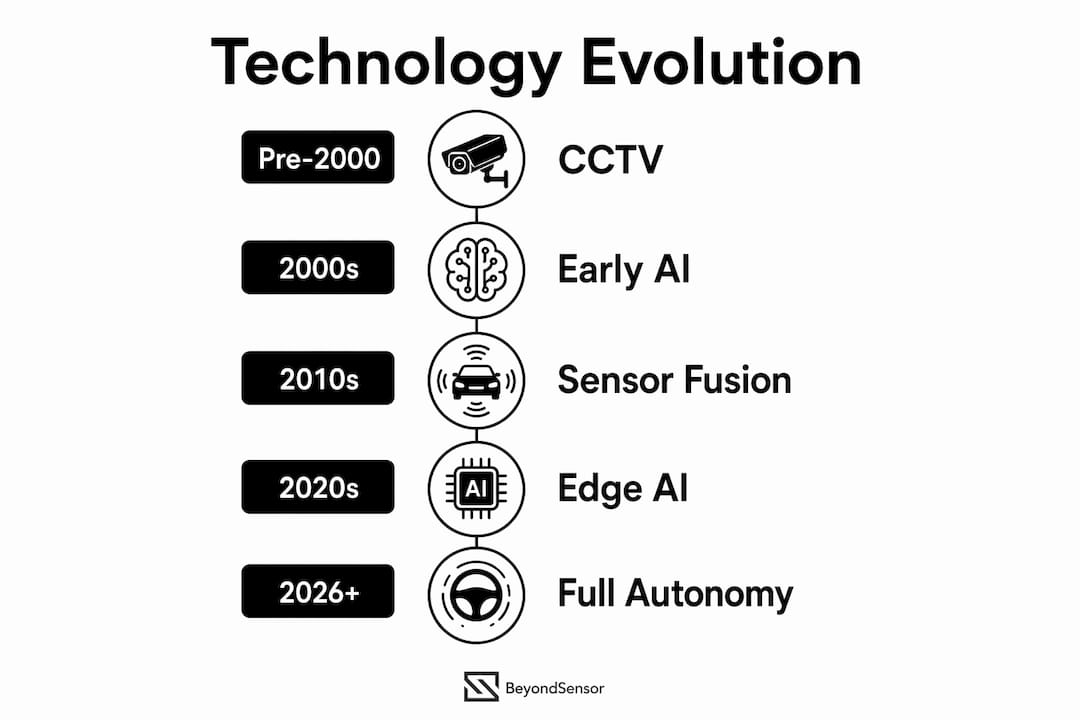
Early surveillance infrastructure was entirely human-dependent. Operators watched fixed-camera feeds, logged incidents manually, and responded after the fact. The introduction of digital recording in the 1990s improved storage but did nothing to reduce cognitive load. The real inflection point came with Video Content Analytics (VCA), which enabled real-time object tracking and classification and began shifting the burden of pattern recognition from humans to software.
Key milestones in the evolution of autonomous surveillance:
- 1990s: Digital CCTV replaces analog tape; centralized recording becomes standard
- Early 2000s: VCA software introduces motion detection and basic object classification
- 2010s: Deep learning models dramatically improve facial recognition, vehicle tracking, and behavioral anomaly detection
- 2015–2020: Multi-sensor fusion architectures emerge, combining optical, thermal, and acoustic feeds into single analytical pipelines
- 2020–2023: Multi-Agent Systems (MAS) and Holonic Multi-Agent Systems (HMAS) enter surveillance design, enabling each sensor node and processing method to operate as an autonomous agent within a larger coordinated network
- Edge AI processing is maturing, enabling real-time inference at the sensor level without dependence on centralized cloud infrastructure
| Era | Primary Technology | Human Role |
|---|---|---|
| Pre-2000 | Analog CCTV | Continuous active monitoring |
| 2000–2010 | Digital recording, basic VCA | Reactive review |
| 2010–2020 | Deep learning, sensor fusion | Alert-based intervention |
| 2020–2026 | HMAS, edge AI, goal-driven agents | Exception-based oversight |
The HMAS model deserves particular attention. By decomposing a surveillance network into nested, self-similar agent groups called holons, HMAS architectures achieve fault tolerance and modularity that conventional software engineering approaches cannot match. A city-scale vehicle tracking experiment using this architecture demonstrated that systems with simple agent behaviors could deliver tracking quality comparable to the best image analysis approaches, with meaningful gains in runtime performance.
Why autonomous surveillance delivers real operational advantages
The operational case for autonomous surveillance in military and security contexts is not theoretical. These systems address concrete problems that human-operated networks cannot solve at scale.
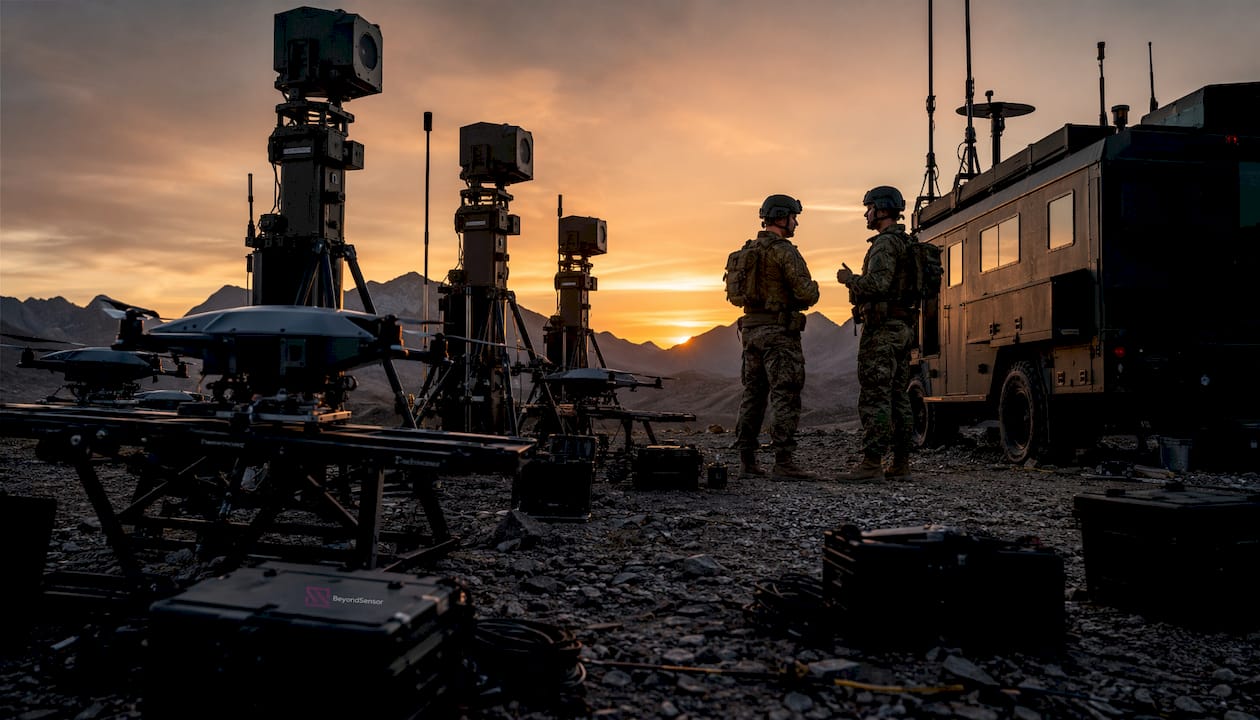
Reduced cognitive load without reduced coverage. Human operators monitoring multiple video feeds suffer from attention fatigue within minutes. Autonomous systems process every feed continuously, flagging only the events that meet defined threat thresholds. Fusing multi-modal sensor data into intuitive interfaces means operators engage with interpreted situational pictures rather than raw data streams, which preserves cognitive capacity for high-stakes decisions.
Scalability across hostile or inaccessible terrain. Decentralized architectures allow surveillance coverage to expand horizontally without proportional increases in personnel. A perimeter defense network covering hundreds of square kilometers can be managed by a small operations team when the system itself handles detection, classification, and initial response coordination.
Improved detection accuracy through sensor fusion. No single sensor type performs reliably across all environmental conditions. Optical cameras fail in low light; thermal imagers struggle to distinguish targets in high-heat environments; acoustic sensors generate false positives in urban noise. Multi-sensor fusion, combining inputs at the feature level or the decision level, produces classification confidence that individual sensors cannot achieve alone.
Reduction of false positives and alert fatigue. Alert fatigue is one of the most documented failure modes in security operations. When every motion trigger generates an alarm, operators begin ignoring alarms. AI-driven classification filters events against learned behavioral models, dramatically reducing the ratio of nuisance alerts to genuine threats.
Pro Tip: Design your alert thresholds around confirmed threat signatures from your specific operational environment, not generic factory defaults. A system calibrated on urban traffic patterns will generate excessive alerts on a rural perimeter, and vice versa.
Where autonomous surveillance systems are deployed right now
Military and security organizations across the United States are not waiting for these technologies to mature further. Deployments are active and expanding across several distinct mission categories.
UAV swarms for battlefield and perimeter monitoring
Networked unmanned aerial vehicles using onboard cameras assist in navigation and threat identification for ground troops, with AI/ML applications processing sensor data to detect enemy presence, movement, and activity patterns. The U.S. Army Combat Capabilities Development Command (DEVCOM) has examined UAV swarms as a tool for providing dismounted soldiers with situational awareness that exceeds what any individual operator could maintain. Programs like DARPA's Heterogeneous Aerial Reconnaissance Team have developed systems where drone teams pilot themselves, automatically assess suspicious activity, coordinate with nearby units, and notify human operators only when intervention is warranted.
Dismounted soldier support systems
Soldiers operating in complex terrain face information overload as much as information scarcity. Autonomous surveillance platforms address this by fusing visual, thermal, and acoustic sensor data into manageable streams delivered through intuitive human-machine interfaces. The design of these interfaces accounts for human information processing models, including attention-sharing constraints and multi-tasking limits, so that the system augments rather than overwhelms soldier cognition.
Fixed perimeter defense
Ground-based autonomous security systems protect critical infrastructure including military installations, power facilities, and border zones. These deployments typically combine fixed optical and thermal cameras with ground-based radar and acoustic sensors, all feeding into an AI classification engine that distinguishes personnel, vehicles, and wildlife without operator involvement.
Urban surveillance and crisis management
Autonomous surveillance systems designed for urban environments handle the additional complexity of dense, dynamic scenes. Multi-camera cooperation enables city-scale tracking of individuals or vehicles across intersections, with autonomous drone platforms increasingly integrated into rapid-response frameworks for crisis management scenarios.
- UAV swarm deployment for wide-area battlefield monitoring
- Dismounted soldier augmentation via AI-fused sensor interfaces
- Fixed perimeter defense at military installations and critical infrastructure
- Urban multi-camera tracking networks for law enforcement and crisis response
- Maritime domain awareness using Automatic Identification System integration with AI analytics
- Border surveillance combining ground sensors, aerial assets, and AI classification
- Facility access control with behavioral anomaly detection layered on biometric systems
What the next wave of autonomous surveillance will look like
The trajectory of autonomous surveillance technology through 2026 and beyond points toward systems that are faster, more distributed, and more capable of operating without any centralized infrastructure at all.
Edge AI processing is the most consequential near-term development. Processing real-time surveillance data locally at the sensor reduces latency and bandwidth demands, enabling timely autonomous decisions in environments where cloud connectivity is unavailable or compromised. A forward-deployed military sensor node that must wait for a cloud round-trip to classify a threat is operationally unacceptable. Edge inference eliminates that dependency.
Improved data fusion techniques will extend beyond combining sensor modalities to integrating contextual data, historical behavioral patterns, and environmental models into a single reasoning framework. Systems will not just detect an anomaly; they will assess whether it fits a known threat pattern given the time of day, weather conditions, and recent activity in the area.
Goal-driven autonomy will deepen. Current systems are largely reactive or task-oriented. The next generation will exhibit genuinely proactive behavior, elaborating multi-step plans at runtime to satisfy mission objectives that were not explicitly anticipated at design time.
Emerging trends to watch through 2026 and beyond:
- Continual learning: Systems that update their behavioral models from operational experience without requiring manual retraining cycles
- Multi-domain sensor fusion: Integration of space-based, aerial, and ground-level sensor data into unified operational pictures
- Swarm coordination protocols: Standardized communication frameworks enabling heterogeneous UAV and ground sensor networks to coordinate autonomously
- Explainable AI (XAI) for surveillance: Audit-ready reasoning logs that document why a system flagged a specific event, supporting legal and ethical accountability
- Human-machine teaming standards: Formalized protocols defining when autonomous systems escalate to human operators and how that handoff occurs
Technical and operational considerations for deploying these systems
Building or deploying an autonomous surveillance system in a military or security context involves decisions that go well beyond selecting sensors and cameras. The architecture choices made at the design stage determine whether the system will scale, adapt, and remain maintainable over a multi-year operational lifecycle.
Autonomous vs. automated: get the architecture right from the start. A system built on fixed rule-based scripting will fail when it encounters conditions outside its design parameters. True autonomous capability requires an independent reasoning layer that generates and adjusts action plans dynamically. This distinction shapes every downstream design decision, from the AI models selected to the computational hardware specified.
Edge processing vs. centralized cloud: a genuine trade-off. Centralized architectures offer easier management and more computational headroom for complex models, but they introduce latency and single points of failure. Edge architectures are more resilient and faster but require more sophisticated hardware at each node. Most production deployments in 2026 use a hybrid approach, with edge nodes handling real-time classification and a central system managing correlation, logging, and operator interfaces.
Modular, scalable system design. HMAS architectures that decompose the surveillance network into nested autonomous agent groups offer the best combination of scalability, fault tolerance, and adaptability. When a sensor node fails, the surrounding agents compensate. When the operational area expands, new nodes join the holarchy without requiring a system redesign.
Key deployment considerations:
- Define the autonomy level explicitly: reactive, task-oriented, or goal-driven, and document the human oversight requirements for each level
- Specify edge vs. cloud processing boundaries based on latency requirements and connectivity assumptions
- Design sensor fusion pipelines for both feature-level and decision-level fusion to maximize classification confidence
- Build in explainability from the start, not as a retrofit, to support audit and compliance requirements
- Establish human-machine teaming protocols that define escalation triggers, operator response windows, and fallback behaviors
Pro Tip: When evaluating multi-sensor architectures, test the system's behavior under sensor degradation conditions, not just optimal conditions. A system that performs well when all sensors are functional but fails silently when one goes offline is a liability in operational environments.
Beyondsensor's AI analytics capabilities and sensor integration expertise reflect exactly this kind of architecture-first thinking, combining modular hardware with AI reasoning layers designed for real-world deployment conditions rather than controlled test environments.
Ethical and legal considerations in autonomous surveillance for military and security
Autonomous surveillance systems operating in military and security contexts carry legal and ethical obligations that cannot be treated as afterthoughts. The governance frameworks governing these systems are specific, and the consequences of non-compliance extend from operational failure to civil liability and international legal exposure.
Meaningful human oversight is the central requirement across every major governance framework. The U.S. Department of Defense Directive 3000.09 requires that autonomous and semi-autonomous weapons systems be designed to allow commanders to exercise appropriate levels of human judgment over the use of force. The Freedom Online Coalition's guiding principles on surveillance technologies extend this requirement to non-weapons surveillance, stressing that human oversight must be meaningful, not nominal. A system that technically routes alerts through a human operator but provides no real opportunity for review before action does not satisfy this standard.
Data privacy and algorithmic transparency are equally non-negotiable. Surveillance systems that collect biometric data, track individuals across locations, or build behavioral profiles are subject to the Fourth Amendment's protections against unreasonable search and seizure, as interpreted through a growing body of case law on digital surveillance. Any AI system incorporated into a surveillance platform must be auditable: operators and oversight bodies need to understand why the system flagged a specific individual or event.
Non-discrimination requirements apply directly to AI-driven classification systems. Where a surveillance process incorporates an AI system, the development of that system must employ appropriate, justifiable, equitable, transparent, and understandable design practices. Deployed systems must be routinely evaluated for discriminatory effect and unintended bias, particularly against marginalized or vulnerable groups. This is not a soft ethical preference; it is a legal obligation under federal civil rights law and applicable international commitments.
Proportionality and necessity govern the scope of surveillance deployment. A system capable of tracking every individual in a city is not automatically authorized to do so. The legal authority for any surveillance operation must be commensurate with the threat being addressed, and the least intrusive effective method must be preferred. For military applications, the law of armed conflict adds additional constraints on targeting, discrimination between combatants and civilians, and the use of autonomous systems in lethal decision chains.
The practical implication for system designers and operators is clear: ethical and legal compliance must be built into the architecture, not bolted on after deployment. Audit logs, explainability modules, bias evaluation pipelines, and human escalation protocols are not optional features. They are the difference between a system that can be legally operated and one that cannot.
Beyondsensor: built for the complexity of autonomous surveillance

Deploying autonomous surveillance at operational scale requires more than capable hardware. It demands a partner who understands the full stack, from sensor physics to AI reasoning layers to the governance frameworks that govern how these systems can legally operate. Beyondsensor delivers exactly that combination for system integrators and defense-oriented organizations working at the intersection of physical security and advanced AI.
Beyondsensor's BeyondSecure platform provides the secure, scalable sensor infrastructure that autonomous surveillance deployments require, with architecture designed for modular expansion, edge processing integration, and compliance with the human oversight requirements that military and government customers demand.
Key Takeaways
Autonomous surveillance systems are defined by their AI-driven reasoning layer, which enables goal-driven, adaptive behavior that automated systems cannot replicate, making them the foundational technology for military and security operations in 2026.
| Point | Details |
|---|---|
| Autonomous vs. automated | Autonomous systems generate adaptive action plans; automated systems execute fixed scripts. |
| HMAS architecture | Holonic Multi-Agent Systems enable scalable, fault-tolerant surveillance networks through nested autonomous agent groups. |
| Edge AI is operationally critical | Local inference at the sensor eliminates cloud latency and supports real-time decisions in contested environments. |
| Human oversight is mandatory | Meaningful human oversight is a legal requirement across DoD directives and international surveillance governance frameworks. |
| Ethical compliance requires architecture-level design | Audit logs, bias evaluation, and escalation protocols must be built in from the start, not added after deployment. |
Recommended
- Explore emerging security technology trends for 2026 | News | BeyondSensor
- Defining Intelligent Sensor Networks: A 2026 Guide | News | BeyondSensor
- Advanced sensing technologies: A practical guide for security managers | News | BeyondSensor
- Infrastructure Surveillance Integration Guide for Facilities | News | BeyondSensor
Read More Articles
RTSP Security Risks: Integrators Must Block Exposed Ports 554 and 8554
See how integrators can reduce RTSP security risks: close exposed ports 554 and 8554, secure camera access, and verify each deployment with practical checks.
Require MAEpp and X Accuracy Before You Buy People Counting Systems
Verify people counting accuracy by demanding MAEpp, X Accuracy, and directional-bias reports. Validate on-site with at least 100 events per direction...
30–90 Day Pilot Validates Redundant Camera Networks for Engineers
Standards led, practical steps for engineers to deploy redundant camera networks: MRP, dual homing, and aggregation patterns, commissioning checks, and...
30 Day Pilot Proves Video Analytics Accuracy for Security Teams
Validate video analytics accuracy with scenario tests, camera tuning, transfer learning and a 30 day edge first pilot for security teams.
Let's Build YourSecurity Ecosystem.
Whether you're a System Integrator, Solution Provider, or an End-User looking for trusted advisory, our team is ready to help you navigate the BeyondSensor landscape.
Direct Advisory
Connect with our regional experts for tailored solutioning.