
Which sensors monitor bridges, what each measures, how data reaches engineers, and how to specify a system for Singapore infrastructure and facility owners.
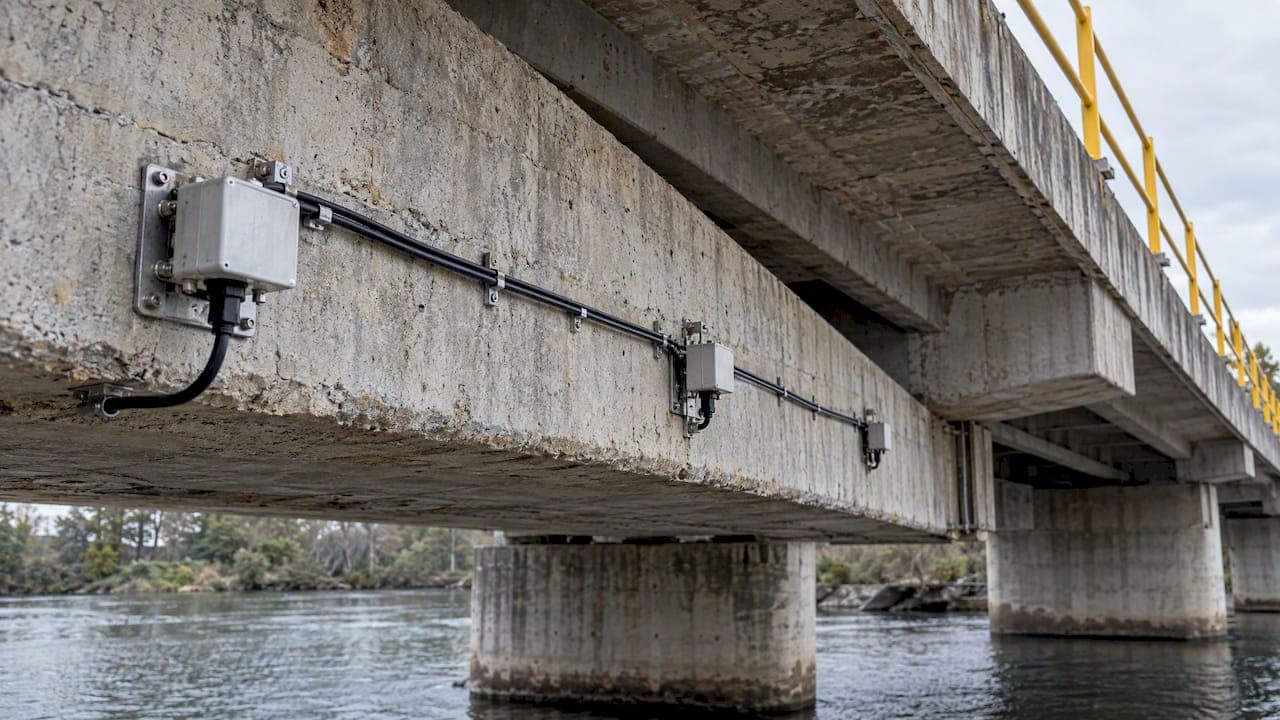
Bridge Monitoring Sensors: Types, Placement and Data Use

Bridge monitoring sensors are devices fixed on or in a structure that record strain, movement, vibration, tilt, corrosion and environmental conditions continuously, so owners can judge how the bridge really behaves instead of waiting for the next visual inspection. A sound system combines several sensor types, sends data to a secure platform and turns readings into maintenance decisions. This guide explains each sensor, what it tells you, how to plan the deployment and what Singapore owners should check first.
TL;DR
- Common bridge sensors are accelerometers, strain sensors, corrosion sensors, LVDTs (displacement) and optical-fiber sensors. Each answers a different question.
- A single parameter rarely describes bridge condition. Plan a multi-type system that links loads, responses and environment.
- Value comes from the data pipeline: transmission, storage, backup, alert rules and a clear owner for every alarm.
- Specify range, sensitivity, resolution and environmental durability before you pick hardware, then plan installation safety, procurement and insurance.
- In Singapore, start with the Land Transport Authority (LTA) requirements for your asset, and use exception-based monitoring so engineers review what matters.
Table of Contents
- What bridge monitoring sensors do
- Which parameters a bridge system can track
- The main sensor types and what each one measures
- Why one parameter is never enough
- From sensor to decision: the data pipeline
- How sensor data guides maintenance
- Singapore context
- Selecting sensors: a practical checklist
- Installation, safety and procurement
- Our perspective
- Working with an integrator
- Plan your sensing project with BeyondSensor
- FAQ
- Sources
What bridge monitoring sensors do
Structural monitoring uses sensing devices installed on or in a structure to capture data continuously over time, with the goal of assessing structural performance objectively and accurately, according to a Transportation Research Board circular on structural monitoring. The same document notes that the data can help identify the causes of performance problems, assess live-load impacts, prioritize projects and verify that repairs or rehabilitation worked.
That last point matters to owners who spend money on strengthening work. A sensor record from before and after a repair gives you evidence, not an opinion.
Monitoring does not replace inspection. A trained engineer still sees cracking, spalling and bearing damage that no accelerometer reports. Sensors add what the eye cannot: behavior between inspections, at night, during storms and under peak traffic.
Which parameters a bridge system can track
A review of bridge health monitoring in the journal literature groups the measurable quantities into four families (Challenges in Bridge Health Monitoring: A Review):
| Family | Examples | Why it matters |
|---|---|---|
| External loading | Wind, seismic activity, traffic | Explains why the structure responds the way it does |
| Structural response | Strain, displacement, acceleration | Shows how the bridge carries load and whether stiffness is changing |
| Environmental parameters | Temperature, humidity, rain | Lets you separate normal seasonal movement from real change |
| Environmental effects | Corrosion | Tracks deterioration that is slow and hidden |
For a tropical city like Singapore, the environmental family deserves attention. Heat and humidity shift readings every day, and a model that ignores them produces false alarms.
The main sensor types and what each one measures
A 2023 academic review lists the sensors most often used in bridge structural health monitoring: accelerometers, strain sensors, corrosion sensors, LVDTs and optical-fiber sensors. Here is how to think about each.

Accelerometers
They measure vibration. From the signals, engineers derive natural frequencies and mode shapes. A drop in a bridge's natural frequency can point to lost stiffness, which is why accelerometers are the workhorse of dynamic monitoring. They are also easy to mount and well suited to wireless nodes.
Strain sensors
They record how much a member stretches or compresses under load. A network of strain sensors on girders, cables or bearings shows how load paths behave and whether stress ranges are growing. Fiber optic sensors and strain gauges are among the most popular choices for this job, as one structural health monitoring overview is often cited for, but check the specification of each device against your own range and durability needs.
LVDTs and displacement sensors
Linear variable differential transformers measure movement across joints, bearings and cracks. They are direct and easy to interpret: a joint that opens a little more every season is a plain signal for the maintenance team.

Corrosion sensors
They track the conditions that lead to reinforcement or steel deterioration. They suit marine-exposed piers, decks with chloride exposure and any element you cannot easily inspect.
Optical-fiber sensors
Fiber sensors can measure strain and temperature along a length, not only at a point. They are valuable on long spans and in electrically noisy environments, and they are common in long-term monitoring programs.
Tilt, temperature and weather sensors
Inclinometers show rotation of piers and abutments. Temperature and weather sensors give the context to read everything else. They are cheap compared with the structural sensors and they save you from misreading thermal movement as damage.
Why one parameter is never enough
Reviewers of the field stress that monitoring protocols built on a single parameter are generally insufficient for a full condition assessment, and that integrated, multi-type sensor systems are needed (same review). In practice:
- A change in frequency means little without temperature and load data beside it.
- A strain spike during a storm needs wind records to interpret.
- A joint displacement trend needs traffic counts to rule out overloading.
Design the sensor set around questions, not around products. Write down the three or four decisions the data must support, such as scheduling bearing replacement or confirming a strengthened girder, then choose the minimum sensor mix that answers them.
From sensor to decision: the data pipeline
Sensor data can be stored locally or sent by cellular modem to a secure server or data center, then viewed through an internet portal, according to the TRB circular. A technical standard for bridge structural health monitoring from Shenzhen adds that effective system integration can include layered data storage, backup and failure-recovery functions (桥梁结构健康监测技术标准, 2024). Those are the right questions for any owner:
- Acquisition: how often is each channel sampled, and is time synchronized across sensors?
- Transmission: wired, cellular or wireless mesh, and what happens during an outage?
- Storage and backup: where does raw data live, and who can restore it?
- Processing: is anything computed at the sensor node to reduce data volume?
- Alerting: which thresholds create alarms, who receives them, and what is the response?
- Reporting: how do readings become a maintenance priority list?
Edge processing is worth a closer look. A two-week wireless deployment on a pedestrian bridge in Singapore in 2013 used embedded processing at the sensor node to track dynamic behavior from accelerometers, as described in a structural health monitoring paper. Computing at the node keeps data volumes manageable and makes wireless monitoring practical.
How sensor data guides maintenance
Sensor data can be used to assess bridge performance under service loads, verify or update design rules and prioritize maintenance and rehabilitation (review). A useful framework has three levels:
- Baseline: record the healthy behavior across seasons and traffic patterns.
- Deviation: flag changes that exceed normal variation after removing temperature and load effects.
- Action: link each type of deviation to a defined response, from a targeted inspection to load restriction.
The weak point in many projects is the last step. A paper on sensor-based monitoring of bridge assets observes that it is often unclear what to do with the data (Coveney, 2022). Agree on response rules before the first sensor is bolted down.
Singapore context
Singapore is an active testbed for bridge sensing. A wheeled robot equipped with sensors to capture bridge vibration signals and pass them to engineers has been tested on three bridges in Singapore, with support from NTU, NUS and LTA, and robotic inspection platforms there use 4G and GNSS for AI-assisted assessment (ETH Zurich Future Resilient Systems report, 2025). It shows that mobile and fixed sensing can complement each other.

On requirements, LTA's civil design criteria for road and rail transit systems set out expectations for design life, durability and access for inspection and maintenance, and refer to provisions for monitoring where normal inspection is impossible (LTA civil design criteria). An earlier research paper on a Singapore expressway viaduct reported that LTA includes a provision for structural monitoring in tender specifications (Tan and Chakraborty). Because documents are revised, confirm the current edition and the requirements for your specific asset with LTA or your appointed qualified person before you finalize a design.
Selecting sensors: a practical checklist
Sensor selection has to weigh range, sensitivity, resolution and environmental durability to keep the system stable and reliable (TRB circular). Turn that into a short specification table before you request quotes:
| Criterion | Question to answer |
|---|---|
| Range | What are the largest strains, displacements and accelerations expected, including extremes? |
| Sensitivity and resolution | What is the smallest change that would change a decision? |
| Durability | Can it survive heat, humidity, rain, salt and cable or bracket fatigue for the planned life? |
| Power and connectivity | Mains, battery or solar? What is the fallback link? |
| Time sync | Can channels be compared in time across the structure? |
| Openness | Can data move to other platforms without proprietary lock-in? |
| Maintenance | How are sensors calibrated, replaced and verified? |
For deeper selection logic that applies across sensing projects, see our guides on key criteria for security sensors and the sensing solution selection guide. For outdoor and weather-exposed deployments, our environmental sensing guide covers durability and calibration.
Installation, safety and procurement
Installing a turnkey structural-monitoring solution calls for multidisciplinary experience across fieldwork, safety protocols, electronics and software, and owners should also consider procurement protocols and appropriate insurance coverage (TRB circular). On a live bridge, that translates into:
- Traffic management and working-at-height plans agreed before mobilization.
- Access control and site supervision; planners often bring in specialists in construction site security when sensor cabinets and cabling are exposed during installation.
- Cable routing and enclosure ratings that match the weather.
- A commissioning test that proves every channel reads correctly and every alarm reaches the right person.
- A documented handover, including spare parts and a calibration schedule.
For sensor placement discipline, our article on standards-led sensor placement shows how to test positions in a pilot before rolling out. The same pilot-first approach reduces rework on a bridge. Remote structures also benefit from the buffering and procurement checks in our remote site monitoring guide.
Our perspective
Most bridge monitoring projects do not fail on the sensors. They fail between the sensor and the decision. Data arrives from several vendors in different formats, alarms go to an inbox nobody owns, and engineers drown in readings that mean nothing.
We build around exception-based monitoring: the platform watches every channel all the time, because AI never blinks, and people review only what departs from the baseline. That requires a unified view over multi-vendor hardware, which is where we put our engineering effort. Our approach combines tailored hardware and software, localized technical validation for Southeast Asian deployments and integration that respects the equipment an owner already has.
For infrastructure owners and system integrators, our advice is simple. Define the decisions first, choose a multi-type sensor set second, and insist on an open data path third. Then validate it on a small pilot before scaling. We support that path through solution integration, channel enablement for integrators and matchmaking with the right technology partners.
Eumir
Working with an integrator
A bridge system touches civil engineering, electronics, networking and software. Integrators who coordinate those disciplines carry much of the project risk, so give them clear acceptance criteria: channel list, sampling, uptime, alert logic and reporting format. If you are building your own integration practice, our sensor link guide for system integrators explains how to connect sensors to platforms cleanly, and our guide to sensor applications shows how facility owners turn readings into safer and more efficient operations.
Plan your sensing project with BeyondSensor
We help system integrators, security solution providers, government agencies and facility owners in Singapore, Malaysia and the Philippines design and deploy sensor-based systems. Our Solution Integration service brings multi-vendor sensing into one operating view, and Ecosystem Matchmaking connects you with the technology partners a project needs. Our dashboards and AI tools support exception-based monitoring of the surrounding site, from perimeters to patrols.

If you are scoping a monitoring deployment, talk to our team about your assets, constraints and timeline.
FAQ
What sensors are most common on bridges?
Accelerometers, strain sensors, corrosion sensors, LVDTs and optical-fiber sensors are the most frequently used. Accelerometers capture vibration, strain sensors capture load response, LVDTs capture movement at joints and bearings, and fiber sensors suit long spans. Temperature and weather sensors usually accompany them to provide context.
Can one sensor type monitor a whole bridge?
Not reliably. Experts note that protocols based on a single parameter are generally insufficient for a comprehensive condition assessment. A combination of response, load and environmental sensors lets you separate real change from normal variation.
How does the data reach engineers?
Data can be stored locally or sent over a cellular modem to a secure server or data center, then accessed through an internet portal. Good designs add layered storage, backup and failure recovery so a network outage does not cause data loss.
What should I confirm first for a bridge in Singapore?
Check the current LTA requirements for your asset type, and confirm with your appointed qualified person what monitoring is expected. Then define the decisions the data must support, so the sensor list follows from the purpose.
Sources
- Structural Monitoring, Transportation Research Board circular
- Challenges in Bridge Health Monitoring: A Review
- Algorithms and Techniques for Structural Health Monitoring
- 桥梁结构健康监测技术标准
- Dynamic Mobile Sensing for Resilient Transport Infrastructure
- Structural health monitoring of civil infrastructure systems
- LTA civil design criteria for road and rail transit systems
- A Structural Health Monitoring Paradigm for Civil Infrastructure
Recommended
Read More Articles
MQTT Security Best Practices for Singapore Deployments
A practical MQTT security checklist for Singapore teams: TLS 1.3, mutual authentication, topic ACLs, hardening, monitoring and IMDA and CSA requirements.
Preventive Maintenance for CCTV: A Singapore Guide
A practical preventive maintenance plan for CCTV in Singapore: checklist, inspection rhythm, SPF-aligned SLA terms, fault logging and what to put in a contract.
Thermal Camera Calibration: Methods, Intervals and Singapore Checks
How thermal camera calibration works, how often to do it, how to read a certificate, and what to check with Singapore labs before you rely on the readings.
Line of Sight Survey: Methods, Tools and Site Checks
What a line of sight survey is, how surveyors and GIS analysts run one, and how to record results for CCTV, wireless and sensor deployments in Singapore.
Let's Build YourSecurity Ecosystem.
Whether you're a System Integrator, Solution Provider, or an End-User looking for trusted advisory, our team is ready to help you navigate the BeyondSensor landscape.
Direct Advisory
Connect with our regional experts for tailored solutioning.