
Learn how advanced sensing with AI, sensor fusion, and IoT boosts security accuracy and operational efficiency for industrial and government environments.

Understanding advanced sensing: boost security and efficiency

TL;DR:
- Advanced sensing combines multisensor data fusion, edge AI, and IoT for predictive, interpretation-based security.
- It enhances hazard detection, robotic safety, and predictive maintenance with faster response and fewer false alarms.
- Deployment challenges include harsh environments, cybersecurity, sensor calibration, and integration complexities.
Most security systems still rely on sensors that do one thing: signal when a threshold is crossed. That worked well enough for simpler environments. But industrial automation facilities and government security operations now face threats that are faster, more deceptive, and more variable than a single-point sensor can handle. Advanced sensing integrates intelligent processing, multi-modal data fusion, and IoT connectivity to deliver monitoring that is genuinely predictive, not just reactive. This guide breaks down what makes advanced sensing different, how it works mechanically, where it performs best, and what decision-makers must weigh before deploying it at scale.
Table of Contents
- Defining advanced sensing: Key features and technologies
- The mechanics of advanced sensing: Fusion, edge AI, and IoT
- Security and safety applications of advanced sensing
- Expert challenges and considerations in advanced sensing
- Traditional sensors vs. smart sensing: The new trade-offs
- Going beyond detection: Why smart fusion and edge AI are non-negotiable
- Explore advanced sensing solutions for your security needs
- Frequently asked questions
Key Takeaways
| Point | Details |
|---|---|
| Advanced sensing defined | Advanced sensing integrates AI, multi-modal fusion, and IoT to deliver proactive, reliable monitoring in complex environments. |
| Fusion and edge AI | Combining data streams and processing at the edge enables ultra-fast, accurate detection and response. |
| Security applications | Advanced sensors protect assets with predictive, low-false-alarm monitoring for hazards and access control. |
| Deployment challenges | Real-world deployments require robust design, cybersecurity awareness, and standards compliance. |
| Analog vs. smart sensors | Smart sensors cost more but offer diagnostics, multi-variable insights, and less maintenance compared to analog. |
Defining advanced sensing: Key features and technologies
Advanced sensing is not simply a better sensor. It is a system where hardware innovations combine with sophisticated software, including AI and machine learning, and where every device is networked for continuous, coordinated data analysis. The result is a platform that does not just detect but interprets, adapts, and predicts.
Three core technologies define this category. First, multi-modal fusion combines data streams from different sensor types, such as thermal, acoustic, visual, and chemical, to produce richer situational awareness than any single input could provide. Second, edge AI processes data locally on the device or nearby gateway, reducing latency and keeping sensitive data on-site. Third, IoT connectivity links every node into a shared operational picture, enabling coordinated responses across an entire facility or campus.
AI/ML, edge processing, and IoT together optimize safety outcomes and enable predictive maintenance at a level that legacy systems simply cannot reach. The practical benefits for industrial and government operators include:
- Predictive maintenance: Sensor data trends reveal equipment degradation before failure occurs, cutting unplanned downtime.
- Proactive threat detection: Anomalies are flagged and analyzed before they escalate into incidents.
- Operational resilience: Redundant data streams mean a single sensor failure does not blind the system.
- False positive reduction: Multi-modal context filters out nuisance alerts that would overwhelm a traditional alarm system.
For decision-makers evaluating sensor technology in automation, the shift from detection to interpretation is the defining upgrade. Environments where false positives trigger costly shutdowns or where downtime carries regulatory consequences are exactly where advanced sensing delivers measurable ROI.
Pro Tip: When scoping an advanced sensing deployment, map your highest-cost failure modes first. That is where AI-driven predictive analytics will generate the fastest payback and the clearest business case for stakeholders.
For a broader overview of the technology landscape, the advanced sensor technologies guide covers the full spectrum of current sensing tools available to security and automation professionals.
The mechanics of advanced sensing: Fusion, edge AI, and IoT
Understanding how advanced sensing works mechanically helps you evaluate vendor claims and architecture choices with confidence. The intelligence in these systems comes from three interlocking mechanisms.
Sensor fusion operates at three levels: data level (raw signal aggregation), feature level (extracted pattern comparison), and decision level (combining independent conclusions). Each level offers different trade-offs between processing load and accuracy. Decision-level fusion, for example, is more resilient to a single sensor failure because each node contributes a verdict rather than a raw number.
Edge AI eliminates the round-trip latency of cloud processing. When a safety scanner detects an anomalous motion pattern, the AI model running on the local gateway can trigger a response in milliseconds, not seconds. This matters enormously in environments where a delayed response to a hazard has physical consequences.
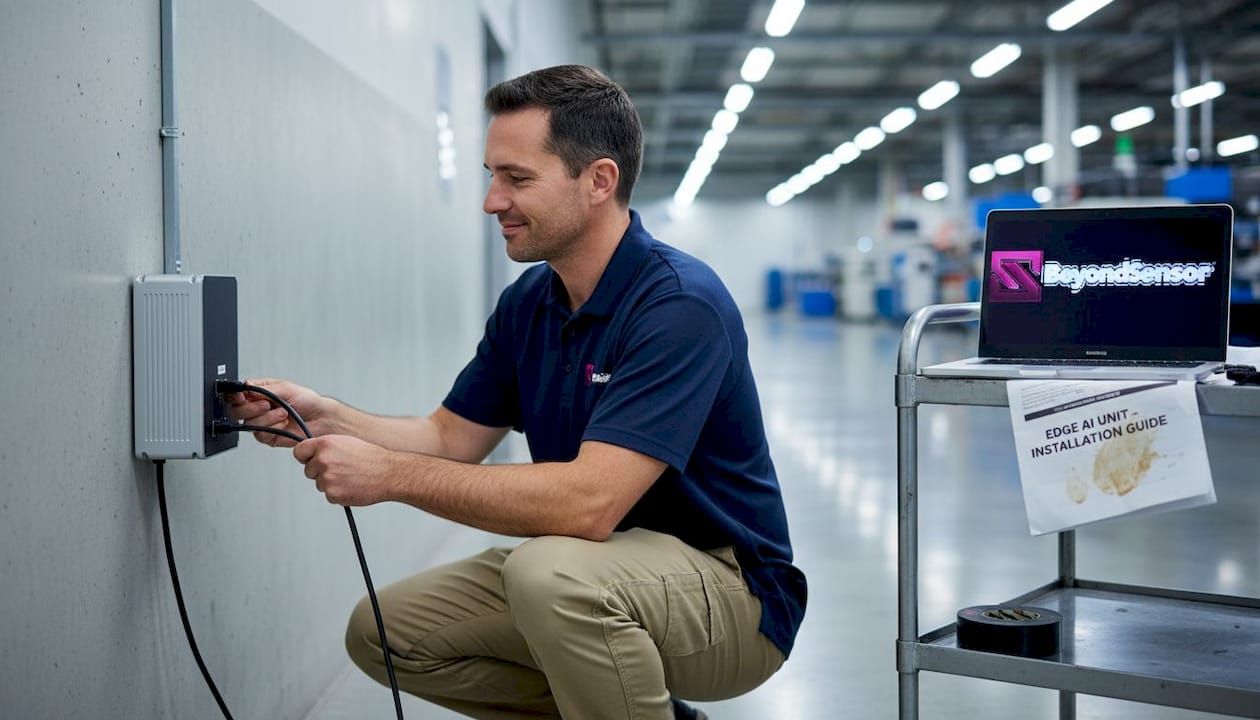
IoT connectivity ensures that every response is coordinated. A gas sensor detecting a threshold breach can simultaneously alert the control room, adjust ventilation, and lock access doors, all without human intervention.
Here is a direct comparison of advanced versus traditional sensor approaches:
| Capability | Traditional sensors | Advanced sensing systems |
|---|---|---|
| Data output | Single variable | Multi-modal, fused |
| Processing location | Centralized control room | Edge and cloud hybrid |
| Response latency | Seconds to minutes | Milliseconds |
| False positive rate | High in complex environments | Significantly reduced |
| Predictive capability | None | AI-driven trend analysis |
| Maintenance model | Reactive | Predictive |
To deploy advanced sensing effectively, follow this sequence:
- Audit your environment for signal types, interference sources, and coverage gaps.
- Select fusion architecture based on latency requirements and sensor redundancy needs.
- Deploy edge AI nodes at critical decision points to minimize response time.
- Integrate IoT layers to enable cross-asset coordination and centralized visibility.
- Validate with live data to tune thresholds and confirm detection accuracy before full rollout.
Pro Tip: Prioritize sensor fusion strategies that support decision-level fusion in high-stakes zones. If one sensor is compromised or obscured, the system still reaches the correct conclusion.
For compliance and configuration guidance, sensor security best practices outlines the key steps for secure and reliable deployments.
Security and safety applications of advanced sensing
With the mechanics understood, the real-world applications make the value concrete. Advanced sensing is already operating across some of the most demanding security and safety environments in industrial automation and government infrastructure.
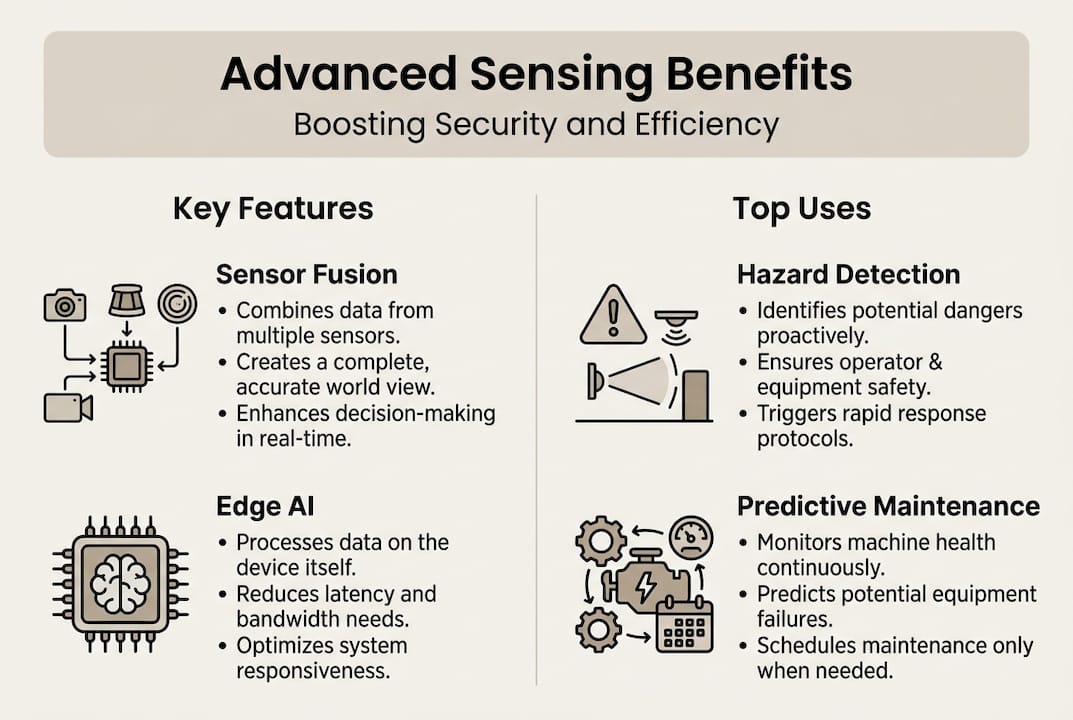
Hazard detection is one of the most critical use cases. Sensor fusion supports hazard detection for gas leaks, fire, and chemical exposure, combining environmental sensors with thermal imaging to confirm threats before triggering costly evacuations. Fusion reduces false positives that would otherwise desensitize operators to real alerts.
Collaborative robot (cobot) safety under ISO/TS 15066 requires real-time perimeter and zone monitoring. Safety laser scanners such as the S3000 achieve 4-meter range and 60ms response time, meeting the speed requirements for human-robot interaction zones. These scanners integrate with advanced sensing platforms to dynamically adjust safety zones based on operational context.
Predictive maintenance accuracy has reached measurable benchmarks. CNN-LSTM hybrid models now deliver 96.1% predictive accuracy in industrial maintenance applications, enabling facilities to schedule interventions before failures occur rather than after.
Structural health monitoring (SHM) and access control in critical infrastructure round out the application profile. Vibration sensors, strain gauges, and acoustic emission detectors fused with access event data create a layered picture of both physical integrity and security posture.
Key performance indicators across these applications:
| Application | Key metric | Advanced sensing advantage |
|---|---|---|
| Hazard detection | False positive rate | Reduced via multi-modal fusion |
| Cobot safety zones | Response time | 60ms with safety laser scanners |
| Predictive maintenance | Detection accuracy | 96.1% with CNN-LSTM models |
| Access control | Event correlation | Cross-sensor verification |
For teams building out infrastructure safety with sensors, these benchmarks provide a practical baseline for procurement and performance validation. Organizations that invest in tailored security solutions consistently outperform those relying on generic, off-the-shelf sensor configurations. You can also explore how security agencies are already deploying these capabilities in the field.
Expert challenges and considerations in advanced sensing
Deployment realities are rarely as clean as lab benchmarks suggest. Decision-makers need to understand the friction points before committing to architecture choices.
"The gap between controlled test environments and live industrial deployments is where most advanced sensing projects encounter unexpected costs and delays."
Harsh environments, EMI, and calibration drift are the most commonly cited technical barriers. Sensors in manufacturing floors face electromagnetic interference from motors and welding equipment. Outdoor government installations deal with thermal cycling, dust ingress, and humidity. Rugged sensor design with IP67 or higher ratings and EMI shielding is not optional in these contexts.
Cybersecurity and IEC/ISO compliance are equally non-negotiable. Every IoT-connected sensor expands the attack surface. Unpatched firmware, default credentials, and unencrypted data channels are real vulnerabilities in operational technology networks.
Key challenges and mitigation strategies:
- Calibration drift: Schedule automated diagnostics and cross-sensor validation to catch drift before it affects accuracy.
- Cross-sensitivity: Select sensors with built-in compensation algorithms or use fusion to filter spurious readings.
- Data scarcity for rare events: Synthetic datasets, such as those generated by platforms like RoboFusion, supplement real-world training data for low-frequency hazards.
- Integration complexity: Standardize on open protocols (OPC-UA, MQTT) to reduce vendor lock-in and simplify system updates.
- Regulatory compliance: Map deployments to sensor system compliance frameworks from the outset, not as an afterthought.
Pro Tip: Build a synthetic data pipeline early. Rare hazardous events may never appear in your training dataset at sufficient volume. Hybrid real-synthetic datasets consistently outperform real-only datasets for edge-case detection.
For ongoing guidance on securing networked sensor infrastructure, sensor cybersecurity tips covers the operational security measures that matter most in live deployments.
Traditional sensors vs. smart sensing: The new trade-offs
For decision-makers steering large capital investments, the choice between analog and smart sensor architectures is not purely technical. It is a strategic trade-off with budget, maintenance, and operational implications.
Analog sensors remain simpler, reliable, and cost-effective for stable, single-variable control loops. A pressure transmitter in a well-characterized process loop does not need AI. It needs accuracy and uptime. Analog devices deliver both at low cost.
Smart sensors justify their higher upfront cost in environments where:
- Multiple variables interact and single-point detection is insufficient.
- Maintenance costs from unplanned failures exceed the cost of predictive analytics.
- Regulatory requirements demand audit trails and multi-variable documentation.
- Security threats are adaptive and require context-aware detection.
The processing architecture also matters. Centralized signal processing concentrates intelligence but creates single points of failure and latency. Decentralized edge processing distributes intelligence, improving resilience and response speed at the cost of more complex configuration and firmware management.
| Factor | Analog sensors | Smart sensors |
|---|---|---|
| Upfront cost | Low | Higher |
| Diagnostics | Minimal | Advanced, self-reporting |
| Data output | Single variable | Multi-variable, contextual |
| Maintenance model | Reactive | Predictive |
| Integration flexibility | Limited | High (open protocols) |
| Best use case | Stable, simple loops | Complex, dynamic environments |
For a detailed breakdown of where each approach fits, the analog vs. smart sensors analysis covers the decision criteria that matter most for industrial and government procurement teams.
Going beyond detection: Why smart fusion and edge AI are non-negotiable
Legacy systems were built for a different threat landscape. Simple digital sensors report what happened. Advanced sensing systems interpret what is happening and anticipate what will happen next. That distinction is not incremental. It is architectural.
The most sophisticated threats in industrial and government environments are specifically designed to evade single-point detection. Spoofed access credentials, gradual environmental changes that stay below individual sensor thresholds, and coordinated physical intrusions all exploit the gaps that legacy systems leave open. Sensor fusion and edge AI close those gaps by requiring adversaries to defeat multiple, correlated data streams simultaneously.
Government initiatives on autonomous sensor management explicitly highlight anti-deception and hybrid dataset strategies as priorities for next-generation security deployments. This is not theoretical. It reflects operational lessons from environments where passive detection has already proven insufficient.
The organizations that will lead in secure, efficient operations are those that treat sensing as an active, adaptive layer of their security posture, not a passive alarm system. Edge AI never blinks. Fusion never misses a correlated signal. That is the operational standard that modern threats demand. Explore what is possible at the frontier of sensor innovation advances and see how the next generation of sensing architecture is being built today.
Explore advanced sensing solutions for your security needs
If you are planning or upgrading a sensor-driven security program, the architecture decisions you make now will define your operational resilience for the next decade. The mechanics, benchmarks, and trade-offs covered in this article are exactly the foundation you need to evaluate vendors, justify budgets, and design systems that perform under real-world conditions.

BeyondSensor brings edge AI, sensor fusion, and security-focused sensing to demanding industrial and government environments across Southeast Asia. Whether you are a system integrator, a government agency, or an industrial operator, solutions for security agencies and enterprise clients are built to meet the standards and challenges outlined here. Visit BeyondSensor to connect with specialists who understand your environment and your requirements.
Frequently asked questions
How does advanced sensing improve security over traditional sensors?
Advanced sensing uses AI, data fusion, and real-time analytics to minimize false alarms, increase detection accuracy, and enable predictive action in complex environments. Sensor fusion and AI drastically cut false positives and raise reliability in live security operations.
What are some real-world examples of advanced sensing in action?
Applications include hazard detection, predictive maintenance, robotic safety zones, and access control systems in factories and critical infrastructure. Industrial automation uses advanced sensors for hazard monitoring, structural health monitoring, and access control with enhanced safety outcomes.
What challenges should organizations expect when deploying advanced sensor networks?
Common challenges are harsh environmental conditions, ensuring data security, system integration, and maintaining calibration over time. Experts cite environmental stress, cybersecurity, and interoperability as the top deployment barriers.
How can organizations address the scarcity of hazardous event data for sensor training?
Synthetic datasets are used to supplement rare event data when training advanced detection algorithms. Hybrid real-synthetic datasets fill training gaps for rare hazards and improve model performance at the edge.
What standards are important for advanced sensing in security?
Key standards include IEC and ISO guidelines, which ensure safety, reliability, and interoperability of advanced sensor systems. Compliance with IEC and ISO is essential for operability and safety in professional sensor deployments.
Recommended
- Sensing tools guide: Types, accuracy, and security uses | News | BeyondSensor
- Top sensor security tips for safety & compliance 2026 | News | BeyondSensor
- Why tailored security solutions outperform generic systems | News | BeyondSensor
- How sensor technology drives smarter industrial automation | News | BeyondSensor
Read More Articles
Geofencing Alerts for Site Security: Setup Guide for Singapore
How to design geofencing alerts that flag real security events, cut alert fatigue and stay within PDPA and IPA rules at Singapore sites.

CCTV Operator Training in Singapore: Skills, Courses and Costs
What CCTV operator training involves in Singapore: the PRSF course, fees and subsidies, the 31 December 2026 deadline, and skills for AI-assisted control rooms.
Role-Based Access Control: A Practical Guide for Singapore Security Teams
How role-based access control works, where it breaks (role explosion, stale roles), and how to apply it to both cyber and physical security in Singapore.

Security Site Survey: Facility Teams’ Checklist for Funded Fixes
Assess site risks, turn findings into budgeted action, and use field checklists, reporting templates, and PDPA notes for camera and biometric deployments.
Let's Build YourSecurity Ecosystem.
Whether you're a System Integrator, Solution Provider, or an End-User looking for trusted advisory, our team is ready to help you navigate the BeyondSensor landscape.
Direct Advisory
Connect with our regional experts for tailored solutioning.