
Discover what threat detection AI is and how it transforms security. Learn to implement it effectively and close the gap between expectations and reality.

Threat detection AI: Boost security with advanced intelligence

TL;DR:
- AI-driven threat detection redefines how security systems identify, classify, and respond to threats at machine speed. It outperforms traditional rule-based methods in accuracy, speed, and adaptability, but requires careful implementation, ongoing training, and explainability to be effective. Successful deployment depends on organizational discipline, layered defense strategies, and collaboration between AI and human analysts.
Security managers who expect AI-driven threat detection to work like a smarter alarm system are already behind the curve. This technology doesn't simply automate existing rules; it rewrites how threats are identified, classified, and acted upon at machine speed. Yet the gap between vendor promises and real-world performance remains wide enough to mislead even experienced security leaders. This guide cuts through the noise, defining what threat detection AI actually does, how it performs under rigorous benchmarks, where it falls short, and how your organization can implement it with eyes open and expectations grounded in evidence.
Table of Contents
- What is threat detection AI?
- How threat detection AI works: Under the hood
- AI-powered vs. traditional threat detection: Key differences
- When AI falls short: Challenges and limitations
- Getting started: Applying threat detection AI in your organization
- The real-world truth: Why AI is essential if adopted wisely
- Explore advanced AI threat detection solutions with BeyondSensor
- Frequently asked questions
Key Takeaways
| Point | Details |
|---|---|
| What threat detection AI is | It uses advanced machine learning to spot threats that static rules can miss, making detection faster and more accurate. |
| AI strengths vs. legacy tools | AI is proactive, adaptive, and delivers higher precision compared to traditional security systems. |
| Challenges of AI adoption | False positives, adversarial risks, and model drift require ongoing monitoring and adjustment. |
| Responsible deployment steps | Success comes from auditing systems, picking high-impact use cases, and continuous improvement. |
| Best outcomes mix human expertise | Combining AI with skilled teams delivers the most resilient security posture. |
What is threat detection AI?
Threat detection AI refers to security systems built on machine learning (ML) and deep neural networks that analyze large, continuous streams of security data to identify threats in real time. Unlike older tools that match events against a fixed list of known threat signatures, AI-based systems learn from data patterns, adapt over time, and can flag anomalies that no human analyst or rule set anticipated.
The core capabilities that set these systems apart include:
- Real-time pattern recognition: AI scans video feeds, sensor logs, network traffic, and access events simultaneously, linking signals across sources.
- Anomaly detection: Rather than asking "does this match a known threat?", AI asks "does this deviate meaningfully from normal behavior?"
- Context awareness: Modern systems weight detections based on time of day, user role, location, and historical behavior, reducing noise.
- Self-improving models: Supervised and semi-supervised learning pipelines allow models to improve as they process new data.
- Multimodal analysis: AI can process video, audio, motion data, and logs together, building richer situational awareness than any single sensor could provide.
The evidence for AI's performance advantage is compelling. AI system benchmarks show accuracy of 0.95, precision of 0.93, recall of 0.92, and an F1 score of 0.92, consistently outperforming traditional rule-based methods on the same datasets. These aren't theoretical numbers. They reflect rigorous testing against real-world security scenarios.
Organizations exploring using AI in security systems often find that the performance gap is widest in high-volume, complex environments where human analysts are overloaded and legacy tools generate a flood of irrelevant alerts.
Pro Tip: Before selecting any AI threat detection platform, define precisely what you need to detect, under what conditions, and what your tolerance is for false positives. AI is only as good as the goals and training data behind it.
How threat detection AI works: Under the hood
Understanding the mechanics helps security managers evaluate vendor claims and set realistic deployment expectations. At its core, AI-based threat detection follows a logical pipeline that transforms raw sensor data into actionable intelligence.
- Data ingestion: The system continuously collects data from cameras, access control logs, network endpoints, environmental sensors, and other sources. Volume and diversity of inputs directly affect detection quality.
- Preprocessing and normalization: Raw data is cleaned, timestamped, and formatted so different data types can be analyzed together without distortion.
- Pattern recognition: Deep learning models, including convolutional neural networks (CNNs) for image and video analysis, recurrent neural networks (RNNs) for sequential data like logs, and Transformer architectures for contextual understanding, identify patterns within the normalized data.
- Context analysis: The system evaluates each detected pattern against contextual variables such as time, location, frequency, and associated entities to determine whether an alert is warranted.
- Adaptive learning: As new verified threat and non-threat examples are labeled and fed back into the model, detection accuracy improves over time without requiring a full system rebuild.
The performance numbers for leading multimodal architectures are striking. Multimodal CNN-RNN-Transformer models achieve an AUC of 0.96, F1 of 0.94, and a latency of just 23 milliseconds on edge hardware. That latency figure matters enormously for physical security. At 23ms, the system can flag an event and trigger a response before a human analyst has even noticed the alert.
You can assess AI model speed and edge performance for specific hardware configurations, which helps narrow down viable deployment options before committing to infrastructure investment.
| Metric | Traditional Rule-Based | AI Multimodal Model |
|---|---|---|
| Accuracy | ~0.75 | 0.95 |
| Precision | ~0.70 | 0.93 |
| Recall | ~0.68 | 0.92 |
| F1 Score | ~0.69 | 0.92 |
| AUC | ~0.72 | 0.96 |
| Latency | Variable | 23ms (edge) |
These figures illustrate why organizations moving from legacy detection to AI-driven platforms frequently report fewer missed threats and more actionable alerts per hour of analyst time.
AI-powered vs. traditional threat detection: Key differences
Traditional threat detection relies on pre-programmed rules or known attack signatures. If a behavior matches a defined rule, an alert fires. If it doesn't match, nothing happens. This works well for documented, predictable threats but fails the moment an attacker changes tactics even slightly.

AI-powered detection is fundamentally proactive. It learns what normal looks like and flags deviations, including attack methods the system has never seen before. This distinction is practical, not just theoretical. A signature-based system will never detect a novel intrusion technique until that technique is formally documented, shared, and programmed into a rule update. AI doesn't wait for that cycle.
That said, adversarial robustness and explainability remain real challenges for AI systems. Attackers aware of AI detection can craft inputs designed to confuse models. This is why explainable AI (XAI) and layered defenses remain essential complements to any AI deployment.
| Capability | Traditional detection | AI-powered detection |
|---|---|---|
| Detection speed | Rule-dependent | Real-time, sub-second |
| Novel threat handling | Limited (signature-based) | Strong (pattern-based) |
| Adaptability | Manual updates required | Self-improving with new data |
| Explainability | High (rule is visible) | Requires XAI tooling |
| False positive rate | Moderate to high | Lower with tuning |
| Deployment complexity | Low | Moderate to high |
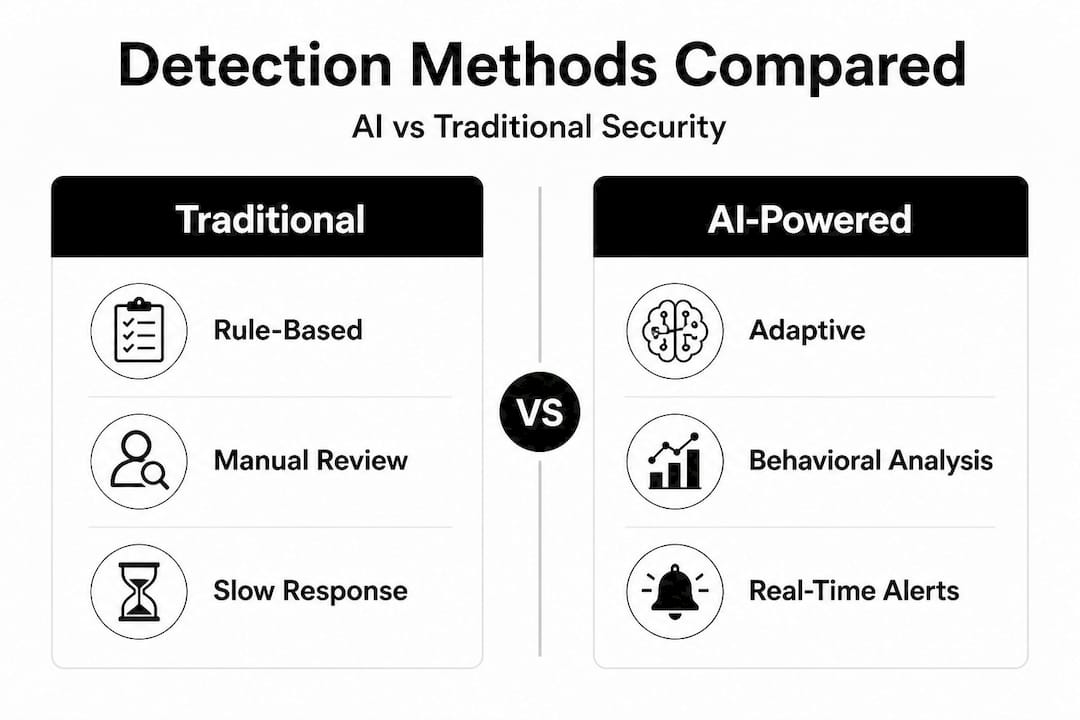
Security managers evaluating emerging security technologies should pay close attention to the explainability row in that table. AI's value drops significantly if your team can't understand why an alert fired. Regulatory environments increasingly demand audit trails that AI alone cannot always produce without XAI support.
For those managing diverse physical and digital security environments, reviewing advanced sensing tech for security managers provides useful context on integrating AI detection with sensor infrastructure.
A hybrid approach often yields the best results in practice:
- Use AI for anomaly detection, novel threat identification, and high-volume pattern analysis.
- Retain traditional controls for known attack signatures and compliance-driven monitoring.
- Implement XAI layers to ensure every alert can be explained, reviewed, and acted on with confidence.
Pro Tip: Treating AI as a replacement for legacy controls creates gaps. Deploy it as an additional intelligence layer on top of your existing framework, not instead of it.
When AI falls short: Challenges and limitations
Security managers who have deployed AI-based detection at scale will confirm that the technology is not frictionless. Understanding its failure modes before deployment is how you protect both your organization and your credibility as a security leader.
False positives, model drift, and adversarial vulnerabilities represent the most common operational challenges. High false positive rates stem from subtle data deviations that the model incorrectly flags as threats. In a busy facility with hundreds of sensors, even a 5% false positive rate can generate hundreds of meaningless alerts per day, overwhelming your SOC team and causing alert fatigue.
Model drift is a quieter but more dangerous problem. Over time, as environments change, attacker tactics evolve, or simply as hardware ages and sensor data quality shifts, the patterns an AI was trained on no longer accurately reflect current reality. A model that performed well at deployment may degrade silently unless your team actively monitors its accuracy and schedules retraining cycles.
Understanding adversarial attacks is increasingly critical as threat actors become aware that AI tools are being used against them. Adversarial attacks involve deliberate manipulation of input data, subtle changes to images, spoofed sensor readings, or poisoned training data, designed specifically to fool AI detection models. Certified defenses against these attacks exist but can reduce model accuracy by 10 to 30%, creating a real trade-off between robustness and performance.
"No detection system alone prevents real-world attacks. AI threat detection must be one layer within a multilayered defense strategy. Detection without response protocols, escalation procedures, and physical controls leaves critical gaps regardless of how sophisticated the model is."
To mitigate these challenges in deployment, security teams should prioritize:
- Continuous monitoring of detection metrics: Track false positive and false negative rates weekly. Set thresholds that trigger a model review or retraining cycle automatically.
- Scheduled retraining pipelines: Define retraining intervals based on how fast your environment changes. High-traffic or high-change environments may need monthly cycles.
- Input validation and anomaly filtering: Implement preprocessing checks that flag suspicious sensor data before it enters the AI pipeline, reducing the surface area for adversarial manipulation.
Exploring robust security practices for AI systems gives security teams structured approaches for managing operational fatigue and keeping detection performance high over the long term.
Getting started: Applying threat detection AI in your organization
Moving from a theoretical understanding of AI threat detection to an operational deployment requires structured planning. The organizations that get this right are those that treat AI adoption as a program, not a product purchase.
Empirical benchmarks confirm that multimodal AI systems are now fast and accurate enough for practical deployment across a wide range of real-world environments. The barrier is rarely technical capability. It's organizational readiness and implementation discipline.
Follow these steps to build a solid foundation:
- Audit your existing security infrastructure: Catalog your current sensors, cameras, access control systems, and data logging tools. AI detection is only as strong as the data it receives. Gaps in sensor coverage or poor data quality will limit performance from day one.
- Identify priority use cases: Not every security function needs AI immediately. Start with the highest-value, highest-volume detection challenges where your current tools are demonstrably failing, such as after-hours perimeter intrusion or insider threat detection in sensitive areas.
- Assess data availability and quality: AI models need substantial volumes of labeled, representative data to train effectively. Evaluate whether your existing logs and sensor archives are sufficient or whether you need a data collection phase before training begins.
- Select and test AI solutions rigorously: Run vendor solutions in parallel with your existing tools during a defined pilot period. Measure detection rates, false positive rates, and response times against your current baseline before committing to full deployment.
- Plan for continuous improvement: AI deployment is not a one-time project. Build retraining schedules, performance review cycles, and escalation procedures into your operational model from the start.
Pro Tip: Prioritize vendors who offer explainable AI (XAI) options and retraining services as part of their support model. A system you can't explain or update is a liability, not an asset.
For security leaders building the internal case for AI investment, the guide on AI analytics for security leaders provides the framing and performance data needed to support budget and stakeholder conversations.
The real-world truth: Why AI is essential if adopted wisely
Here is the uncomfortable observation we've reached after working with security deployments across diverse environments: simply having AI doesn't make an organization more secure. The technology is a tool. Like any precision instrument, it performs exactly as well as the operator, the calibration, and the process behind it.
The organizations that fail with AI threat detection almost always share the same pattern. They purchased a platform, ran a short pilot, declared success, and then reduced human oversight because they assumed the AI would handle everything. Within months, alert fatigue set in, model drift degraded performance quietly, and the team lost confidence in the system entirely.
The organizations that succeed treat AI as an evolving toolkit that requires investment, tuning, and collaboration between machines and experienced analysts. AI never blinks. It processes data continuously and flags patterns no human could track across hundreds of simultaneous feeds. But it also doesn't understand your organization's specific risk context, operational rhythms, or threat priorities without being guided.
Overreliance on black-box AI creates dangerous blind spots. When your team doesn't understand why a particular alert fired or why a specific threat was missed, you lose the ability to improve your posture. XAI is not a luxury feature. It is a foundational requirement for any deployment that needs to be trusted, audited, and defended to leadership or regulators.
The biggest breakthroughs we see consistently come from organizations where senior security analysts work directly alongside AI output, verifying high-confidence detections, investigating edge cases, and feeding insights back into the training pipeline. That collaboration produces detection accuracy that neither humans nor AI could achieve independently.
The final point most vendors won't tell you clearly: tailored security solutions consistently outperform generic off-the-shelf deployments. Every organization's threat landscape, sensor environment, and operational context is different. A model trained on generic data performing reasonably well in a demo will underperform against your specific threats without customization.
Explore advanced AI threat detection solutions with BeyondSensor
Threat detection AI delivers measurable results when it's configured, validated, and supported correctly. BeyondSensor specializes in exactly that kind of precision deployment.

BeyondSensor designs and delivers high-performance AI threat detection systems tailored to mission-critical security environments across Singapore, Malaysia, the Philippines, and the wider Southeast Asian region. Whether you're a government agency, a large enterprise, or a regional integrator building out client solutions, the team provides localized expertise, validated hardware-software integration, and ongoing model support to ensure your deployment performs over time. Explore purpose-built AI solutions for security agencies or learn how BeyondSensor supports for system integrators who need scalable, compliant AI detection frameworks for diverse client environments.
Frequently asked questions
How accurate is AI-based threat detection compared to traditional methods?
AI systems achieve up to 0.95 accuracy with precision of 0.93 and recall of 0.92, significantly outperforming traditional rule-based tools that typically score in the 0.68 to 0.75 range on comparable benchmarks.
What are the main risks of using AI for threat detection?
Common risks include high false positive rates from subtle data deviations, model drift that degrades accuracy over time, and vulnerability to adversarial attacks that deliberately manipulate input data to evade detection.
Can AI detect completely new, unknown threats?
AI systems are effective at identifying novel attack patterns through anomaly detection and behavioral analysis, but truly unprecedented threat types still benefit from human analyst oversight to confirm and contextualize findings accurately.
Why does threat detection AI need to be retrained?
Model drift occurs as attacker tactics evolve and environmental conditions change, progressively degrading a model's accuracy unless it is retrained regularly with updated, representative data from current operations.
What is explainable AI (XAI) and why does it matter?
XAI makes the reasoning behind AI decisions transparent and auditable, which is critical for security teams that need to trust AI findings enough to act on them and justify those actions to leadership, compliance teams, or regulators.
Recommended
- Harnessing AI for Security Systems: Boost Protection and Efficiency | News | BeyondSensor
- AI analytics for sensor tech security leaders | News | BeyondSensor
- Understanding advanced sensing: boost security and efficiency | News | BeyondSensor
- Top intelligent sensing technologies to boost facility security | News | BeyondSensor
Read More Articles

RTSP Security Risks: Integrators Must Block Exposed Ports 554 and 8554
See how integrators can reduce RTSP security risks: close exposed ports 554 and 8554, secure camera access, and verify each deployment with practical checks.

Require MAEpp and X Accuracy Before You Buy People Counting Systems
Verify people counting accuracy by demanding MAEpp, X Accuracy, and directional-bias reports. Validate on-site with at least 100 events per direction...
30–90 Day Pilot Validates Redundant Camera Networks for Engineers
Standards led, practical steps for engineers to deploy redundant camera networks: MRP, dual homing, and aggregation patterns, commissioning checks, and...
30 Day Pilot Proves Video Analytics Accuracy for Security Teams
Validate video analytics accuracy with scenario tests, camera tuning, transfer learning and a 30 day edge first pilot for security teams.
Let's Build YourSecurity Ecosystem.
Whether you're a System Integrator, Solution Provider, or an End-User looking for trusted advisory, our team is ready to help you navigate the BeyondSensor landscape.
Direct Advisory
Connect with our regional experts for tailored solutioning.