
Discover how to choose sensing technology for security to protect your assets. Elevate your strategy with our expert guide!

How to choose the right sensing technology for security

TL;DR:
- Selecting the right sensors based on facility risk zones and environmental conditions is crucial.
- Matching sensor types to target materials and environmental challenges ensures reliability and reduces false alarms.
- Effective validation through field testing and integration with verification technology enhances overall security performance.
A wrong sensor choice does not just create inconvenience. It creates gaps in your security posture that cost real money, erode staff trust, and leave critical assets exposed. Across Southeast Asia, security managers and facility owners are deploying sensing technologies at an accelerating pace, yet many still struggle with mismatched solutions: motion detectors that trigger on passing vehicles, perimeter sensors that fail in tropical humidity, and cloud-dependent systems that lag when network reliability is inconsistent. This guide gives you a structured, evidence-based system for selecting, matching, and validating the right sensing technology for each zone and application in your facility.
Table of Contents
- Define your security objectives and risk areas
- Match sensing technologies to target materials and environments
- Compare sensor performance and reliability metrics
- Minimize false alarms and optimize verification
- Steps to implement and validate your sensing solution
- A practitioner's perspective: What most sensor guides miss about real-world security
- Explore advanced sensing solutions for your facility
- Frequently asked questions
Key Takeaways
| Point | Details |
|---|---|
| Clarify objectives | Defining specific security goals and risk zones is the foundation for choosing the right sensors. |
| Match sensor to materials | Select sensors based on the exact materials and environmental conditions they will monitor. |
| Prioritize verification | Integrate advanced technologies like AI and CCTV to reduce false alarms and improve response. |
| Evaluate real performance | Consider working range, accuracy, and local network limits—not just specs—when choosing sensors. |
| Test and improve | Field-testing and staff feedback are critical for optimizing sensing systems over time. |
Define your security objectives and risk areas
Now that you know what's at stake, start by clarifying exactly what you want your sensor solution to accomplish. Before you evaluate a single product datasheet, you need a clear map of your facility's risk landscape. Skipping this step is one of the most common and costly mistakes organizations make.
Start by categorizing your risk zones and operational needs:
Risk zone categories to assess:
- Perimeter and external boundaries: Entry gates, fences, loading docks, and outdoor parking areas where intrusion is the primary concern
- Controlled access points: Server rooms, data centers, chemical storage, and executive areas requiring strict access monitoring
- Operational process zones: Manufacturing floors, warehouses, and logistics areas where equipment monitoring and people tracking drive efficiency
- Low-risk general areas: Open offices, common corridors, and public lobbies where basic motion detection is typically sufficient
Understanding the importance of advanced sensors in each zone helps you allocate budget intelligently rather than uniformly. Not every square meter of your facility carries the same risk weight.
Once zones are mapped, define your operational goals clearly. Are you detecting intrusion? Monitoring process equipment for anomalies? Tracking people flow for safety compliance? Protecting high-value assets? Each goal points toward a different class of sensing technology.
The investment logic follows naturally from this mapping. Intelligent sensing options like fiber optic or laser-based perimeter detection are justified for critical boundaries despite their higher cost. For indoor low-risk areas, passive infrared (PIR) or basic motion sensors are cost-effective, though they carry known limitations such as missing stationary or slow-moving targets. As noted in sensor selection guidance, high-reliability technology for critical perimeters versus cheaper PIR for indoor low-risk areas is a standard and proven trade-off framework. Applying it deliberately protects your budget while preserving security integrity where it matters most.
Match sensing technologies to target materials and environments
Once you know your goals, it's time to match sensor types to your materials and environment. This is where many facilities go wrong. They select sensors based on brand familiarity or price alone, without asking a fundamental question: what exactly does this sensor need to detect, and under what physical conditions?
The table below provides a practical comparison of the major sensor types used in security and operational monitoring:
| Sensor type | Best for detecting | Working range | Strengths | Limitations |
|---|---|---|---|---|
| Inductive | Ferrous metals | 1 mm to 60 mm | High precision, durable | Metals only, short range |
| Capacitive | Non-metals, liquids, plastics | 1 mm to 25 mm | Versatile materials | Sensitive to moisture/dust |
| Ultrasonic | Objects, barriers, people | 20 cm to 10 m | Works in low light, fog | Affected by temperature, sound |
| Photoelectric | Objects, barriers, transparent items | Up to 60 m | Long range, fast response | Dust, direct sunlight interference |
| AI cameras | People, vehicles, behavior | 1 m to 100+ m | Contextual intelligence, verification | Requires network, higher cost |
Matching the right technology to your target material is not optional. According to sensor selection principles, inductive sensors work for ferrous metals, capacitive sensors handle non-metals and liquids, and ultrasonic or photoelectric sensors suit varied materials or physical barriers. Applying the wrong sensor type to the wrong material produces unreliable detection regardless of how well the device is installed.
Environmental factors deserve equal attention. Southeast Asia's climate introduces challenges that temperate-region sensor specs often underestimate. High ambient humidity, heavy monsoon rainfall, dust from construction or industrial activity, and temperature swings between air-conditioned interiors and outdoor zones all degrade sensor performance over time. Outdoor sensors must carry appropriate IP ratings, typically IP67 or higher for perimeter applications. Capacitive sensors, while versatile, are particularly prone to false triggers in high-moisture environments and need careful calibration.
For indoor zones, consider vibration from nearby machinery, which can affect ultrasonic sensors, and direct sunlight angles that can blind photoelectric sensors at certain times of day. Explore the full range of sensor types and uses to understand which technologies are validated for your specific environmental profile.
Pro Tip: Before committing to a sensor model for any critical zone, run a two-week field trial under your actual site conditions. Test during the worst-case scenario: peak humidity, maximum traffic, and any recurring environmental interference. A sensor that performs well in a controlled demo may behave very differently in a tropical industrial environment.
Compare sensor performance and reliability metrics
After matching the right kind of sensor, the next step is understanding how well your options will work under real conditions. Vendor datasheets present ideal performance numbers. Your job is to pressure-test those numbers against your actual operational environment.

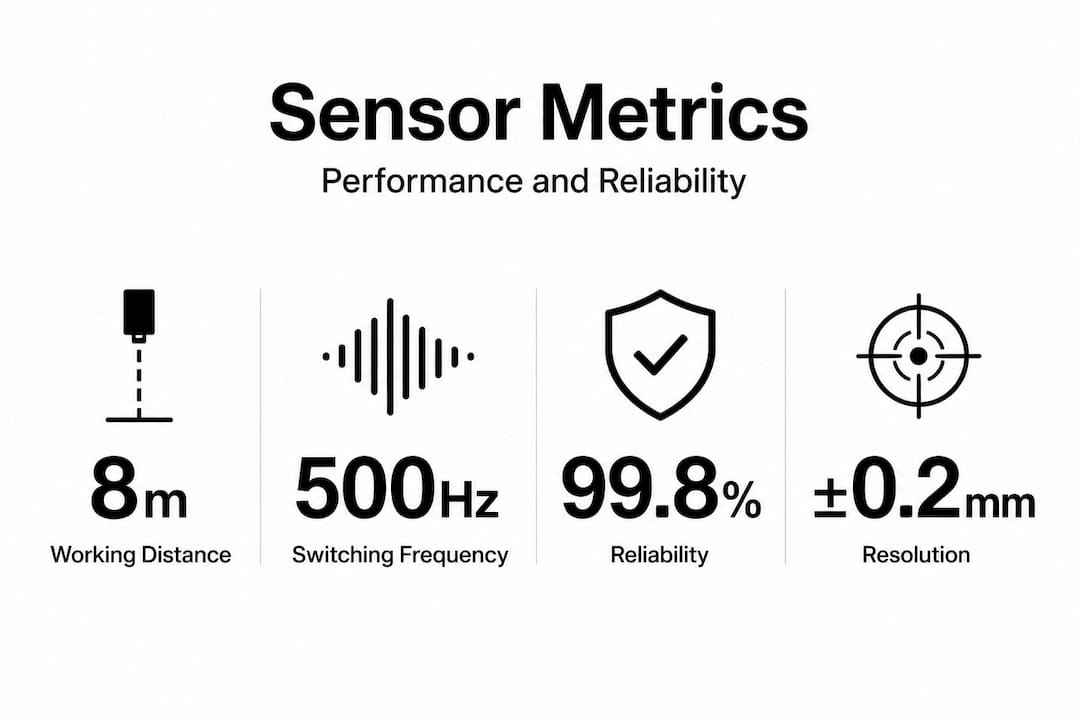
The core performance metrics to evaluate include working distance, switching frequency, accuracy, repeatability, resolution, cost, and long-term reliability. Here is a summary of typical ranges across common sensor types:
| Metric | Inductive | Capacitive | Ultrasonic | Photoelectric | AI camera |
|---|---|---|---|---|---|
| Working distance | Short (1-60 mm) | Short (1-25 mm) | Medium (20 cm to 10 m) | Long (up to 60 m) | Very long (1-100+ m) |
| Response speed | Very fast | Fast | Moderate | Very fast | Moderate to slow |
| Accuracy | Very high | High | Moderate | High | High (context-dependent) |
| Maintenance needs | Low | Low to moderate | Moderate | Low to moderate | Moderate to high |
| Relative cost | Low | Low | Moderate | Moderate | High |
Use this numbered checklist when evaluating sensor specifications against your facility's actual requirements:
- Define minimum working distance based on your installation geometry, not the sensor's maximum rated range
- Confirm switching frequency is adequate for the speed of movement or process you need to detect
- Verify accuracy and repeatability under your environmental conditions, not just lab conditions
- Assess maintenance access for each sensor location, particularly for elevated or outdoor installations
- Calculate total cost of ownership, including installation, calibration, and replacement cycles over five years
- Check compatibility with your existing security management platform or SCADA system
- Validate certifications relevant to Southeast Asian regulatory requirements, including local safety and EMC standards
Understanding operational efficiency criteria means going beyond the spec sheet. A sensor with a slightly lower detection range but superior resistance to humidity and vibration will outperform a higher-spec unit that degrades within six months of outdoor installation. The sensing solution benefits that matter most are the ones that hold up across your full operational lifecycle, not just during the initial commissioning phase.
Minimize false alarms and optimize verification
Beyond simple specs, minimizing false alarms and ensuring timely, reliable alarm verification are essential for effective security. A sensor that triggers constantly for non-events is worse than no sensor at all. Security staff quickly learn to ignore alarms that are almost always false, creating a dangerous blind spot precisely where vigilance is most needed.
Strategies for reducing false alarms and improving verification:
- Integrate sensors with AI cameras to provide visual confirmation before escalating an alarm to human response teams
- Use sensor fusion by combining two or more sensor types (for example, PIR plus microwave) so that an alarm only triggers when both sensors agree
- Apply AI-based signal processing at the edge to filter environmental noise before it becomes an alarm event
- Set detection zones carefully to exclude known sources of interference such as vehicle lanes, HVAC vents, or tree lines
- Implement tiered alarm logic where low-confidence events trigger silent monitoring and high-confidence events trigger immediate response
The data on AI-enabled verification is compelling. AI cameras reduce false alarms by 27 to 53 percent compared to basic motion detectors, with specific improvements of 43 percent for pet-triggered events, 67 percent for vehicle-triggered events, and 30 percent for environmental triggers. These are meaningful reductions that directly translate to fewer wasted responses and greater staff confidence in the system.
However, AI verification introduces a critical tradeoff:
"Cloud-based AI processing adds an average of 4.8 seconds of latency to alarm verification. In Southeast Asia's variable network environments, this delay can be significantly longer during peak hours or in facilities with limited bandwidth. For time-critical security applications, local edge processing is strongly preferred over cloud-dependent verification pipelines."
Advanced signal processing and AI can cut false alarm rates by 30 to 60 percent, but the architecture matters enormously. Integrating sensors with CCTV for verification and choosing local versus cloud processing based on your network profile are decisions that must be made before procurement, not after installation.
Understanding advanced sensing for efficiency means treating false alarm reduction as a primary design criterion, not an afterthought. Consult your secure facilities guide to see how layered verification architectures are structured for high-stakes environments.
Pro Tip: Always check with your IT and OT teams about network reliability, bandwidth constraints, and failover protocols before committing to any cloud-based verification system. In facilities where network connectivity is intermittent, a locally processed edge AI solution will deliver far more consistent security outcomes.
Steps to implement and validate your sensing solution
With selection and verification strategies in place, it's crucial to follow a structured process for implementation and ongoing evaluation. Deployment without a validation framework is how organizations end up with sensing systems that look complete on paper but underperform in practice.
Follow this implementation checklist for a disciplined deployment:
- Select sensors based on zone risk mapping and material matching, applying the criteria from sections above to finalize your technology choices
- Conduct an onsite pilot installation in your highest-priority zone before full-scale rollout, using real operational conditions
- Simulate intrusion and operational events during commissioning to verify detection rates and response times under controlled conditions
- Review false alarm data from the first two to four weeks of operation and adjust detection thresholds, zone boundaries, and sensitivity settings accordingly
- Integrate sensors with your security management platform, ensuring alarm data flows correctly to monitoring stations and mobile response teams
- Train security and operations staff on alarm response protocols, system interfaces, and escalation procedures specific to the new sensing technology
- Establish a monitoring and maintenance schedule, including periodic calibration checks, firmware updates, and physical inspection of sensor housings
- Conduct quarterly performance reviews using detection rate data, false alarm logs, and staff feedback to drive iterative improvement
Applying sensor evaluation metrics such as working distance, switching frequency, reliability, and repeatability during your pilot phase gives you objective data to compare against vendor claims. Revisiting material-matching principles during the review cycle ensures that any environmental changes, such as new equipment, modified layouts, or seasonal weather shifts, are addressed before they degrade system performance.
For compliance-related installations, review security compliance tips to ensure your deployment meets local regulatory requirements across Singapore, Malaysia, the Philippines, and other Southeast Asian markets. Always conduct live simulation tests when the facility is unoccupied or during low-activity periods to avoid disrupting operations and to ensure accurate baseline measurements.
A practitioner's perspective: What most sensor guides miss about real-world security
Most sensor selection guides are written from an engineering perspective, which means they focus heavily on specifications and largely ignore the human and environmental realities that determine whether a sensing system actually works in the field.
Here is what we consistently observe across Southeast Asia installations: the facilities that experience the most security failures are not the ones that chose the wrong sensor type on paper. They are the ones that chose the right sensor type but deployed it without accounting for network fragility, maintenance access, or staff behavior under high false alarm conditions.
When false alarms are frequent, security teams adapt. They begin treating alerts as noise rather than signals. This behavioral shift is invisible in any performance report, but it is one of the most dangerous outcomes of a poorly tuned sensing system. Investing in verification technology, whether AI cameras, sensor fusion, or edge processing, pays for itself not just in reduced response costs but in preserving the operational discipline of your security team.
Southeast Asia's climate is genuinely unforgiving for sensing hardware. Humidity, heat cycling, and monsoon conditions accelerate hardware degradation in ways that European or North American sensor ratings do not fully capture. Ruggedized housings, local processing capability, and simplified maintenance access are not premium features in this region. They are baseline requirements.
The sensor tool insights that matter most come from field experience, not datasheets. Prioritize solutions that balance reliability, maintainability, and staff training. A slightly less sophisticated sensor that your team understands and maintains well will outperform a cutting-edge system that nobody knows how to calibrate after the vendor leaves.
Explore advanced sensing solutions for your facility
For organizations ready to act, professional support can unlock the full potential of advanced sensing technologies. Selecting, integrating, and validating sensing systems across complex facilities is a process that benefits enormously from localized expertise, particularly in Southeast Asia's diverse regulatory and environmental landscape.

BeyondSensor works directly with security managers and facility owners across Singapore, Malaysia, and the Philippines to match the right sensing technologies to each facility's specific risk profile, operational environment, and compliance requirements. From perimeter protection to process monitoring, our tailored hardware-software solutions are designed for the realities of the region, not just the ideal conditions of a test lab. Whether you need hands-on deployment support, ecosystem integration, or guidance on AI security solutions for high-stakes environments, the BeyondSensor platform is built to support your next step with precision and confidence.
Frequently asked questions
What is the best sensor for high-security perimeters?
High-reliability technologies like fiber optic or laser sensors are preferred for critical perimeters despite their higher cost, due to their superior accuracy and resistance to environmental interference. These technologies are specifically suited to applications where a missed detection carries significant security consequences, as confirmed by established sensor selection guidance.
How can I reduce false alarms in my facility?
Integrating AI-enabled cameras with your existing sensors is one of the most effective strategies, with AI verification reducing false alarms by 27 to 53 percent compared to basic motion detection. Sensor fusion, careful zone configuration, and tiered alarm logic further reduce nuisance events.
What is the impact of cloud-based sensors on alarm response time?
Cloud-based AI verification adds an average latency of 4.8 seconds per alarm event, and in Southeast Asia's variable network environments this delay can be considerably longer. Local edge processing is strongly recommended for any application where response speed is a security priority.
Why do sensor specs sometimes not translate to real-world performance?
Environmental factors including high humidity, dust accumulation, temperature cycling, vibration from nearby equipment, and inconsistent network connectivity often affect actual sensor reliability far more than the performance figures advertised under controlled lab conditions.
How should I validate new sensing technologies on site?
Test sensors under real operational conditions by simulating intrusion and process events during low-activity periods, then monitor false alarm rates and detection accuracy over the first four weeks before adjusting system parameters and finalizing your full deployment.
Recommended
- Top intelligent sensing technologies to boost facility security | News | BeyondSensor
- Top advantages of sensing solutions for secure facilities | News | BeyondSensor
- Understanding advanced sensing: boost security and efficiency | News | BeyondSensor
- Sensing tools guide: Types, accuracy, and security uses | News | BeyondSensor
Read More Articles
RTSP Security Risks: Integrators Must Block Exposed Ports 554 and 8554
See how integrators can reduce RTSP security risks: close exposed ports 554 and 8554, secure camera access, and verify each deployment with practical checks.
Require MAEpp and X Accuracy Before You Buy People Counting Systems
Verify people counting accuracy by demanding MAEpp, X Accuracy, and directional-bias reports. Validate on-site with at least 100 events per direction...
30–90 Day Pilot Validates Redundant Camera Networks for Engineers
Standards led, practical steps for engineers to deploy redundant camera networks: MRP, dual homing, and aggregation patterns, commissioning checks, and...
30 Day Pilot Proves Video Analytics Accuracy for Security Teams
Validate video analytics accuracy with scenario tests, camera tuning, transfer learning and a 30 day edge first pilot for security teams.
Let's Build YourSecurity Ecosystem.
Whether you're a System Integrator, Solution Provider, or an End-User looking for trusted advisory, our team is ready to help you navigate the BeyondSensor landscape.
Direct Advisory
Connect with our regional experts for tailored solutioning.