
Explore advanced sensing technologies explained in this practical guide for security managers. Learn to enhance safety by choosing the right sensors.

Advanced sensing technologies: A practical guide for security managers

TL;DR:
- Advanced sensing technologies like LiDAR, radar, thermal imaging, and chemical sensors offer targeted, reliable detection in Southeast Asia's environment.
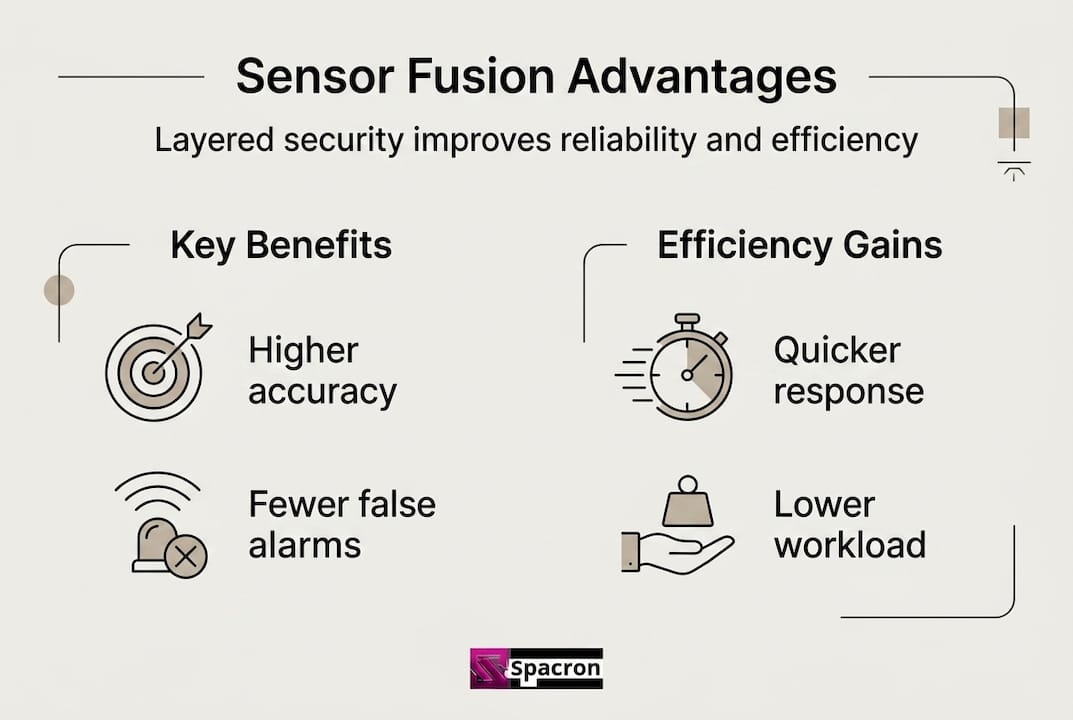
- Multi-sensor fusion reduces false alarms and enhances operational efficiency by combining complementary detection capabilities.
- Proper deployment, calibration, regional expertise, and system integration are key to effective, resilient security sensor systems.
Security managers across Southeast Asia operate in environments where the wrong sensor choice can create dangerous blind spots rather than eliminate them. Many facilities run on the assumption that upgrading to a newer camera or adding a motion detector constitutes a meaningful security improvement. That assumption is costly. Advanced sensing technologies, including LiDAR (Light Detection and Ranging), radar, thermal imaging, and chemical detection systems, each carry distinct strengths and specific vulnerabilities that directly affect operational reliability. This guide cuts through the confusion, compares sensor categories with evidence-based clarity, and delivers actionable steps for deploying sensing systems that actually perform in Southeast Asian conditions.
Table of Contents
- What are advanced sensing technologies and why do they matter?
- Key types of sensing technologies: Strengths and vulnerabilities
- False alarms and operational efficiency: Addressing real-world challenges
- Integrating sensing solutions: Practical steps for Southeast Asian facilities
- Why conventional sensor upgrades fall short: Our perspective
- Next steps: Explore tailored sensing solutions for your facility
- Frequently asked questions
Key Takeaways
| Point | Details |
|---|---|
| Sensor fusion enhances reliability | Combining sensor types significantly reduces vulnerabilities and improves detection accuracy. |
| Multi-sensor kits cut false alarms | Using integrated sensors that adapt to environmental changes minimizes disruptive false positives. |
| Local context matters | Southeast Asian climates and regulations demand customized sensor selection and ongoing maintenance. |
| Integration is key | Holistic system upgrades outperform simple device swaps for operational security and efficiency. |
What are advanced sensing technologies and why do they matter?
Building on the introduction, let's unpack what advanced sensing means and why it is transformative for facility security.
Advanced sensing technologies go far beyond traditional cameras and motion detectors. They represent a class of intelligent, high-precision instruments capable of detecting physical, chemical, and environmental changes in real time. For security managers, the relevant categories include LiDAR for spatial mapping, radar for motion tracking in low-visibility environments, thermal imaging for heat-signature detection, and chemical sensors for identifying hazardous substances or gases. Each of these serves a different detection purpose, and confusing them or treating them as interchangeable is a fundamental operational mistake.
Facilities across Southeast Asia face a layered threat landscape. Intrusion remains the most obvious concern, but environmental hazards, including gas leaks, chemical spills, and fire precursors, present equally severe risks. At the same time, false alarms generated by poorly calibrated sensors drain staff attention, erode response readiness, and ultimately undermine security culture. A team that responds to twenty false alarms a week will inevitably slow its response to the twenty-first, which may be real.
Multi-sensor configurations address this directly. Advanced sensing and security deployments that layer detection types produce more reliable situational awareness than single-sensor setups. For example, a facility managing chemical storage can combine electrochemical sensors with photoionization detectors within an Ion Mobility Spectrometry (IMS) framework, where multi-sensor data cross-validates readings before triggering an alert. This dramatically reduces false positives without sacrificing sensitivity to real threats.
Southeast Asia's operational context makes sensor selection particularly consequential:
- Tropical humidity (often above 80%) degrades sensor accuracy if calibration is not adaptive
- Dense urban environments in cities like Manila, Kuala Lumpur, and Singapore introduce acoustic and RF interference
- Regulatory diversity across ASEAN countries affects what detection systems are legally deployable
- Rapid infrastructure development means facilities must plan for sensor scalability from the outset
- Heat and precipitation cycles challenge thermal sensors and optical systems consistently year-round
Understanding these regional realities is the first step toward selecting sensing technologies that deliver results rather than generate operational problems.
Key types of sensing technologies: Strengths and vulnerabilities
Understanding the core types lays the foundation for evaluating their practical use.
Every sensing technology has a performance ceiling and an Achilles heel. Security managers who know both are better positioned to design layered systems that perform when conditions are least favorable. The following breakdown covers the most operationally relevant sensor categories.
LiDAR maps its environment by emitting laser pulses and measuring return times to create precise three-dimensional point clouds. It delivers exceptional spatial accuracy and works well for perimeter mapping, vehicle detection, and access control at entry points. The limitation is physical: LiDAR vulnerable to fog and rain scattering, which significantly degrades point cloud density and introduces detection gaps. For Southeast Asian facilities in coastal or elevated areas where fog and heavy rain are seasonal realities, relying solely on LiDAR for perimeter security is a calculated risk.
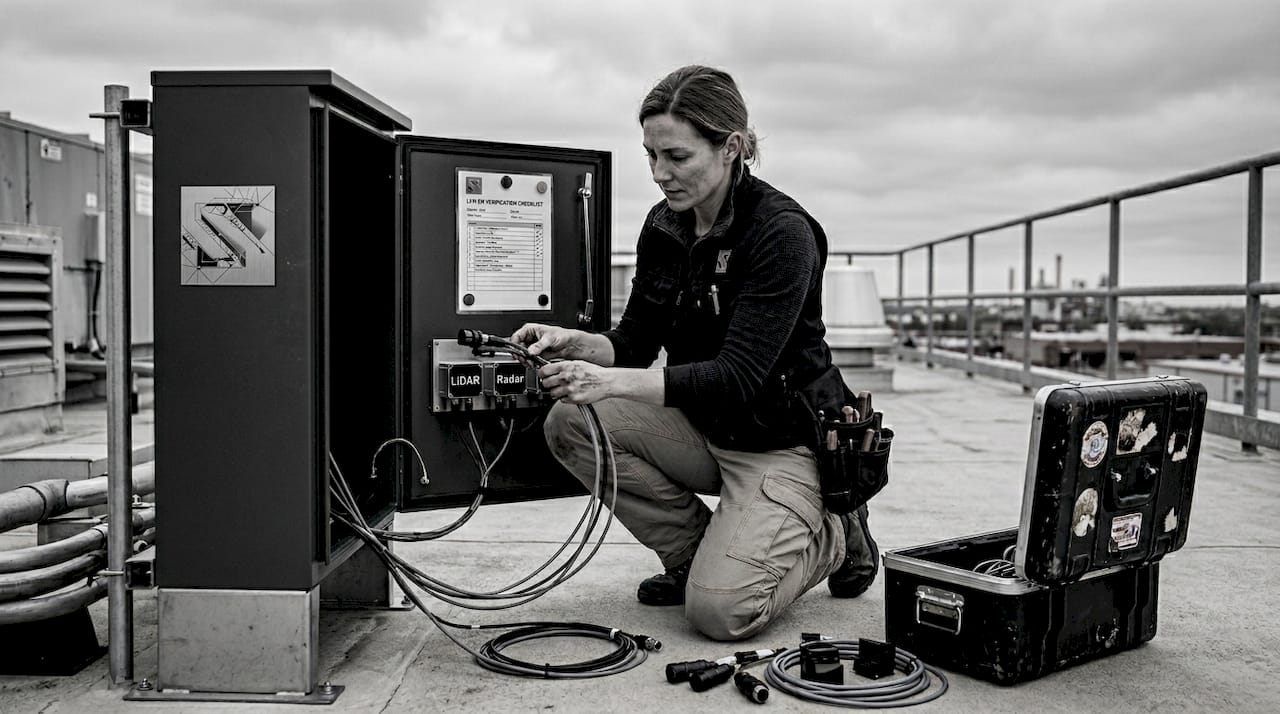
Radar performs well where LiDAR struggles. It penetrates rain, fog, and dust with minimal signal degradation, making it a strong candidate for outdoor perimeter monitoring in tropical climates. However, radar is susceptible to radiofrequency (RF) interference, which is increasingly common in dense urban environments filled with wireless networks, mobile devices, and industrial equipment. A radar system in an electronics manufacturing facility, for instance, may experience significant noise without proper shielding or frequency management.
Thermal imaging detects heat signatures rather than reflected light, enabling detection in complete darkness and through smoke. This makes it highly valuable for nighttime intrusion detection and fire precursor identification. The vulnerability? In extreme ambient heat, such as on rooftops or industrial processing floors in Southeast Asia, background temperatures approach body temperature, causing the camera to produce false detections or miss actual threats.
Fusion sensors combine the data streams of two or more sensor types, typically LiDAR, camera, and radar, to produce a composite picture that compensates for individual weaknesses. Early fusion systems are more resilient to desynchronization attacks and environmental interference because they correlate data before processing rather than afterward. They are more complex to deploy but significantly more reliable under real-world conditions.
| Sensor type | Key strength | Key vulnerability | Best use case |
|---|---|---|---|
| LiDAR | 3D spatial precision | Fog and rain scattering | Indoor mapping, access control |
| Radar | All-weather detection | RF interference | Outdoor perimeter, coastal facilities |
| Thermal | Night and smoke detection | Extreme ambient heat | Nighttime surveillance, fire detection |
| Fusion (LiDAR + camera) | Layered accuracy | Sync delays, complexity | Critical infrastructure, high-risk zones |
| Chemical (IMS-based) | Trace-level detection | Humidity sensitivity | CBRNE threat environments |
"A security system is only as strong as its weakest sensor layer. Identifying that layer before an incident, not after, is what separates proactive security management from reactive damage control."
Pro Tip: Do not design your sensor architecture around best-case weather. Design it around your worst seasonal conditions, whether that is monsoon-level rain, peak summer heat, or dense urban RF noise. Layer top intelligent sensing tech to cover the conditions your primary sensors cannot handle. For a deeper look at sensor types and uses, cross-referencing capabilities against your specific threat profile is essential before any procurement decision.
False alarms and operational efficiency: Addressing real-world challenges
Now that we have covered vulnerabilities, let us examine how advanced sensing directly tackles operational realities.
False alarms are not just an inconvenience. They are a measurable operational threat. Every unnecessary alert consumes guard attention, triggers incident logging, and erodes team confidence in the system. In high-frequency false-alarm environments, security teams begin to anticipate that alerts are non-events, which creates exactly the gap a real intruder or hazardous event can exploit. This is sometimes called "alert fatigue," and it is a genuine risk in facilities running poorly calibrated or single-sensor systems.
Chemical and environmental sensors are particularly prone to false positives in Southeast Asian climates if not properly configured. Humidity fluctuations, common during rainy seasons, can affect electrochemical sensor baselines. Temperature spikes in outdoor or semi-enclosed areas shift photoionization detector (PID) sensitivity curves. Without adaptive calibration, both scenarios generate spurious alerts. IMS-based CBRNE detection systems address this by cross-referencing signals from multiple sensor modalities before classifying a reading as a threat, reducing the false-alarm rate without compromising detection sensitivity.
The operational efficiency gains from getting this right are substantial. The following steps outline a practical approach:
- Select multi-sensor detection kits that cross-validate readings internally before generating alerts. Single-point sensors should be reserved for low-stakes monitoring only.
- Calibrate regularly and seasonally. In Southeast Asia, calibration schedules should account for dry season versus monsoon season baseline shifts. Quarterly calibration is the minimum for outdoor and semi-exposed sensors.
- Monitor environmental conditions continuously. Integrate temperature, humidity, and atmospheric pressure feeds into your sensor management platform so anomalies in readings can be contextualized against environmental data in real time.
- Set adaptive alert thresholds. Work with your technology partner to configure thresholds that adjust dynamically rather than remaining fixed. A fixed threshold calibrated in February will likely underperform in July under peak humidity.
- Track false-alarm rates as a performance metric. Report them monthly alongside true-detection rates to build a measurable picture of system reliability.
| Environmental factor | Impact on sensor accuracy | Recommended mitigation |
|---|---|---|
| High humidity (above 80%) | Electrochemical baseline drift | Adaptive calibration, humidity-compensated sensors |
| Extreme ambient heat | Thermal false detections | Differential thermal analysis, background averaging |
| RF-dense urban areas | Radar signal noise | Frequency-managed radar, shielded installations |
| Heavy rain and fog | LiDAR point cloud loss | Radar backup, fusion sensor architecture |
The advantages of sensing solutions that are properly calibrated and layered go beyond reduced false alarms. They reduce overtime staffing for manual verification, lower incident logging burdens, and allow security directors to reallocate skilled personnel toward higher-level threat assessment rather than routine alert response. For facilities interested in securing operations with sensors, this efficiency case is often the strongest argument for upgrading from basic to advanced sensing configurations.
Integrating sensing solutions: Practical steps for Southeast Asian facilities
With challenges and solutions clear, here is how to bring sensing technologies into practice.
Selecting the right sensor is only the beginning. Deployment quality, workflow integration, and ongoing maintenance determine whether a sensing system actually performs or simply occupies rack space. Security managers in Southeast Asia face specific integration challenges: variable regulatory environments across ASEAN countries, limited local calibration expertise for niche sensor types, and the operational reality of managing diverse facility profiles ranging from petrochemical plants to mixed-use commercial towers.
The selection process should begin with a clear threat profile assessment. Ask the following questions before evaluating any product:
- What are your primary threat vectors? Intrusion, environmental hazard, fire, or combined?
- What are your worst-case environmental conditions by season?
- What regulatory standards govern your detection systems in your specific jurisdiction?
- Do you need real-time integration with an existing access control or video management system (VMS)?
- What is your team's current technical capability for system maintenance and calibration?
Answering these questions honestly shapes a procurement specification that filters unsuitable products before evaluation begins. For example, a facility in a coastal industrial zone near Manila will prioritize radar and fusion sensors for perimeter coverage, whereas a pharmaceutical cold-storage facility in Singapore will prioritize thermal and chemical detection with strict humidity compensation.
Staff training is not optional. A sophisticated sensor system operated by undertrained personnel delivers mediocre results. Training should cover alert interpretation, basic calibration procedures, and escalation protocols. It should be conducted in-language and updated whenever the sensor configuration changes. Facilities that invest in structured training programs see measurably faster response times and fewer missed detections caused by human error.
For ongoing optimization, consider these actionable steps:
- Establish a sensor performance log that tracks alert accuracy, false-alarm rates, and maintenance activity monthly
- Engage local technology suppliers who understand regional regulatory environments and can provide in-country calibration and support
- Schedule firmware and software updates consistently. Many modern sensors receive over-the-air updates that improve detection algorithms, and facilities that skip updates fall behind in performance
- Conduct quarterly threat and vulnerability reviews to assess whether your sensor configuration still matches your evolving threat profile
Emerging security tech trends for 2026 increasingly emphasize edge-processing capabilities within sensors themselves, reducing latency in detection and decision-making. Facilities integrating sensors now should prioritize platforms that support edge computing to remain compatible with next-generation analytics. It is also worth noting that LiDAR delays impact fusion systems more than standalone cameras, which means fusion architectures require careful latency management during integration. Working with integrators who have validated this in regional deployments is essential.
Pro Tip: Engage a certified system integrator with documented experience in Southeast Asian facilities before finalizing your sensor architecture. Regional expertise in navigating local compliance requirements and managing tropical environment calibration is worth more than a lower upfront equipment cost. Advanced sensors for modern security deployments consistently perform better when integrator expertise matches the regional context.
Why conventional sensor upgrades fall short: Our perspective
Most security upgrades we observe follow a familiar pattern: a facility experiences an incident or a compliance audit flags a gap, procurement replaces the affected device with a newer model, and the organization considers the issue resolved. It rarely is. Replacing a single thermal camera with a higher-resolution model does not address the absence of radar coverage in fog conditions. Swapping out a chemical sensor without recalibrating the broader detection network leaves the system vulnerable to cross-sensor conflicts.
Real improvement comes from system-level thinking, not device-level substitution. The facilities that demonstrate the strongest security posture are those that treat sensor integration as an ongoing operational discipline rather than a one-time capital project. They map sensor coverage zones against threat vectors, audit calibration records, and test detection performance under simulated adverse conditions.
Southeast Asia's regulatory and environmental complexity intensifies this requirement. A tailored security solution built for local conditions and compliance frameworks will consistently outperform a generic international specification applied without adaptation. The region's diversity demands adaptive thinking, not catalog-driven procurement.
Next steps: Explore tailored sensing solutions for your facility
The operational principles outlined in this guide translate directly into better-performing, more resilient security systems. But applying them effectively requires the right technology partner.

BeyondSensor works with security agencies and system integrators across Singapore, Malaysia, and the Philippines to design and deploy sensing architectures tailored to specific facility profiles and regional compliance requirements. Our approach combines high-precision sensor selection with validated integration expertise, ensuring your system performs across all seasonal and environmental conditions. Explore the full range of sensing solutions and capabilities available, and connect with our regional team to discuss your facility's specific sensing requirements.
Frequently asked questions
How do advanced sensors reduce false alarms in Southeast Asian facilities?
Advanced sensors like IMS-based systems use multi-sensor cross-validation combining electrochemical and photoionization detection to confirm readings before generating alerts, which directly reduces false positives caused by humidity and temperature fluctuations.
Which sensing technology is best for extreme weather and visibility challenges?
Sensor fusion is the most resilient option, as fusion and early fusion systems combine LiDAR, radar, and cameras to compensate for individual weaknesses including fog scattering, extreme heat false reads, and RF interference.
What maintenance steps are recommended for optimum sensor operation?
Regular seasonal calibration, structured staff training, and continuous environmental condition monitoring are the three most critical steps for maintaining reliable sensor performance over time.
Are advanced sensors compliant with regional regulations in Southeast Asia?
Most advanced sensing platforms offer flexible integration architectures that can be configured to satisfy local regulatory requirements, but compliance verification with your specific jurisdiction's standards should always be confirmed with a qualified local supplier before deployment.
Recommended
- Understanding advanced sensing: boost security and efficiency | News | BeyondSensor
- Sensing tools guide: Types, accuracy, and security uses | News | BeyondSensor
- Explore emerging security technology trends for 2026 | News | BeyondSensor
- Why advanced sensors are essential for physical security | News | BeyondSensor
Read More Articles
RTSP Security Risks: Integrators Must Block Exposed Ports 554 and 8554
See how integrators can reduce RTSP security risks: close exposed ports 554 and 8554, secure camera access, and verify each deployment with practical checks.
Require MAEpp and X Accuracy Before You Buy People Counting Systems
Verify people counting accuracy by demanding MAEpp, X Accuracy, and directional-bias reports. Validate on-site with at least 100 events per direction...
30–90 Day Pilot Validates Redundant Camera Networks for Engineers
Standards led, practical steps for engineers to deploy redundant camera networks: MRP, dual homing, and aggregation patterns, commissioning checks, and...
30 Day Pilot Proves Video Analytics Accuracy for Security Teams
Validate video analytics accuracy with scenario tests, camera tuning, transfer learning and a 30 day edge first pilot for security teams.
Let's Build YourSecurity Ecosystem.
Whether you're a System Integrator, Solution Provider, or an End-User looking for trusted advisory, our team is ready to help you navigate the BeyondSensor landscape.
Direct Advisory
Connect with our regional experts for tailored solutioning.