
For security teams and system integrators: harden sensor fusion security with ETSI hardware controls, documented attack evidence, and a practical...
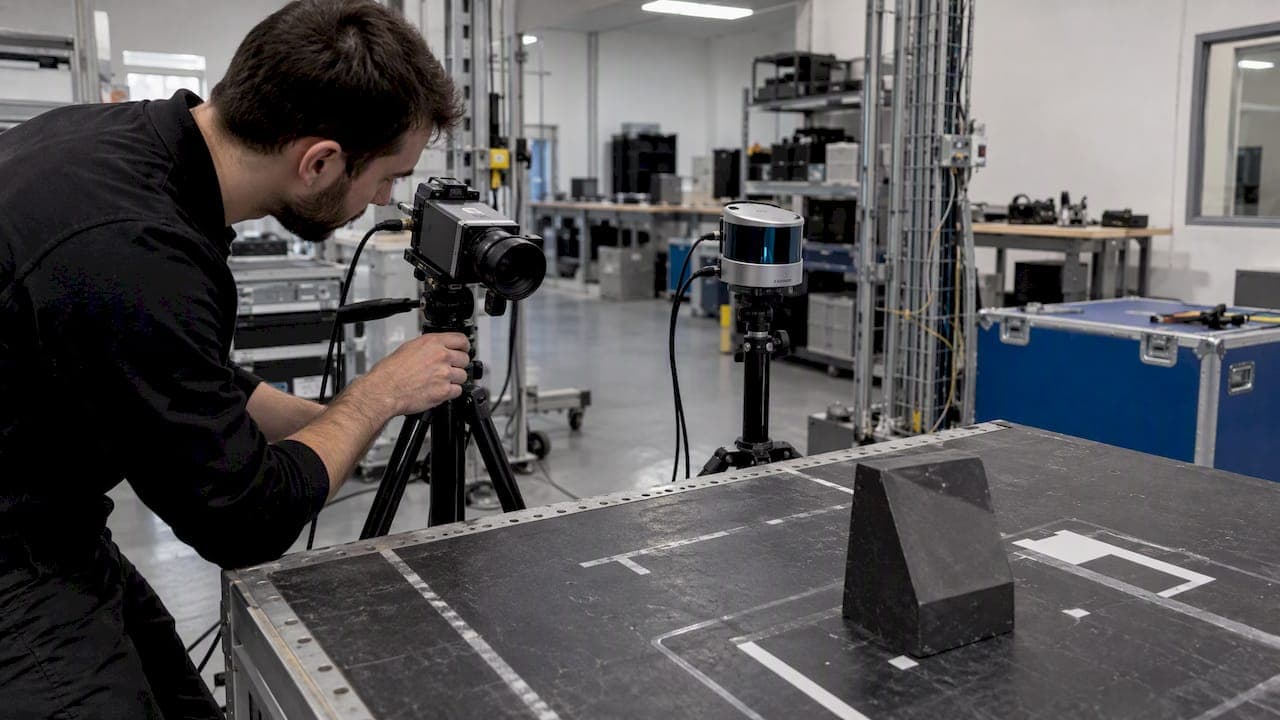
97% Takeover Success Demoed: Sensor Fusion Security for Practitioners

Sensor fusion combines complementary sensors, camera, LiDAR, radar, IMU and GNSS, to raise detection accuracy and cut false alarms across a security deployment. The gain is real, but conditional: fusion only holds up against motivated attackers when the architecture includes dynamic sensor trust and hardware-level controls. Without those two elements, a fused system is often easier to defeat than a single sensor working alone.
TL;DR:
- Sensor fusion improves detection accuracy by pairing sensors with complementary weaknesses, but effectiveness depends on dynamic trust management and hardware security controls.
- Attacks like spoofing, injection, and adversarial objects can exploit the increased attack surface, especially when trust in sensors is not continuously monitored or verified.
- Implementing a trust layer that adjusts sensor influence based on recent agreement, combined with hardware protections like secure boot and isolated processing, enhances resilience.
- Prioritizing trust and consistency in sensor inputs, along with vulnerability profiling and hardware integrity, is more effective than merely increasing the number of sensors.
- Secure deployment requires regular calibration, synchronization, and testing of fusion systems, alongside hardware-level security standards to prevent compromise.
Table of Contents
- 1. How sensor fusion sharpens detection across modalities
- 2. What attackers actually target in fused sensing systems
- 3. Defensive architectures that hold up under attack
- 4. Hardware hardening and the standards that define it
- 5. Deploying real-time fusion at the edge without breaking it
- 6. How BeyondSensor approaches secure fusion deployments
- 7. Real-world patterns where fused detection earns its cost
- 8. What the research actually tells security teams to prioritize
- 9. How BeyondSensor can help secure your sensor-fusion projects
- Sources
- FAQ
1. How sensor fusion sharpens detection across modalities
Every sensor type has a blind spot, and sensor fusion security works by pairing sensors whose weaknesses rarely overlap. A camera reads intent and identity but struggles in darkness or fog. Radar pushes through weather and darkness but offers coarse spatial resolution. LiDAR delivers precise depth and shape data, at a higher cost and with sensitivity to rain and dust. Thermal imaging catches body heat signatures that optical sensors miss entirely. Acoustic sensors pick up glass breaks or gunshots outside any camera's field of view. IMUs track motion and orientation continuously, even when other feeds drop out. GNSS anchors absolute position, when it can be trusted.
In practice, integrators lean on a handful of proven pairings:
- Camera plus radar: visual confirmation of a radar-flagged intrusion, reducing false alarms from wildlife or foliage movement.
- LiDAR plus camera: precise perimeter geometry combined with identity and behavior cues, common in high-value facility monitoring.
- IMU plus GNSS: continuous positioning that survives brief satellite signal loss or urban canyon interference.
- Thermal plus acoustic: night-time intrusion detection that does not depend on ambient light.
The overview of sensor fusion fundamentals covers when each pairing earns its added cost and complexity. For real-time security applications, calibration and synchronization matter as much as sensor choice: timestamps must align within milliseconds, and extrinsic calibration between sensors needs periodic verification, since physical drift from vibration or thermal expansion quietly degrades fusion accuracy over months of operation.
2. What attackers actually target in fused sensing systems
Fused systems face a wider attack surface than single-sensor setups, not a narrower one, because an attacker only needs to compromise the weakest input the fusion algorithm still trusts. Security teams generally group these attacks into five categories:
- Spoofing: feeding a sensor a fabricated but plausible signal, most commonly against GNSS receivers.
- Injection: introducing false data directly into a processing pipeline, bypassing the physical sensor entirely.
- Replay: capturing legitimate sensor output and retransmitting it to mask a real event.
- Adversarial physical objects: specially crafted shapes or patterns designed to fool perception models.
- Coordinated campaigns: simultaneous attacks across multiple modalities to defeat redundancy assumptions.
Research into GPS spoofing against multi-sensor fusion localization found that the FusionRipper attack could force a vehicle's fusion system into a takeover state with a success rate of 97% or higher in off-road scenarios, by profiling the brief windows where the system's confidence in its own position estimate drops. That finding matters well beyond autonomous vehicles: any fused security system that relies on GNSS for geofencing or asset tracking carries the same exposure.
A documented attack success rate above 97% against multi-sensor fusion localization, reported by the FusionRipper study, shows that fusion alone does not guarantee resistance to a patient, well-profiled attacker
A related study on adversarial objects against camera and LiDAR fusion demonstrated that a single carefully crafted physical object can manipulate both sensor streams at once, defeating the assumption that an attacker needs to compromise each sensor independently. The common thread across these attacks is timing: attackers look for the moments when a fusion system's internal confidence is lowest, then strike during that window rather than attempting a brute-force, always-on spoof that would be easier to detect.
3. Defensive architectures that hold up under attack
The strongest countermeasure against a sensor fusion takeover is a trust layer that treats sensor reliability as a variable, not a constant. A Dynamic Sensor Trust Engine assigns each input a running confidence score based on recent agreement with other modalities, then reweights the fusion algorithm's output accordingly. When one sensor starts disagreeing with the consensus, its influence shrinks automatically rather than dragging the whole system toward a false reading.
Several specific techniques reinforce this approach:
- Cross-modal consistency checks compare readings across sensor types to flag statistical mismatches before they reach a decision layer.
- Temporal evidence accumulation weighs anomalies over time instead of reacting to a single suspicious frame, catching slow, stealthy attacks that a snapshot-based system would miss.
- Byzantine-tolerant fusion assumes a defined number of sensors may be actively lying, and produces a reliable output anyway, a pattern worth the added compute cost in high-security deployments such as perimeter defense for critical infrastructure.
- Safe-state fallback forces the system into a conservative mode, such as alerting a human operator, whenever confidence across all modalities drops below a defined threshold simultaneously.
Research on multi-modal threat detection architectures found that combining hierarchical fusion with temporal anomaly detection and dynamic trust weighting achieved 97.3% detection accuracy with a precision of 96.8% and an average inference latency of 8.7 milliseconds on Jetson AGX Orin hardware. Crossmodal consistency tensors, which capture higher-order statistical relationships between sensor streams, served as a key input feature for the temporal detector in that work.
Pro Tip: Build your fallback logic before you build your fusion algorithm. A system that knows how to fail safely is harder to exploit than one that only knows how to succeed.
Design patterns that assume "an attacker cannot compromise every sensor at once" are fragile. Practical attacks increasingly target multiple modalities in parallel, so fusion architectures need built-in mistrust and the ability to reconfigure on the fly rather than static weighting schemes decided at design time. The sensor integration strategies guide walks through adaptive fusion patterns in more depth.
4. Hardware hardening and the standards that define it
Software-level trust scoring only works if the hardware beneath it is not already compromised, which is why sensor hub security has become its own discipline. ETSI TS 103 864 defines cybersecurity threats and requirements specifically for consumer sensor hubs, organized around three interface protection levels, SI1, SI2, and SI3, each addressing a different degree of exposure between the sensor, the hub, and the host application.
The standard's core provisions give integrators a concrete checklist:
- Hardware-isolated secure execution domains that keep sensor processing separate from the general application environment.
- Algorithm integrity verification to confirm that fusion and signal-processing code has not been tampered with.
- Secure caching and deletion of raw data once it has been processed, limiting what an attacker can recover if a device is compromised.
- Data classification by privacy impact, low, medium, or high, paired with least-collection policies and explicit authorization before any raw data moves off-device.
ETSI GR ISC 004, covering integrated sensing and communications, adds a separate warning: unauthorized sensing is a physical-layer threat that standard encryption does not address, because encrypting a data stream does nothing to stop a sensor from being read by someone who should not have access to it in the first place. The guidance also flags that fusion itself can leak higher-resolution information across systems with mismatched capabilities, which argues for privacy enforcement applied at the system level, not just at each individual sensor.
For integrators building deployment checklists, that translates into secure boot on every edge device, signed firmware with no unsigned update path, TPM-backed key storage for sensor credentials, and verified supply-chain provenance for every sensor module before it goes into a live system. The guide to hardware-level security beyond encryption expands on how these controls apply outside pure physical security, into industrial and environmental sensing deployments as well.
5. Deploying real-time fusion at the edge without breaking it
Where fusion runs, edge device or cloud server, changes the entire risk and performance calculation. Edge processing cuts latency and keeps raw sensor data off the network, reducing both exposure and bandwidth cost. Cloud processing offers more compute for heavier models but introduces network latency and a data-in-transit risk that pure edge deployments avoid.
A practical rollout sequence looks like this:
- Establish time synchronization across every sensor feed before any fusion logic runs, since misaligned timestamps quietly corrupt cross-modal consistency checks.
- Verify extrinsic and intrinsic calibration on a defined schedule, not just at installation, because vibration and thermal cycling drift sensor alignment over months.
- Run vulnerability profiling against your own fusion pipeline, deliberately measuring the windows where confidence drops, the same approach researchers used to find exploitable gaps in the FusionRipper study.
- Instrument telemetry for trust scores, not just raw detections, so operators can see when the system's internal confidence is degrading before a false negative occurs.
- Build an incident response playbook specifically for sensor takeover scenarios, distinct from a general network breach playbook, since the symptoms and containment steps differ.
Pro Tip: Treat a sudden, unexplained rise in one sensor's trust score with the same suspicion as a drop. A spoofed input often looks unusually clean.
A separate research framework fusing IMU, steering, and accelerometer data with LSTM prediction and dynamic time warping detected four distinct GNSS spoofing attack types within the latency bounds required for operational use, a useful reference point for teams evaluating whether their own detection pipeline runs fast enough to matter.
6. How BeyondSensor approaches secure fusion deployments
Sensor-based security systems built with the understanding that fusion architecture and hardware trust are inseparable, not sequential steps, start from a sensing stack designed around dynamic trust weighting and hardware-isolated processing rather than bolting those controls on afterward. Regional teams can offer localized validation instead of a one-size-fits-all deployment template.
A typical implementation sequence starts with a site-specific threat assessment, followed by sensor pairing selection based on the environment's lighting, weather, and perimeter geometry, then calibration and trust-engine tuning before the system goes live. Ongoing monitoring tracks per-sensor trust scores alongside standard detection metrics, giving security teams visibility into degradation before it becomes a blind spot.
— Eumir
7. Real-world patterns where fused detection earns its cost
The clearest wins for sensor fusion security tend to show up in environments where a single sensor type consistently generates too many false alarms to be operationally useful on its own. Perimeter intrusion detection is a common example: radar alone flags every moving branch or stray animal, but pairing it with a camera for visual confirmation, or with LiDAR for precise geometry, pushes the decision from a maybe to a verified event before a human ever needs to look.
Industrial facilities running environmental monitoring alongside physical security see a similar pattern. Thermal sensors catch overheating equipment and intruders in the same data stream, while acoustic sensors pick up mechanical faults and break-ins with the same microphone array. Visitor management systems that fuse badge data with camera-based identity checks reduce the tailgating risk that either control misses alone.

None of these patterns rely on exotic hardware. They rely on disciplined pairing of complementary sensors, a trust layer that can tell the difference between a sensor degrading and a sensor lying, and hardware protections that keep the whole pipeline honest. That combination, more than any single sensor upgrade, is what separates a fusion deployment that reduces false alarms from one that just adds more data to ignore.
8. What the research actually tells security teams to prioritize
The most overrated idea in this field is that adding more sensors automatically adds more security. It does not. Redundancy without trust scoring is a false sense of safety.
What the evidence actually supports is narrower and more useful: invest first in the trust and consistency layer, then in hardware isolation, and treat additional sensors as the last lever to pull, not the first. Most integrators do the opposite, buying more hardware before they have built the logic to know when any of it is lying. A two-sensor system with a solid trust engine will outperform a five-sensor system that blindly averages its inputs.
If you take one thing from this guide, make it vulnerability profiling. Test your own fusion pipeline the way the FusionRipper researchers tested theirs, looking for the windows where confidence drops, before an attacker finds them for you.
— Eumir
9. How BeyondSensor can help secure your sensor-fusion projects
Building a fusion pipeline that resists spoofing, injection, and coordinated attacks takes more than sensor selection. It takes an architecture that bakes in dynamic trust and hardware isolation from the start, which is exactly where BeyondSensor's Solution Integration service is built to help.

For system integrators and security teams planning a deployment, BeyondSecure provides a hardened sensing foundation, and BeyondPatrol applies fused sensor data to automated patrol and monitoring workflows without requiring a from-scratch build. If you are evaluating partners for multi-vendor sensor integration, Solution Integration gives your team a starting point for an architecture review built around the trust and hardening principles covered in this guide. Reach out to scope your deployment and see what a dynamic trust engine looks like applied to your own site.
Sources
Security teams building or auditing a fusion pipeline should keep these sources on hand:
- TS 103 864 - Cyber Security; Security Threats and related Requirements for Consumer Sensor Hubs
- Multi-Modal Threat Detection for Autonomous Vehicles Using Intelligent Multi-Sensor Security Analytics (IMSSA)
- Drift with Devil: Security of Multi-Sensor Fusion based Localization in High-Level Autonomous Driving under GPS Spoofing
For geolocation-specific spoofing detection, ShieldLabs offers a dedicated resource comparing device motion signals against GNSS data.
FAQ
What is sensor fusion used for?
Sensor fusion combines data from multiple sensor types, such as cameras, radar, LiDAR, and GNSS, to produce a more accurate and reliable picture of an environment than any single sensor could provide alone. In security contexts, it is used for intrusion detection, perimeter monitoring, asset tracking, and reducing false alarms by cross-checking one sensor's reading against another's.
Does the BNO055 have sensor fusion?
The BNO055 is an inertial measurement unit that integrates an accelerometer, gyroscope, and magnetometer with onboard fusion processing to output combined orientation data. That fusion is limited to motion and orientation sensing, and it is a different scope from the multi-modal security fusion covered in this guide, which combines distinct sensor categories like vision and radar.
What is the difference between sensor fusion and data fusion?
Sensor fusion specifically combines raw or processed outputs from physical sensors, like cameras and radar, to improve perception of the physical world. Data fusion is a broader term that can also include combining non-sensor data sources, such as databases or historical records, so sensor fusion is best understood as one specific application within the larger category of data fusion.
How is sensor fusion done?
Sensor fusion typically happens in stages: raw data from each sensor is preprocessed and time-synchronized, then combined using an algorithm that weighs each input's reliability, often with techniques like Kalman filtering, Bayesian inference, or neural network based fusion models. Modern security-focused implementations add a dynamic trust layer that adjusts each sensor's weight in real time based on how well it agrees with the other modalities.
Recommended
Read More Articles

Stop False Dispatches: 5 SOP Steps for Singapore Alarm Triage
SOP first, verification led alarm triage workflow for Singapore facilities. Five SOP steps aligned to PDPC, SGPolice and ABS guidance.
Singapore Procurement: Live Pilot for Intrusion Detection Analytics
Procurement-first checklist for Singapore teams: require live pilots, add PDPA checks to RFPs, and judge intrusion detection analytics by pilot results...

Avoid Outages: IMDA/JST Camera Firmware Management for Administrators
Practical operations-first guidance for security administrators to run staged, auditable firmware updates across multi-site camera fleets, aligned to IMDA...

Avoid 90 Second Chaos: Visitor Watchlist Screening for Singapore Teams
Practical, compliance-first playbook for visitor watchlist screening: SOPs, vendor requirements, PDPA and IMDA guidance, and BeyondSensor integration tips...
Let's Build YourSecurity Ecosystem.
Whether you're a System Integrator, Solution Provider, or an End-User looking for trusted advisory, our team is ready to help you navigate the BeyondSensor landscape.
Direct Advisory
Connect with our regional experts for tailored solutioning.