
Explore sensing tool types, accuracy benchmarks, and deployment strategies for industrial security and automation. Learn how to select and scale sensors effectively.

Sensing tools guide: Types, accuracy, and security uses

TL;DR:
- Different sensor types rely on unique physics; selecting the wrong type leads to unreliable data.
- Proper deployment, calibration, and analytics are essential for sensor networks to achieve high accuracy.
- Environmental resilience and cybersecurity are critical for future-proof, secure, and effective sensing solutions.
Sensors are not interchangeable. A vibration sensor that prevents a catastrophic motor failure in a petrochemical plant operates on entirely different physics than the infrared proximity sensor guarding a server room entrance. Yet many security and automation professionals treat sensor selection as a commodity decision, defaulting to familiar brands or lowest cost. That approach carries real operational risk. This guide breaks down the major sensor classes, their performance benchmarks, practical deployment strategies, and the advanced considerations that separate reliable sensor networks from ones that fail under pressure.
Table of Contents
- Understanding sensing tools: Types and methodologies
- Measuring performance: Benchmarks and accuracy
- Practical deployment: Integrating and scaling sensing tools
- Considerations for advanced applications and security
- How to future-proof your sensor strategy
- Unlock advanced sensing solutions for your organization
- Frequently asked questions
Key Takeaways
| Point | Details |
|---|---|
| Sensor type matters | Choose sensors based on operational needs and environmental conditions for maximum reliability. |
| Data-driven decisions | Use benchmarks and real-world performance metrics to select and deploy sensing tools effectively. |
| Advanced integration | Combine sensor fusion and edge analytics for scalable, actionable security and maintenance solutions. |
| Security is dynamic | Account for evolving cybersecurity threats and use advanced intrusion detection for IIoT sensors. |
Understanding sensing tools: Types and methodologies
Having established the pivotal role of sensing tools, let's break down the main sensor types and how they actually function.
Sensors broadly fall into four operational classes: temperature, pressure, proximity and motion, and vision. Each class relies on distinct physical principles, which is why selecting the wrong type for a given application produces unreliable data regardless of brand quality or price point.
Temperature sensors use resistance temperature detectors (RTDs) or thermistors that change electrical resistance in response to heat. RTDs offer higher accuracy and long-term stability, making them standard in process industries. Thermistors respond faster but drift more over time, which matters in continuous monitoring scenarios.
Pressure sensors convert mechanical force into electrical signals using flexible diaphragms. When pressure deforms the diaphragm, a transducer reads the deflection. These appear everywhere from hydraulic systems to cleanroom differential pressure monitoring.
Proximity and motion sensors split into two dominant technologies. Infrared (IR) sensors detect changes in radiated heat or reflected light, while Hall effect sensors measure magnetic field changes caused by moving metallic objects. As noted in industrial automation sensor methodologies, temperature sensors use RTDs and thermistors for resistance changes, pressure sensors use diaphragms, proximity and motion work via infrared or Hall effect, and vision sensors use CCD, IR, and UV cameras for image analysis.
Vision sensors are the most data-rich class. Charge-coupled device (CCD) cameras capture visible light with high fidelity. IR cameras detect heat signatures invisible to the human eye. UV cameras identify specific chemical signatures or surface defects. Understanding sensor technology for automation at this level is what separates effective deployments from ones that generate noise.
MEMS (Micro-Electro-Mechanical Systems) sensors deserve special mention. Fabricated through semiconductor micromachining, they pack motion detection capability into extremely compact, low-power packages. MEMS accelerometers and gyroscopes are now standard in asset tracking, structural health monitoring, and perimeter security devices.
| Sensor type | Operating principle | Typical use cases |
|---|---|---|
| Temperature (RTD/thermistor) | Resistance change with heat | Process control, HVAC, fire detection |
| Pressure (diaphragm) | Mechanical deflection to signal | Hydraulics, cleanrooms, pipeline monitoring |
| Proximity/motion (IR, Hall effect) | Infrared or magnetic field change | Intrusion detection, conveyor systems |
| Vision (CCD, IR, UV) | Image capture and analysis | Surveillance, defect inspection, perimeter security |
| MEMS (accelerometer, gyroscope) | Micromachined mechanical response | Asset tracking, vibration analysis, structural monitoring |
Key characteristics to evaluate across all sensor classes:
- Resolution: The smallest detectable change in the measured variable
- Response time: How quickly the sensor reacts to a change
- Operating range: The span of conditions within which the sensor performs to spec
- Output type: Analog (continuous signal) vs. digital (discrete values)
Measuring performance: Benchmarks and accuracy
Now that you understand the methodologies, let's examine how sensors prove their effectiveness and accuracy in real operational scenarios.
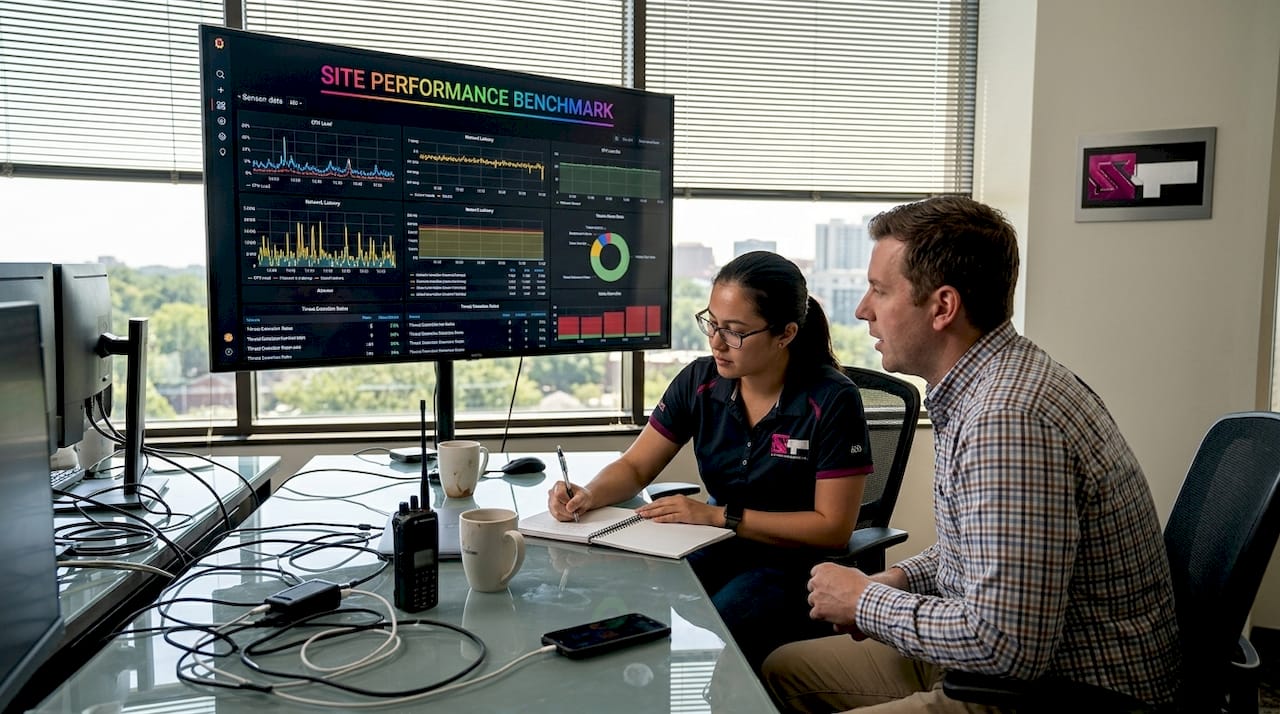
Datasheets tell one story. Field performance tells another. The gap between them is where security and automation decisions get made or broken.
For intrusion detection, the numbers are compelling when the right analytics are applied. Detection accuracy of 97 to 99% is achievable using decision tree and XGBoost models on industrial control system (ICS) datasets. Vibration sensors detect 70 to 85% of mechanical failures before they become critical events. IIoT sensor deployments reduce maintenance costs by 30 to 45% and cut operational failures by 60 to 80%.
Those numbers only hold when the sensor network is properly configured and the analytics layer is tuned to the specific environment. Raw sensor data without processing is just noise.
Field insight: Edge analytics, where data is processed at or near the sensor rather than transmitted to a central server, can reduce the volume of transmitted data by up to 95%. This matters enormously for bandwidth-constrained industrial environments and for reducing latency in time-sensitive security responses.
Here is how benchmark performance breaks down across common security and automation applications:
| Application | Sensor type | Benchmark accuracy | Key metric |
|---|---|---|---|
| Intrusion detection | Motion, vision | 97 to 99% | DT/XGBoost on ICS datasets |
| Mechanical failure prediction | Vibration (MEMS) | 70 to 85% detection | Pre-failure identification |
| Predictive maintenance | IIoT multi-sensor | 30 to 45% cost reduction | Maintenance frequency |
| Operational failure reduction | IIoT multi-sensor | 60 to 80% fewer failures | Failure event rate |
When evaluating sensor solutions, align your benchmarks to your specific failure modes. A vibration sensor optimized for rotating equipment will not deliver the same detection rates on a static structural element. Specificity in sensor selection directly drives accuracy in the field.
For teams working through security compliance with sensor tech, these benchmarks also serve as baseline evidence for regulatory reporting and audit readiness. Documented sensor performance data strengthens compliance posture significantly.
The analytics layer is not optional. Sensors generate data. Analytics generate decisions. Without a properly tuned processing pipeline, even a 99% accurate sensor becomes operationally useless.
Practical deployment: Integrating and scaling sensing tools
Understanding benchmarks is one step. Deployment is where theory meets practice. Here's how to bring sensing tools into live environments.
Effective deployment starts before any hardware is ordered. The first step is mapping your operational risk profile to specific failure modes. A rotating pump requires vibration sensors. A perimeter fence line requires IR motion or vision sensors. A server room needs temperature and humidity sensors alongside access control triggers. Matching sensor type to failure mode is the foundational discipline, as smart maintenance infrastructure guidance confirms: prioritize sensors matching failure modes, use wireless and edge configurations for scalability, and integrate with a Computerized Maintenance Management System (CMMS) for actionable outputs.
Deployment steps for a sensor network:
- Risk and failure mode mapping: Identify every asset or zone requiring monitoring and document the specific failure mode or threat vector for each.
- Sensor type selection: Match each failure mode to the appropriate sensor class and output type (analog vs. digital).
- Topology planning: Decide between wired and wireless configurations. Wired sensors offer lower latency and higher reliability in fixed installations. Wireless sensors enable faster deployment and easier scaling in dynamic or large-area environments.
- Edge analytics configuration: Deploy processing capability at or near the sensor cluster to filter noise, reduce data transmission load, and enable local alerting.
- CMMS integration: Connect sensor outputs to your maintenance management system so that alerts trigger work orders automatically rather than requiring manual review.
- Calibration and baseline establishment: Run sensors for a defined period under normal operating conditions to establish performance baselines before activating alert thresholds.
- Ongoing maintenance scheduling: Plan for regular calibration checks, firmware updates, and physical inspection cycles.
For teams navigating the security compliance process, documenting each of these steps creates the audit trail regulators expect. Organizations that invest in tailored security solutions consistently outperform those using generic, one-size-fits-all deployments on both detection rates and compliance metrics.
Pro Tip: The most common deployment failure is skipping the baseline establishment phase. Without a documented normal operating profile, alert thresholds are guesswork. Integrators frequently move straight from installation to live alerting, generating false alarms that erode operator trust in the system within weeks.
Considerations for advanced applications and security
After deployment, advanced users must navigate limitations and security threats. Here's what to know to avoid costly mistakes.
Datasheet specifications are optimistic by design. Real-world performance involves derating, which means accepting reduced performance due to environmental conditions. Field studies show derating of 25 to 40% from rated specifications due to temperature extremes, humidity, vibration, electromagnetic interference, and contamination. Analog output sensors consistently outperform digital sensors in harsh conditions because they degrade gracefully rather than failing abruptly.
Multi-sensor fusion, combining data from multiple sensor types to build a richer operational picture, is increasingly standard in high-stakes environments. The tradeoff is real though. When correlated sensors are fused, the entropy gain (the additional information value) is lower than if the sensors were measuring independent variables. Fusion architecture must account for sensor correlation to avoid overconfidence in combined outputs.
Key advanced considerations for security professionals:
- Derating planning: Build a 30 to 40% performance buffer into sensor specifications for any harsh or outdoor environment
- Analog vs. digital selection: Default to analog outputs in environments with temperature extremes, high vibration, or electromagnetic interference
- Fusion correlation analysis: Map sensor dependencies before designing fusion logic to avoid compounding errors
- Cybersecurity hardening: IIoT sensors are active attack surfaces, and post-quantum intrusion detection systems alongside fault diagnosis mechanisms are now considered essential for high-security deployments
- Anomaly detection benchmarking: Datasets like DataSense enable organizations to validate their anomaly detection models against known cyber-physical attack patterns before going live
For government users and agencies operating critical infrastructure, these cybersecurity considerations are not optional. Nation-state level threats specifically target IIoT sensor networks as entry points into operational technology environments.
Pro Tip: Most integrators focus exclusively on physical sensor hardening and ignore firmware update cadences. Unpatched sensor firmware is one of the most exploited attack vectors in cyber-physical security incidents. Establish a firmware governance policy before deployment, not after an incident.
How to future-proof your sensor strategy
Here is the uncomfortable truth most sensor guides avoid: the biggest risk in sensor strategy is not choosing the wrong technology. It is assuming the environment stays static after deployment.
We have seen organizations invest in technically excellent sensor networks that degraded within 18 months because the operational environment changed. New equipment was added nearby, creating electromagnetic interference. Facility expansions altered airflow patterns that threw temperature sensors out of calibration. Legacy analog systems were integrated with new digital platforms without accounting for signal conversion losses.
Conventional wisdom says to select sensors based on specifications and budget. The more durable approach is to select sensors based on environmental resilience and integration flexibility. A sensor that performs at 80% of spec across a wide range of conditions outperforms a 99% spec sensor that deroutes under real-world stress.
Adaptive, multi-layered sensing is now the operational standard, not a premium option. Virtual guard and VLM-based security innovation is already demonstrating how layered sensor inputs, combined with intelligent analytics, create security postures that adapt rather than just monitor. The organizations building that capability now will hold a significant operational advantage as threat landscapes continue to shift.
Unlock advanced sensing solutions for your organization
The depth of knowledge required to deploy, benchmark, and secure a modern sensor network is significant. Getting it right demands both technical precision and operational experience.

BeyondSensor works with security agencies and system integrators to design and deploy sensor solutions that match real-world operational demands, not just datasheet promises. From IIoT-enabled predictive maintenance networks to multi-layered physical security architectures, our advanced sensing platform is built for environments where accuracy, resilience, and compliance are non-negotiable. If you are ready to move from generic deployments to precision-engineered sensing solutions, BeyondSensor is the partner built for that level of work.
Frequently asked questions
What are the most reliable sensor types for harsh industrial environments?
Analog output sensors and MEMS devices consistently outperform digital sensors in harsh conditions because they degrade gradually rather than failing without warning, as field performance data confirms.
How does sensor fusion improve security and automation?
Sensor fusion combines multiple data streams to raise detection accuracy and reduce false alarms, though correlated sensors may deliver lower entropy gains than independent sensor inputs.
How can IIoT sensors enhance facility maintenance and reduce operational failures?
IIoT sensor deployments can cut maintenance costs by up to 45% and reduce operational failures by up to 80% when properly integrated with analytics and CMMS platforms.
What cybersecurity risks should security professionals consider with IIoT sensors?
IIoT sensors are active attack surfaces vulnerable to cyber-physical intrusions, making post-quantum intrusion detection and firmware governance policies essential components of any secure deployment.
Recommended
- Security compliance in sensing systems: a step-by-step guide | News | BeyondSensor
- Physical security compliance: standards and sensor tech guide | News | BeyondSensor
- How sensor technology drives smarter industrial automation | News | BeyondSensor
- Why tailored security solutions outperform generic systems | News | BeyondSensor
Read More Articles

Geofencing Alerts for Site Security: Setup Guide for Singapore
How to design geofencing alerts that flag real security events, cut alert fatigue and stay within PDPA and IPA rules at Singapore sites.

CCTV Operator Training in Singapore: Skills, Courses and Costs
What CCTV operator training involves in Singapore: the PRSF course, fees and subsidies, the 31 December 2026 deadline, and skills for AI-assisted control rooms.

Role-Based Access Control: A Practical Guide for Singapore Security Teams
How role-based access control works, where it breaks (role explosion, stale roles), and how to apply it to both cyber and physical security in Singapore.

Security Site Survey: Facility Teams’ Checklist for Funded Fixes
Assess site risks, turn findings into budgeted action, and use field checklists, reporting templates, and PDPA notes for camera and biometric deployments.
Let's Build YourSecurity Ecosystem.
Whether you're a System Integrator, Solution Provider, or an End-User looking for trusted advisory, our team is ready to help you navigate the BeyondSensor landscape.
Direct Advisory
Connect with our regional experts for tailored solutioning.