
Discover the role of AI in anomaly detection and how it revolutionizes industrial security. Make informed tech investments today!

How AI transforms anomaly detection in industrial security

TL;DR:
- Industrial security leaders face increased pressure due to sophisticated threats and complex environments that legacy detection systems cannot handle effectively. AI-based anomaly detection offers a significant advantage by adapting to evolving risks, but deployment requires careful consideration of methods, data quality, and operational challenges to ensure reliable results. Successful implementation depends on aligning technological choices with operational needs, fostering robust validation processes, and integrating AI tools into comprehensive security workflows.
Industrial security leaders are under more pressure than ever. Threats are more sophisticated, operational environments are more complex, and legacy detection systems were simply never built for the scale or subtlety of today's risk landscape. AI-based anomaly detection promises a genuine leap forward, but the gap between a vendor's benchmark claims and real-world performance in your facility can be vast. This article cuts through the noise to explain how AI actually changes anomaly detection, which methods matter, where the real pitfalls lie, and how security directors can make sharper, more defensible decisions about technology investment and deployment.
Table of Contents
- Why traditional anomaly detection falls short
- Core AI methods powering anomaly detection
- Industrial realities: Dealing with rare events and shifting data
- Comparing AI anomaly detection approaches in practice
- Best practices for deploying AI anomaly detection in industry
- Where most directors misjudge AI's role in anomaly detection
- Connecting AI anomaly detection to smarter industrial operations
- Frequently asked questions
Key Takeaways
| Point | Details |
|---|---|
| AI surpasses legacy systems | AI methods detect complex, novel threats that traditional signature-based approaches often miss in industrial security. |
| Method choice impacts resilience | Selecting the right AI approach depends on data type, operational demands, and resource constraints. |
| Benchmarking is not foolproof | Performance scores can mislead—real-world results depend on deployment context and continuous validation. |
| Manage risks proactively | Regularly update models and align AI solutions with evolving plant operations and threats for lasting value. |
Why traditional anomaly detection falls short
Legacy anomaly detection systems were engineered around a core assumption: threats look predictable. Rule-based systems flag activity that matches known signatures, and threshold-based alerts trigger when a value exceeds a predefined limit. This approach worked reasonably well when industrial environments were relatively static and attack patterns were well-documented.
The problem is that neither of those conditions holds today. Industrial sites face evolving threats, sophisticated intrusion methods, and a constant stream of new operational configurations. Legacy systems designed for known threats become blind to anything that falls outside their rule sets. The result is a dangerous accumulation of both false negatives (missed real threats) and false positives (unnecessary alerts that drain response resources).
Consider a few concrete failure modes:
- Signature drift: Attackers modify their methods incrementally. A rule tuned to detect one attack pattern will miss a slight variation, even if the underlying threat is identical.
- Complexity overload: As plants add more sensors, machines, and networked devices, the number of rule combinations grows exponentially. Manual maintenance of rule sets becomes untenable.
- Context blindness: A rule-based system sees individual data points, not patterns across time. It cannot recognize that a subtle, sustained deviation over 48 hours is more dangerous than a brief spike.
"Legacy rule-based systems weren't built for the adaptive threat landscape of modern industrial environments. Every gap in coverage represents a security liability that compounds over time."
Empirical benchmarking confirms that deep learning models, including LSTM (Long Short-Term Memory) networks, consistently outperform classical methods on real-world time-series datasets. However, these gains come with meaningful trade-offs in computational resources and training requirements. That balance is central to every deployment decision. Security teams exploring advanced threat detection need to weigh both sides of that equation before committing to a technology path.
Core AI methods powering anomaly detection
Understanding the mechanics of AI-based detection does not require a machine learning degree. What it does require is a working knowledge of the four dominant strategies and their practical implications for industrial security.
Research published in automated AI anomaly detection confirms that modern industrial AI systems rely on learned representations rather than fixed rules. Specifically, the four core approaches are:
- Feature embedding: The AI learns a compressed representation of normal behavior. An anomaly is anything that doesn't map closely to that learned representation. This is well-suited for image-based inspection and complex sensor arrays.
- Reconstruction-based methods: The model learns to reconstruct "normal" inputs. Anomalies produce high reconstruction errors because the model was never trained to recreate them. Autoencoders are a common implementation.
- Forecasting and residual analysis: The model predicts what should happen next based on historical patterns. When actual data deviates significantly from the forecast, an anomaly is flagged. LSTM networks are the workhorse here.
- Hybrid methods: These combine two or more of the above strategies, often improving robustness at the cost of added complexity and resource demand.
Each method has a different relationship with labeled data:
| Method | Learning type | Label requirement | Best for |
|---|---|---|---|
| Feature embedding | Self-supervised | Low | Complex sensor or image data |
| Reconstruction-based | Unsupervised | Very low | Baseline drift, novel faults |
| Forecasting/residual | Semi-supervised | Moderate | Time-series, sequential processes |
| Hybrid | Varies | Moderate to high | High-stakes, multi-source environments |
Directors evaluating AI analytics applications for their facilities should pay close attention to this label requirement column. Labeling anomaly data in industrial environments is expensive and slow. Methods that rely on abundant labeled attack samples may underperform in practice simply because you can't generate enough training examples for rare events.
Pro Tip: Don't get distracted by which algorithm is trending in academic papers. Match the method to your data type, your anomaly frequency, and your operational context. A reconstruction-based model on a well-instrumented process line will outperform a more complex hybrid model that's been trained on insufficient or unrepresentative data.
Exploring AI-powered security systems that support multiple detection strategies gives your team the flexibility to adapt as your environment and threat profile evolve.
Industrial realities: Dealing with rare events and shifting data
The lab-to-field gap is where most AI anomaly detection deployments either prove their worth or fall apart. There are four operational challenges that every security director needs to understand before signing off on a deployment.
Data imbalance is the most pervasive problem. In most industrial environments, 99% or more of recorded events are normal operations. A model trained on this data will naturally bias toward predicting "normal" because that's statistically safe. When a rare attack or fault does occur, the model may not have enough representative examples to recognize it. Techniques like synthetic data generation (SMOTE) and anomaly-weighted loss functions help, but they are not complete solutions.

Distribution shift occurs when the operational environment changes in ways the model wasn't trained to handle. A new machine on the floor, a seasonal process change, an updated firmware version on a sensor network, all of these can shift the statistical profile of "normal" enough to cause the model to generate a spike in false positives or miss genuine anomalies. Research on smart grid anomaly detection shows that AI models can fail substantially under distribution shifts and rare-event regimes, with issues around interpretability, transferability, and robustness to noise representing genuine operational risks, not theoretical concerns.
Key challenges to monitor after deployment:
- Noise and time delays: Sensor data in industrial environments is rarely clean. Measurement noise, communication latency, and missing values can degrade model performance without triggering any obvious system error.
- Adversarial manipulation: Sophisticated attackers can deliberately craft inputs to fool an AI model, a risk that's especially serious in cyber-physical systems where the cost of a missed detection is high.
- Interpretability gaps: When an AI flags an anomaly, operators need to understand why. Black-box models that offer no explanation generate distrust and alert fatigue.
Key stat: In challenging real-world visual inspection scenarios, state-of-the-art AI models can drop below 60% AU-PRO (Area Under Per-Region Overlap), a critical signal that field performance may not match benchmark claims.
Pro Tip: Set a scheduled model review cadence, not just when something breaks. Every significant change to plant configuration, sensor hardware, or operational process warrants a re-evaluation of your detection baselines. Staying current with emerging trends for 2026 also helps you anticipate which threats are evolving fastest so you can prioritize your retraining effort.
Comparing AI anomaly detection approaches in practice
Choosing an AI anomaly detection solution involves more than picking the method with the highest published accuracy. Security directors need to weigh a matrix of operational trade-offs.
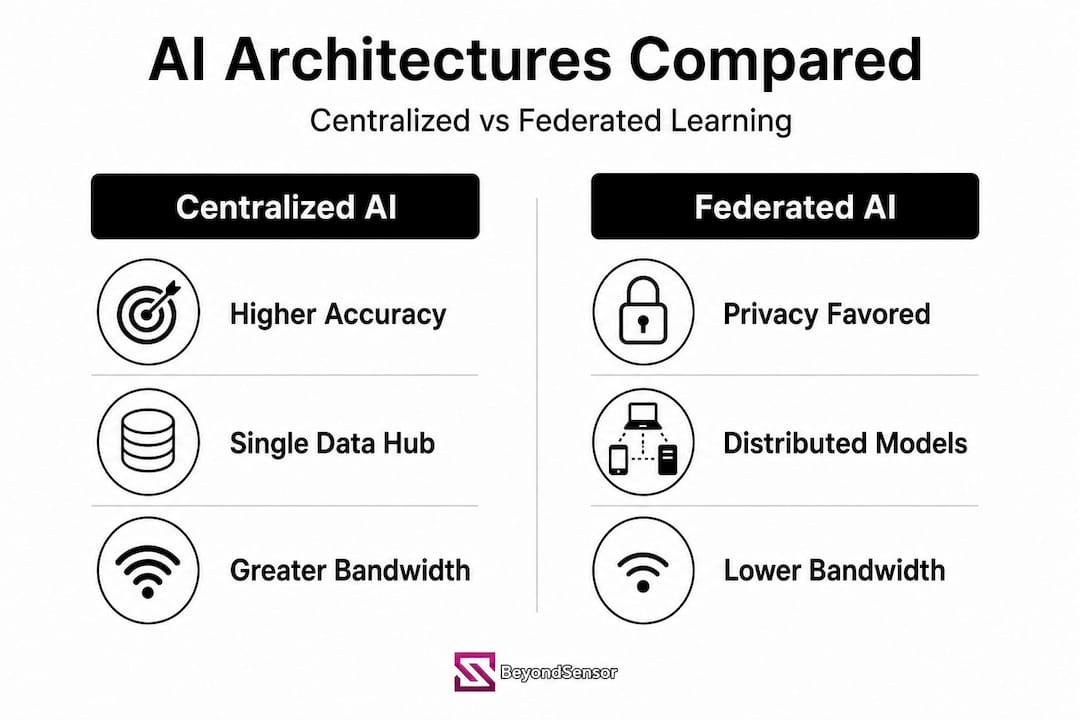
One of the most significant architectural decisions is centralized versus federated AI. Centralized models consolidate all data in one location for training and inference. Federated models train locally on distributed data and share only model updates, not raw data. Research on federated learning in cyber-physical systems documents the practical trade-offs clearly: federated approaches offer stronger privacy and reduced data transmission overhead, but they also introduce additional gaps around adversarial resilience and model explainability.
| Dimension | Centralized AI | Federated AI |
|---|---|---|
| Accuracy | Generally higher | Slightly lower |
| Communication cost | High (raw data transfer) | Lower (model updates only) |
| Privacy | Lower | Higher |
| Explainability | Easier to audit | More complex |
| Adversarial resilience | Better studied | Active research gap |
A second critical decision point is how you evaluate vendor claims. Benchmark saturation is a real problem. Many legacy visual anomaly detection datasets have been over-optimized to the point where the rankings are driven by small dataset-specific quirks rather than genuine model quality. Similarly, for time-series detection, the quality of the forecasting residual can dominate the end-to-end performance more than the choice of anomaly detection algorithm itself. The "winning" model on a public benchmark may underperform significantly on your specific data.
A practical evaluation checklist for security leaders:
- Define your success criteria first. What is the operational cost of a false negative versus a false positive in your environment? This shapes every other trade-off.
- Test on your own data. Insist on a proof-of-concept evaluation using your actual sensor data, not the vendor's reference dataset.
- Assess resource requirements honestly. Deep models require more compute, more memory, and more maintenance. Factor in the total cost of ownership.
- Require explainability outputs. Any system that cannot tell your operators why an alert was triggered will generate friction and erode trust.
- Check regulatory alignment. Especially for critical infrastructure, data handling, model auditability, and incident logging must meet applicable standards.
Evaluating intelligent sensing technologies against these criteria gives you a structured lens that protects you from being swayed by impressive-sounding benchmark numbers alone. Understanding how these tools connect to applications in safety and efficiency is equally important for building the business case internally.
Best practices for deploying AI anomaly detection in industry
The path from decision to effective deployment is not a straight line, but a structured approach significantly reduces the risk of wasted investment.
- Audit your data before selecting a model. Volume, labeling quality, class balance, and time coverage all determine which AI methods are viable. Skip this step and you're building on an unstable foundation.
- Align AI methods with specific security objectives. Process integrity threats require different detection logic than physical access anomalies or network intrusion detection. A single model rarely covers all three well.
- Pilot with interpretable models first. Logistic regression, decision trees, or shallow neural networks won't always match deep learning accuracy, but they generate explainable outputs that help your team build intuition and trust before deploying more complex systems.
- Establish routine validation loops. Schedule regular model performance reviews tied to operational change events. Don't wait for a breach or a surge in false positives to trigger a review.
- Invest in team training alongside the technology. An AI model is only as effective as the operators who act on its outputs. Security analysts need to understand what the model does, where it can fail, and how to escalate when confidence is low.
Performance gains from AI over signature-based methods are real, but they must be balanced against computation overhead, training and labeling effort, and the operational risk created by false positives and false negatives in imbalanced, shifting data environments. This is not an argument against AI adoption. It's an argument for realistic adoption planning. Connecting AI anomaly detection to smarter industrial automation and integrating with AI in facility management workflows ensures that detection outputs translate into real operational responses, not just archived alerts.
Where most directors misjudge AI's role in anomaly detection
There's a consistent pattern we see across industrial deployments: security directors over-index on published benchmark scores when selecting AI solutions, then under-invest in the operational infrastructure needed to keep those models performing.
Benchmark leaderboards are competitive artifacts. Dataset choice and evaluation protocol can shift the apparent "winner" entirely, particularly when legacy visual datasets are saturated and time-series models depend heavily on forecasting residual quality. What looks like a decisive accuracy advantage in a research paper may completely disappear when the model encounters your plant's specific noise profile or a slightly different sensor configuration.
The models that perform best in real operational settings are not always the most academically impressive. They're the ones that are robust to sensor noise, explainable enough for operators to trust, maintainable under evolving conditions, and aligned with your threat model. A technically superior model that generates unexplained alerts and requires a PhD to maintain is a liability, not an asset.
Our view is that the most overlooked investment in industrial AI security is not the algorithm. It's the process layer around it: the validation cadence, the operator training, the alert triage workflow, and the feedback loop that lets your model improve over time. Understanding advanced sensing for security from an operational lens, not just a technical one, is what separates facilities that get sustained value from AI from those that shelve expensive systems after 18 months.
Connecting AI anomaly detection to smarter industrial operations
Deploying AI-driven anomaly detection effectively requires more than selecting the right algorithm. It demands a technology partner that understands the intersection of sensing hardware, data infrastructure, and real-world operational security.

BeyondSensor works directly with solutions for system integrators and industrial operators to bridge the gap between AI's potential and practical deployment. Whether you're evaluating your first AI detection pilot or optimizing an existing deployment, our industrial AI tools are designed for the realities of complex, high-stakes industrial environments. We also connect security leaders with validated products and suppliers to ensure every component in your detection stack meets the reliability and compliance standards your operations demand. The next step is a conversation about where your current detection gaps are and how targeted AI solutions can close them.
Frequently asked questions
What is the main advantage of AI over traditional rule-based anomaly detection in industrial settings?
AI can detect novel and rare security threats that traditional rule-based systems often miss by learning complex data patterns and adapting to evolving environments. Unlike fixed signatures, AI anomaly detection uses learned feature embeddings, reconstruction errors, and forecasting residuals to identify deviations that no rule was ever written to catch.
How does data quality and volume impact AI anomaly detection effectiveness?
High-quality, diverse data is essential because poor or limited data increases false positives and negatives, especially under rare-event conditions. AI models may fail entirely under distribution shifts or when anomaly examples are too few to support reliable learning.
Why are benchmarking results sometimes misleading when choosing an AI anomaly detection solution?
Benchmark results may not reflect real-world industrial scenarios because datasets and evaluation protocols can exaggerate certain model strengths while obscuring weaknesses that only appear under genuine operational conditions.
What is federated learning and what are its trade-offs for anomaly detection?
Federated learning allows AI models to train across decentralized data sources without transferring raw data, which strengthens privacy. However, federated approaches introduce trade-offs in accuracy, communication overhead, and resilience to adversarial attacks compared to centralized models.
Recommended
- AI analytics for sensor tech security leaders | News | BeyondSensor
- Harnessing AI for Security Systems: Boost Protection and Efficiency | News | BeyondSensor
- Threat detection AI: Boost security with advanced intelligence | News | BeyondSensor
- How automation strengthens industrial security operations | News | BeyondSensor
Read More Articles
RTSP Security Risks: Integrators Must Block Exposed Ports 554 and 8554
See how integrators can reduce RTSP security risks: close exposed ports 554 and 8554, secure camera access, and verify each deployment with practical checks.

Require MAEpp and X Accuracy Before You Buy People Counting Systems
Verify people counting accuracy by demanding MAEpp, X Accuracy, and directional-bias reports. Validate on-site with at least 100 events per direction...
30–90 Day Pilot Validates Redundant Camera Networks for Engineers
Standards led, practical steps for engineers to deploy redundant camera networks: MRP, dual homing, and aggregation patterns, commissioning checks, and...

30 Day Pilot Proves Video Analytics Accuracy for Security Teams
Validate video analytics accuracy with scenario tests, camera tuning, transfer learning and a 30 day edge first pilot for security teams.
Let's Build YourSecurity Ecosystem.
Whether you're a System Integrator, Solution Provider, or an End-User looking for trusted advisory, our team is ready to help you navigate the BeyondSensor landscape.
Direct Advisory
Connect with our regional experts for tailored solutioning.