
Discover why choose adaptive security to cut through noise and enhance protection for your SOC team. Unlock better efficiency today!

Adaptive security: reduce noise and boost protection

TL;DR:
- Adaptive security learns behavioral norms of specific environments to reduce false positives and enhance detection accuracy. It continuously refines detection logic through analyst feedback, enabling dynamic threshold adjustments and contextual risk scoring. Successful deployment requires governance, proper onboarding of edge case policies, ongoing model review, and integration with broader security systems.
Security operations centers are drowning. The average SOC team processes thousands of alerts per day, yet industry estimates consistently show that more than half of those alerts are false positives, creating a cycle of fatigue that erodes analyst effectiveness and lets real threats slip through. Adaptive security reduces false positives and noise by tuning detection rules to your specific environment, directly improving SOC efficiency. This article explains what adaptive security actually is, how it delivers measurable improvements, what governance pitfalls to watch for, and how to build a successful deployment from the ground up.
Table of Contents
- What is adaptive security?
- How adaptive security reduces noise and improves detection
- Governance and edge cases: what decision-makers need to know
- Implementing adaptive security: practical considerations and first steps
- Why adaptive security often underperforms: a practitioner's view
- How BeyondSensor can help you unlock adaptive security
- Frequently asked questions
Key Takeaways
| Point | Details |
|---|---|
| False positives drop | Adaptive security can reduce unnecessary alerts by up to 18 percent when tuned to your environment. |
| Governance is vital | Without proper oversight and training, adaptive models may cause new risks like lockouts or eroded trust. |
| Edge cases matter | Smart configuration for normal-but-surprising behaviors avoids friction while maintaining protection. |
| Rollout guides success | Best practices, feedback loops, and staff training are essential for effective adaptive deployments. |
What is adaptive security?
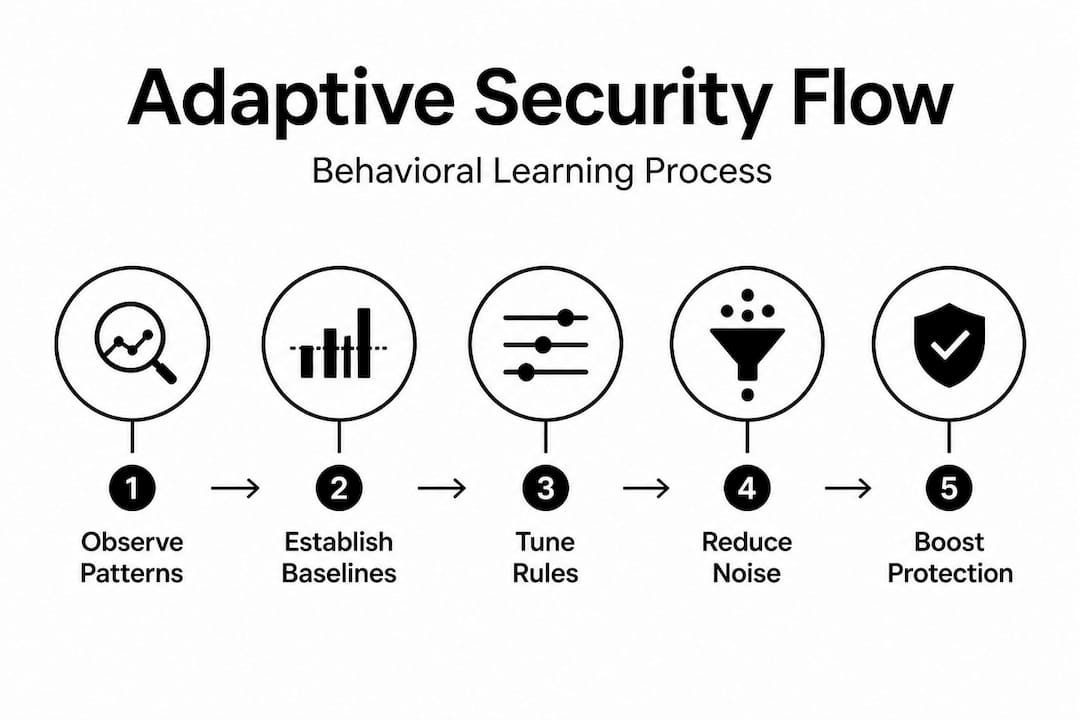
Adaptive security is not simply a more advanced version of rule-based detection. It is a fundamentally different operating model. Where traditional systems apply fixed thresholds and static rule sets uniformly across an environment, adaptive security learns the behavioral norms of your specific infrastructure, your users, your devices, and your operational rhythms, and continuously refines its detection logic to reflect that reality.
The core mechanic is behavioral learning. An adaptive system observes patterns over time: when users typically authenticate, which systems talk to which, what volume of data flows through specific pathways, and what access requests look like on a normal day. From this baseline, the system identifies deviations that signal genuine risk, rather than firing on any activity that technically matches a generic threat signature.
Using adaptations to tune detection rules and reduce false positives is central to how modern adaptive platforms operate. When analysts review an incident and mark it as a known-safe behavior, that feedback gets absorbed into the model. The system updates. The next time the same pattern appears, it either suppresses the alert or routes it to a lower-priority queue. This is learning from security decisions in practice, not in theory.
Key capabilities that distinguish adaptive systems from static or heuristic alternatives:
- Behavioral baselining at the user, device, and network level
- Continuous rule refinement based on analyst feedback and environmental drift
- Context-aware risk scoring that weights alerts based on asset criticality and situational factors
- Automated suppression of known-safe patterns without requiring manual rule edits
- Dynamic threshold adjustment in response to planned or unplanned operational changes
These capabilities matter because today's threat landscape changes constantly. Attackers adapt their tactics specifically to evade static signatures. A rule written to catch one variant of a lateral movement pattern will miss the next iteration of that same technique. Adaptive systems don't stand still either, and that symmetry is their defining operational advantage.
How adaptive security reduces noise and improves detection
Now that we know adaptive security is dynamic, let's examine how it substantively reduces false alerts and enhances operational outcomes in measurable terms.
The mechanism starts with environment-specific tuning. Rather than applying a one-size-fits-all ruleset, an adaptive platform profiles each deployment individually. A manufacturing facility has very different network behavior from a financial services office. A hospital's access patterns differ radically from a government data center. Treating these environments identically guarantees excessive noise.
Behavioral baselining and incident rule adaptation compound this effect. Once a baseline is established, the system can identify not just technical anomalies but contextual ones. An employee downloading a large archive at 2 AM is flagged. The same employee doing the same thing during a known quarterly reporting cycle is not, because the system understands the pattern in context.

The quantified result is significant. Adaptive methods reduce false positives by 18% using contextual risk scoring, according to peer-reviewed research. That number may sound modest, but consider what it means operationally.
| Metric | Static security system | Adaptive security system |
|---|---|---|
| False positive rate | High (often 50%+ of alerts) | Reduced by up to 18% with contextual scoring |
| Analyst time on false alerts | 2 to 4 hours per shift | Significantly reduced |
| Mean time to detect (MTTD) | Longer due to noise | Shorter, with cleaner alert queues |
| Rule maintenance overhead | High (manual updates required) | Lower (system self-tunes via feedback) |
| Response accuracy | Variable, fatigue-affected | More consistent, priority-focused |
"When analysts stop chasing shadows, they start catching threats. Adaptive security is the operational shift from volume-based alerting to quality-based detection."
The downstream effects of reduced noise extend beyond analyst workload. When workflows with advanced sensors and adaptive detection logic work together, incident response times improve because teams are working from cleaner, higher-confidence alerts. Investigations become more focused. Evidence chains are easier to construct. Reporting to leadership becomes more accurate, because the data driving security metrics is less contaminated by false signal.
Applying physical security best practices in conjunction with adaptive software creates a layered, intelligent defense. Physical access events, sensor triggers, and environmental data can all feed adaptive models, giving them richer context to score alerts accurately.
Governance and edge cases: what decision-makers need to know
Adaptive isn't perfect out of the box, and savvy leaders must consider edge cases and guardrails before deploying these systems at scale.
The most important principle is that governance is non-negotiable. An adaptive system learns from its environment, which means it also learns from bad inputs. If feedback loops are poorly managed, if analysts dismiss alerts incorrectly, or if the system is tuned too aggressively to suppress alerts in a particular zone, the model can develop blind spots. Governance is critical because adaptive models can backfire if ungoverned, increasing lockouts or eroding trust in the system over time.
Common edge cases that catch organizations off guard include:
- Traveling employees whose login locations, access times, and device behaviors suddenly shift, triggering risk score spikes that generate excessive friction
- Organizational restructuring where role changes cause legitimate access pattern deviations that look like privilege escalation
- Planned maintenance windows that produce unusual network traffic patterns the system hasn't seen before
- New system deployments where a freshly onboarded application communicates with previously unseen endpoints
- Seasonal operational changes in industries like retail or logistics where behavior shifts predictably but dramatically
Each of these scenarios can cause an ungoverned adaptive system to produce a wave of alerts or, worse, trigger automatic responses that disrupt legitimate operations. The damage is not just operational. When adaptive systems repeatedly interrupt valid workflows, analysts and end users lose confidence in the technology. That trust erosion is difficult to recover.
Balancing automation and human oversight requires deliberate policy design. Context-aware technology usage guidelines should define how the system handles unexpected but legitimate behaviors, what thresholds trigger human review rather than automated response, and how feedback from those reviews gets incorporated back into the model.
Pro Tip: Before going live, map your top ten most disruptive edge cases and define explicit accept/reject policies for each. This pre-work prevents the most common governance failures and gives your team clear protocols when the unexpected happens.
Implementing adaptive security: practical considerations and first steps
Success is not automatic. Set your deployment up right with these implementation strategies, and you'll avoid the most expensive mistakes organizations make when adopting adaptive security.
-
Establish an accurate behavioral baseline before activating detection. Run the system in observation mode for at least two to four weeks. The baseline you build here is the foundation everything else rests on. A noisy or inaccurate baseline means a noisy system.
-
Prioritize your highest-value assets for initial tuning. Don't try to adapt everything at once. Start with critical servers, privileged accounts, and sensitive physical access zones. Prove the model works there before expanding.
-
Define acceptance criteria for known edge cases upfront. As discussed above, document how the system should handle traveling employees, role changes, and maintenance windows. Define accept/reject criteria for edge cases before they occur, not after an incident reveals the gap.
-
Build a formal analyst feedback loop. Adaptive systems improve through deliberate input. Establish a daily or weekly practice where analysts review suppressed alerts and contested decisions. Their corrections directly improve model accuracy.
-
Train staff on what adaptive means operationally. Many teams come from environments where the ruleset is fixed. They need to understand that this system changes, that suppression decisions are intentional, and that their feedback shapes detection quality. Applying sensor security tips alongside staff training ensures the full picture, physical sensors and software models alike, is working from consistent operational principles.
-
Integrate with your broader security stack. Adaptive detection platforms are most effective when they receive data from multiple sources: endpoint agents, network monitoring tools, physical access control systems, and environmental sensors. Follow a security integration guide to ensure data pipelines are clean and inputs are validated before they reach the model.
-
Measure and report on detection quality, not just volume. Traditional security metrics focus on alert counts. Adaptive security demands a shift toward precision and recall: how many real threats were caught, how many false positives were generated, and how quickly detection occurred. Reviewing operational efficiency in security through this lens gives leadership an accurate picture of return on investment.
Pro Tip: Create a monthly "model health" review where your team evaluates baseline drift, edge case handling, and detection accuracy trends. This review cadence is what separates organizations that maintain adaptive performance over time from those that see results degrade after the initial deployment high.
Context-aware model features are particularly valuable in physical security environments where sensor data, access control logs, and video analytics can feed the adaptive model with rich environmental context. When the model understands not just who accessed a zone but what the surrounding sensor environment looked like at that moment, its risk scoring becomes substantially more accurate.
Why adaptive security often underperforms: a practitioner's view
Here is something most vendor briefings won't tell you: the majority of adaptive security deployments that underperform do so not because the technology is flawed, but because the organization treated it as a product purchase rather than a capability investment.
The sales narrative around adaptive security tends to emphasize the automation side heavily, the self-tuning, the reduced manual overhead, the AI-driven detection. What it glosses over is that adaptive systems require continuous governance and meaningful human input to deliver on those promises. Adaptive systems require governance and continual adjustment, otherwise trust and performance erode over time. That is not a limitation of specific vendors. It is a structural reality of learning-based systems.
We have observed a consistent pattern: organizations that treat their adaptive security platform as a living operational process consistently outperform those that configure it once and move on. They assign ownership to a specific team or individual. They run regular model reviews. They build feedback into analyst workflows rather than treating it as an optional extra. They track detection quality metrics the same way they track system uptime.
The teams that struggle tend to share a different mindset. They see the purchase as the achievement. Once deployed, the system is expected to manage itself. But adaptive systems are not autonomous security departments. They are tools that amplify good operational practices, and they reflect poor ones just as accurately.
There is also a cultural dimension worth addressing. Staff education and feedback loops are as vital as the technology itself. When analysts understand how their decisions shape the model, they engage differently. They become invested in detection quality rather than just alert clearance. That shift in orientation produces compounding improvements over time.
The true competitive advantage of adaptive security emerges when humans and automation co-evolve, each learning from the other in structured cycles. The guide for security managers on advanced sensing technologies captures this principle well: technology enables, but process sustains.
How BeyondSensor can help you unlock adaptive security
If you're evaluating adaptive security solutions and want capabilities that go beyond theoretical promises, BeyondSensor delivers a hardware-software ecosystem purpose-built for precision detection and operational intelligence.

BeyondSensor integrates advanced sensing infrastructure with intelligent analytics to support adaptive security deployments across physical and operational environments. Whether you're working through a system integrator or evaluating platform capabilities directly, the BeyondSecure innovation suite provides the environmental data inputs, detection logic, and feedback architecture that adaptive models require to perform. Explore the full range of solutions on the BeyondSensor platform and connect with our team to discuss how adaptive security can be deployed effectively within your operational context.
Frequently asked questions
How does adaptive security minimize false positives in real-world deployments?
Adaptive security learns normal behavioral patterns specific to each environment, then tunes detection rules against that baseline, reducing excess alerts by up to 18% through contextual scoring. The result is fewer interruptions for analysts and more accurate prioritization of genuine threats.
What are the risks of poorly governed adaptive security systems?
Without proper oversight, adaptive models can develop blind spots or generate excessive lockouts when user behaviors shift naturally. Governance prevents lockout risks and degraded trust by ensuring human review shapes the model's learning trajectory.
How should organizations handle edge cases, like traveling employees?
Organizations should define accept/reject criteria for known legitimate but unusual behaviors before deployment. Context-aware features that incorporate location, time, and access history reduce unnecessary friction without sacrificing detection accuracy.
Is adaptive security only relevant for large enterprises?
No. Any organization managing sensitive physical assets, operational infrastructure, or privileged access systems can benefit from reduced alert fatigue and improved detection quality, regardless of team size or security budget.
Recommended
- Physical security best practices: strategies for safer facilities | News | BeyondSensor
- Secure Sensing Explained: Defend Industrial & Environmental Ops | News | BeyondSensor
- Understanding advanced sensing: boost security and efficiency | News | BeyondSensor
- Harnessing AI for Security Systems: Boost Protection and Efficiency | News | BeyondSensor
- Top AWS network security tips for robust cloud protection
Read More Articles

RTSP Security Risks: Integrators Must Block Exposed Ports 554 and 8554
See how integrators can reduce RTSP security risks: close exposed ports 554 and 8554, secure camera access, and verify each deployment with practical checks.

Require MAEpp and X Accuracy Before You Buy People Counting Systems
Verify people counting accuracy by demanding MAEpp, X Accuracy, and directional-bias reports. Validate on-site with at least 100 events per direction...

30–90 Day Pilot Validates Redundant Camera Networks for Engineers
Standards led, practical steps for engineers to deploy redundant camera networks: MRP, dual homing, and aggregation patterns, commissioning checks, and...

30 Day Pilot Proves Video Analytics Accuracy for Security Teams
Validate video analytics accuracy with scenario tests, camera tuning, transfer learning and a 30 day edge first pilot for security teams.
Let's Build YourSecurity Ecosystem.
Whether you're a System Integrator, Solution Provider, or an End-User looking for trusted advisory, our team is ready to help you navigate the BeyondSensor landscape.
Direct Advisory
Connect with our regional experts for tailored solutioning.