
Discover how edge analytics in security systems revolutionizes threat detection and enhances real-time decision-making for security professionals.

How edge analytics transforms security outcomes

TL;DR:
- Edge analytics processes sensor data locally, reducing latency, bandwidth, and privacy risks for security operations. Deploying a hybrid approach that combines on-device detection with cloud analysis offers optimal performance, scalability, and privacy protection. Success depends on integrating operational workflows and ongoing model management rather than solely on technology implementation.
The assumption that powerful analytics only work when data is sent to the cloud is being challenged every day across security operations worldwide. Edge analytics, which processes data directly on or near the sensor, has fundamentally shifted what's possible in real-time threat detection, privacy-sensitive deployments, and high-throughput sensor networks. For security managers and directors evaluating where to invest next, this shift is not incremental. It is structural. This article covers the essentials of edge analytics, its most valuable use cases, deployment strategies, key challenges, and expert recommendations to guide your decision-making.
Table of Contents
- What is edge analytics? Defining the new security paradigm
- Core use cases: Video and non-video sensors at the edge
- Implementation strategies: Edge, cloud, and hybrid models
- Challenges and pitfalls: What to know before rolling out
- Edge analytics in security: What most organizations miss
- Next steps: Transform your security with advanced AI edge solutions
- Frequently asked questions
Key Takeaways
| Point | Details |
|---|---|
| Edge vs. cloud comparison | Edge analytics enables faster, local decision-making while reducing cloud costs but comes with resource trade-offs. |
| Efficient real-time detection | Both video and non-video sensors benefit from edge analytics, achieving high accuracy and responsiveness. |
| Hybrid deployment flexibility | Combining edge and cloud models helps balance performance, privacy, and operational reliability. |
| Adaptation and updates | OTA updates are critical for maintaining edge model effectiveness in changing environments. |
What is edge analytics? Defining the new security paradigm
Edge analytics refers to the processing and analysis of sensor data at or near the point of collection, rather than sending that data to a centralized server or cloud platform. In a security context, this means a camera, radar module, or environmental sensor runs inference algorithms locally, generating actionable alerts without round-trip latency to a data center.
The contrast with traditional cloud analytics is sharp. In a cloud-first model, raw video or sensor data travels over a network to a remote processing environment, undergoes analysis, and returns a result or triggers an alert. That pipeline introduces latency measured in hundreds of milliseconds to several seconds, which is unacceptable when a perimeter breach, fire anomaly, or unauthorized access event demands an immediate response.
Edge analytics eliminates that delay. It also reduces bandwidth consumption, because only metadata or alert-level events need to leave the local network, not continuous raw streams.
For security leaders, the practical difference shows up clearly in the comparison below:
| Feature | Edge analytics | Cloud analytics |
|---|---|---|
| Latency | Milliseconds (on-device) | 200ms to several seconds |
| Bandwidth usage | Minimal (metadata only) | High (raw data streams) |
| Privacy protection | Data stays on-premise | Data traverses external networks |
| Uptime dependency | Works offline | Requires network connectivity |
| Scalability | Hardware-bound | Elastic, but costly |
| Processing complexity | Optimized/lightweight models | Full-scale deep learning |
Relevant AI analytics for security leaders understand that this architecture is not a one-size replacement for cloud processing. Instead, it is a differentiated tool with clear advantages for latency-sensitive, privacy-critical, and bandwidth-constrained deployments.
Common security applications include real-time perimeter monitoring, person or vehicle detection, license plate recognition, access control verification, and environmental hazard detection. The technical approach varies by complexity. Tiered inference methodologies at the edge, such as using lightweight models for motion and object detection while routing complex behavioral analysis to the cloud, are standard practice. Object tracking algorithms like SORT and DeepSORT run efficiently on dedicated hardware accelerators including NVIDIA Jetson, Google Coral TPU, and TI TDA4VM, purpose-built for on-device AI workloads.
Key characteristics of production-ready edge analytics deployments include:
- On-device inference using quantized or pruned neural network models
- Hardware acceleration through GPU, TPU, or dedicated neural processing units
- Tiered inference pipelines that separate simple detection from complex classification
- Non-maximum suppression (NMS) to reduce false positives in object detection
- Batch processing for optimizing throughput within power constraints
This architecture is enabling a new generation of security deployments that are faster, more resilient, and more privacy-aware than anything possible with purely cloud-dependent systems.
Core use cases: Video and non-video sensors at the edge
With a definition in place, let's examine how edge analytics is deployed for the two major sensor categories: video and non-video.
Video sensor applications represent the most visible edge analytics use case. On-camera inference enables instant person detection, object classification, loitering detection, and crowd density estimation. Unlike passive recording, edge-enabled cameras act as active agents, generating structured event data rather than raw footage. This matters enormously for real-time sensing applications where response time is measured in seconds.
A typical edge video analytics pipeline works as follows:
- The camera captures a frame at its native resolution.
- The on-device processor downsamples or crops the region of interest.
- A lightweight detection model (often MobileNet or YOLO-nano variant) identifies objects or persons.
- Tracking algorithms like DeepSORT assign consistent IDs across frames.
- Alert logic checks against predefined rules (zone crossing, dwell time, object class).
- An event metadata packet is generated and sent to the security management platform.
- Only flagged events trigger raw video retrieval, dramatically reducing storage and bandwidth.
Non-video IoT sensor applications are where edge analytics is expanding most aggressively. Environmental sensors for temperature, vibration, acoustic signatures, and electromagnetic anomalies all generate continuous streams of data. Cloud processing of these streams is expensive and latency-prone. At the edge, lightweight signal processing using Fourier and Wavelet transforms combined with machine learning achieves impressive results: shallow neural networks reach F1 scores of 0.94, while TinyML models achieve F1 scores of 0.92 with 60% less energy consumption compared to cloud-routed models. Federated learning adds another layer of capability, enabling anomaly detection across distributed sensor networks without centralizing raw data.
| Sensor type | Model approach | F1 score | Energy profile |
|---|---|---|---|
| Video (camera) | YOLO-nano, MobileNet + DeepSORT | 0.89 to 0.95 | Moderate |
| Environmental IoT | Shallow NN + Wavelet processing | 0.94 | Low |
| IoT (TinyML) | TinyML edge models | 0.92 | 60% less than cloud |
| Acoustic / vibration | Signal processing + ML classifiers | 0.88 to 0.93 | Very low |
These numbers validate the case for energy-efficient AI models that can sustain around-the-clock operation without demanding costly power infrastructure. At scale, this becomes a significant factor in total cost of ownership.

Pro Tip: When evaluating edge hardware for non-video sensors, prioritize platforms that support TinyML frameworks like TensorFlow Lite or Edge Impulse. These tools dramatically simplify deploying trained models onto low-power microcontrollers without sacrificing the F1 scores you need for reliable anomaly detection.
Across both video and non-video use cases, the common thread is that intelligent sensing technologies must balance detection accuracy, power consumption, and processing speed simultaneously. Edge analytics, when properly architected, achieves all three.
Implementation strategies: Edge, cloud, and hybrid models
Understanding use cases sets the stage for weighing different deployment strategies for your organization's security infrastructure.
Three primary deployment models exist, and each carries a distinct set of trade-offs worth understanding before committing resources.
Pure edge deployment places all analytics processing on-device or at a local gateway. This model maximizes privacy protection because raw sensor data never leaves the local network. It also delivers the lowest latency and maintains functionality during network outages. The constraints are real, though: compute capacity is finite, models must be lightweight, and managing firmware and model updates across large fleets of devices adds operational complexity.
Pure cloud deployment centralizes all processing, enabling the most powerful models and simplifying central management. It is, however, dependent on network reliability, introduces measurable latency, and generates ongoing bandwidth costs. For high-security environments or data-sensitive sectors, routing raw video or sensor data off-site raises compliance and privacy concerns that are difficult to resolve.
Hybrid edge-cloud deployment is increasingly the recommended standard for serious security operations. Lightweight detection runs at the edge for immediate response; complex behavioral analysis, forensic investigation, and model training run in the cloud. This architecture leverages the strengths of both environments. Hybrid deployment recommendations are now widespread in the industry precisely because they balance compute power, privacy requirements, and latency in ways that neither pure model achieves alone.
| Deployment model | Latency | Privacy | Cost at scale | Offline capability | Model complexity |
|---|---|---|---|---|---|
| Pure edge | Milliseconds | Highest | Hardware costs | Full | Lightweight only |
| Pure cloud | Seconds | Lower | High bandwidth fees | None | Unlimited |
| Hybrid | Milliseconds (edge) + seconds (cloud) | High | Balanced | Partial | Full range |
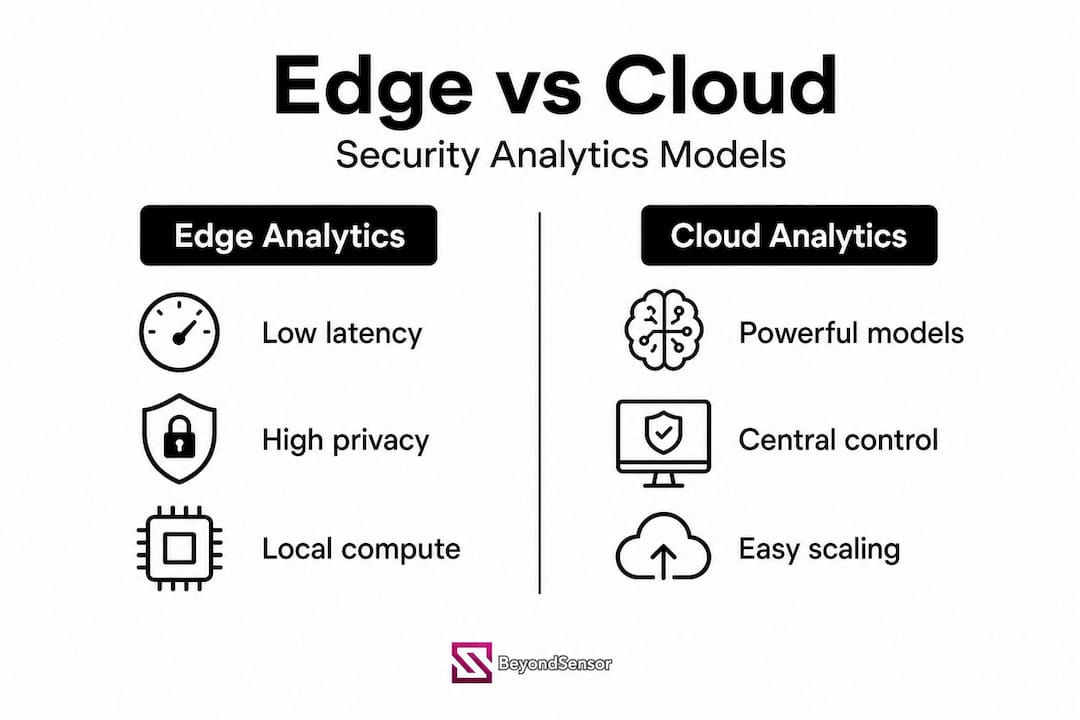
The choice between these models depends heavily on your organization's specific threat environment, regulatory obligations, and existing infrastructure. Reviewing emerging security tech trends reveals that hybrid architectures are dominating new deployments because they give security operations flexibility without forcing a binary choice.
Real-world constraints shape these decisions in ways that vendor presentations often omit. Power availability affects which hardware can run which models. Network reliability in industrial or remote environments drives more toward pure edge. Regulatory frameworks around data residency push heavily toward keeping raw data on-premise.
Pro Tip: Start with a tiered inference hybrid architecture even if your initial deployment is small. Designing the pipeline to separate lightweight edge inference from cloud-based behavioral analysis from the outset makes scaling far cleaner than retrofitting a pure edge system later. Advanced threat detection AI consistently performs better when detection and classification layers are intentionally separated by deployment tier.
Key factors to evaluate for deployment model selection:
- Regulatory requirements for data residency and privacy
- Network reliability and available bandwidth at each sensor location
- Power infrastructure and acceptable consumption per device
- Response time requirements for different alert categories
- Total cost of ownership including hardware, bandwidth, and ongoing management
Challenges and pitfalls: What to know before rolling out
Strategic decisions aside, real-world deployment faces hurdles. Let's cover pitfalls you can sidestep with the right knowledge.
The most underestimated challenge in edge analytics deployments is model drift. A model trained on footage from summer lighting conditions may degrade noticeably when winter reduces natural light or when renovation changes a facility's interior. Seasonal variation, environmental changes, and shifts in operational patterns all affect detection accuracy over time. OTA model updates are the standard mitigation. Without a structured OTA update process, edge devices run on outdated models, and accuracy silently declines.
Quantization and pruning trade-offs are another reality. To run models on low-power edge hardware, developers apply quantization (reducing numerical precision) and pruning (removing less critical model parameters). These techniques are necessary but carry a 5 to 10% accuracy cost on complex tasks. For basic detection, this is manageable. For nuanced classification tasks like differentiating between an authorized worker and an intruder in similar clothing, that margin matters.
Common deployment pitfalls and their mitigations:
- Insufficient testing in real lighting conditions. Models validated in labs frequently underperform in the field. Always run site-specific validation before going live.
- Overlooked firmware management. Security teams often focus on the analytics model but neglect underlying device firmware. Unpatched firmware is a cybersecurity vulnerability on your sensor network.
- Inadequate power planning. Running inference continuously on an undersized power supply causes device instability. Budget properly for always-on AI workloads.
- No fallback protocol. If edge processing fails, what happens? Define your fallback to cloud or human monitoring before deployment, not after an incident.
- Siloed alert outputs. Edge devices generating alerts that don't integrate with your security management platform add monitoring burden rather than reducing it. Integration planning must happen at project inception.
"The technology works. What fails most often is the integration between what the sensor detects and what the operator can act on. Edge analytics that generates alerts no one responds to systematically is not a security improvement. It is noise at the edge."
For operational efficiency best practices, the process of validating, deploying, and maintaining edge analytics systems must be treated as a continuous operational discipline, not a one-time installation project.
Edge analytics in security: What most organizations miss
Finally, let's move from theory to experience and examine what security leaders consistently overlook with edge analytics projects.
The most persistent misconception is that deploying edge analytics is primarily a technology problem. It is not. The technology, from NVIDIA Jetson hardware to TinyML frameworks, is mature and well-documented. What consistently undermines deployments is the failure to integrate edge analytics outputs into existing operational workflows. A camera that detects a perimeter intrusion in milliseconds provides zero security value if the alert enters a queue that operators review every 20 minutes.
The pilot-to-scale gap is the phase that vendors rarely discuss honestly. Pilots succeed in controlled conditions with dedicated attention. Scaling to dozens or hundreds of edge nodes across multiple facilities introduces model management complexity, device heterogeneity, network variability, and operator training requirements that are fundamentally different problems. Organizations that treat scaling as a linear extension of the pilot routinely encounter cost overruns and performance gaps.
Post-deployment adaptation is also chronically underbudgeted. Edge models are not static assets. They require ongoing tuning, OTA updates, and periodic retraining as physical environments evolve. Security teams that lack a formal model lifecycle process see accuracy degrade within months of deployment, often without realizing it until an incident exposes the gap.
The organizations that achieve the best outcomes share one common trait: they invest as much in the operational framework around the technology as in the technology itself. Processes for alert triage, model update governance, device health monitoring, and operator training make the difference between an edge analytics deployment that transforms security outcomes and one that becomes an expensive maintenance burden.
Tailored security solutions consistently outperform generic deployments precisely because they account for these operational realities from the beginning. The sensor and the algorithm are the starting point. The system that surrounds them determines the actual outcome.
Next steps: Transform your security with advanced AI edge solutions
Ready to leverage these insights? Here's how you can make edge analytics work for your security organization.
The gap between understanding edge analytics and deploying it effectively across a real security infrastructure is where most organizations need a trusted partner. BeyondSensor brings together hardware validation, software integration expertise, and regional deployment experience to support that journey from pilot to scale.

Whether you are a system integrator designing multi-site edge deployments or an end-user evaluating where AI-driven sensing fits your security roadmap, BeyondSecure innovation delivers practical, validated solutions built for real operational environments. Our team works across Singapore, Malaysia, the Philippines, and expanding markets throughout Southeast Asia to deliver solutions that are localized, compliant, and scalable. Visit BeyondSensor to connect with our team and explore how edge analytics can be the foundation of your next security upgrade.
Frequently asked questions
How does edge analytics reduce operational costs in security systems?
Edge analytics processes data locally, minimizing bandwidth consumption and cloud infrastructure expenses, which allows cost-effective deployment at scale. TinyML models on IoT sensors achieve F1 scores of 0.92 while using 60% less energy, directly reducing power and transmission costs per node.
Can edge analytics be updated to adapt to new threats?
Yes, security teams should implement structured over-the-air (OTA) model update processes to ensure analytics remain accurate as environments and threats evolve. Without OTA protocols, model drift from seasonal changes causes silent accuracy degradation across deployed devices.
What is the main limitation of edge analytics compared to cloud?
Edge analytics faces power and compute constraints that require model optimization through quantization and pruning, which can cause a 5 to 10% accuracy loss on complex classification tasks that cloud-based models handle without restriction.
Which hardware is commonly used for edge analytics in security?
NVIDIA Jetson, Google Coral TPU, and TI TDA4VM are the most widely deployed platforms, offering hardware-accelerated inference for both video analytics and IoT sensor processing in production security environments.
Recommended
- AI analytics for sensor tech security leaders | News | BeyondSensor
- Defining operational efficiency in security: insights & best practices | News | BeyondSensor
- Harnessing AI for Security Systems: Boost Protection and Efficiency | News | BeyondSensor
- Explore emerging security technology trends for 2026 | News | BeyondSensor
Read More Articles
Event Correlation for Physical Security: Verify Alarms Before Dispatch
Learn how security teams combine cameras, access control, and sensors to verify alarms, reduce false alarms, and deploy event correlation with edge analytics.
RTSP Security Risks: Integrators Must Block Exposed Ports 554 and 8554
See how integrators can reduce RTSP security risks: close exposed ports 554 and 8554, secure camera access, and verify each deployment with practical checks.

Require MAEpp and X Accuracy Before You Buy People Counting Systems
Verify people counting accuracy by demanding MAEpp, X Accuracy, and directional-bias reports. Validate on-site with at least 100 events per direction...
30–90 Day Pilot Validates Redundant Camera Networks for Engineers
Standards led, practical steps for engineers to deploy redundant camera networks: MRP, dual homing, and aggregation patterns, commissioning checks, and...
Let's Build YourSecurity Ecosystem.
Whether you're a System Integrator, Solution Provider, or an End-User looking for trusted advisory, our team is ready to help you navigate the BeyondSensor landscape.
Direct Advisory
Connect with our regional experts for tailored solutioning.