
Unlock the potential of defining sensing ecosystems for security. Discover how a coordinated approach transforms data into actionable insights.

Defining Sensing Ecosystems for Security Professionals

TL;DR:
- A sensing ecosystem is a layered system of sensors, connectivity, edge and cloud computing, and intelligent applications that work together to monitor and respond to real-world data. Effective design emphasizes architecture, time synchronization, and governance to prevent data silos, false alerts, and reactive operations. Proper implementation relies on planning from outcomes to calibration, with organizational accountability ensuring reliable and proactive security management.
A sensing ecosystem is defined as a coordinated, multi-layered system of physical devices, connectivity infrastructure, edge and cloud computing, and intelligent applications that work together to capture and act on real-world data. The industry term for this architecture is an IoT ecosystem, though "sensing ecosystem" is the preferred term in security and facility management contexts where physical perception and real-time response are the primary goals. Defining sensing ecosystems correctly matters because organizations that treat them as simple device networks consistently underinvest in integration and overspend on hardware. The result is data silos, missed alerts, and reactive operations when proactive ones were entirely achievable. This guide breaks down the architecture, functional framework, common misconceptions, and implementation steps you need to deploy one effectively.
What are the key components of sensing ecosystems?
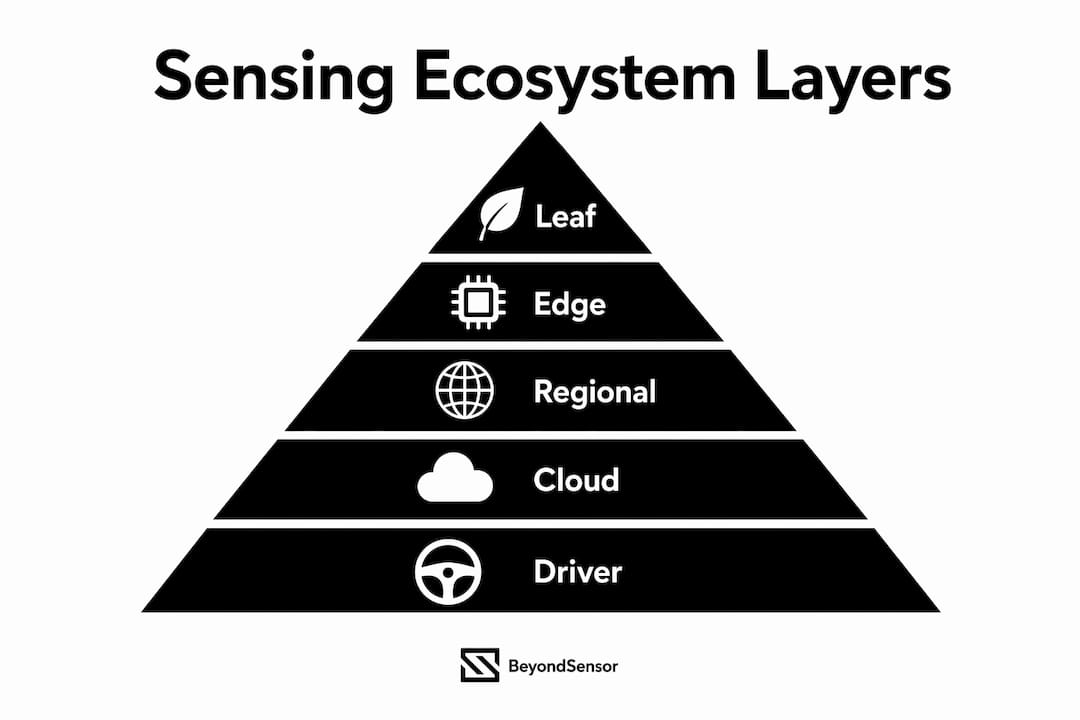
A sensing ecosystem is built on four architectural layers, each with a distinct role. Understanding those layers is the first step toward designing a system that actually performs under operational pressure.
The four layers are:
- Leaf (Sensor) Layer — Physical devices including cameras, motion detectors, thermal sensors, access control readers, and environmental monitors. These devices capture raw signals from the physical world. Their job is observation only; they do not make decisions.
- Edge Layer — Local gateways and processors that perform deterministic inference and I/O management. Edge nodes handle millisecond-latency tasks like motion classification and threshold alerts without waiting for cloud round-trips.
- Regional Layer — Intermediate nodes that reconcile state across multiple edge zones. A regional node in a large facility might aggregate data from 20 edge gateways and detect patterns that no single gateway can see alone.
- Cloud Layer — Centralized infrastructure for policy management, long-term learning, compliance logging, and cross-site analytics. Cloud is not where speed happens; it is where intelligence matures.
| Layer | Primary Function | Latency Tolerance |
|---|---|---|
| Leaf (Sensor) | Signal capture | Sub-millisecond |
| Edge | Local inference and control | 1–10 ms |
| Regional | State reconciliation | 10–100 ms |
| Cloud | Policy, learning, compliance | Seconds to minutes |
One technical detail that separates functional deployments from failed ones is time synchronization. Without millisecond-level sync using hardware-assisted Precision Time Protocol (PTP) or Time-Sensitive Networking (TSN), sensor fusion produces misaligned timestamps. Misaligned timestamps cause false anomaly alerts and control errors that erode operator trust within weeks of deployment.

Pro Tip: Deploy TSN-enabled switches at the edge layer from day one. Retrofitting time synchronization into a live security network costs significantly more than building it in at the design stage.
Connectivity technologies including Wi-Fi, 5G, and LoRaWAN each serve different layers. LoRaWAN suits low-bandwidth environmental sensors at the leaf layer. 5G supports high-throughput video feeds between edge and regional nodes. Wi-Fi covers dense indoor deployments where cabling is impractical. Choosing the wrong protocol for a layer creates bottlenecks that no amount of cloud compute can fix.
How does the sense-core-driver framework clarify ecosystem functions?
The SENSE-CORE-DRIVER model is the clearest functional framework for understanding what a sensing ecosystem actually does. It decouples observation from decision-making and execution, which is critical for organizations that need to maintain human accountability in automated environments.
- SENSE is the observation layer. It captures signals from the physical world, validates them, and prioritizes relevant data for processing. Sensing is not raw data collection. It requires identification and filtering of signals that carry operational meaning, which is why disciplined system design matters more than sensor count.
- CORE is the interpretation and reasoning layer. It applies analytics, machine learning models, and rule engines to transform validated signals into situational awareness. In a security context, CORE is where a camera feed becomes a trespassing alert or where a temperature reading becomes a fire risk score.
- DRIVER is the decision and action layer. It executes responses, triggers workflows, and maintains institutional oversight. The DRIVER layer is where machine autonomy meets human governance.
"The SENSE-CORE-DRIVER architecture ensures that machine autonomy aligns with institutional legitimacy. Decoupling observation from execution is not an academic distinction — it is the design principle that makes automated security systems auditable and defensible."
The DRIVER layer deserves particular attention in security and facility management deployments. Automated door locks, alarm escalations, and access revocations all carry legal and operational consequences. The DRIVER layer must log every action with a traceable decision chain. Without that chain, compliance audits become guesswork and incident investigations stall.
Security in automation is a direct function of how well the DRIVER layer enforces human oversight protocols before executing high-consequence actions. Organizations that skip this governance layer in the name of speed consistently face liability exposure when automated decisions go wrong.
What misconceptions exist when defining sensing ecosystems?
The most damaging misconception in defining sensing ecosystems is treating them as a collection of devices rather than an integrated socio-technical system. Experts consistently caution against treating sensing ecosystems as fixed product groups. The value of a sensing ecosystem comes from the connections between components, not from any individual sensor's specifications.
Three misconceptions that consistently derail deployments:
- Data collection equals sensing. Raw data collection is passive. Sensing requires active identification, validation, and prioritization of signals that carry operational meaning. A facility with 500 cameras generating unprocessed footage is not a sensing ecosystem. It is a storage problem.
- High-spec sensors guarantee performance. Value in sensing ecosystems derives from data connections and integration architectures, not hardware specifications. A $50 sensor in a well-integrated system outperforms a $500 sensor feeding a data silo.
- The ecosystem is a technology problem, not an organizational one. Sensing ecosystems are socio-technical networks involving human actors, institutional processes, and machine components. Deploying technology without redesigning the workflows around it produces systems that operators ignore or override.
Pro Tip: Before purchasing any sensing hardware, map your data flows first. Identify where data will be processed, who will act on it, and what decisions it needs to support. Hardware selection comes last, not first.
The shift from reactive to autonomous operations requires robust integration architecture above all else. Organizations that buy high-specification sensors without investing in edge processing, data pipelines, and governance frameworks end up with expensive reactive systems. The architecture is the product.
How can organizations build sensing ecosystems for security?
Practical implementation of a sensing ecosystem for security or facility management follows a sequence that most organizations get wrong by starting with hardware procurement. The correct sequence starts with architecture planning.
- Define operational outcomes first. Specify what the system must detect, how fast it must respond, and what actions it must trigger. These requirements determine your latency tolerances, which determine your layer architecture.
- Design the layered architecture before selecting sensors. Map where edge nodes will sit, how regional nodes will aggregate data, and what the cloud layer will handle. Use sensor integration architecture principles to avoid creating bottlenecks between layers.
- Implement time synchronization at the edge layer. Deploy PTP or TSN from the start. This is non-negotiable for any system that fuses data from multiple sensor types.
- Build automated recalibration loops. Sensor drift and domain shift are inevitable in production environments. Assuming sensors remain factory-calibrated produces ghost anomalies that degrade operator trust and trigger alert fatigue.
- Filter at the edge, not the cloud. Heavy preprocessing of high-frequency data at the edge or regional level prevents the bandwidth trap of sending all raw data to the cloud. This is the difference between a system that scales and one that collapses under load.
| Approach | Edge Filtering | Cloud Dependency | Latency | Scalability |
|---|---|---|---|---|
| Edge-first architecture | High | Low | 1–10 ms | High |
| Cloud-first architecture | Low | High | 500+ ms | Limited |
| Hybrid architecture | Medium | Medium | 10–100 ms | Moderate |
The DRIVER layer implementation deserves a dedicated governance review before go-live. Define which automated actions require human confirmation, which can execute autonomously, and which must be logged for audit. Beyondsensor's real-time sensing resources provide detailed guidance on configuring low-latency edge processing within these governance constraints.
Multi-tier sensor deployments that shift from reactive to proactive security demonstrate how layered sensor architectures deliver complete operational visibility. The principle applies equally to physical security as it does to network monitoring: coverage without integration is not protection.
Key takeaways
A sensing ecosystem delivers operational value only when its layered architecture, time synchronization, and governance framework are designed together from the start.
| Point | Details |
|---|---|
| Architecture before hardware | Design your Leaf, Edge, Regional, and Cloud layers before selecting any sensors or devices. |
| Time sync is non-negotiable | Deploy PTP or TSN at the edge layer to prevent sensor fusion failures and false anomaly alerts. |
| SENSE-CORE-DRIVER governs accountability | Use this framework to separate observation, reasoning, and action for auditable, compliant automation. |
| Integration creates value | Data connections between components matter more than individual sensor specifications. |
| Recalibration prevents trust erosion | Automated calibration loops counter sensor drift and protect the integrity of sensed data over time. |
The complexity nobody talks about
I have spent years watching organizations deploy sensing ecosystems and make the same mistake at the same point in the process. They nail the sensor selection. They get the connectivity right. Then they go live and the system starts generating false alerts within 60 days. Every time, the cause is the same: sensor drift and missing time synchronization.
The industry conversation about sensing ecosystems focuses almost entirely on connectivity protocols and AI models. Almost nobody talks about the unglamorous work of keeping sensors calibrated in production environments. Temperature fluctuations, vibration, dust accumulation, and firmware updates all shift sensor baselines. A system that was accurate at commissioning drifts into unreliability within months if automated recalibration is not built in from the start.
The second underappreciated complexity is the DRIVER layer governance gap. Organizations invest heavily in SENSE and CORE. They buy cameras, deploy edge AI, and build dashboards. Then they connect the output directly to automated actions without defining who is accountable when the system makes a wrong call. That gap is not a technology problem. It is an organizational design problem that technology cannot solve on its own.
My view on where the sector is heading: the organizations that will lead in security and facility management over the next five years are not the ones with the most sensors. They are the ones that treat their sensing ecosystem as a governed, self-correcting socio-technical system. The hardware is a commodity. The architecture and the accountability framework are the competitive advantage.
— Eumir
How Beyondsensor supports your sensing ecosystem deployment
Beyondsensor works directly with system integrators and facility operators to design and deploy sensing ecosystems that perform under real operational conditions. The team brings layered architecture expertise, sensor integration support, and real-time analytics configuration to projects across Singapore, Malaysia, the Philippines, and the broader Southeast Asian region.
If your organization is moving from reactive security operations to a proactive, integrated sensing architecture, Beyondsensor's system integrator solutions provide the technical depth and regional validation your deployment requires. For teams evaluating specific tools for sensor data processing and analytics, the Beyondsensor tools catalog covers the full integration stack. Contact Beyondsensor to discuss your architecture requirements and get a deployment assessment tailored to your sector.
FAQ
What is a sensing ecosystem, exactly?
A sensing ecosystem is a coordinated, multi-layered system of physical sensors, connectivity infrastructure, edge and cloud computing, and intelligent applications that work together to capture and act on real-world data. It is also referred to as an IoT ecosystem in broader industry literature.
How many layers does a sensing ecosystem architecture have?
A standard sensing ecosystem architecture has four layers: Leaf (sensors), Edge (local processing), Regional (state reconciliation), and Cloud (policy and long-term analytics). Each layer has distinct latency tolerances and functional responsibilities.
What is the sense-core-driver framework?
The SENSE-CORE-DRIVER framework categorizes sensing ecosystem functions into three layers: SENSE for signal observation, CORE for reasoning and interpretation, and DRIVER for decision execution with institutional oversight. It ensures machine autonomy aligns with human accountability.
Why do sensing ecosystems fail in production?
The two most common causes of production failure are sensor drift without automated recalibration and missing millisecond-level time synchronization. Both issues degrade data accuracy and generate false anomaly alerts that erode operator trust over time.
What is the difference between data collection and sensing?
Data collection is passive accumulation of raw signals. Sensing requires active identification, validation, and prioritization of signals that carry operational meaning. A sensing ecosystem without disciplined signal filtering is a storage system, not an operational intelligence platform.
Recommended
- Secure Sensing Explained: Defend Industrial & Environmental Ops | News | BeyondSensor
- Sensing tools guide: Types, accuracy, and security uses | News | BeyondSensor
- Security compliance in sensing systems: a step-by-step guide | News | BeyondSensor
- Integrated physical security ecosystems: strategies for protection | News | BeyondSensor
Read More Articles
RTSP Security Risks: Integrators Must Block Exposed Ports 554 and 8554
See how integrators can reduce RTSP security risks: close exposed ports 554 and 8554, secure camera access, and verify each deployment with practical checks.

Require MAEpp and X Accuracy Before You Buy People Counting Systems
Verify people counting accuracy by demanding MAEpp, X Accuracy, and directional-bias reports. Validate on-site with at least 100 events per direction...
30–90 Day Pilot Validates Redundant Camera Networks for Engineers
Standards led, practical steps for engineers to deploy redundant camera networks: MRP, dual homing, and aggregation patterns, commissioning checks, and...
30 Day Pilot Proves Video Analytics Accuracy for Security Teams
Validate video analytics accuracy with scenario tests, camera tuning, transfer learning and a 30 day edge first pilot for security teams.
Let's Build YourSecurity Ecosystem.
Whether you're a System Integrator, Solution Provider, or an End-User looking for trusted advisory, our team is ready to help you navigate the BeyondSensor landscape.
Direct Advisory
Connect with our regional experts for tailored solutioning.